
What is BRC Certification and How to Get It?
Learn what BRC certification is, its key requirements, benefits, audit process, costs, and how food businesses can prepare for and achieve BRCGS certification.
Published:Last updated:Author:Saro Loucks
BRCGS (British Retail Consortium Global Standard), or BRC, is an internationally recognized food safety audit process used to evaluate food safety systems across the supply chain. As a leading trade association, BRC sets global standards for food safety, quality, and operational criteria across various industries. The BRC Food Safety standard, based on the BRCGS Global Standard for food safety management systems, helps food manufacturers, retailers, and service providers demonstrate effective management systems that ensure product safety from source to shelf. Adopted by over 22,000 locations in more than 130 countries, BRCGS provides a trusted framework for food safety.
FoodReady offers comprehensive support with BRC consultants and BRC software to help organizations prepare for and maintain BRC audits or GFSI certification. Our platform includes all the components needed to streamline compliance, and you can schedule a meeting with one of our food safety experts to see a demonstration, get your questions answered, and receive pricing information.
Key Takeaways
- BRC certification is a globally recognized food safety and quality standard issued by the British Retail Consortium (BRCGS), aligned with the Global Food Safety Initiative (GFSI).
- Achieving BRCGS certification demonstrates legal compliance, a strong food safety program, and a commitment to continuous improvement in food safety culture and operational excellence.
- The certification process involves comprehensive food safety training, implementation of HACCP plans, internal audits, and third-party audits by a BRCGS-registered certification body.
- BRC certification helps companies ensure food safety, prevent contaminated food, and meet retailer and buyer requirements, enhancing brand reputation and consumer trust.
- Maintaining certification requires ongoing internal audits, corrective actions, and annual recertification to uphold compliance with the global food safety standard.
- BRCGS certification supports global market access by meeting internationally recognized food quality and safety criteria, reducing audit burdens, and promoting operational discipline.
- Utilizing food safety and quality management software can streamline compliance, traceability, and audit readiness, reinforcing a company’s commitment to the global food safety standard.
What are the Benefits of Achieving BRC Certification?
BRC certification is more than a regulatory milestone; it’s a strategic advantage that demonstrates your commitment to food safety, operational excellence, and market readiness.
Whether you’re selling to retailers, food service providers, or directly to consumers, BRC certification sets your business apart.
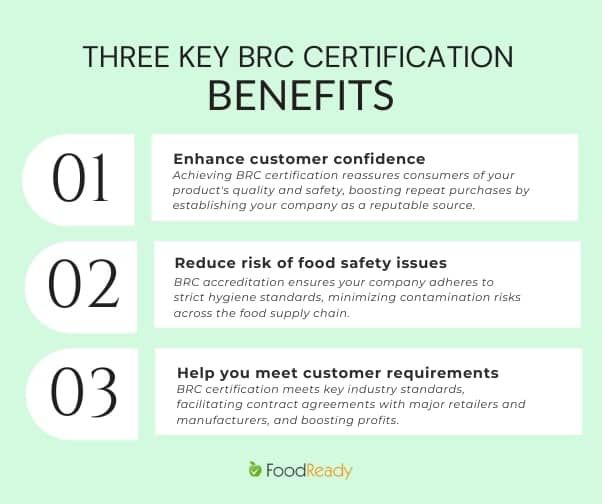
1. Enhance Customer Confidence
A BRC-certified facility gives consumers peace of mind that the food they purchase meets strict safety and quality standards. It proves your company is operating at the highest level possible, whether your products are served in restaurants or sold in grocery aisles. Certification reinforces your brand’s integrity and helps build lasting customer trust.
2. Reduce the Risk of Food Safety Issues
By adhering to the BRC Global Standard, your business implements robust hygiene practices, documentation systems, and hazard controls, such as HACCP protocols. These safeguards minimize the risk of contamination and foodborne illness, reduce costly recalls, and streamline your response to safety incidents.
3. Meet Retailer and Buyer Requirements
Large retailers and manufacturers, including names like Costco, Whole Foods, Publix, and Kroger, often require BRC certification before they’ll consider doing business with a supplier.
Certification opens doors to these high-volume markets, boosts your credibility, and positions your company for long-term growth.
BRC certification can be very beneficial for your company. It allows you to work with large retailers, who often require that their suppliers have this certification before working with them. A BRC certification ensures that your company is operating at the highest level possible and provides consumers with confidence in knowing that their food will be safe when eating out at restaurants or buying groceries from your store.
Additional Benefits of BRC Certification
Beyond major benefits like retailer access and global credibility, BRC certification brings a host of smaller yet meaningful advantages that contribute to operational excellence, internal alignment, and market appeal.
Improved Supplier Relationships
Suppliers are more likely to prioritize your business when they see you’re BRC certified. It signals professionalism, reliability, and a shared commitment to food safety, which can lead to stronger partnerships and better terms.
Easier Staff Training and Onboarding
With documented procedures and clear standards, BRC-certified facilities often experience smoother onboarding and training for new employees. Teams operate with more consistency and fewer miscommunications, boosting morale and efficiency.
Audit Readiness for Other Standards
Once your business is BRC certified, you’re much closer to being audit-ready for other GFSI standards (like SQF or FSSC 22000), customer-specific audits (e.g., Costco or Whole Foods), or regulatory inspections. BRC gives you a strong compliance foundation.
Marketing & Brand Leverage
Displaying your certification on packaging, websites, or sales materials reinforces your commitment to quality. This can enhance consumer trust and give your brand a competitive edge in crowded categories.
Operational Discipline
Even outside of food safety, BRC encourages better workflows, documentation habits, and team communication. It helps instill a culture of structure and accountability across your facility.
What are the 12 Fundamental Requirements of the BRC Standard?
The 12 main requirements you must follow for the BRC standard are listed below:
- Your senior management is committed to continually improving safety and quality.
- You have a detailed food safety plan in place. (HACCP, SQF, GMP)
- You conduct regular internal audits.
- You manage suppliers of raw materials and packaging.
- You have corrective and preventive actions in place.
- You track and document ingredients from suppliers for traceability.
- Your factory layout, flow of processes and movement of staff must be sufficient to prevent the risk of product contamination and to comply with relevant legislation.
- You employ appropriate and effective hygiene regulations.
- You carefully separate and contain all known allergens.
- You provide a facility layout, floor plan, and organization that is in compliance with your food safety plan.
- All your food products are correctly labeled and packaged.
- You provide sufficient training for your employees that encompasses all areas of food production including but not limited to raw material handling, preparation, processing, packing and storage.
- You must meet food safety culture requirements as introduced by the BRC Global Standard. These requirements are necessary for certification and support ongoing food safety improvements.
FoodReady is a food safety software and consulting company. Our software has an AI HACCP builder, food traceability, you can create your own checklists to manage your HACCP plan or track other items, ingredients, tasks, or events. With our Enterprise program you will have access to food safety quality assurance professionals who can help you with GFSI, SQF, GMP, SOP, BRC, CGMP, HACCP, USDA, FDA FSMA, gap analysis, or prepare for audits like the Costco audit, the Whole Foods, Publix, Kroger, Safeway, Meier, HEB and more.
Pass Your BRC Audit the First Time
Simplify your path to BRC certification with FoodReady software and expert consulting.

Dashboard
BRC Certification Grades
BRC certification grades are an essential component of the certification process. They indicate the level of compliance a site has achieved against the BRC Global Standard for Food Safety.
Here’s how the BRCGS Culture Excellence Food Safety Culture Module Assessment grading system scores.
Range Score | Grade | Basic Explanation |
90-100 | A+ | Very high scores above the industry norm indicate excellent satisfaction and agreement. |
85-89 | A | High scores, above the industry norm, show general satisfaction and well-utilized tools and mechanisms. |
80-84 | B+ | High scores indicate general satisfaction and the presence of supportive tools, with room for enhancement. |
75-79 | B | Above industry norm, indicating satisfaction and the existence of supportive mechanisms. |
70-74 | C+ | Medium scores, close to the industry norm, show partial satisfaction with some practical tools. |
65-69 | C | Medium scores indicate partial satisfaction and some practical tools, but improvements are needed. |
60-64 | D+ | Low scores, below industry norm, show general dissatisfaction and ineffective or inconsistent tools. |
55-59 | D | Low scores indicate dissatisfaction and low agreement levels, with necessary tool improvements. |
50-54 | E+ | Very low scores, well below the industry norm, indicate profound dissatisfaction and very low agreement. |
0-49 | E | Indicative of profound dissatisfaction, with a significant need for tools and support mechanisms changes. |
What is the Scope of BRC Certification?
BRC certification applies to a wide range of businesses and operations, each with unique requirements and specifications. From large-scale manufacturers to small-scale farmers, and from local retailers to global distributors, BRC offers standards that cater to the size, scale, and specialization of diverse entities within the food industry.
These standards also extend to companies involved in distribution, including storage, shipping, and logistics, ensuring product safety and compliance throughout the food supply chain. BRC standards provide a framework to help companies manage product safety during storage and distribution, supporting the safety, quality, and legality of products at every stage.
Furthermore, BRCGS standards are not confined by national borders or legal jurisdictions.
They are adaptable to various international arenas and are recognized by global regulators and multinational corporations.
Their universal applicability underscores the fundamental value they bring to the international food supply chain.
Certified Companies and Products
Achieving BRCGS certification places companies in the BRCGS directory, a comprehensive and publicly accessible database of certified businesses and their products.
This directory serves as a trusted resource for retailers, manufacturers, and customers seeking assurance that the food and consumer products they buy or supply meet the highest standards of safety and quality. Companies listed in the BRCGS directory can proudly display the BRCGS logo on their packaging and marketing materials, signaling their commitment to excellence in food safety and quality management.
The BRCGS certification scheme covers a broad range of food and consumer products, and is recognized by thousands of companies and retailers worldwide. This recognition not only enhances brand credibility but also facilitates access to new business opportunities and partnerships within the global food industry.
How to Get BRC Certified?
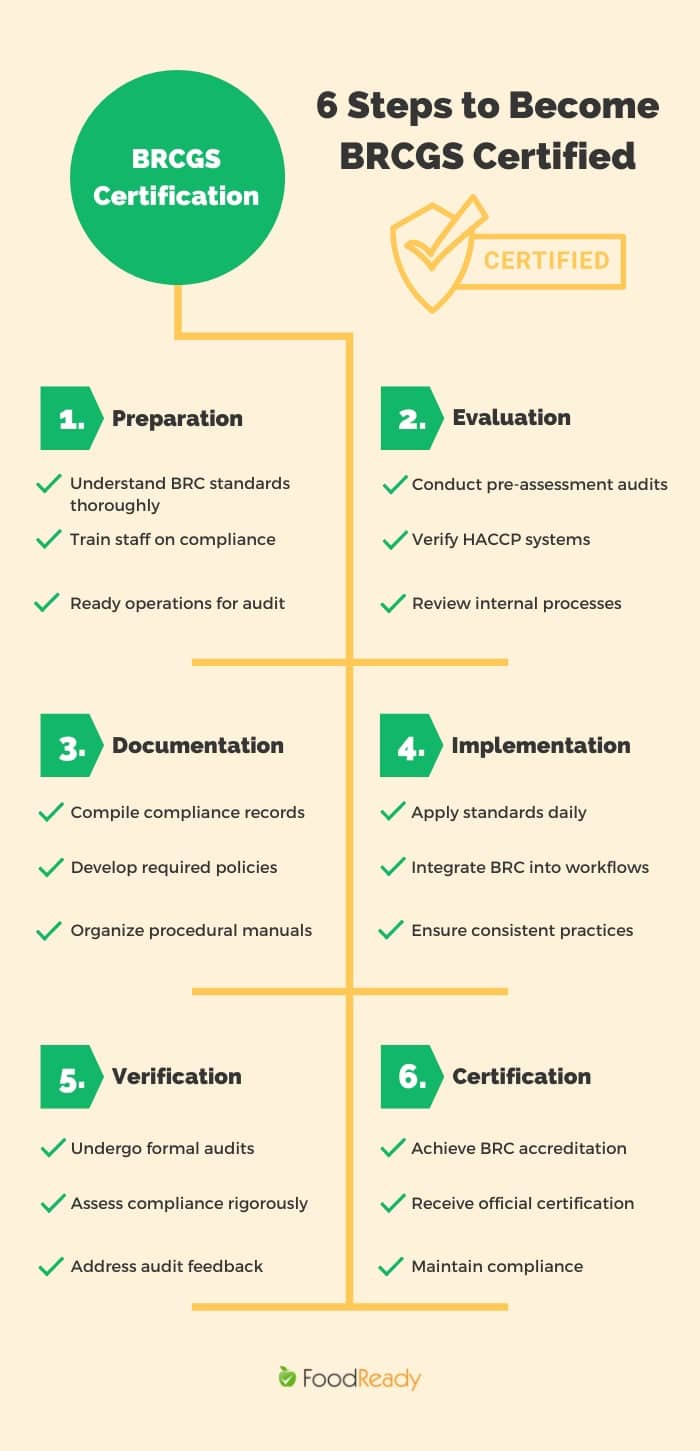
The process of BRC certification involves six steps:
- Preparation: The first step is to understand the BRC requirements and complete any necessary staff training.
- Evaluation: Engage in a pre-assessment, internal audits, and HACCP verification. A pre-assessment audit can help identify gaps and ensure documentation, site practices, and personnel are ready. It is important to conduct a self assessment to evaluate your readiness and compliance before the formal audit.
- Documentation: Develop and compile the required policies, procedures, and records.
- Implementation: Integrate the BRC standards into all your business processes.
- Verification: Undergo formal certification audits by accredited certification bodies.
- Certification: Upon successfully passing the certification auditing, you will receive BRC certification, which will be subject to surveillance and re-evaluation.
Obtaining BRC certification is both a process and a milestone. The last step involves an external audit by accredited BRC auditors, who evaluate the business’s systems, facilities, and practices against BRC’s meticulous criteria.
BRC Certification Costs
The costs of obtaining BRC certification can vary widely based on your organization’s size, the complexity of your operations, and the chosen certification body. You should budget for costs associated with initial certification, including preparation and training, as well as ongoing maintenance costs, including annual reviews and recertification audits. The certification process involves a third-party audit by an accredited body to confirm that a company’s systems and practices meet BRCGS requirements.
Maintaining and Improving BRC Standards
Certification is just the beginning of a company’s BRC journey. Maintaining standards requires ongoing commitment and vigilance. Regular internal audits, training updates, and staying abreast of evolving BRC criteria are critical elements of post-certification compliance. Equally important is the ongoing development and continual enhancement of food safety management systems to ensure sustained compliance and proactive progress toward full BRCGS certification. It is essential to maintain robust quality processes, as these structured procedures and practices uphold high standards and drive continual improvement. BRCGS certification promotes operational discipline by identifying inefficiencies and enhancing processes.
Maintaining and improving BRC standards is a dynamic process that necessitates adaptation to new information, technologies, and market trends. Companies must embed a culture of continuous learning and improvement to ensure their BRC certification remains a living testament to their commitment to food safety and quality.
Challenges and Solutions in BRC Implementation
Logistical Challenges
Managing documentation and processes can be complex.
Solution: Use food safety software to streamline documentation and compliance tracking.
Operational Challenges
Aligning current practices with BRC standards may require significant changes.
Solution: Break down the implementation into manageable steps and build cross-functional teams.
Resource Constraints
Limited time and personnel to dedicate to certification efforts.
Solution: Seek external advice and support from consultants or partner organizations.
Maintaining Continuous Improvement
Sustaining compliance and ongoing improvements post-certification.
Solution: Conduct regular internal audits and foster a culture of continuous learning.
Resistance to Change
Overcoming reluctance within the organization to adopt new standards.
Solution: Communicate benefits clearly and involve leadership to champion the process.
Complexity of Standards
Understanding and interpreting detailed BRC requirements.
Solution: Attend training courses and leverage expert guidance to clarify standards.
Adopting a systematic and strategic approach to these challenges demonstrates resilience and resourcefulness, key qualities underpinning successful BRC certification.
Partner Organizations in BRC Certification
BRCGS collaborates with a network of elite partner organizations to provide comprehensive support and resources for food manufacturers pursuing certification. These partnerships offer access to a wide range of training courses, industry events, and expert guidance, all designed to help companies implement effective food safety management systems and achieve BRCGS certification.
Partner organizations play a vital role in promoting the BRCGS certification scheme and supporting manufacturers through every step of the certification journey. By leveraging these partnerships, companies benefit from the latest industry knowledge, best practices, and practical tools needed to protect the global supply chain and ensure the safety of food products.
Together, BRCGS and its partner organizations are committed to connecting and protecting businesses, customers, and other stakeholders across the world, reinforcing the value of globally trusted certification programs.
Our Food Safety and Quality Management Software features:
FoodReady offers expert consulting and software solutions to help businesses achieve and maintain BRCGS certification. Our team includes staff trained in GFSI benchmarked standards like SQF, BRC, and HACCP, with founders who have over 25 years of food safety auditing experience. We provide tools such as an AI-powered HACCP builder with over 80 templates, a hazards database, and CCP logs integrated with Bluetooth thermometers to streamline compliance.
Our platform features an intuitive checklist builder with conditional logic and scheduling, replacing traditional spreadsheets with mobile-accessible grids. We support batch management, recipe formulation, and traceability through lot tracking and inventory management, integrating with QuickBooks™ for seamless operations. Additionally, our system automates supplier document management, sending requests and organizing files to save significant time.
Monitoring and verification tools offer real-time CCP logs, corrective action reporting, and notifications for limit breaches. Environmental monitoring includes swabbing documentation and scheduling with integration to third-party labs. The cloud-based system supports English and Spanish mobile apps compatible with Mac and Android, providing real-time updates accessible from any location.
Wrapping-up
For businesses seeking to secure a BRC certification, the effort and resources invested are not only measures of compliance but commitments to a better, safer, and more resilient food industry. The vitality of the global food market depends on such proactive initiatives, and BRC stands as a model worth emulating and exceeding.
Frequently Asked Questions
What is the latest BRC standard?
The latest BRC standard is Food Safety Issue 9. It was launched on August 1, 2022.
Is ISO the same as BRC?
They are different. ISO covers any product, whereas BRC focuses on a specific range of fields.
How often do businesses need to renew their BRC Certification?
BRC Certification typically requires an annual renewal through a re-audit process to ensure ongoing compliance with the BRC standards. This ensures that food safety management systems remain effective and up-to-date with any changes in the standard or industry practices.
What are the common challenges companies face when trying to obtain BRC Certification?
Companies often face challenges such as understanding the specific requirements of the BRC standard, aligning their current practices with those standards, managing the documentation required for the audit, and ensuring that all staff are adequately trained and engaged in the process. Utilizing food safety software and consulting services can help address these challenges.
Can small to medium-sized enterprises (SMEs) also achieve BRC Certification, and how?
Yes, SMEs can achieve BRC Certification. The process involves developing and implementing a robust food safety management system that meets the BRC standards. SMEs may find it beneficial to leverage specialized software and consulting services to prepare for the certification process, ensuring they meet the necessary requirements without excessive overhead.
How does BRC certification impact small-scale suppliers?
BRC certification can significantly benefit small-scale suppliers by enhancing their marketability to major retailers and manufacturers that require their suppliers to adhere to strict food safety standards. It also helps in improving their operational efficiencies and product quality.
What is the role of technology in maintaining BRC Certification compliance?
Technology, particularly food safety and quality management software, plays a crucial role in maintaining BRC Certification compliance. It helps in streamlining the documentation process, ensuring real-time monitoring and control over food safety processes, managing supplier compliance, and facilitating efficient and effective internal and external audits. Tools like HACCP builders, CCP logs, and traceability systems are essential for achieving and maintaining compliance.
How often do certified companies need to update their training and knowledge regarding BRC standards?
It is recommended that certified companies update their training and knowledge annually to stay aligned with any updates or changes in BRC standards.
What is the process for a company located in a non-English speaking country to get BRC certified?
Companies in non-English speaking countries can pursue BRC certification by working with local certification bodies that provide auditors fluent in the local language. BRC provides documentation and standards translated into several languages to accommodate non-English speakers.
Can BRC certification be achieved by organizations outside the food industry?
Yes, while BRC initially focused on the food industry, it has expanded to include standards for packaging and packaging materials, storage and distribution, and agents and brokers, making it relevant for a broader range of industries.
Can BRC certification be revoked, and under what circumstances?
Yes, BRC certification can be revoked if a company significantly fails to maintain the required standards during surveillance audits, if there’s evidence of a major food safety breach, or if the company refuses to comply with audit requirements.
What is the use of a BRC certificate?
A BRC certificate demonstrates that a company meets strict international food safety and quality standards. It helps build trust with retailers, suppliers, and consumers while ensuring compliance with regulatory and industry requirements.
What is the difference between BRC and ISO?
BRC is a certification standard specifically focused on food safety and supply chain compliance, while ISO (International Organization for Standardization) covers a broader range of quality and management systems across multiple industries. For example, ISO 22000 deals with food safety management, but BRC is often more prescriptive and retailer-driven.
Is BRC the same as HACCP?
No. HACCP (Hazard Analysis and Critical Control Points) is a risk management system for identifying and controlling food safety hazards. BRC certification requires HACCP implementation but also includes additional requirements such as quality management, supplier approval, traceability, and facility standards.
How widely recognized is BRCGS certification?
BRCGS is recognized by 70% of the top 10 global retailers and is implemented at more than 22,000 sites across 130 countries, making it one of the most widely accepted GFSI schemes.
Does BRCGS certification improve food safety performance?
Yes. Organizations that achieve certification often report a significant reduction in food recalls, sometimes by up to 40%, due to stronger preventive controls and monitoring systems.
Speak with our Expert Consultants
15–30 minutes. We map FoodReady to your process, plug in your real HACCP plan, and show you the auditor view before the call ends.
About the author

Saro Loucks
Director of Content & Food Safety Advisor
Saro Loucks is the Director of Content and a Food Safety Advisor for FoodReady. Saro is certified in HACCP and a trained SQF Practitioner. When Saro is not editing, writing, or advising new customers on what food safety goals they should pursue, she enjoys spending time with her family, baking gluten-free sourdough bread, and playing Mahjong.