Getting FSSC 22000 certified is one of the biggest things a food manufacturer can do to show how serious they are about their food safety system. It tells retailers, supply chain partners, and regulatory bodies that your facility operates to internationally recognized standards, that your controls have been independently audited, and that your documentation stands up to scrutiny. But certification is not a once-off project. It’s an ongoing operational discipline, and the requirements keep changing.
Right now, FSSC 22000 is in the middle of one of its biggest changes in years. Version 7 is due out in May 2026 and brings significant changes to prerequisite programs, sustainability integration, allergen management, food safety culture requirements, and GFSI alignment. Organizations currently certified to Version 6 need to know what’s coming and start preparing now. This guide breaks down what FSSC 22000 requires, how to build a compliant food safety management system, what the 2026 changes mean for your facility, and how FoodReady supports your compliance from the ground up.
What is FSSC 22000 and Why Does It Matter?
FSSC 22000, which stands for Food Safety System Certification 22000, is a GFSI benchmarked certification scheme for food safety management systems. It was developed by the Foundation FSSC, a non-profit organisation based in the Netherlands and is used by over 35,000 organisations worldwide across food manufacturing, food processing, packaging, catering, retail and logistics.
The scheme is built on three pillars.
The first is ISO 22000, the international standard for food safety management systems.
The second is the relevant sector-specific ISO/TS 22002 prerequisite program, which provides technical requirements for good manufacturing practices for specific food production categories.
The third is a set of additional FSSC scheme requirements that go beyond ISO 22000 to address areas like food defense, food fraud mitigation, allergen management, and environmental monitoring.
Because FSSC 22000 is a GFSI benchmarked certification scheme, getting certified opens up access to supply chains that require GFSI benchmarked certification as a commercial condition of doing business. Major retailers, foodservice operators and global food brands across North America, Europe and beyond use GFSI recognition as their supplier qualification threshold. For food manufacturers targeting those markets, FSSC 22000 certification is not a nice-to-have. It’s a market access requirement.
The Core Requirements of FSSC 22000
Understanding how to comply with FSSC 22000 starts with understanding what the scheme actually requires. The structure follows ISO 22000, which means it’s organized around the High-Level Structure used by most modern ISO management system standards. That makes it compatible with other management systems a facility may already have, such as ISO 9001 for quality or ISO 14001 for environmental management.
The food safety management system built under FSSC 22000 must include a documented food safety policy, defined roles and responsibilities, a comprehensive hazard analysis based on HACCP principles, a system of prerequisite programs that control the production environment, operational prerequisite programs for process specific controls, and critical control points with defined critical limits, monitoring procedures and corrective actions. The scheme also requires a food defence plan, a food fraud vulnerability assessment, an allergen management plan with an onsite allergen register and a risk-based environmental monitoring program targeted at relevant pathogens and indicator organisms.
Food safety culture is a formal requirement under FSSC 22000 Version 6 and will carry even more weight under Version 7. That means organisations must do more than document their food safety procedures. They must demonstrate active communication, training and employee engagement around food safety at all levels of the business. Auditors will evaluate culture through observation and interview, not just documentation. A facility where the production floor doesn’t understand why the controls exist will struggle under FSSC 22000 audit scrutiny regardless of how complete their paperwork is.
Quality control integration is another area that became mandatory under Version 6. Organisations must now establish a quality policy, define quality objectives and have monitoring systems that verify finished products consistently meet specifications. This includes calibration of checkweighers and measuring equipment, management of line start-up and changeover procedures and verification of product labelling claims.
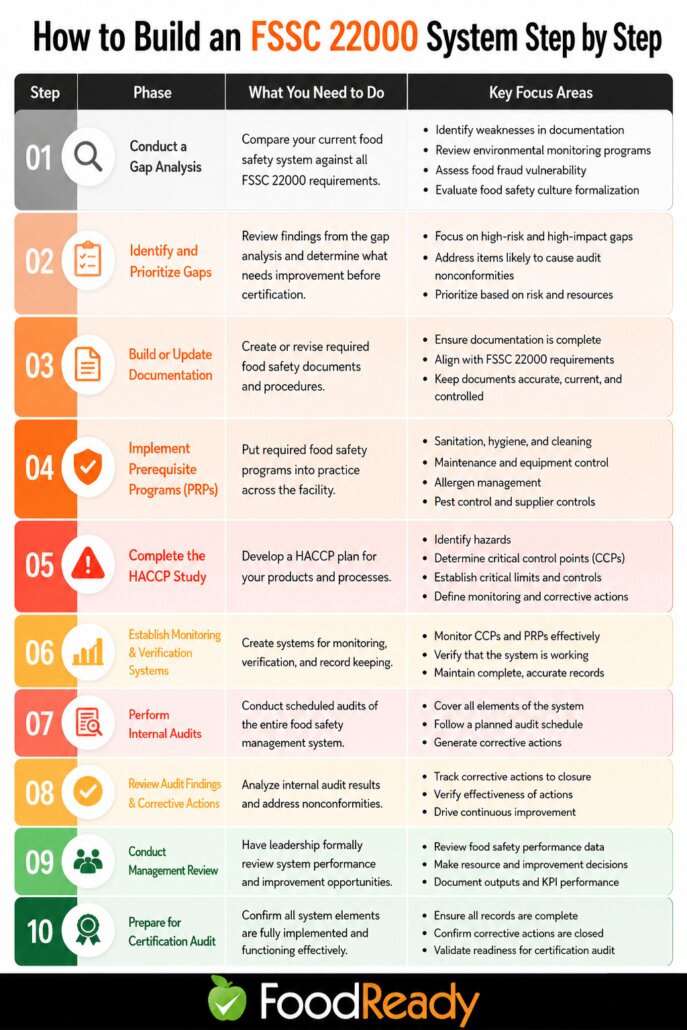
How to Build an FSSC 22000 System Step by Step
Getting FSSC 22000 certified is a structured process. The starting point is a gap analysis that measures your current food safety system against the full scheme requirements. Many facilities use external GFSI consulting services to perform the gap assessment. Most sites find gaps in documentation completeness, environmental monitoring program design, food fraud vulnerability assessment, and food safety culture formalization. Knowing exactly where those gaps are before a pre-audit is what makes the difference between a clean first certification and a costly series of corrective actions.
Once gaps are identified, the build phase involves updating or creating the required documentation, implementing the prerequisite programs across your site, completing the HACCP study for your product and process categories and establishing the monitoring, verification and record-keeping systems the scheme requires. This is where FoodReady’s HACCP plan builder adds value, providing a structured framework for developing the hazard analysis and critical control point documentation that sits at the heart of your FSSC 22000 system.
Internal auditing is a mandatory component of the scheme and a real quality assurance activity rather than just a compliance tick box. Your internal audit program must cover all elements of the food safety system on a planned schedule and generate corrective actions that are tracked to closure. The output of your internal audit program is one of the first things an FSSC 22000 auditor will review, because it shows how seriously your facility takes its own compliance monitoring.
Management review is the formal process through which your leadership team reviews the performance of the food safety system and makes resource and improvement decisions.
Under FSSC 22000, management review outputs must be documented and must show that leadership is actively engaged with food safety performance data rather than just treating it as an administrative exercise.
This is where the compliance landscape becomes important to get right now.
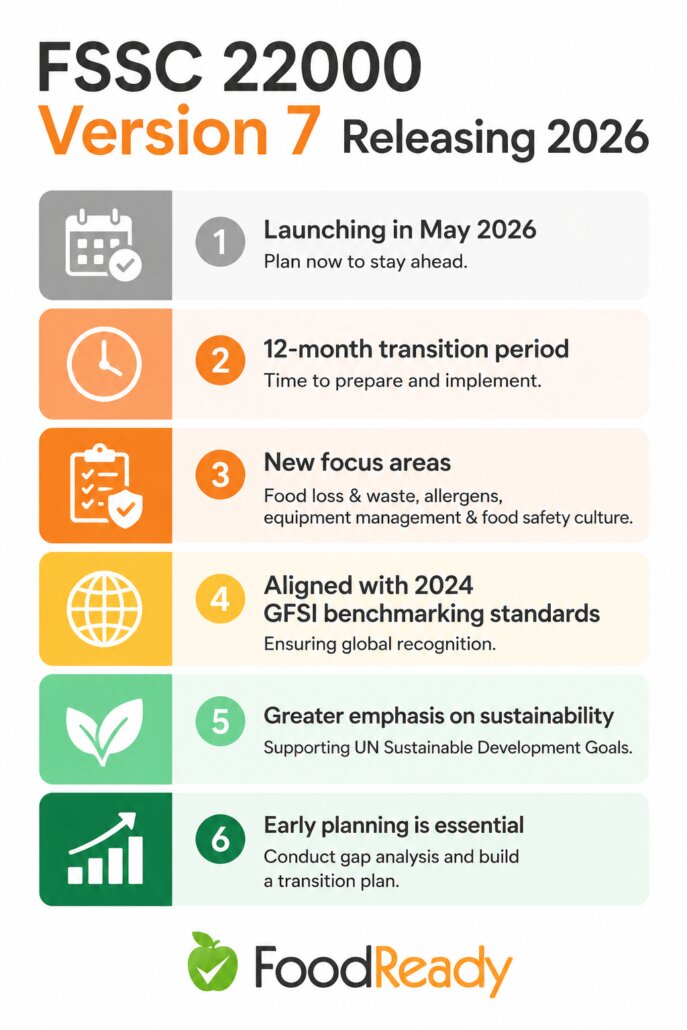
FSSC 22000 Version 7 is due out in May 2026 and will be the next evolution of one of the world’s most widely recognized food safety certification schemes.
Certification bodies and certified organisations will have a 12 month transition period to implement the new version from publication.
So if you are currently certified to Version 6, your transition audit window opens shortly after May 2026 and you will need to be fully compliant before your current certification cycle ends.
FSSC 22000 Version 7: What to Expect?
The updates in FSSC 22000 Version 7 will include new product categories, audit duration and additional FSSC requirements in areas such as food loss and waste, quality control, equipment management, allergen management and food safety and quality culture.
The new version will also align with the 2024 GFSI benchmarking requirements to ensure international acceptance of FSSC 22000 certification. For context on how FSSC 22000 fits alongside SQF, BRCGS and other schemes, see the broader landscape of certifications that fall under GFSI. Public communications from the Foundation indicate an increased focus on sustainability and UN Sustainable Development Goals within the scheme.
The changes are significant around prerequisite programs, sustainability and GFSI. Organizations should expect moderate changes to their food safety management systems. Any organization certified to Version 6, especially manufacturers, processors, packaging facilities and distributors, should start monitoring the updates and planning their transition.
For food manufacturers, the practical implications of Version 7 fall into several categories. Allergen management documentation will need to be reviewed against the new requirements. Food loss and waste programs, which were guidance under Version 6, will become formal requirements. Equipment management documentation will be scrutinized closer. And food safety culture will be integrated deeper into the audit process, so facilities need to invest in real culture development rather than just procedure writing.
The facilities that transition smoothly are those that treat the Version 7 update as a planned improvement project rather than a last minute rush. That means reviewing the Version 7 scheme documents as soon as they are published in May 2026, doing a structured gap analysis against the new requirements and building a transition plan with timelines tied to your existing certification cycle.
How FoodReady Helps With FSSC 22000?
Building and maintaining an FSSC 22000 compliant food safety management system requires more than good intentions and binders full of procedures. It requires a platform and supporting expertise that keeps your documentation complete, your records up to date and your team ready for what auditors will actually look at. FoodReady’s food safety software and consulting platform is designed for that purpose. Tools like top-rated HACCP software options help benchmark functionality, and the HACCP plan builder on the FoodReady platform creates hazard analysis and critical control point documentation that meets the ISO 22000 requirements at the heart of FSSC 22000. The structure follows the internationally recognized seven principles of HACCP and produces the documented system that certification body auditors expect to see. For facilities building their system from scratch or updating existing documentation to meet Version 6 or Version 7 requirements, this feature reduces the time and expertise needed to get the hazard analysis right.
Prerequisite program management across a food manufacturing facility involves a large volume of monitoring records, verification activities and corrective actions. FoodReady’s platform centralizes all that documentation so it’s accessible, timestamped and auditable. When an FSSC 22000 auditor asks for environmental monitoring records, allergen cleaning verification records or supplier approval documentation, the answer is a few clicks rather than a physical filing cabinet search.
For allergen management, which is getting more focus under both Version 6 and the upcoming Version 7, FoodReady supports the documentation of your onsite allergen register, allergen cleaning and changeover procedures and verification activities. That documentation chain is what shows an auditor that your allergen controls are not just written down but actively managed and verified.
Supplier management is a key component of FSSC 22000 compliance, especially the requirements around supplier monitoring and verification. FoodReady’s supplier approval and document management features keep certificates of analysis, GFSI certification records, supplier food safety plans and audit results organized and up-to-date. For BRCGS or SQF certified suppliers, check out GFSI certification consulting to ensure your supplier qualification framework aligns with FSSC 22000 scheme requirements.
FoodReady has experience with FSSC 22000 audits and FSSC 22000 consultants to help facilities prepare for certification and navigate the Version 7 transition. Whether you are seeking initial certification, preparing for a recertification audit or planning your Version 7 upgrade, the food safety consulting services team provides the gap analysis, documentation support and audit preparation guidance that gets facilities to certification rather than close to it. For facilities pursuing parallel certification pathways, resources such as the SQF certification overview, SQF audit preparation guide and BRCGS certification overview provide useful information on how FSSC 22000 fits with the other major GFSI schemes.
Certification is a Journey, Not a Destination
FSSC 22000 certification is a big deal for any food manufacturing facility. It shows the market, regulators and your own team that food safety is embedded in how you operate, not tacked on as an afterthought. But certification is not the end of the journey. Version 7 is coming. Requirements will continue to evolve. Your markets will continue to raise their expectations.
The facilities that maintain certification year after year and transition through version changes without disruption are the ones that treat their food safety management system as a living operational system rather than a periodic audit project. That requires the right platform, the right expertise and the commitment to continuous improvement that the scheme is designed to recognize. See how FoodReady supports that journey at foodready.ai.
FAQs
FSSC 22000 is a GFSI benchmarked food safety management system certification scheme built on ISO 22000 and sector-specific prerequisite programs. It is used by over 35,000 organizations globally and is recognized by major retailers and food brands as a supplier qualification standard. When evaluating the best food safety certification for your facility, FSSC 22000 is often compared with HACCP, SQF and BRCGS based on customer requirements and export markets.
ISO 22000 is the foundational international standard for food safety management systems. FSSC 22000 builds on it by adding sector-specific prerequisite programs and additional scheme requirements covering food defense, food fraud, allergen management and environmental monitoring. FSSC 22000 is the GFSI benchmarked certification scheme. ISO 22000 on its own is not GFSI recognized.
A food safety policy, a full HACCP-based plan that is created and implemented correctly, prerequisite and operational prerequisite programs, food fraud vulnerability assessment, food defense plan, allergen management program with onsite allergen register, risk-based environmental monitoring program, quality control integration and food safety culture program.
Version 7 is due out in May 2026 and includes updates to prerequisite programs, product categories, audit duration, allergen management, food loss and waste requirements, equipment management and food safety culture integration. It also aligns with the 2024 GFSI benchmarking requirements and adds more emphasis on sustainability.
The Foundation FSSC will provide a 12-month transition period from the date of Version 7 publication in May 2026. If you’re currently certified under Version 6, start reviewing the updated scheme requirements as soon as Version 7 is published and plan your transition audit within your existing certification cycle.
It depends on the maturity of your food safety management system. Facilities with existing HACCP documentation and prerequisite programs can often complete initial certification preparation in 3-6 months. Facilities building their system from scratch typically need 6-12 months before they’re ready for a stage one audit.
FoodReady has a HACCP plan builder based on ISO 22000, centralized prerequisite program and corrective action documentation, allergen and supplier management features and consulting support for gap analysis, audit preparation and version transition planning. The platform keeps your food safety management system documentation complete, current and audit-ready across certification cycles.