If your product crosses a border, goes into a retail chain or gets audited during a regulatory audit, there’s a good chance Codex Alimentarius is part of the conversation. Most food manufacturers have heard the name. Fewer understand what it actually covers, how it affects their day-to-day compliance obligations and what has recently changed. That knowledge gap is a real risk in an industry where international food safety standards are increasingly driving what inspectors, certification bodies and customers expect to see.
This guide breaks down everything you need to know about Codex Alimentarius standards, why they matter for food manufacturers, what the 2026 updates mean for your facility, and how FoodReady keeps you aligned with international requirements without adding compliance overhead to your team.
What Is Codex Alimentarius?
Codex Alimentarius is a collection of international food standards, guidelines and codes of practice developed jointly by the Food and Agriculture Organization of the United Nations and the World Health Organization. The name translates from Latin as “food code,” and the program has been running since 1963. It is administered by the Codex Alimentarius Commission, an intergovernmental body with over 188 member countries.
The standards it covers are broad. Food additives, contaminant limits, pesticide and veterinary drug residue limits, food labeling standards, HACCP guidelines, GMP requirements and food hygiene codes of practice all fall under its scope. If it touches food safety or fair food trade, there’s almost certainly a Codex text that addresses it.
Why Codex Alimentarius Matters for Food Manufacturers?
The practical reason Codex matters is market access.
When your product enters a new country, that country’s food regulatory framework is often built on or aligned with Codex standards. When an importer asks for documentation, the specifications they are working from frequently reference Codex maximum limits for contaminants, additives or residues. When a GFSI certification body like SQF or BRCGS evaluates your food safety system, the underlying principles of that evaluation trace back to Codex HACCP principles and food hygiene codes of practice. Even if you only sell domestically, Codex alignment matters.
The FDA and FSMA regulatory framework in the United States incorporates principles that parallel Codex guidance on preventive controls and HACCP. A facility that understands Codex Alimentarius has a stronger foundational understanding of why their food safety obligations exist and what regulators are looking for when they conduct an inspection or review documentation.
Beyond compliance, Codex standards represent scientific consensus on food safety risk. The standards are developed using risk assessments conducted by independent expert bodies, including the Joint FAO and WHO Expert Committee on Food Additives. That scientific foundation is why Codex texts carry weight. They are not arbitrary limits. They reflect what the evidence says about protecting consumer health, and that is what every credible food safety compliance framework is built on.
What Codex Alimentarius Covers?
Codex standards cover a wide range of food safety and quality topics. For food manufacturing facilities, the most relevant areas are food hygiene codes of practice, food additive provisions under the General Standard for Food Additives, maximum levels for contaminants and toxins, maximum residue limits for pesticides and veterinary drugs, allergen labeling requirements and guidelines for the application of HACCP systems.
The General Principles of Food Hygiene (CXC 1-1969) is one of the most referenced Codex texts globally. It establishes HACCP as the internationally recognized framework for food safety management and provides the foundation that GMP standards and food safety plans are built on. Understanding this document is not optional for food manufacturers. It is the baseline. A properly designed HACCP plan built on these principles will hold up under both domestic regulatory review and international market scrutiny.
Food labeling standards under Codex, particularly the General Standard for the Labelling of Pre-packaged Foods, set out what information must appear on a product label and how it must be presented. With e-commerce and digital labeling practices evolving rapidly, this area of Codex is getting more attention from regulators worldwide.
2026 Changes to Codex Alimentarius
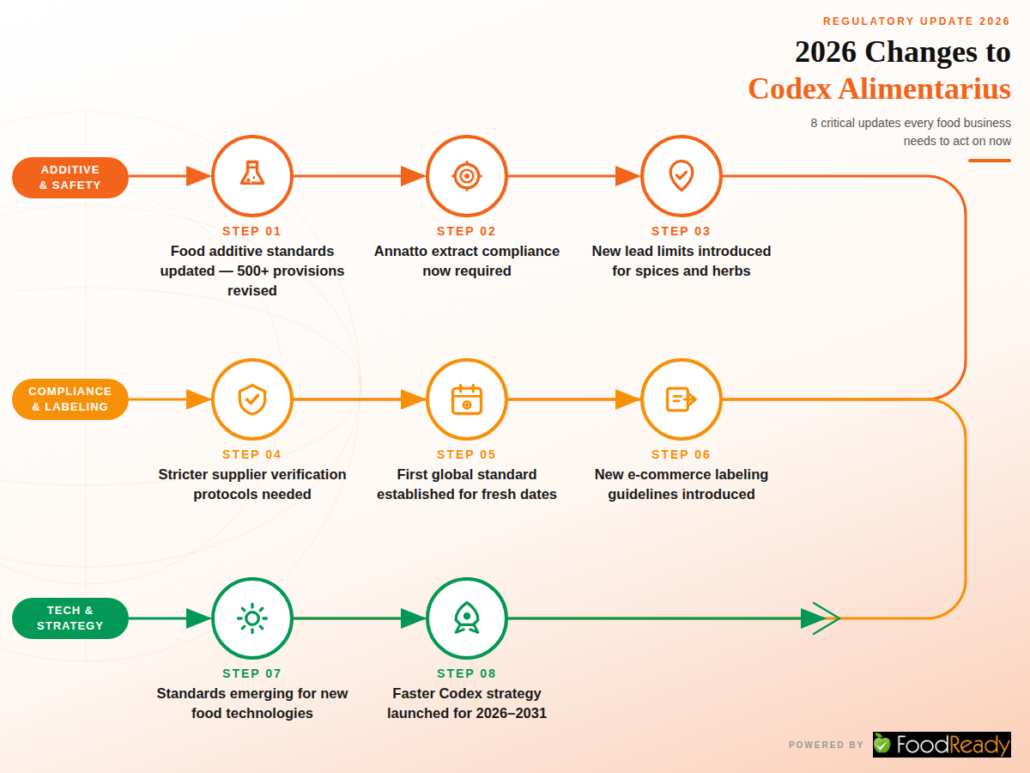
The 48th Session of the Codex Alimentarius Commission, held in November 2025, produced a big set of updates that are shaping compliance expectations for 2026 and beyond. One of the biggest changes is the General Standard for Food Additives. Over 500 food additive provisions were reviewed at the session with a focus on color additives across food categories. Several were revoked and new ones adopted. Food manufacturers using annatto extracts, for example, need to verify their specific applications are compliant with the revised provisions.
New maximum levels for lead were set for cinnamon and dried culinary herbs. These are now included in the General Standard for Contaminants and Toxins in Food and Feed. Spice and herb manufacturers and processors sourcing these ingredients need to verify their supplier documentation reflects these updated limits.
The Commission also adopted the first international standard for fresh dates at CAC48 and updated guidelines for e-commerce food labeling and guidelines on the use of digital technology to deliver food labeling information. These are areas where regulatory expectations have been moving fast and Codex is now catching up. Manufacturers selling through digital channels or exploring dematerialized labeling need to review these new texts.
Looking ahead to the rest of 2026, the Codex Committee on Food Additives met in March 2026 and the agenda included a new standard for baker’s yeast and a project document for guidelines on cell culture media components used in cell based food production. These are leading edge areas where Codex standards are being developed to address emerging food technologies before they become mainstream.
The Commission also approved a new Strategic Plan for 2026 to 2031 at its 47th Session in 2024. That plan reinforces Codex’s core values of inclusiveness, collaboration, consensus building and transparency and reaffirms the Commission’s commitment to developing standards that respond to emerging food safety challenges in a timely way.
For food manufacturers, this means the pace of Codex standard development will not slow down, and understanding the relationship between SQF and GFSI becomes even more important when choosing your certification path.
How FoodReady Helps with Codex Alimentarius Compliance?
Aligning your food safety system with Codex Alimentarius standards is not a one-time exercise. Standards are updated regularly, your product formulations and processes change and your markets may change over time. FoodReady’s food safety software and consulting platform is designed to support that ongoing alignment, not just a one time audit preparation exercise.
The HACCP plan builder on the FoodReady platform is based on the Codex General Principles of Food Hygiene. When your team builds or updates a HACCP plan through the platform the structure follows internationally recognized Codex principles which means it is aligned with what FDA inspectors, GFSI auditors and international buyers expect to see. That alignment is not incidental. It is built in.
Supplier document management within FoodReady keeps certificates of analysis, allergen declarations and supplier approvals organized and accessible. When Codex updates its contaminant limits or additive provisions your team needs to quickly verify if your existing supplier specifications still meet the updated requirements. Having those documents stored centrally and current is what makes that verification fast and auditable rather than a scramble through filing systems.
For manufacturers working towards or maintaining SQF, BRCGS or other GFSI certifications FoodReady’s GFSI certification consulting support provides the expert guidance to ensure your documentation holds up under audit scrutiny. Those certification frameworks are built on Codex foundations and having food safety consulting support that understands both the Codex layer and the certification layer is a real advantage. Resources like the BRC food safety certification overview and the SQF audit preparation guide can help your team understand where those requirements intersect.
The cloud based architecture of FoodReady means compliance records, CCP logs, lot tracking data and sanitation documentation are accessible from anywhere, updated in real time and never dependent on a physical filing system that can be compromised.
When food safety regulations evolve and your documentation needs to reflect the updated requirements the platform supports that update across your entire compliance record not just a single form, helping you stay aligned with GFSI-recognized certifications.
The Standard Behind the Standards
Codex Alimentarius is not a bureaucratic technicality. It is the scientific and procedural foundation that most of the world’s food safety regulations trace back to. Understanding it well means understanding why your compliance obligations exist, not just what they are, and that understanding is what separates facilities that perform well under audit pressure from those that scramble when the inspectors arrive.
The 2026 landscape is one where Codex standards are being updated faster, covering new product categories and technologies and being applied more consistently across global markets. The facilities that stay ahead of those changes are the ones with systems and support in place to track and adapt to them. Want to see how FoodReady supports your compliance from the ground up? Explore the platform or book a free consultation at foodready.ai.
FAQs
A collection of international food standards, guidelines and codes of practice developed jointly by the FAO and WHO since 1963. It is administered by the Codex Alimentarius Commission, which includes over 188 member countries.
Not directly but the WTO references it as the international benchmark for food safety in trade disputes and many nations have incorporated its standards into domestic law. Alignment is a practical requirement for any manufacturer operating across borders.
Food additives, contaminant and toxin limits, pesticide and veterinary drug residue limits, food hygiene and GMP codes of practice, HACCP guidelines, food labeling standards and official inspection and certification guidance across all food types.
CAC48 in November 2025 revised over 500 food additive provisions, set new lead limits for cinnamon and dried herbs, adopted the first international fresh dates standard and released updated e-commerce and digital labeling guidelines. The March 2026 CCFA session covered baker’s yeast standards and cell based food production guidance.
HACCP is embedded in the Codex General Principles of Food Hygiene and is the internationally recognized framework for food safety management. A properly built HACCP plan with expert consulting support is by design aligned with Codex food hygiene requirements.
Both schemes are built on food safety principles that originate in Codex frameworks particularly the General Principles of Food Hygiene. Achieving GFSI certification means your system is substantially aligned with Codex standards.
FoodReady’s HACCP builder follows Codex General Principles of Food Hygiene, supplier document management keeps additive and contaminant specifications current and the consulting team supports GFSI certification preparation so your documentation holds up under audit.