Curious about SQF Edition 10? It’s finally here, and it’s shaking things up with a fresh, digital-first approach that will change how your site interacts with the SQF Code. The official SQF code by your Food Safety Category (FSC) can be found at https://www.sqfi.com/the-sqf-code/choose-your-code/code-selector/
SQF Edition 10 centers on SQFI’s innovative online Code Selector, making compliance smoother, smarter, and more streamlined than ever.
From a transition standpoint, here’s what SQFI’s telling us consistently across multiple official pages:
- Audits to Edition 10 are anticipated to begin on January 2, 2027 (and they won’t start any earlier than that date, no matter what).
- That date’s still contingent on the GFSI benchmarking process (meaning the start date could shift later, but definitely not earlier).
- Audits before the implementation date? They’re sticking with Edition 9. Audits on or after the implementation date? That’s Edition 10 territory – and your Certification Bodies aren’t going to mix Edition 9 and Edition 10 requirements in a single audit.
While there is time, use the time strategically to think about Change, not passively, ok?
And yes, Change Management is one of those updates for Version 10!
Key definitions you’ll see in this guide
SQF Edition 10 (SQF Food Safety Code, Edition 10)
The newest edition of the SQF Food Safety Code, released as a digitized web experience to help sites and auditors navigate requirements with greater clarity. SQFI describes Edition 10 as a robust digitized experience, and points users to the Code Selector as the starting point. It is currently being benchmarked against GFSI.
Code Selector
SQFI’s online tool that helps you identify the right SQF Code(s) based on your Food Sector Category (FSC) and scope.
GFSI benchmarking
A formal evaluation process is used to ensure the new codes are accredited against the GFSI standards.
SQF Edition 10 at a glance
- Release Date: Early March 2026 (non-GFSI benchmarked).
- What’s new structurally: A digitized Code experience designed to improve navigation and precision, updated Guidance documents, and with the Code Selector front and center as the starting point.
- Audit start (earliest): SQFI anticipates audits to begin with Edition 10 on January 2, 2027, and explicitly states that audits will not commence earlier than that date.
- A big dependency: The go-live audit date is contingent on the GFSI benchmarking application process and may be delayed (not earlier).
Why Edition 10 Matters and Why SQFI Went Digital-First?
The SQF Food Safety Code, Edition 9 is a GFSI benchmarked food safety code used worldwide across the supply chain. The SQF program is managed by SQFI, a division of FMI, The Food Industry Association, which also administers the SQF Codes.
Edition 10 isn’t just some clause renumbering exercise. SQFI is presenting it as a step toward clearer navigation, more precise scope alignment to GFSI, and a digitized experience for you and the auditors.
The “starting point”?
That’s the Code Selector, designed to reduce ambiguity when you’re selecting the right Code(s) for your products and processes. Let our team help connect you to a Certification Body to schedule your audit.
The Code Selector changes the game for multi-scope operations
SQFI’s Edition 10 FAQ explains that the digital system is going to let you, and when you pair that with the major steps to prepare for an SQF audit, see how Edition 10 will actually play out during certification:
- Use an interactive interface to identify the correct Code based on the scope
- Generate a single consolidated Code if your site operates under multiple Food Sector Categories (FSCs) and Codes
- Access embedded links and resources directly in the Code
- Generate real-time translations
- Produce a printer-friendly version (downloadable as a PDF) when you need it
This matters operationally because it’s pushing organizations toward living systems (linked evidence, clear scope control, and more dynamic updates) rather than those “audit-season binders” we’re all familiar with.
PDFs aren’t “gone,” but they’re no longer the center of gravity
A common misconception is that digitized means “no PDFs.” SQFI clarifies that the Code is printable and can be downloaded as a PDF (via a printer icon), but the digital interface is the primary experience.
Appendices and supporting materials are now handled differently
SQFI also separated traditional appendices into their own web resources (such as the Glossary, Multi-site Certification rules, Food Sector Categories, and logo rules).
And here’s something important for your implementation teams: SQFI is providing a central “Guidance & Checklists” hub that lists Edition 10 guidance documents (including Food Safety Culture Assessment Plan, Change Management, Environmental Monitoring, Management Review, etc.) and Edition 10 checklists by Code.
Applying code is the focus for anyone managing the SQF program.
Timeline and Audit Rules for the SQF 9→10 Transition
Official dates and what they mean for your scheduling
SQFI’s official guidance is consistent: the expected start date for audits with Edition 10 is January 2, 2027. Audits scheduled on or after that date are expected to be to Edition 10, and that date remains contingent on the GFSI benchmarking application process.
SQFI also states, in plain terms, that audits to Edition 10 will not commence earlier than January 2, 2027. If the benchmarking process requires more time, the start date could move later.
Which edition applies to your audit?
SQFI’s direction is simple:
- If your audit occurs before the mandatory Edition 10 implementation date, you will be audited to Edition 9.
- If your audit occurs on or after the implementation date, you will be audited to Edition 10.
- Certification Bodies will not mix requirements from both editions in a single audit.
SQFI also highlights an important nuance: if you had an Edition 9 audit that resulted in a surveillance audit scheduled after the Edition 10 implementation date, that surveillance audit would still be against Edition 9 requirements.
What doesn’t change
A few high-anxiety topics are clarified directly in SQFI’s Edition 10 FAQ:
- Unannounced audits: the requirement hasn’t changed, and the three-year timeframe isn’t disrupted by Edition 10’s release.
- Renumbering: SQF doesn’t require sites to align internal procedures to Code numbering. However, if your documentation’s built around clause numbering, you may need to revise cross-references for Edition 10.
Auditor planning guidance
Based on the transition window and how sites typically struggle (evidence readiness, training reach beyond the SQF Practitioner/Backup, and those “system vs paperwork” gaps), here’s a practical ramp-up model that aligns with SQFI’s January 2027 audit start messaging; if you need external support, there are specialized SQF certification companies that can guide you through this process:
- Existing SQF-certified sites: you need to begin conversion work immediately (gap assessment → action plan → implementation evidence), so you’re not compressing “system change” into late 2026. This matches SQFI’s own advice to perform a gap assessment well before the go live date.
- Gap audits: start these in October 2026 (recommended), so you’ve got time to correct systemic issues and build records before January 2027. Contact FoodReady to schedule yours.
- New sites starting June/July 2026: build your implementation plan as if your initial certification audit’s going to be Edition 10 in January 2027, so you don’t have to rework fundamentals midstream.
(Those three bullets reflect auditor planning advice – your Certification Body always controls the final scheduling and audit edition rules for your audit cycle.)
What Are The Biggest Edition 10 Changes to Prioritize?
Have you been keeping up with what SQFI’s been doing? Let’s face it: SQFI has consistently been pushing Edition 10 as this big strategic evolution thing with emphasis on food safety culture, change management, and environmental monitoring, and honestly, they’ve been hammering those same themes across blogs and all their supporting guidance stuff, which lines up closely with broader strategies for improving food safety culture across operations.
What’s different in Edition 10 is not just that these topics are hanging around, but that they’re increasingly being treated as systems that must be evidenced, assessed, and trended, and in some cases, they now carry heavier scoring consequences (which nobody’s really excited about, let’s be honest).
Food safety culture becomes auditable through an assessment plan
SQFI states pretty clearly that Edition 10 adds this new requirement across all Edition 10 Food Safety Codes: sites must have a food safety culture assessment plan in place, and they’ve got a dedicated guidance document to back it up. This goes beyond just administering a questionnaire!
The Food Safety Culture Assessment Plan Guidance Document defines food safety culture as shared values, beliefs, and behaviors (formal and informal), then positions the assessment plan as a structured way to determine whether culture actually supports or undermines food safety objectives. Pretty straightforward when you think about it.
That guidance document really emphasizes that assessment is about “behavioral realities,” you know, gaps between what’s written down and what people actually do, and taking proactive action to make culture stronger.
The minimum components you should be ready to show
The guidance document lays out expected plan elements as:
- effective communication strategies
- comprehensive training programs
- mechanism for feedback
- regular measurement and evaluation (KPIs, maturity models, integration into management review)
For Food Manufacturing, SQFI’s Edition 10 checklist makes this requirement clear. The clause says a food safety culture assessment plan must be documented, implemented, and maintained. At a minimum, it must cover communication, training, feedback, and measurement and evaluation. Not rocket science, but you gotta have it all documented.
What auditors and practitioners follow RIO?
SQFI’s “Road to RIO” framing is useful here. Auditors will review records, conduct interviews, and make observations to confirm you did more than write a policy and leave it at that. They want to see that you put it into practice and made sure it works. The guidance document examples include reviewing documentation (plans, surveys, action plans, internal audits), interviewing leadership and front-line staff, and observing real behaviors, such as whether people actually feel safe speaking up and whether production pressure overrides food safety. We’ve all seen that happen, right?
Change management becomes a defined, documented program
Edition 10 introduces a clearer expectation that sites must manage operational change in a structured way to prevent unintended food safety consequences. SQFI’s Change Management Guidance Document defines change management as a systematic approach to planning, evaluating, documenting, communicating, and verifying changes that could impact the integrity and effectiveness of the food safety system.
Here’s the key point. The guidance document says the site’s procedure should apply to changes that could affect food safety and quality. That includes product formulations and manufacturing processes, ingredients and materials, specifications, equipment, and food safety plans, including critical limits. That’s a lot of ground to cover.
What “good change management” looks like in practice
SQFI’s guidance organizes a change management procedure into this lifecycle that includes:
- initiation/classification (planned, unplanned, temporary, emergency)
- impact assessment and risk assessment (including whether new hazards are introduced or risks increase)
- approval by authorized personnel
- implementation (including training and updated procedures)
- validation and verification
- documentation/communication
- review and closure
This whole “validation/verification” expectation aligns with broader preventive control thinking: for example, FDA’s preventive controls rule requires validation “whenever a change to a control measure…could impact” whether it effectively controls hazards. Makes sense when you think about it, and it fits neatly inside a well-built food safety and quality assurance (FSQA) program framework.
What auditors will sample
SQFI is pretty explicit about this: auditors will look for a documented, approved procedure; evidence that changes since the last audit actually went through that process; and records showing the change description, risk/impact assessment, approvals, validation/verification, document updates, and communication/training.
Expect auditors to also use more of a process audit style vs a checklist style audit. This will directly involve Change management as sample records will lead to programs that may have been updated/modified.
This is where a lot of sites get caught: they made the change safely, but didn’t prove they made the change safely. Big difference there.
Environmental monitoring becomes more explicitly risk-based
SQFI flagged this key update: conducting a risk-based assessment to determine environmental monitoring has always been part of the program. However, sites should begin to move away from static models and toward site-specific risk-based monitoring with randomization based upon a defined schedule.
In SQF’s Environmental Monitoring Guidance Document (February 2, 2026), SQFI explains that while EMPs provide value broadly, their “scope and intensity must be based on the risk of cross-contamination with environmental pathogens,” and that the SQF Code requires a risk assessment to determine the type and frequency of controls needed.
The same guidance document provides examples of risk factors your assessment should consider: product risk profile (like products that support pathogen growth), post-lethality exposure points for RTE foods, facility design/zoning, historical positives/findings, and environmental conditions like moisture and niches. This program is to verify cleaning and sanitation are effective in eliminating pathogens for high risk processes or proceducts. They further provide examples of high risk where a more “complex” program needs to be implemented, such as for RTE products. Pretty comprehensive overall. FoodReady can help guide you through this.
See the steps to develop an effective environmental monitoring program for SQF compliance.
Scoring changes: core clauses carry heavier consequences
SQFI explains that Edition 10 retains the familiar “100 minus deductions” model but introduces Core Clauses with greater scoring impact. Under SQFI’s own scoring overview:
| Minor | 1 point |
| Core Clause Minor | 2 points |
| Major | 5 points |
| Core Clause Major | 7 points |
| Critical | 50 points |
SQFI also defines “core clause minor” and “core clause major” in its glossary as minor/major non-conformances issued against requirements identified within an identified core clause. Basically, double the pain.
For Food Manufacturing, SQFI lists core clause examples such as management commitment, approved supplier program, food safety plan, environmental monitoring, CAPA, product identification, allergen management, sanitation, and foreign material control, basically the areas auditors already treat as indicators of system health, now formally weighted in scoring. So if you mess up in these areas, it’s gonna hurt more.
A Conversion Roadmap You Can Run Like a Project
SQFI encourages sites to begin closing gaps now so that audits are less surprising later, especially as the January 2027 date approaches. You’ve got some serious work to do – close those gaps with intention, conduct a gap assessment, strengthen that management review, get your internal audits thinking risk-based, and really put your culture and “system effectiveness” through the wringer.
Here’s a down-to-earth roadmap (it aligns with what SQFI expects and what auditors actually look for) that you can tweak based on how big your site is and the kinds of risks you’re dealing with.
From April to September 2026: get scope and gaps under control
Let’s start with the basics – you want to make sure you’re building the right system for the right Code (because building the wrong one is just a waste of everyone’s time).
Select team members and a project lead for the updates/reviews. SQF Practitioners or Backups may not necessarily be that person but needs to be directly involved. Confirm there is a way to track and monitor activity. We like to set milestones to ensure we stay on track. Invite all team members to an initial meeting and establish check in points…don’t make these times too long or you’ll lose their attention.
Go ahead and use SQFI’s Code Selector to double-check your FSC(s) and get the correct Edition 10 Code output detailed changes, especially if you’ve got a site that spans multiple categories (trust me, this gets confusing fast).
Then you’ll want to run a documented Edition 10 gap assessment and put together a written action plan with real owners and actual deadlines. SQFI’s pretty explicit about doing this as soon as the Code drops, and they’ve got official checklists and guidance to help you out (so why not use them?).
At the very least, your gap assessment needs to cover what they’re calling the “Edition 10 headline systems”:
- food safety culture assessment plan evidence
- change management procedure and records
- risk-based environmental monitoring rationale and trending
- management review records that actually demonstrate decisions and trend review (not just who showed up to the meeting)
From October to December 2026: run internal audits and build documents/records that show areas of improvement/alignment
By this point, you’re not trying to “write new programs” anymore. You’re trying to improve them and validate they meet your SQF / Food Safety System. (And Quality if you have it)
Your internal audit goals should include:
- Taking a look at recent process/product/material changes and making sure they actually followed your change management workflow (impact/risk, approvals, validation/verification, training, document control – the whole nine yards).
- Running at least one culture assessment cycle (survey/interviews/observations), getting some findings out of it, and documenting what you’re going to do about it – auditors want to see that you can spot cultural risks and actually improve things over time.
- Showing that your environmental monitoring sampling locations and frequencies make sense from a risk perspective, that you’re tracking trends in the results, and that your corrective actions are actually preventing problems (not just putting a band-aid on them).
This is why starting those internal audits around October 2026 makes sense and depending on your audit cycle: it gives you time to pile up records and show you can follow through before we hit early 2027.
From January 2027 onward: treat core clauses as “system health checkpoints.”
Since core clauses pack a bigger scoring punch, you’ll want to shift your internal audit, annual management review, and management meetings to focus accordingly (it’s just common sense).
SQFI’s own “Which Code Edition Should I Use?” guidance calls out core clause areas as foundational high-risk elements and pushes for “risk-based evaluation” in internal audits and stronger management review analysis.
Put it this way: if your internal verification schedule doesn’t really test how well core clauses work, Edition 10’s going to expose that pretty quickly.
Prepare for SQF Edition 10 With Confidence
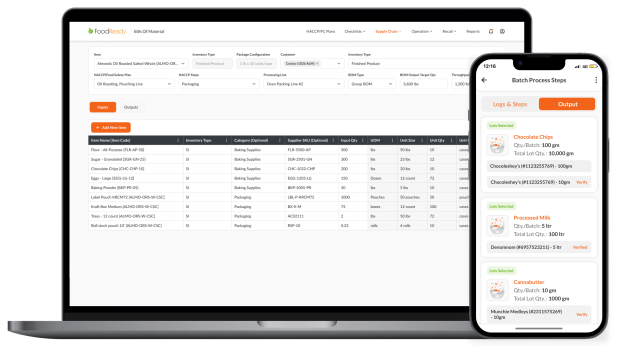
FoodReady helps you manage gap closure, change control, EMP readiness, and audit documentation in one platform.
How Can FoodReady Simplify Edition 10 Changes?
Edition 10’s designed to be easier to navigate digitally – but your internal system still has to hold up when they’re checking Records, doing Interviews, and making Observations.
A well-set-up SaaS platform (like FoodReady) can cut down on the “compliance friction” that derails Edition 10 conversions by helping your teams:
Centralize that Edition 9→10 requirement mapping and gap closure so you can show what changed, what you updated, who signed off on it, and when it went live – without digging through spreadsheets and shared drives (we’ve all been there).
Operationalize change management by turning that guidance lifecycle (initiation → risk assessment → approval → implementation → validation/verification → evaluation/closure) into a controlled workflow with required fields, attachments, and approvals – so those “tribal knowledge changes” don’t turn into audit findings.
Make food safety culture something you can actually measure by tracking survey distribution, completion, results, corrective actions, communication artifacts, and KPI trends; this lines up with SQFI’s emphasis on measurement, evaluation, and continuous improvement – not just a one-time “culture statement” that sits in a binder somewhere.
Strengthen your environmental monitoring readiness by linking EMP risk assessments, zone maps, sampling plans, results, trending, and corrective actions – supporting those risk-based expectations SQFI talks about.
Team of industry consultants and SQF consultants to assist in the pending changes. This guidance can help assess best practices to meet the SQF code.
If SQF Edition 10 is about demonstrating that your systems work the way it was intended and “when no one is watching,” then SaaS is most valuable when it demonstrates the evidence your team has worked hard to maintain and auditors will expect.
Frequently Asked Question
SQFI went digital with Edition 10 to improve the user experience, centered on the Code Selector. You can still generate a printer-friendly version that can be printed or downloaded as a PDF (for those of us who still like paper sometimes). Multiple languages are now available.
SQFI’s expecting audits to begin in Edition 10 on January 2, 2027, depending on how the GFSI benchmarking goes, and audits will not start earlier than January 2, 2027 (so don’t worry about rushing into anything just yet).
SQFI’s own transition guidance encourages sites to use this transition window to conduct a documented gap assessment as soon as the Code’s released, beef up management review and internal audits, and avoid last-minute Q4 2026 scrambling (nobody wants that kind of stress).
SQFI’s been pretty consistent about Edition 10 focus areas: food safety culture, change management, and risk-based environmental monitoring (you’ll be hearing about these a lot).
Nope. SQFI says the unannounced audit requirement hasn’t changed, and the three-year timeframe isn’t affected by Edition 10’s release. Speak with your Certification Body if your unannounced is during the early part of the Edition 10 go live period.
SQFI doesn’t require your site policies/procedures to match up with SQF Code numbering; however, if you built your system around Code numbering, you might need to revise your internal references for Edition 10 (which could be a bit of a pain, honestly).
SQFI says SQF is going through the GFSI benchmarking application process for Edition 10 recognition. Until Edition 10 is recognized by GFSI, the Edition 9 Food Safety Code remains the GFSI recognized edition, and audits to Edition 10 won’t start until benchmarking is completed and recognized.
SQFI has Edition 10 supporting materials on their website, including the Guidance & Checklists hub, which lists Edition 10 guidance documents and Edition 10 checklists by Code (pretty straightforward to find).
Yes. While not mandatory, SQF training centers provide courses as well as SQFI offers an SQF Edition 10 Conversion Course that focuses on practical implementation, including emphasis on food safety culture, change management, and environmental monitoring, and includes downloadable resources (e.g., change management guidance and food safety culture assessment guidance – handy stuff to have). Ask us more about the SQF training centers.