Key Takeaways
Tight temperature control across cooking, cooling, storage, and distribution is the backbone of modern food production safety and quality. Without it, pathogens multiply rapidly, toxins form, and products become unsafe long before they reach consumers.
- The core danger zone ranges are 41–135°F (5–57°C) in the U.S. FDA Food Code and 40–140°F (4–60°C) in many global standards. Staying out of this band is your first line of defense against bacterial growth and foodborne illnesses.
- Regulators including FDA (21 CFR Part 117, FSMA), EU hygiene regulations, and GFSI schemes like SQF and BRCGS expect documented, monitored, and verifiable temperature control at each Critical Control Point (CCP).
- Digital, automated monitoring and traceability platforms like FoodReady drastically reduce manual logging, human error, and audit stress while improving real-time control over temperature sensitive products.
- This article walks manufacturers through practical setpoints, process controls, validation approaches, and tech stack choices for ovens, chillers, blast freezers, cold storage, and transport across the entire food supply chain.
Why Temperature Control Is Critical in Food Production
Time–temperature abuse is consistently listed by the CDC and FDA as a top root cause of foodborne illness outbreaks in the U.S. Between 2015 and 2023, improper temperature control, particularly during cooling and hot holding, has contributed to dozens of documented outbreaks. According to CDC estimates, the top pathogens including Salmonella, Campylobacter, and Clostridium perfringens together cause approximately 9.9 million illnesses, 53,300 hospitalizations, and over 900 deaths annually in the United States.
Common pathogens thrive in the temperature danger zone. Salmonella, Listeria monocytogenes, E. coli O157:H7, and Clostridium perfringens multiply rapidly between 41–135°F (5–57°C), with many bacteria grow and doubling every 20 minutes under optimal conditions. C. perfringens alone causes nearly one million illnesses annually, largely tied to improper cooling or holding of cooked bulk items like soups, stews, and rice.
Important note on toxins: Some bacteria, like Staphylococcus aureus and Bacillus cereus, produce toxins at danger zone temperatures that become heat-stable and survive later cooking. This means temperature control must occur before toxin formation, and you cannot rely on cooking afterward to fix the problem.
Temperature control protects not only food safety but also sensory quality and shelf life. Products like RTE deli meats, dairy desserts, frozen meals, and beverages suffer degraded texture, color, and moisture when exposed to temperature deviations. Slow freezing creates large ice crystals that damage cell structure, while refrigerated items stored even slightly above target temperatures experience accelerated spoilage.
The business risk is real. The 2015 Blue Bell Creameries listeriosis outbreak serves as a stark reminder: Listeria-contaminated ice cream caused multiple illnesses and deaths, leading to a complete recall of all products, facility shutdowns, and disposal of over 8 million gallons of ice cream. Contributing factors included sanitation failures and inadequate chilled storage control. Similar outbreaks involving deli meat and cheese between 2019–2023 have reinforced that cold foods and refrigeration failures remain significant risk factors.
Regulatory Framework: How Temperature Control Ties Into Compliance?
In the U.S., temperature control is mandated primarily through FSMA’s Preventive Controls rule (21 CFR Part 117) and enforced via FDA inspections and third-party audits. Food manufacturers must demonstrate that temperature-based controls are identified, monitored, and verified as part of their food safety management system.
Key U.S. regulatory anchors include:
- 21 CFR Part 117.130(c)(2) requires process preventive controls for parameters including time and temperature
- Part 117.145 mandates monitoring of preventive controls with sufficient frequency to ensure effectiveness
- Part 117.150 covers corrective actions, verification requirements, and recordkeeping when monitoring reveals deviations
- 21 CFR § 117.206 establishes modified requirements for warehousing facilities storing TCS foods requiring refrigeration
The FDA Food Code establishes the danger zone of 41–135°F (5–57°C) for TCS foods (Time/Temperature Control for Safety foods), driving requirements for cooking temperatures, hot holding, cold storage, cooling schedules, and reheating. These standards form the foundation that state and local health departments enforce.
Major GFSI benchmarked schemes, including SQF Edition 9, BRCGS Food Safety Issue 9, and FSSC 22000, explicitly require temperature control programs with defined critical limits, calibration schedules, and trendable records. Certification bodies audit against these requirements, making robust temperature documentation essential for maintaining certification.
- International context: Global exporters must harmonize temperature programs across markets. EU Regulation (EC) No 852/2004 on the hygiene of foodstuffs and Codex HACCP guidelines establish similar expectations, requiring full hazard analysis including time–temperature hazards.
- FoodReady’s role: The platform helps document CCP limits, log temperature readings, maintain calibration records, and generate audit-ready reports aligned with FSMA and GFSI schemes, eliminating the scramble before audits.
Temperature Control Across the Production Process
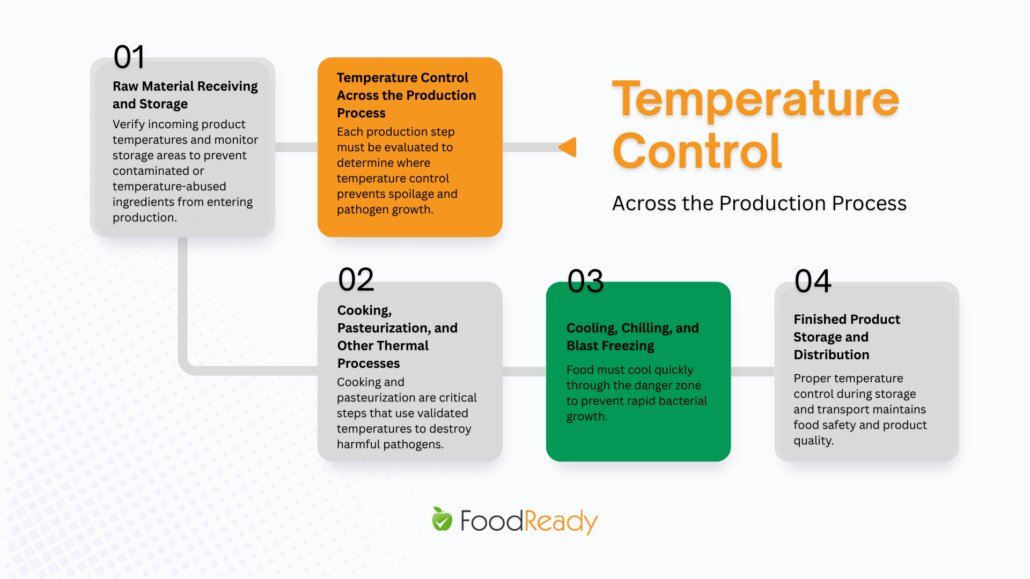
Each processing step (from receiving through cooking, cooling, packaging, storage, and distribution) must be evaluated in a hazard analysis to decide where temperature is a Critical Control Point (CCP) or a prerequisite program. The goal is to identify where control is essential to prevent spoilage and significantly reduce pathogen risk.
A typical process flow for food manufacturers includes:
- Raw material receiving
- Refrigerated/frozen storage
- Prep and batching
- Thermal processing (cooking, pasteurization, HTST)
- Cooling/freezing
- Packaging
- Finished goods storage
- Distribution
Each step requires specific temperature requirements based on product type, whether you’re producing cooked RTE meats, yogurt, frozen entrees, or sauces.
Raw Material Receiving and Storage
Verifying supplier tanker, truck, or pallet temperatures at receiving is the first line of defense against contamination entering your facility. Many plants use a 2–4°F internal buffer below regulatory limits to allow for unloading time and temperature recovery.
Staff should measure the internal temperature of sample cases using calibrated probe thermometers, not just rely on carrier paperwork or truck air temperature. Surface readings from infrared guns are useful for screening, but don’t replace core temperature verification.
When loads exceed specs, follow documented rejection or hold procedures:
- Record actual temperatures and lot information
- Notify QA immediately
- Log nonconformance in the food safety management system
- Determine disposition (reject, hold for evaluation, or accept with conditions)
Raw storage coolers and freezers must be mapped and monitored for hotspots. Annual thermal mapping identifies problem areas, while quarterly verification checks confirm ongoing performance. Door management and avoiding overloading are essential for proper preparation of storage areas.
FoodReady can log incoming lot temperatures, link them to supplier COAs, and flag lots that arrive out of spec for automatic hold and review, eliminating paper trails and manual cross-referencing.
Cooking, Pasteurization, and Other Thermal Processes
Cooking, pasteurization, UHT, and HTST processes are typically CCPs because they provide pathogen reduction through a validated kill step and thermal lethality. These steps require validated time–temperature combinations and continuous monitoring to ensure every unit receives the intended treatment.
Minimum internal temperature examples:
| Product | Minimum Internal Temperature |
|---|---|
| Poultry (whole, ground, stuffed) | 165°F (74°C) |
| Comminuted meats | 155°F (68°C) |
| Whole-muscle pork, beef | 145°F (63°C) + rest |
| Fish | 145°F (63°C) |
| Milk pasteurization (HTST) | 161°F (72°C) for 15 seconds |
| Validation is critical. Reference scientific literature, challenge studies, or process authority letters to establish lethality parameters and confirm what temperature kills bacteria in food for your specific products. For products like cooked hams or RTE soups, documented validation studies provide the foundation for your cooking process parameters. |
Here are some monitoring best practices:
- Continuous chart recorders on HTST systems
- Digital data loggers on fryers, ovens, and steam tables
- Manual checks for batch kettles with thermocouples at cold spots
- Production logs documenting temperatures, times, and operator initials
Corrective actions must be defined in advance. If critical limits are not met, for example (internal temperature reads 158°F when the minimum is 165°F) hold affected lots, reprocess if possible, or dispose, and document the investigation per your HACCP plan.
FoodReady can store critical limits, guide operators with step-by-step SOPs on tablets, and automatically capture temperature readings from integrated sensors, ensuring the cooking process is documented and verifiable.
Cooling, Chilling, and Blast Freezing
Improper cooling is one of the most common causes of outbreaks, especially for cooked rice, soups, stews, sauces, and large roasts produced in bulk. When hot food sits in the danger zone too long, pathogens like C. perfringens multiply rapidly to dangerous levels.
The widely used cooling guideline requires:
- Cool from 135°F to 70°F within two hours
- Cool from 70°F to 41°F within the next four hours
- Total cooling time: maximum 6 hours
Practical cooling methods:
- Blast chillers: High-velocity cold air rapidly drops temperature; ideal for large batches
- Ice baths with cold water: Effective for kettles and smaller containers
- Shallow containers: Product depth ≤ 2–3 inches (5–7.5 cm) to maximize surface area
- Cooling paddles: Ice-filled paddles stirred through hot liquids accelerate heat transfer
- Portioning: Dividing large containers into smaller containers before chilling
Standard walk-in coolers are designed for holding, not rapid cooling. Their refrigeration capacity cannot handle large hot loads without significantly raising ambient temperature and endangering other stored products. Schedule production so hot loads don’t overwhelm cooler capacity.
Cooling verification requires measuring probe temperatures in the thickest parts at defined intervals, documenting times and temps, and taking corrective actions if the curve doesn’t meet validated profiles.
For blast freezing, typical setpoints run -25°F (-32°C) air temperature or colder to achieve fast crust freezing. This minimizes ice crystal size, preserving texture and quality in frozen entrees and vegetables. Robust door management and defrost scheduling protect against temperature excursions.
Finished Product Storage and Distribution
Finished goods storage serves both food safe compliance and brand protection. Once product leaves the plant, it must stay cold or frozen across the entire supply chain. Any break in the cold chain compromises both safety and quality.
Typical storage setpoints:
| Product Type | Temperature Range |
|---|---|
| RTE refrigerated foods | 34–38°F (1–3°C) |
| Frozen entrées, ice cream | -10 to 0°F (-23 to -18°C) |
| Chocolate/confectionery | Moderate temps with humidity control |
| Temperature sensitive foods | Per validation studies |
| Distribution centers and trucks should have continuous temperature monitoring with alarm thresholds and documented checks before loading and upon arrival at customer depots. Higher temperatures during transport lead to quality degradation and safety risks. |
Data loggers or IoT sensors placed in pallets, reefers, and shipping containers prove that temperatures remained within spec from dispatch to delivery. This documentation is increasingly vital for FSMA 204 traceable foods and customer requirements.
FoodReady can link lot codes to outbound shipments, capture temperature data from integrated fleet or warehouse systems, and provide a traceability trail supporting rapid recall or withdrawal if needed. This integration across the food supply chain distribution and storage protects your products from manufacturing through retail.
Designing a Temperature Control Program (TCP)
A Temperature Control Program is a structured component of your facility’s overall food safety management system, whether that’s based on HACCP, HARPC, or ISO 22000. It documents where and how temperatures must be controlled throughout your operation and how they integrate with batch management software for food production.
The components of an effective TCP include:
- Product and process risk assessment: Identify where temperature control is essential based on product characteristics and hazard analysis
- Identification of CCPs and prerequisite programs: Distinguish between critical control points requiring monitoring and operational prerequisites
- Critical limits: Define specific temperatures and times based on regulations, science, and validation
- Monitoring plans: Specify frequency, responsible roles, tools, and documentation methods
- Corrective actions: Establish procedures for deviations including hold, evaluate, reprocess, or dispose decisions
- Verification activities: Schedule calibrations, internal audits, record reviews, and trend analysis
- Recordkeeping: Maintain documentation for regulatory retention periods
Practical example: A mid-sized ready-meal plant might define CCPs at cook (minimum internal temperature for meat), cool (time–temperature curve), and cold storage (maximum holding temperature), while using prerequisites like ambient temperature controls for staging rooms where products aren’t held long enough for significant bacterial growth.
The TCP should align with plant capacity and technology. Older facilities might rely more heavily on manual checks but should have a roadmap to progressive digitization to reduce human error and improve audit readiness.
FoodReady can host your TCP, connect it to digital HACCP plans and SOPs, and provide templates for different product categories (meat, bakery, beverage, frozen meals) to speed implementation and ensure consistency across sites.
Digitizing Temperature Control With FoodReady
FoodReady is an all-in-one platform built for food manufacturers, co-packers, and distributors that want to modernize temperature control, food traceability software, and food safety compliance without building their own tech stack.
The platform combines multiple capabilities:
- HACCP and SOP builders: Define CCPs, critical limits, and monitoring frequencies with guided workflows
- Real-time lot tracking: Connect temperature data to production runs, lots, and finished goods automatically
- Digital checklists: Push monitoring tasks to operator-friendly mobile devices with prompts for temperature entries
- Sensor integrations: Connect with wireless sensors, IoT devices, and data loggers for automatic data capture, aligning with key technologies in food traceability
- Audit-ready reports: Generate documentation aligned with SQF, BRCGS, FSSC 22000, and customer requirements
For FSMA 204 traceability, FoodReady links time–temperature records to Critical Tracking Events, including transformation, shipping, and receiving. This creates a complete chain of custody showing not just where product went but that it remained food safe throughout.
The recall and mock-recall feature demonstrates the power of centralized data. When temperature and lot information are integrated, teams can trace affected product within minutes rather than hours, significantly reduce both risk and recall scope when incidents occur.
FoodReady consulting services help plants redesign temperature control strategies, validate processes, and migrate from paper logs to fully digital workflows on realistic timelines, typically 3–6 months depending on facility complexity.
Ready to simplify temperature control and stay audit-ready?
See how FoodReady helps you monitor, document, and manage food safety in real time.
Best Practices and Common Pitfalls in Temperature Control
Even plants with strong equipment can fail if practices are weak. The difference between a compliant program and an effective one often comes down to daily execution and proper training.
Best practices that make a difference:
- Routine staff training on proper preparation, measurement techniques, and documentation
- Clear visual SOPs posted at production lines and storage areas
- Standardized thermometers with daily ice-point checks before use
- Pre-shift equipment checks confirming coolers, freezers, and ovens are functioning
- Robust door management in cold rooms (minimize open times, strip curtains, rapid-close doors)
- FIFO inventory rotation to prevent old product from sitting in storage too long
Frequent pitfalls observed in operations:
- Relying solely on air temperature rather than internal product temperature
- Taking readings from convenient locations rather than worst-case positions (coldest spot in oven, warmest spot in cooler)
- Failing to cool thick products adequately due to depth or lack of proper equipment
- Not investigating repeated alarms or excursions, treating alerts as nuisances rather than signals
- Data gaps from incomplete manual logging or missed readings during busy shifts
Human-factor issues:
- Rushed operators skipping readings or estimating values
- Incomplete logs hurriedly filled in before audits
- Lack of accountability when monitoring is “everyone’s job but no one’s responsibility”
- Insufficient proper training on new equipment or procedures
Digital tools like FoodReady help close these gaps by enforcing required fields, time-stamping entries automatically, assigning tasks to specific individuals, and escalating overdue checks to supervisors. When the system won’t let you proceed without entering a temperature, compliance becomes built into the workflow.
Treat temperature control as a continuous improvement area. Revisit limits and methods as product lines change, new equipment comes online, and regulations evolve. What worked five years ago may not reflect current best practices or risk profiles.
FAQ
Programs should be formally reviewed at least annually, and whenever there is a significant change: new product introduction, new equipment installation (such as a spiral freezer or upgraded HTST system), new supplier, or updated regulations. Internal audit findings, customer complaints, or near-miss events involving temperature excursions are also triggers to re-evaluate limits, monitoring methods, and corrective actions. FoodReady can schedule periodic reviews and centralize documentation so updates are version-controlled and visible across teams and sites.
Auditors and inspectors will usually want to see HACCP or Preventive Controls plans identifying temperature-based CCPs, written SOPs describing monitoring procedures, and clearly defined critical limits for each controlled step. They also expect monitoring records (batch logs, chart recordings, or digital logs), calibration certificates for measurement devices, corrective-action reports documenting how deviations were handled, and verification records including internal audit results. Multi-year retention, often at least the product shelf life plus 1–2 years, is standard, and digital storage via platforms like FoodReady simplifies retrieval during audits.
Focus first on low-cost improvements: staff training on proper measurement techniques, standardized and properly calibrated handheld thermometers, clearly labeled setpoints on all equipment, and better procedures for cooling in shallow containers, loading coolers, and door management. Recommend incremental digitization by starting with digital checklists and mobile temperature logging, then adding wireless sensors for high-risk coolers and freezers as budget allows. FoodReady offers scalable software and consulting that works with existing equipment, helping smaller operations modernize workflows without immediate large hardware investments.
FSMA 204 focuses on tracking Key Data Elements (KDEs) at Critical Tracking Events for foods on the Food Traceability List. While temperature recording isn’t explicitly mandated for all products, temperature context is increasingly expected by customers and regulators for high-risk items. Recording time–temperature data alongside lot movements demonstrates that traceable products stayed within safe limits from receiving through shipping, strengthening both compliance and defensibility during an incident investigation. FoodReady is designed to handle FSMA 204 traceability, tying KDEs to production batches, lots, and temperature records for rapid product history reconstruction.
Validation typically involves a combination of scientific literature, regulatory guidance, and in-plant testing, sometimes including third-party process authorities or microbiological challenge studies. Plants should measure actual product core temperatures at worst-case positions (coldest spot in ovens, thickest part of product during cooling), confirm that time–temperature profiles consistently meet intended lethality or cooling targets, and document the studies thoroughly. FoodReady can store validation studies, associate them with specific processes or SKUs, and ensure that daily monitoring remains aligned with validated parameters over time.