

What Are the Core Principles of ISO 14001 Environmental Management Systems?
Learn how the Guide to ISO 14000 Standard facilitates environmental compliance and effective management for food manufacturers.
Published:Last updated:Author:Anzelle Romani
Key Takeaways
- ISO 14000 is a family of international environmental management standards developed by the International Organization for Standardization, with ISO 14001:2015 serving as the core certifiable standard for establishing an effective environmental management system.
- Since its initial release in 1996, ISO 14001 has grown to over 300,000 valid certificates worldwide across more than 170 countries as of the mid-2020s, reflecting strong global adoption across manufacturing and service sectors.
- For food manufacturers, processors, co-packers, and distributors, ISO 14000 addresses critical environmental aspects including energy consumption, water use, packaging waste, refrigeration systems, and supply chain carbon footprint.
- ISO 14001’s High Level Structure enables seamless integration with food safety and traceability programs such as FSMA 204, HACCP plans, and GFSI schemes like SQF and BRCGS, allowing combined audits and unified management processes.
- FoodReady helps food businesses operationalize ISO 14001 requirements through AI-powered documentation, automated environmental monitoring, KPI dashboards, and audit readiness tools that integrate with existing compliance workflows.
Introduction to the ISO 14000 Family
The International Organization for Standardization (ISO) has shaped global business approaches to quality, safety, and environmental protection through voluntary standards. Among its key contributions is the ISO 14000 family, a comprehensive series of environmental management standards first released in 1996 and updated to address evolving challenges.
By the mid-2020s, over 300,000 valid ISO 14001 certificates existed in more than 170 countries, reflecting strong adoption across manufacturing and service sectors. Unlike prescriptive environmental regulations, ISO 14000 focuses on management processes, helping organizations identify environmental aspects, assess impacts, ensure compliance, and drive continual improvement. This flexibility allows companies of all sizes and industries to adapt implementation to their unique operations, supporting both regulatory conformance and proactive environmental stewardship.
Development and Structure of the ISO 14000 Series
The ISO 14000 series emerged in response to growing global environmental concerns in the early 1990s, following the 1992 Rio Earth Summit, to provide organizations with practical tools for proactive environmental management.
Before ISO 14000, the lack of standardization made it difficult to compare environmental systems across organizations.
Supporting Standards Within the Family
ISO 14001 forms the certifiable core, but numerous supporting environmental management standards expand its utility:
Standard | Purpose |
ISO 14004 | General EMS implementation guidelines |
ISO 14006:2020 | Ecodesign integration |
ISO 14020–14025 | Environmental labels and type III environmental declarations |
ISO 14040–14044 | Life cycle assessment methodologies |
ISO 14064 series | Greenhouse gas management at organizational/project levels |
ISO 14067 | Product carbon footprint calculation |
ISO 14046:2014 | Water footprinting |
ISO 14007:2019 | Determining environmental costs |
ISO 14008:2019 | Monetary valuation of environmental impact |
The High-Level Structure Advantage
The Annex SL High Level Structure introduced in the 2015 revision organizes ISO 14001 around clauses covering context, leadership, planning, support, operation, performance evaluation, and improvement, facilitating integration with ISO 9001, ISO 45001, and food safety standards.
The update strengthened focus on risk-based thinking, life cycle environmental impacts, leadership commitment, and external communication. Though voluntary, ISO 14001 certification has become essential in global supply chains, with major food retailers increasingly requiring it from suppliers to demonstrate environmental management credentials.
What Are the Core Principles of ISO 14001 Environmental Management Systems?
ISO 14001:2015 specifies what an EMS must include while granting organizations flexibility in meeting those requirements. The standard structures environmental management around the Plan-Do-Check-Act (PDCA) cycle, embedding continual improvement into the system’s DNA.
Plan-Do-Check-Act in Practice
- Plan: Conduct gap analysis, identify environmental aspects, define context, establish policy, and set measurable objectives.
- Do: Implement controls, provide training, and prepare for emergencies.
- Check: Monitor performance, measure KPIs, audit internally, and evaluate compliance.
- Act: Take corrective actions, conduct management reviews, and improve the system.
Conformity Assessment
ISO itself does not certify organizations. Instead, companies choose how to demonstrate conformity to ISO 14001 based on their commercial needs and customer expectations.
Four Pathways to Conformity
Option | Description | Best For |
Self-declaration | Internal assessment and public statement of conformity | Organizations with limited external pressure |
Second-party audit | Customer conducts audit of supplier | Specific buyer-supplier relationships |
Third-party assessment | Independent auditor verifies without issuing certificate | Building capability before formal certification |
Accredited certification | Accredited body issues formal certificate | Supply chain requirements, public credibility |
The ISO 14001 Certification Process
Accredited third-party certification remains the gold standard for supply chain acceptance. Validation and verification bodies accredited by organizations like the International Accreditation Forum (IAF), UKAS in the UK, or ANAB in the US ensure impartiality and global credibility.
A typical ISO 14001 certification cycle spans 6–18 months for mid-sized organizations:
- Gap analysis: Assess current state against standard requirements
- Implementation: Build or enhance EMS elements
- Stage 1 audit: Document review and readiness assessment
- Stage 2 audit: On-site verification of implementation
- Certificate issuance: Valid for three years
- Surveillance audits: Annual verification
- Recertification: Full audit every three years
Nonconformities identified during audits require correction within specified timelines, with critical review processes ensuring issues are properly addressed.
ISO 14000 in the Food & Beverage Sector
Food systems significantly impact the environment, with agriculture contributing about 30% of global greenhouse gas emissions and food production using roughly 70% of freshwater worldwide.
These concerns drive global retailers to increasingly require ISO 14001 certification from food suppliers to address environmental challenges in their supply chains.
Environmental Aspects in Food Manufacturing and Processing
Food facilities present distinct environmental aspects requiring systematic management:
- Energy-intensive equipment: Steam boilers, ovens, fryers, and processing machinery consume significant electricity and natural gas
- Refrigeration systems: Ammonia or HFC refrigerants pose leak risks; cold storage demands continuous energy
- Cleaning and sanitation: Clean-in-Place (CIP) systems use substantial water and chemicals; wastewater carries high biochemical oxygen demand (BOD) and chemical oxygen demand (COD)
- Packaging materials: Plastics, cardboard, and films generate waste streams requiring proper disposal or recycling
- Food waste: Globally, 1.3 billion tons of food waste occur annually, representing both environmental impact and lost resources
Distribution and Logistics Considerations
Food distribution adds environmental aspects, including cold chain fuel consumption, transport emissions, refrigerant leaks from trucks and warehouses, and energy use in distribution centers. Incorporating material circulation principles through reverse logistics for packaging or organic waste creates additional optimization opportunities.
Integration with Food Safety Systems
ISO 14001 maps efficiently onto ISO standards in the food industry and other existing food safety and quality systems. Organizations can integrate environmental controls with HACCP plans, prerequisite programs, and GFSI-recognized schemes like SQF, BRCGS, and FSSC 22000. The shared High Level Structure with ISO 9001 enables unified procedures, combined training, and integrated internal management tool approaches.
FSMA 204 and Environmental Synergies
FSMA 204 traceability requirements in the United States create unexpected environmental benefits. Lot-level traceability enables more precise recall boundaries, reducing unnecessary food destruction and associated environmental impacts. This intersection turns compliance data into environmental KPIs: CO₂e per lot shipped, waste per production batch, or resource efficiency by product line.
Implementation Challenges and Opportunities (Including SMEs)
Many small and mid-sized food businesses view ISO 14001 as resource intensive. Limited environmental expertise, competing food safety priorities, and cost pressures create real barriers. However, phased approaches and digital tools make certification achievable even for resource-constrained operations.
Common Resource Constraints
- Expertise gaps: Few SMEs employ dedicated environmental professionals; staff juggle multiple responsibilities
- Competing priorities: Food safety, regulatory compliance, and customer audits consume available bandwidth
- Cost concerns: Initial implementation and ongoing audit costs (typically $10,000–$50,000 initially for SMEs) strain budgets
- Time pressures: Production demands leave little capacity for system development
Documentation Challenges
Creating and maintaining required documentation strains many organizations:
- Environmental aspect and impact registers requiring regular updates
- Legal compliance registers tracking permits, inspections, and regulatory requirements
- Monitoring logs for energy, water, waste, and emissions
- Procedure documentation and work instructions
- Training records and competency evidence
Multi-site operations face compounded complexity managing consistent documentation across facilities.
Change Management and Culture
Successful EMS implementation requires engaging line operators, QA/QC teams, maintenance staff, and logistics personnel in environmental objectives. Without cultural buy-in, procedures become paper exercises rather than embedded practices. Building environmental awareness into daily routines parallels the approach successful organizations take with food safety culture.
Opportunities and Benefits
Despite challenges, opportunities outweigh barriers for most organizations:
- Cost savings: Case studies report 5–20% reductions in energy and waste costs through systematic improvement
- Resource efficiency: Better utilization of raw materials, water, and energy improves margins
- Regulatory resilience: Proactive compliance positioning reduces firms regulatory compliance risk exposure as environmental regulations tighten
- Carbon pricing readiness: Organizations with mature environmental assessment capabilities adapt faster to emerging carbon pricing mechanisms
- Financial sector appeal: ESG-focused investors and lenders increasingly favor organizations demonstrating carbon emissions management capability
Phased Implementation for SMEs
ISO 14005 provides guidance for phased EMS implementation, helping SMEs build systems step-by-step rather than attempting full implementation simultaneously. This practical implementation approach aligns with how many food companies approached HACCP and SQF over time.
How Does ISO 14000 Integrate With Digital Compliance, Traceability, and FoodReady?
Modern EMS implementation achieves maximum effectiveness when integrated with digital platforms already handling food safety, traceability, and production data. Standalone environmental systems create redundant data entry and disconnected records, the opposite of resource efficiency.
Lot-Level Traceability Meets Environmental Metrics
FSMA 204-compliant event tracking (growing, receiving, transforming, shipping events) generates data applicable to environmental reporting. Organizations can calculate transport emissions associated with specific lots, track waste generation by product line, and identify which suppliers or processes drive environmental hotspots.
Environmental Controls in HACCP and SOPs
FoodReady’s HACCP plan builder and SOP generator incorporate environmental controls directly into existing food safety workflows:
- Waste segregation steps embedded in production procedures
- Chemical handling instructions addressing both food safety and environmental requirements
- Energy-efficient cleaning procedures balancing sanitation with resource conservation
- Refrigerant handling protocols as prerequisite program elements
Automated Monitoring and Alerts
Digital platforms automate the monitoring and measurement required for ISO 14001:
- Real-time alerts when consumption exceeds thresholds
- Trend dashboards supporting management review
- Nonconformance logs with action tracking
- Environmental reports generated automatically for environmental communication requirements
Organizations report 50–70% reduction in manual effort for environmental data management using integrated digital tools.
Simplified Audit Readiness
FoodReady centralizes records required for ISO 14001 external audits:
- Training documentation and competency records
- Calibration logs for monitoring equipment
- Incident reports and corrective action evidence
- Internal audit findings and closure verification
Combined audits with SQF, BRCGS, or customer standards become more efficient when records live in unified systems.
AI-Driven Pattern Recognition
AI analytics identify patterns human reviewers might miss; spikes in water use correlating with specific production schedules, recurring waste sources by shift or product type, or energy anomalies suggesting maintenance issues. These insights suggest corrective or preventive actions aligned with the PDCA cycle.
Ready to turn your ISO 14000 roadmap into a certified, audit-ready system?
Start building your ISO 14001 framework with FoodReady and simplify compliance from gap assessment to certification.
Practical Roadmap to ISO 14001 Certification for Food Companies
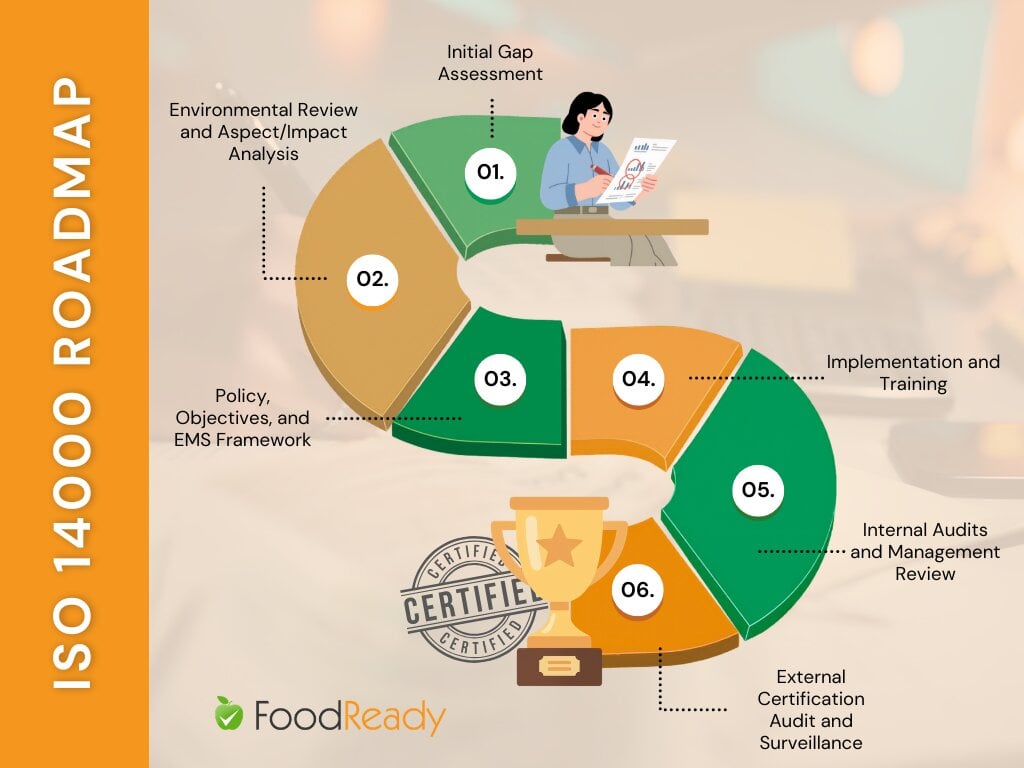
For food and beverage organizations targeting ISO 14001:2015 certification within the next 12–24 months, a structured roadmap accelerates progress while avoiding common pitfalls.
Initial Gap Assessment
Evaluate current practices against ISO 14001 clauses using internal teams, consultants, or diagnostic tools like FoodReady assessments. Document gaps, estimate resources needed, and prioritize high-impact areas. A medium-sized facility typically completes this phase in several weeks.
Environmental Review and Aspect/Impact Analysis
Compile a comprehensive inventory of processes, utilities, emissions, discharges, wastes, and resource use. Focus on high-impact areas:
- Refrigeration systems and refrigerant management
- Boilers and steam generation
- Packaging lines and material waste
- Wastewater treatment and discharge
- Chemical storage and handling
Conduct life cycle inventory analysis for key products to understand full value chain impacts.
Policy, Objectives, and EMS Framework
Draft an environmental policy reflecting company management commitment to pollution prevention, compliance, and improvement. Set 3–5 priority environmental objectives with measurable targets and timelines. Define roles, responsibilities, and documented procedures. Establish the organizational structure for EMS governance.
Implementation and Training
Integrate EMS requirements into existing production, maintenance, and sanitation routines. Train staff on environmental responsibilities and updated work instructions. Deploy software to capture monitoring data automatically where possible. Build emergency preparedness through tabletop exercises and procedure verification.
Internal Audits and Management Review
Perform at least one complete internal ISO 14001 audit cycle covering all standard clauses. Document findings, track corrective actions to closure, and hold a management review meeting to evaluate EMS effectiveness and decide on improvements before external audit.
External Certification Audit and Surveillance
Host Stage 1 (document review and readiness) and Stage 2 (on-site verification) audits with your selected accredited certification body. Address any nonconformities within specified timelines, typically 90 days for minor findings. Plan for annual surveillance audits throughout the three-year certification cycle, then recertification.
Conclusion
ISO 14000, anchored by ISO 14001:2015, provides a globally recognized framework that enables food and beverage organizations to improve environmental performance, manage risk priorities, and meet rising customer expectations. This systematic approach builds organizational capability through continual improvement cycles, delivering benefits beyond compliance. Certified companies can reduce operating costs via energy and water efficiency, strengthen their market position with sustainability-focused retailers and consumers, and align with climate goals through 2030. The standards serve as both an internal management tool and an external marker of environmental commitment.
Digital recordkeeping, traceability systems, and data analytics have transformed how organizations demonstrate environmental performance. Integrated audits covering food safety, quality, and environmental management minimize operational disruption while showcasing mature management systems to customers and regulators. This integration streamlines compliance efforts and enhances credibility, positioning certified food businesses favorably in increasingly sustainability-driven markets.
Frequently Asked Questions
Is ISO 14001 certification mandatory for food manufacturers and distributors?
ISO 14001 remains a voluntary standard without legal mandate in most jurisdictions. However, large retailers, brand owners, and international customers increasingly require or strongly prefer suppliers holding certification. Public tenders and private-label contracts in Europe, North America, and Asia often explicitly reference ISO 14001 for environmental management expectations. Even without formal certification, implementing EMS principles helps organizations meet tightening environmental regulations, support sustainable development objectives, and achieve environmental goals while reducing costs.
How long does it typically take a mid-sized food company to achieve ISO 14001 certification?
Realistic timeframes range from 6-18 months depending on starting point, number of sites, and available resources. Companies with robust existing food safety and quality management systems often progress faster by leveraging current documentation, trained auditors, and established procedures. The High Level Structure alignment between ISO 14001 and standards like ISO 9001 or SQF accelerates integration. Using platforms like FoodReady shortens implementation by standardizing documents, centralizing records, and streamlining internal audits, some organizations have reduced documentation effort by 50% or more.
Can ISO 14001 be integrated with SQF, BRCGS, or FSSC 22000 audits?
Many organizations successfully operate integrated management systems combining ISO 14001 with GFSI-recognized food safety schemes and ISO 9001 quality management. Benefits include shared procedures across systems, combined training programs, unified internal audits covering multiple standards, and fewer operational disruptions from coordinated external audits. The High Level Structure used in ISO 14001:2015 specifically facilitates this integration, with parallel clause structures and compatible requirements for documented information, competence, and management review.
What kind of data does a food company need to collect to support ISO 14001?
Typical data categories include utility consumption (electricity, natural gas, water by meter or facility), waste streams and quantities by type, emissions-related data (refrigerant top-ups, boiler stack emissions where applicable), chemical usage and disposal records, and compliance documentation (permits, inspection reports, regulatory correspondence). Process and production data (throughput, yields, scrap rates) enables normalizing environmental KPIs and demonstrating efficiency improvements over time. FoodReady automates data capture from production systems, inventory records, and connected sensors where available, replacing manual spreadsheets with real-time environmental labels dashboards.
Does ISO 14001 help with reporting on ESG and sustainability to investors or corporate owners?
A certified EMS provides the structured processes, documented controls, and traceable KPIs that ESG, CSR, and sustainability reporting demands. Alignment with ISO 14000 standards, particularly ISO 14064 for GHG inventories and ISO 14067 for product carbon footprint, supports disclosure frameworks and buyer questionnaires addressing environmental reports requirements. Having a recognized international standard in place increases confidence among investors, lenders, and corporate owners in the reliability of environmental data. The risk management discipline embedded in ISO 14001 implementation also demonstrates proactive environmental protection agency relationship management and regulatory preparedness.
Speak with our Expert Consultants
15–30 minutes. We map FoodReady to your process, plug in your real HACCP plan, and show you the auditor view before the call ends.
About the author

Anzelle Romani
Food Safety Specialist
Holds a bachelor’s degree in molecular biology and biotechnology, with concentrations in Genetics and Microbiology. Academic background includes microbial science, contamination control, and molecular processes relevant to food safety. Practical experience includes managing plant tissue culture operations in a laboratory setting, with emphasis on sterile technique, quality control, and reducing biological risks.