Key Takeaways
Food and beverage inventory management must balance product freshness, food safety, and cash flow simultaneously. Consider frozen vegetables requiring consistent sub-zero storage, ready-to-eat salads needing rapid turnover to avoid bacterial growth, or craft beverages avoiding light exposure to prevent flavor degradation. Each demands precise timing and temperature control that general inventory practices simply don’t address.
- Effective inventory management in 2026 must support FSMA 204 traceability, HACCP protocols, and third-party schemes like SQF and BRCGS while still hitting service levels and margin targets.
- FoodReady provides an AI-powered platform that unifies inventory, lot tracking, production, and food safety records for manufacturers, co-packers, and distributors.
- Real-time lot-level visibility across plants, cold storage, and 3PLs reduces waste, speeds recalls, and protects brand reputation.
- This article walks through concepts, formulas, and concrete examples that food and beverage teams can apply this quarter.
What Is Inventory Management in Food & Beverage?
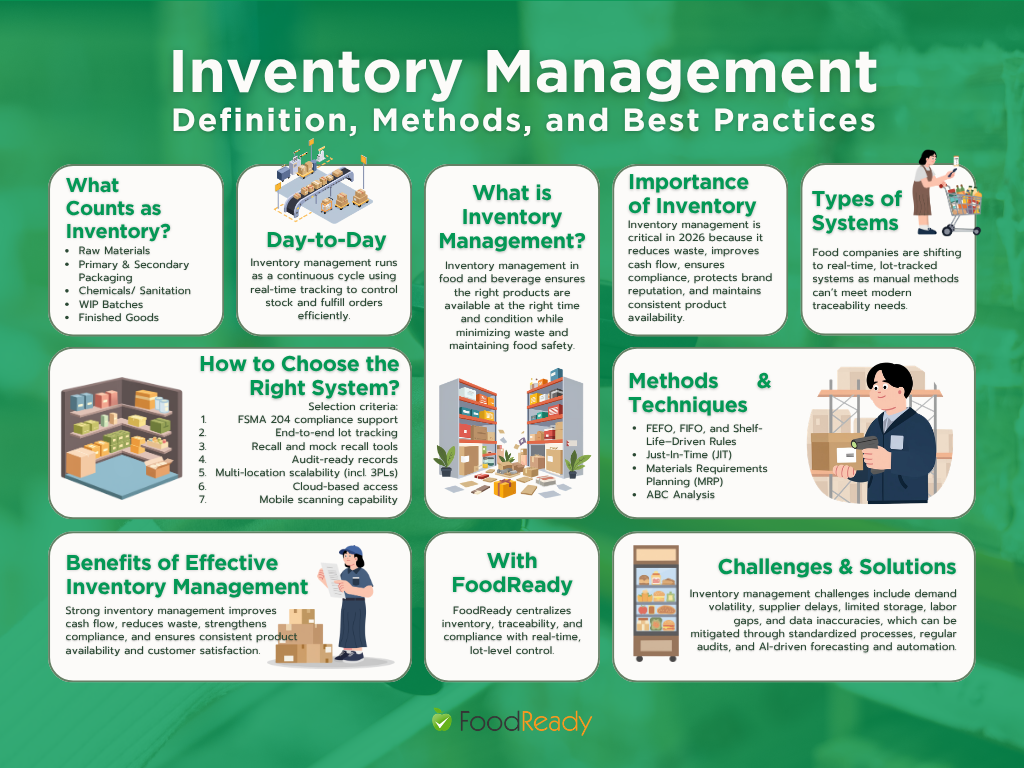
Inventory management in food and beverage centers on planning, ordering, storing, using, and selling raw materials, packaging, work-in-progress items, and finished goods, all while strictly controlling shelf life, ensuring food safety, and managing costs to prevent waste and stockouts.
Inventory spans multiple categories:
- Ingredients: USDA-inspected beef, 50 lb flour bags, spices, dairy
- Packaging: Pouches, corrugated boxes, labels
- Work-in-progress: Blended mixes, dough proofs, fermenting batches
- Finished goods: Case-packed products ready to ship
The goal is straightforward: to have the right lot in optimal condition, in the correct temperature zone, exactly when it is needed, without overproduction that creates waste or shortages that result in lost sales.
For perishable SKUs like yogurt with a 21-day shelf life, how long you hold inventory proves as critical as how much inventory you maintain. The inventory management process connects procurement, production scheduling, quality checks, and logistics seamlessly. In a mid-sized plant processing sauces, for example, systems alert on tomato paste lots nearing expiry to trigger sauce batching before quality drops.
Inventory Management Explained for Perishable and Regulated Products
Managing inventory for perishable, regulated products amplifies complexity beyond nonperishable sectors.
Mandatory temperature controls (freezers at -18°C to 0°C for meats, coolers at 0-4°C for dairy) prevent spoilage.
Contamination risks from allergens or pathogens demand segregated storage. FDA inspections add intense regulatory oversight.
The workflow links:
- Purchasing tomato paste in bulk
- Batching it into sauces during production
- Warehousing across freezer, cooler, and dry zones
- Fulfilling orders to retailers or foodservice outlets
All of this remains constrained by shelf-life rules (FEFO prioritizing the earliest expiry), allergen cross-contamination protocols, and country-of-origin labeling for imports, all of which depend on robust food traceability practices and systems.
Modern perpetual systems employ demand forecasting via AI, analyzing historical sales data and seasonality, lot tracking from supplier lot to customer shipment, and expiry alerts to dictate daily priorities. For multi-site networks, shared dashboards consolidate views across plants, co-packers, and 3PL warehouses.
What Counts as Inventory in a Food Operation?
Concrete inventory categories in food operations include:
| Cateogry | Examples |
|---|---|
| Raw materials | Spices, dairy, meat with strict cold-chain needs |
| Primary packaging | Pouches, bottles, trays |
| Secondary packaging | Corrugate, shrink wrap |
| Chemicals/sanitation | Cleaning supplies, sanitizers |
| WIP batches | Dough proofs, blended mixes |
| Finished goods | Cases, pallets ready for shipment |
From an accounting standpoint, all these count as current assets. From a food safety standpoint, they’re potential sources of risk if mishandled. Distributors track in-transit inventory and capture GPS-enabled temperature logs.
A bakery defines inventory around flour, yeast, and WIP dough with short proofs, emphasizing daily fresh bakes. A beverage company focuses on hops, bottles, and fermenting WIP, balancing shelf-stable cans alongside perishable drafts. Both apply FEFO differently depending on the type of inventory.
How Does Inventory Management Work Day-to-Day?
The inventory management work follows a continuous cycle: forecast, plan, procure, receive, produce, store, pick, ship, and review performance.
Receiving processes capture supplier information, lot numbers, Certificates of Analysis (COAs), and temperatures.
Put-away and storage rules follow FEFO or FIFO, with clear labeling for allergen and organic products using date-coded and color-coded racks.
Production consumes specific lots, creating new lot-coded finished goods and updating stock in real time via mobile apps. This lot-tracking inventory supports both inventory control and recall readiness.
Order fulfillment uses allocation logic respecting customer orders, best-by dates, and distribution lanes. Scanners or mobile devices confirm picks and update inventory records in real time, enabling teams to fulfill orders accurately and meet customer demand.
Why Is Inventory Management So Important in 2026?
U.S. food waste reaches 30-40% of supply, equating to approximately $161 billion annually in grocery and CPG channels. Much of this waste stems from poor inventory management, causing expiries, forced discounts, write-offs, and safety incidents.
Optimized inventory turnover (12-20 annually for fresh products) can slash shrink by 20-30%, boosting gross margins 2-5% and freeing cash flow for capital investments. High fill rates (95%+) and on-time in-full (OTIF) over 98% solidify retailer relationships, as measured in scorecards from chains like Walmart.
Effective inventory management directly impacts:
- Financial performance through reduced waste and improved working capital
- Compliance readiness for FDA inspections and customer audits
- Brand protection through faster recall response
- Customer satisfaction through consistent product availability
Inventory Management Methods and Techniques for Food Companies
No single method fits all SKUs. Companies often mix inventory management techniques across their portfolio, applying stricter rules to perishable and high-risk ingredients like RTE meats and dairy while using simpler approaches for shelf-stable items like sugar and salt.
Common inventory management methods include FEFO/FIFO, Just-in-Time (JIT), Materials Requirements Planning (MRP), economic order quantity, ABC analysis, and safety stock strategies, which are much easier to execute consistently with specialized food inventory software.
FEFO, FIFO, and Shelf-Life–Driven Rules
FIFO (First In, First Out) ships the oldest inventory first based on receipt date. FEFO (First Expired, First Out) prioritizes items closest to expiration regardless of receipt date.
FEFO proves critical for products with variable shelf life. A dairy plant might use FEFO for yogurt lots (21-day life) while applying FIFO for long-life UHT products (6 months).
Operational practices supporting FEFO include:
- Date coding on all items
- Color-coded rack labels by expiry week
- WMS/ERP rules enforcing FEFO during picking
- Automated alerts for lots approaching expiry
FoodReady can surface lots nearing expiry across locations so planners prioritize promotions or production runs, cutting waste by 20% or more.
JIT, MRP, and EOQ in a Food Context
Just-in-Time minimizes on-hand inventory, working well for predictable, frequent deliveries like bread or fresh herbs.
Materials Requirements Planning (MRP) plans ingredient orders and production batches based on 3-6 month rolling forecasts.
EOQ balances bulk purchasing discounts against holding costs. In food sectors, apply conservatively; expiry risk often outweighs volume discounts for perishables.
AI forecasting improves MRP accuracy by learning from seasonality, promotions, and retailer POS data, reducing both stockouts and excess inventory.
ABC Analysis and Segmentation
ABC analysis classifies inventory by value and criticality:
| Class | Characteristics | Example Items |
|---|---|---|
| A | High value/critical, 5% of SKUs, 80% of value | RTE meats, specialty proteins |
| B | Moderate value and risk | Sauces, prepared vegetables |
| C | Low value, high volume | Salt, packaging materials |
Segmentation extends to finished goods by margin, velocity, and strategic importance.
FoodReady can automate ABC classifications based on real transaction data, adjusting as product mix changes.
Types of Inventory Management Systems
Most growing food companies are moving toward perpetual, lot-aware systems that provide inventory visibility across operations.
A manual inventory system using clipboards and spreadsheets struggles with traceability under FSMA 204. Teams cannot generate full traceback reports in minutes using paper records.
A periodic inventory system with monthly or quarterly physical inventory counts can miss short-dated or fast-moving SKUs, creating gaps in inventory records.
A perpetual inventory system with barcode or RFID scanning integrates with production and quality records, providing real-time dashboards across multiple warehouses. Integration with supplier portals upstream and customer EDI downstream ensures consistent inventory data throughout complex supply chains.
What Is an Inventory Management System in a Food Operation?
An inventory management system combines processes and inventory software to track quantities, locations, lots, and status (released, on hold, blocked) of all items.
Essential food-specific features include:
- Lot and sub-lot tracking
- Expiry and shelf-life rules
- Allergen and claim flags (gluten-free, organic)
- Temperature zone mapping
- Links to HACCP plans, SOPs, and COAs
- Environmental monitoring record integration
Example dashboards might show “plant-level inventory by lot and status” or “near-expiry alert” views. Audit trails documenting who changed inventory records and when prove critical during FDA or customer audits.
Choosing the Right Inventory Management System
Selection criteria specific to food and beverage:
- Support for FSMA 204 key data elements and critical tracking events
- Lot tracking from receiving to shipment
- Recall workflows and simulation capabilities
- Validation-ready records for regulatory compliance
- Scalability for multi-location inventory management, including 3PLs and co-packers
- Cloud deployment for real-time access and disaster recovery
- Mobile scanning usability on the plant floor
FoodReady exemplifies an integrated inventory, traceability, and food safety platform designed specifically for food operations, contrasting with generic ERPs that lack food-specific lot rules and compliance features.
What Are the Benefits of Effective Inventory Management in Food & Beverage?
Strong inventory management practices link directly to financial performance, compliance readiness, and food safety outcomes.
Cash flow and working capital: Reducing excess inventory and slow-moving items frees capital. Tightening min/max levels might free $500K for equipment investments.
Waste reduction: Fewer expired lots, better yield through accurate WIP tracking, and lower damage and shrinkage. Companies report 15-25% waste reductions with proper inventory management.
Compliance and risk reduction: Faster traceability during mock and real recalls, better audit scores with GFSI auditors, and reduced regulatory exposure.
Customer satisfaction: Reliable fill rates above 95%, fewer substitutions, and more consistent product quality strengthen retailer and foodservice relationships.
Inventory Management Challenges and How to Overcome Them
Common challenges facing inventory managers include:
- Demand volatility: Holidays and promotions swing demand ±50%
- Supplier delays: 20% of deliveries arrive late
- Limited cold storage space: Physical constraints affect how much inventory you can hold
- Labor shortages: Training gaps affect data entry accuracy
- Data quality issues: 10-15% inventory record inaccuracy is common
Synchronizing inventory with co-packers and 3PLs creates visibility gaps. Managing thousands of SKUs with overlapping allergens, multiple pack sizes, and varying shelf lives compounds complexity.
Practical countermeasures include standardized receiving procedures, routine cycle counts, better master data governance, and cross-training staff. AI tools flag anomalies, improve demand forecasting accuracy, and recommend reorder quantities, helping teams shift from reactive to proactive management.
Inventory Management Technologies Shaping 2026
Modern inventory management in food relies on a technology stack rather than a single tool. Even mid-sized processors can now afford technologies that were enterprise-only five years ago due to SaaS pricing and reduced mobile hardware costs.
Barcode, RFID, and IoT for Traceable Inventory
Barcode and QR codes on ingredient totes, racks, and finished cases enable fast, accurate scanning during receiving, production, and shipping. Radio frequency identification (RFID) makes sense for pallet-level tracking in high-throughput warehouses, though tag costs (~$0.10 each) require ROI evaluation.
IoT sensors monitor cooler and freezer temperatures continuously, linking readings to specific inventory lots for audit evidence and forming part of the broader stack of key technologies in food traceability.
FoodReady can ingest data from scanners and sensors to maintain live, traceable inventory records for each lot, similar to other leading food traceability software platforms.
AI, Predictive Analytics, and Automation
AI models analyze historical orders, seasonality, promotions, and external factors to forecast demand for each SKU. Predictive analytics recommend production plans and purchase orders that reduce costs from both stockouts and overproduction.
Automation use cases include:
- Low-stock alerts triggering automated stock replenishment suggestions
- Recommended rebalancing between warehouses
- Automatic expiry and recall alerts
- Order management optimization
FoodReady combines AI forecasting with food safety and traceability data, ensuring recommendations respect shelf-life limits and regulatory constraints, not just financial optimization.
Future Trends in Food & Beverage Inventory Management
Technology, regulation, and consumer expectations continue to reshape inventory management policies and practices through 2026 and beyond.
FSMA 204 enforcement establishes expectations for near real-time traceback within 24 hours of FDA request. Systems must generate complete lot histories quickly.
Omni-channel growth expands to direct-to-consumer shipping of chilled and frozen goods, adding service inventory complexity and cold-chain coordination challenges.
Sustainability pressures drive targeted reductions in food waste through more precise production planning and inventory processes.
AI-powered, food-specific platforms like FoodReady become increasingly central to managing this complexity at scale.
How FoodReady Supports Inventory Management, Traceability, and Compliance?
FoodReady is an all-in-one platform designed specifically for food manufacturers, processors, co-packers, and distributors.
Core inventory capabilities include:
- Real-time lot-level tracking
- Expiry and FEFO management
- Multi-location visibility across plants, DCs, and 3PLs
- Integrated production and inventory records
The platform automates FSMA 204 recordkeeping, links inventory to HACCP plans and SOPs, and simplifies SQF and BRCGS audit preparation.
Companies can start with focused use cases (one plant, one product family) and expand as they see value from improved inventory management efforts.
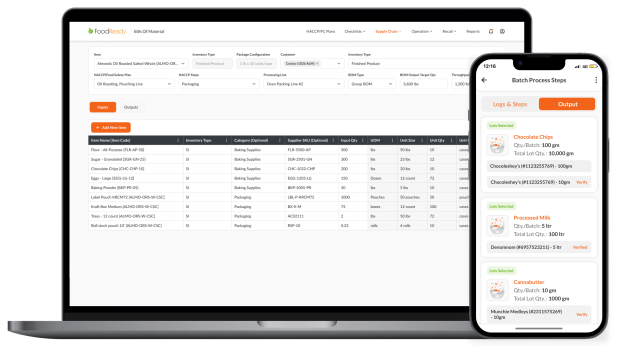
Struggling to manage inventory efficiently?
Simplify it with FoodReady today.
Frequently Asked Questions
Food and beverage inventory must account for perishability, temperature control, and strict regulatory requirements that nonperishable sectors don’t face. Shelf life, use-by dates, allergen controls, and contamination risks all influence how much to stock, storage conditions, and movement velocity. Traceability expectations under FSMA 204 force much more detailed lot-level records than typical non-food operations maintain. Because food safety incidents can trigger recalls and brand damage, the cost of poor inventory management extends well beyond simple write-offs.
FEFO (First Expired, First Out) typically works best for perishable items like dairy, fresh produce, and RTE foods, often combined with safety stock buffers and conservative lead times. Avoid pure JIT for highly perishable, critical ingredients unless suppliers are extremely reliable and alternate sources are qualified. Segment ingredients by risk and shelf life, applying stricter rules and more frequent reviews for high-risk categories. AI-based forecasting tools help balance stockout risk against expiry risk for these items.
FSMA 204 requires enhanced traceability for certain high-risk foods, demanding accurate tracking of key data elements (KDEs) at critical tracking events (CTEs), marking a new era in food traceability and safety regulation. This means capturing detailed lot, supplier, and transformation data at receiving, production, and shipping steps. Manual or spreadsheet-based systems often struggle to meet the required speed and completeness for FDA tracebacks within 24 hours. Platforms like FoodReady automate this recordkeeping and link it directly to inventory movements.
Yes. Many food companies layer specialized inventory and traceability tools on top of existing ERPs, starting with a single plant or product line. Focus first on high-risk or high-value SKUs, implementing better lot tracking, expiry management, and inventory counts. Integrations sync key data between ERP and specialized platforms like FoodReady. Incremental improvements (better receiving data, consistent FEFO rules, basic KPIs) deliver benefits even before a full system overhaul.
While annual physical counts satisfy financial reporting requirements, food producers benefit from ongoing cycle counting throughout the year. Count A-class and high-risk items weekly or monthly, with B and C items on longer cycles adjusted for shrink and expiry patterns. Regular cycle counts improve both financial accuracy and recall readiness by confirming system records match reality. Barcode or mobile scanning with an integrated inventory software system makes frequent counts practical without excessive labor.
The primary goal of inventory management is to ensure the right products are available in the right quantities at the right time. This balance prevents stockouts that disrupt operations and avoids excess inventory that increases carrying costs and waste.
The most common challenges include overstocking, stockouts, inaccurate data, and demand variability. These issues can lead to lost sales, wasted inventory, and reduced customer satisfaction if not properly managed.
Effective inventory management reduces unnecessary holding costs, minimizes waste, and improves cash flow. By optimizing stock levels, businesses can allocate resources more efficiently while maintaining product availability.
Real-time visibility allows businesses to track stock levels, locations, and movement instantly. This enables faster decision-making, more accurate forecasting, and improved order fulfillment accuracy.
Common methods include FIFO (First In, First Out), FEFO (First Expired, First Out), Just-in-Time (JIT), Materials Requirements Planning (MRP), and Economic Order Quantity (EOQ). Each method supports different operational needs depending on product type and demand patterns.
Businesses can prevent these issues by setting clear reorder points, using demand forecasting, and implementing automated inventory systems. These tools help maintain optimal stock levels and respond quickly to changes in demand.
Automation streamlines processes such as tracking, reordering, and reporting. It reduces manual errors, saves labor, and improves overall efficiency, allowing teams to focus on higher-value tasks.
Inventory should be reviewed regularly through methods like cycle counting. High-value or fast-moving items may require weekly or monthly checks, while slower-moving items can be audited less frequently.
Inventory turnover measures how often stock is sold and replaced over a period. A higher turnover rate typically indicates efficient inventory management and strong sales performance.
Modern inventory systems provide real-time data, automation, and integration with other business tools. Scalable systems allow companies to manage increasing complexity while maintaining accuracy, compliance, and operational efficiency.