
FSMA 204: A New Era of Food Traceability and Safety
Learn FSMA 204 requirements, including the Food Traceability List, CTEs, KDEs, Traceability Lot Codes, recordkeeping rules, compliance steps, and food traceability requirements.
Published:Last updated:Author:Radojka Barycki
The FDA’s Food Traceability Rule, also known as the FDA’s Food Traceability, serves as a critical regulatory framework for food safety, setting new standards for tracking and tracing high-risk foods. This rule helps us trace certain high-risk foods, giving consumers greater peace of mind about what’s on their plates.
The FDA’s enactment of the new Food Traceability Rule responds to a critical need for enhanced safety and transparency in the food supply chain. This initiative stems from a history of significant foodborne illness outbreaks in the US, which have highlighted vulnerabilities in tracking and tracing food products. Traditional methods of tracing food origins and distribution paths proved insufficient during these crises, often leading to delayed responses, widespread consumer panic, and substantial economic losses for the food industry.
The rule is part of the broader FDA Food Safety Modernization Act (FSMA), which represents a paradigm shift from reacting to food safety incidents to preventing them. As a food safety regulation, FSMA proactively addresses risks and strengthens the food safety system.
The rule’s idea is to have more detailed record-keeping and traceability for certain high-risk foods to rapidly identify and isolate the source of contamination during an outbreak, minimize public health risks, and ensure quicker, more targeted recalls. By enabling a more transparent food supply chain, the rule aims to achieve fewer foodborne illnesses and improve public health outcomes. This approach helps companies quickly trace food from farm to fork, and bolsters consumer confidence in the food supply.
Here’s what you need to know.
FSMA Rule 204 Overview
FDA’s Food Traceability Final Rule, known as FSMA Rule 204 or FSMA 204, introduces additional recordkeeping requirements for businesses that manufacture, process, pack, or hold foods listed on the FDA’s Food Traceability List (FTL). The rule’s requirements mandate that all entities in the supply chain fully implement these measures to ensure food safety and maximize public health benefits.
The requirements outlined in 21 CFR Part 1 Subpart S are designed to trace Critical Tracking Events (CTEs) in the supply chain of designated foods, including their packing,shipping,receiving, and transformation. Businesses working with FTL foods must maintain records containing Key Data Elements (KDEs) for each CTE.
Under FSMA 204,Holding is also a critical function. It refers to storage activities necessary for preserving or distributing food, such as fumigating stored foods, drying raw agricultural commodities (without converting them into processed foods), or breaking down pallets. Holding can occur in silos, tanks, warehouses, and other storage environments.
Additionally, the Commingled Raw Agricultural Commodity definition addresses produce that is grouped post-harvest but pre-processing. This excludes certain fruits and vegetables already regulated by the Produce Rule. Foods from multiple farms, or seafood from different vessels (after docking), fall under this term when mixed.
FSMA 204 Food Traceability List (FTL)
The Food Traceability List (FTL) identifies high-risk foods that require enhanced recordkeeping under FSMA 204.
These products are prioritized due to their susceptibility to contamination, ensuring a faster and more accurate food traceability process.
Here is the FSMA 204 food traceability list:
| Food Category | Included Items | Excluded Items |
|---|---|---|
| Cheeses (Soft & Semi-Soft) | Cottage, ricotta, brie, feta, mozzarella, blue cheese | Frozen or shelf-stable varieties |
| Shell Eggs | Chicken eggs in shell form | - |
| Nut Butters | Almond, cashew, peanut, and all tree nut butters | Soy or seed butters |
| Cucumbers (Fresh) | All fresh cucumber varieties | - |
| Herbs (Fresh) | Parsley, cilantro, basil | - |
| Leafy Greens (Fresh) | Arugula, kale, romaine, spinach | Whole head of cabbage, tree leaves |
| Leafy Greens (Fresh-Cut) | Single and mixed fresh-cut leafy greens | - |
| Melons (Fresh) | Cantaloupe, watermelon, all melon types | - |
| Peppers (Fresh) | All fresh pepper varieties | - |
| Sprouts (Fresh) | Alfalfa, bean sprouts, and all fresh sprouts | - |
| Tomatoes (Fresh) | All fresh tomatoes | - |
| Tropical Tree Fruits (Fresh) | Mango, guava, lychee | Bananas, citrus fruits |
| Fresh-Cut Fruits | All fresh-cut fruit varieties | - |
| Fresh-Cut Vegetables | All fresh-cut vegetables (excluding leafy greens) | Leafy greens |
| Finfish | Fresh, frozen, smoked tuna, cod, salmon, and other species | Catfish |
| Crustaceans | Shrimp, crab, lobster | - |
| Bivalve Mollusks | Oysters, clams, mussels | The scallop adductor muscle only |
| Ready-to-Eat Deli Salads | Refrigerated salads like potato, egg, and seafood salads | - |
What Are Critical Tracking Events (CTEs)?
Critical Tracking Events (CTEs) are steps in your supply chain that require businesses to track Key Data Elements (KDEs) such as dates, locations, and supplier details.
Here are examples of CTEs:
- Harvesting: Activities on farms or farm mixed-type facilities for removing and preparing raw agricultural commodities (RACs) for food use.
- Cooling:Active temperature reduction processes like hydro cooling or vacuum cooling for RACs.
- Initial Packing:First-time packing of an RAC, excluding foods from fishing vessels.
- First Land-Based Receiver:The first entity taking possession of food from a fishing vessel on land.
- Shipping:Arranging the transport of food from one location to another, excluding direct consumer sales or food donations.
- Receiving:Taking possession of food after transport, including intracompany shipments.
- Transformation:The process of changing an FTL food through its package, label, combining ingredients, or processing. This does not include single-ingredient packaged foods.
A Fishing Vessel is any watercraft used for fishing or supporting fishing activities, such as catch storage, equipment supply, or processing, under the Magnuson-Stevens Act.
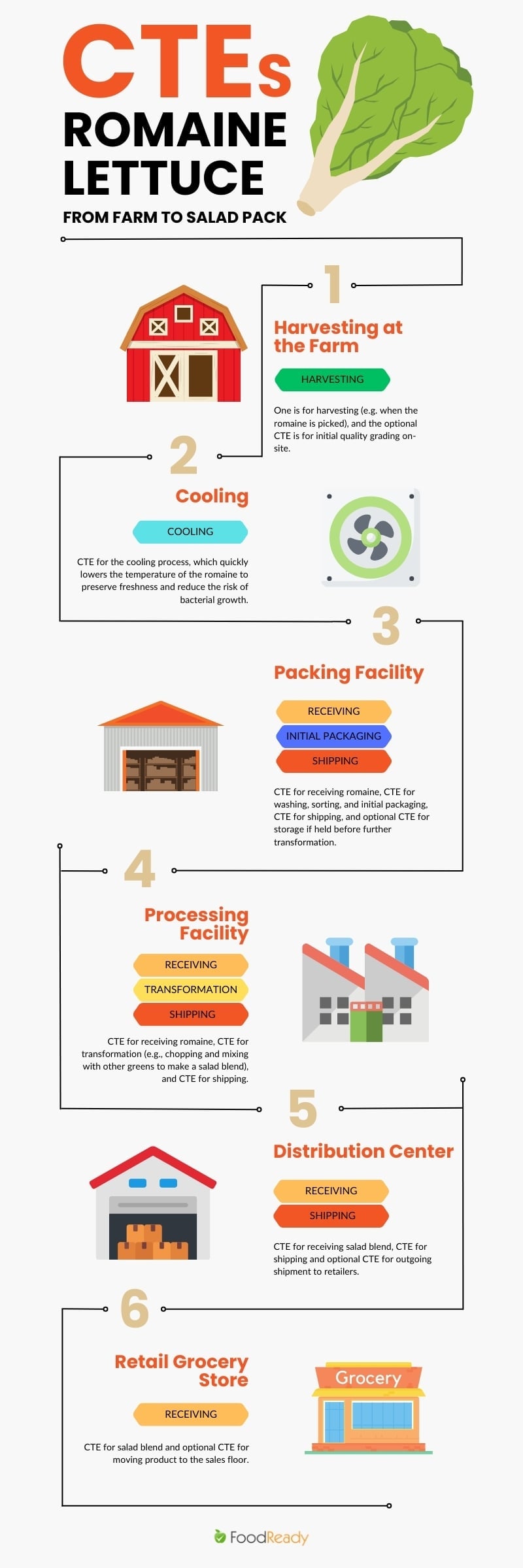
This infographic shows a clear example of how CTEs are tracked for romaine lettuce across the food supply chain.
Traceability Lot Code (TLC)
Businesses must assign a unique Traceability Lot Code (TLC) to FTL foods during initial packing, first land-based receiving, or transformation. This code, often alphanumeric, ensures traceability throughout the supply chain.
The Traceability Lot Code Source refers to the specific location where this code is assigned. Usually at the point of first packing, first land reception, or transformation.
How To Create a Traceability Lot Code System?
Your company does not have to assign a TLC in a specific way. It can be any kind within your Food Traceability Plan, such as a randomly generated number.
To develop a strong TLC system, you need to:
- Create a consistent and unique format
- Automate code generation with software
- Link TLCs to Key Data Elements (KDEs)
- Integrate with supply chain partners
- Audit your system for compliance and efficiency.
Traceability Plan
Entities subject to this rule must establish and maintain a traceability plan detailing:
- Recordkeeping procedures, including format and location of records.
- Methods to identify FTL foods and assign TLCs.
- A point of contact for traceability-related queries.
- For farms, a detailed farm map indicating the growing or raising areas, including geographic coordinates.
To develop and implement an FTP that complies with the Food Traceability Rule, businesses covered by the rule should follow these steps:
- Understand the Rule: Ensure a thorough understanding of the Food Traceability Rule, its requirements, and how it applies to your products and operations.
- Identify Foods on the Food Traceability List (FTL): Create a list of all the foods you manufacture, process, pack, or hold that are on the FTL. Implement procedures for consistently identifying these foods in your inventory and records.
- Record-Keeping Procedures: Decide on a digital or paper-based record-keeping system. Digital systems are often more efficient and easier to search. Keep records in a secure location with access controls to protect confidential information Establish routine procedures for updating records, including the frequency of updates and personnel responsibilities. Ensure that all relevant staff are trained in these procedures.
- Traceability Lot Codes: Create a system for assigning unique traceability lot codes to each batch of food on the FTL. This could be based on production dates, batches, or other distinguishing information. Document the method used for assigning lot codes and how they can be used to trace a product through the supply chain.
- Point of Contact: Designate a person or a team responsible for traceability and assign a general contact title such as "Traceability Coordinator" along with a phone number. Make sure the point of contact information is readily available to all stakeholders and regulatory bodies.
- Farm Map: For producers, create a detailed map of the farm showing the location and name of each field or growing area, including geographic coordinates. The map should include identifiers for each field or container used in aquaculture, like ponds or tanks. Add any relevant details that would aid in identifying the specific locations, such as landmarks or adjacent roads.
- Update and Review: Schedule periodic reviews of the FTP to ensure it remains accurate and reflects current practices. Update the FTP whenever there are changes in processes, products, or regulations that affect your traceability system.
- Retention of Records: Keep a copy of the previous traceability plan for at least two years after any update. Ensure that archived plans can be accessed if needed for regulatory compliance or audits.
- Implementation: Train all relevant staff on their roles within the FTP. Run traceability exercises to test the effectiveness of the plan. Integrate the FTP with other business systems such as inventory management or quality assurance programs.
- Technology Utilization: Consider investing in food traceability software that can streamline the record-keeping and lot tracking process. Use data from the traceability system for continuous improvement and risk management.
- Compliance and Verification: Engage with third-party auditors to verify compliance with the FTP. Stay informed about changes to regulations that may affect your FTP.
By following these steps and ensuring that the FTP is a living document that adapts to changes in your business and the regulatory landscape, you can maintain compliance with the Food Traceability Rule and ensure food safety throughout your supply chain.
Additional Data & Reference Documentation
- Records must be original, legible, and well-preserved, with electronic records having valid links.
- Upon the FDA’s request, records and an electronic sortable spreadsheet with traceability information must be provided within 24 hours or a reasonable time agreed upon.
- Key Data Elements (KDEs): Time, location, product description, supplier information, etc.
- Reference Document: Bills of lading, invoices, production logs, catch certificates, etc.
- Reference Document Number: A unique identifier used to cross-link documents with KDEs
- Product Description: Name, brand, size, variety, packaging format. And when applicable, fish species or market name
Purpose and Benefits of the FDA Traceability Rule
I will highlight 3 key benefits of the traceability rule that our clients often highlight. Those are:
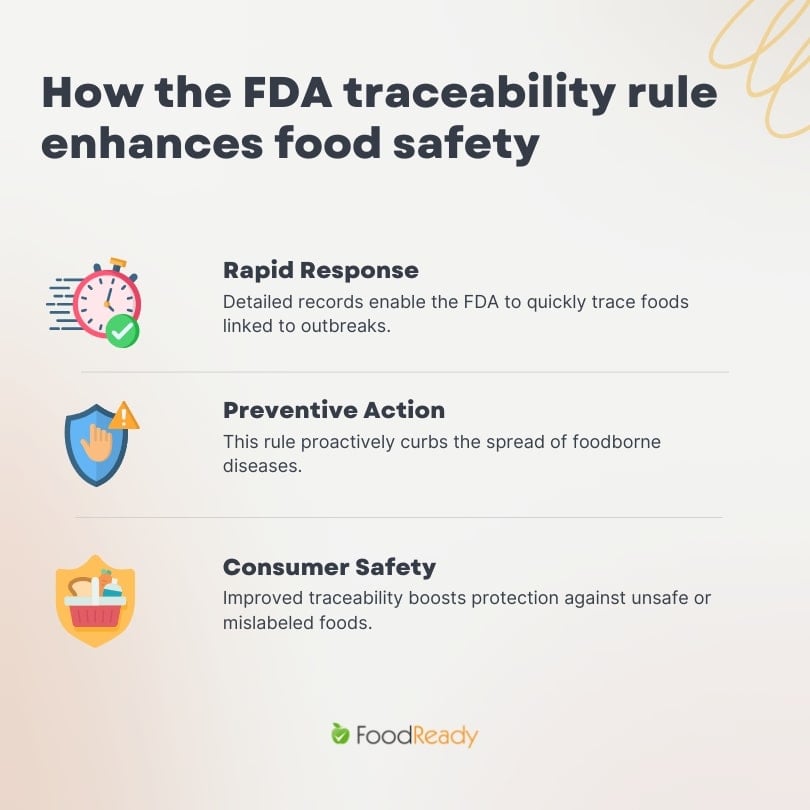
- Rapid Response: The FDA can swiftly pinpoint food recipients involved in illness outbreaks using detailed reports.
- Preventive Measure: The rule is a proactive approach to prevent or mitigate the spread of foodborne diseases.
- Consumer Safety: Enhanced traceability helps protect consumers from health risks posed by adulterated or misbranded foods.
Implementing traceability solutions across the food supply chain is essential for realizing these benefits, as they enable compliance, data accuracy, and transparency at every stage.
The Broad Benefits of Enhanced Traceability
Beyond meeting FSMA 204 expectations, stronger traceability systems can improve day-to-day performance across the operation. When key data is captured consistently and can be retrieved quickly, businesses often see benefits that go well beyond compliance:
- Improved Quality Metrics: Better traceability enables tighter process control and faster root-cause analysis, helping protect product quality and reinforcing consumer trust.
- Optimized Transportation and Logistics: More reliable product movement and milestone visibility can reduce delays, limit spoilage, and improve coordination across shipping and receiving.
- Cost Reduction: Faster investigations and more targeted actions can reduce the cost of recalls, rework, and unnecessary product holds.
- Waste Reduction: Accurate tracking helps prevent misshipments, expired items, and other avoidable losses, supporting more sustainable practices.
- New Market Opportunities: Demonstrating strong traceability and compliance readiness can support customer requirements and open doors to new markets.
Compliance Date for the Food Traceability Rule
The FDA originally set the compliance deadline for the Food Traceability Rule for January 20, 2026. Recognizing the challenges businesses face,the agency now proposes extending the deadline to July 20, 2028.
This gives the food industry more time to strengthen traceability systems and better protect consumers from foodborne risks.
FSMA 204 Requirements by Operator Type
FSMA Rule 204 applies throughout the food supply chain. Below is a breakdown of what each operator type must do. Every operator is also required to establish and maintain a Traceability Plan that details recordkeeping procedures, FTL food identification methods, and a designated traceability contact.
Farms (Harvesting CTE)
A farm is a place where crops are grown, animals are raised, or both, all under one management. It does not need to be one connected area.
Farms growing FTL foods must document the Harvesting CTE. Harvesting covers all activities traditionally conducted on farms to remove raw agricultural commodities from their growing or raising location and prepare them for consumption.
Required KDEs for Farms:
- Name of the field or animal raising area (corresponding to the grower’s name for it), or equivalent location identifier
- For aquaculture: name of the container (pond, pool, tank, cage) from which food was harvested
- Location and description of the immediate subsequent recipient (other than a transporter)
- Commodity and, if applicable, variety of the food
- Quantity and unit of measure
- Location from which the food was harvested
- Date of harvesting
- Reference document type and reference document number
Farms must also collaborate with First Packers of RACs to assign Traceability Lot Codes.
Confidentiality Measures:To protect supplier information, shippers may provide a TLC source “reference” (such as an FDA Food Facility Registration number or web address) instead of directly identifying the source.
Best Practices for Farms:
- Maintain farm maps with geographic coordinates of all growing areas
- Use digital tools (barcodes, RFID) to record harvest data in real time
- Standardize data collection formats to share information efficiently with initial packers
- Train all harvest staff on KDE requirements and the significance of accurate documentation
Cooling Operations (Cooling CTE)
Cooling is the active temperature reduction of a RAC using hydrocooling, icing (except seafood icing), forced air cooling, vacuum cooling, or a similar process before initial packing.
Effective cooling prevents pathogen growth and preserves product integrity. Cooling operations handling FTL foods must document the Cooling CTE and coordinate closely with initial packers.
Required KDEs for Cooling:
- Time and duration of the cooling process (start and end)
- Temperature details recorded at regular intervals
- Cooling method used (equipment and technique)
- Location where cooling took place
- Identification of personnel responsible for cooling
Coolers must also work with First Packers of RACs to ensure Traceability Lot Codes are properly assigned and linked to their cooling records.
Best Practices for Cooling:
- Implement precise temperature monitoring and control mechanisms
- Maintain detailed, timestamped logs of every cooling activity
- Perform regular calibration of all cooling equipment (at minimum annually, or per manufacturer guidelines)
- Conduct regular staff training on FSMA 204 cooling documentation requirements
- Coordinate upstream (with farms) and downstream (with initial packers) to ensure seamless data handoff
First Packers of Raw Agricultural Commodities (Initial Packing CTE)
The First Packer of RACs is the entity that packs a raw agricultural commodity, other than food from a fishing vessel, for the first time. This is one of the most pivotal roles in the supply chain because the packed product is typically the first form of food to carry a production code, making it critical for downstream traceability.
Required KDEs for First Packers:
- Commodity and variety of the food received
- Date the initial packer received the food
- Quantity and unit of measure of the received food
- Location description for the person from whom the food was received
- Traceability Lot Code assigned by the initial packer
- Product description of the packed food
- Quantity and unit of measure of the packed food
- Location description for where the food was initially packed
Additional Requirements for Sprouts:First packers of sprouts must also record:
- Location description for the grower of seeds for sprouting and date of seed harvesting (if available)
- Location and associated lot code for the seed conditioner or processor, and date of conditioning or processing
- Location and associated lot codes for the seed packinghouse, date of packing, and any repacking details
- Location and lot codes for the seed supplier, including master and sub-lot codes
- Description of seeds (seed type, taxonomic name, growing specifications, packaging, antimicrobial treatment)
- Date of receipt of seeds by the sprouter
Note:First packers must receive key data from harvesters and coolers, including farm of origin, harvest date, and cooling details, to shorten traceback timelines.
Best Practices for First Packers:
- Implement digital record-keeping systems capable of capturing and sharing all required KDEs
- Build clear communication channels with harvesters and coolers so data arrives promptly and accurately
- Use barcode scanning, RFID, or blockchain to streamline lot code assignment and management
- Conduct regular audits to identify gaps in data capture or handoff
- Maintain records for a minimum of two years as required by FDA
First Land-Based Receivers (First Land-Based Receiver CTE)
A First Land-Based Receiver is the person or entity taking possession of a food for the first time on land, directly from a fishing vessel. This is a distinct CTE that applies exclusively to the seafood supply chain and is the seafood equivalent of Initial Packing for land-grown commodities.
The First Land Receiver is responsible for assigning the Traceability Lot Code to the seafood at the point it comes ashore, making this role the critical traceability entry point for all fish and shellfish on the FTL.
Required KDEs for First Land-Based Receivers:
- Traceability Lot Code assigned by the First Land Receiver
- Species and/or acceptable market name for unpackaged food, or product description for packaged food
- Quantity and unit of measure of the food
- Harvest date range and locations for the trip during which the food was caught
- Location description for the first land-based receiver (i.e., the TLC source), and if applicable, the TLC source reference
- Date the food was landed
- Reference document type and reference document number
Best Practices for First Land-Based Receivers:
- Use electronic record-keeping systems to capture vessel trip data, species, harvest locations, and landing dates accurately at the dock
- Implement quality control checks at the point of data entry because errors there propagate through the entire downstream supply chain.
- Train all receiving staff on the specific KDEs required for seafood versus land-based commodities, as the requirements differ meaningfully
- Conduct regular audits of traceability records to confirm harvest location data and lot codes are correctly linked
- Collaborate closely with downstream recipients (processors, distributors) to ensure TLCs are passed forward accurately and referenced in all subsequent records
Processors (Transformation CTE)
Processors fall under the Transformation CTE, which covers manufacturing or processing foods, or altering them or their packaging, when the end product is on the FTL. Transformation explicitly excludes initial packing and activities preceding it (harvesting or cooling).
Important:Repacking or repackaging as part of breaking down a master case is considered transformation.
Required KDEs for Processors:
For food used as ingredients:
- Product description for the food to which the TLC applies
- For each traceability lot used: quantity and unit of measure consumed from that lot
For new foods produced:
- Location description for where the food was transformed (the TLC source) and, if applicable, the TLC source reference
- Date transformation was complete
- Product description of the new food
- Quantity and unit of measure of the new food
- Reference document type and reference document number
Processors must assign Traceability Lot Codes to both the input ingredients and the resulting food products.
Best Practices for Processors:
- Implement a robust, consistent system for assigning TLCs to ingredients and finished products
- Document every transformation step, linking it to the appropriate TLC and reference documents
- Leverage traceability software or ERP systems to automate and validate data capture
- Train production staff on lot code management and the consequences of gaps in documentation
- Develop an emergency response plan to quickly isolate and trace affected products in the event of a safety issue
Distributors (Shipping & Receiving CTEs)
Distributors conduct both Receiving and Shipping of FTL foods, both of which are CTEs under FSMA 204.
- Receiving is the act of acquiring a food product at a location following its transportation from a different place, including intracompany transfers between different street addresses.
- Shipping is the preparation and transport of food from one location to another, including intracompany transfers, but excluding direct consumer sales, consumer shipments, and food donations.
Required KDEs for Receiving FTL Foods
- Traceability Lot Code for the food
- Quantity and unit of measure
- Product description
- Location description for the immediate subsequent recipient (other than a transporter)
- Location description for where the food was received from
- Date of receipt
- Location description for the TLC source or TLC source reference
- Reference document type and reference document number
Note: Does not apply to receipt before initial packing of a RAC not from a fishing vessel, or receipt by the first land-based receiver of food from a fishing vessel.
Required KDEs for Receiving Food Exempt from the Rule
- TLC for the food, which must be assigned by the distributor if it has not already been assigned and does not apply to RFEs or restaurants
- Quantity and unit of measure
- Product description
- Location description for the immediate previous source (other than a transporter)
- Location description for where the food was received (TLC source) and TLC source reference (if applicable)
- Date received
- Reference document type and reference document number
Required KDEs for Shipping
- Traceability Lot Code for the food
- Quantity and unit of measure
- Product description
- Location description for the immediate subsequent recipient (other than a transporter)
- Location description for where the food was shipped from
- Date shipped
- Location description for the TLC source or TLC source reference
- Reference document type and reference document number
Note: Does not apply to shipment before initial packing of a RAC not from a fishing vessel.
Best Practices for Distributors:
- Maintain records that are easily retrievable, auditable, and capture the food’s full journey from origin to destination
- Digitize records and use systematic filing to ensure rapid access during a food safety investigation
- Integrate RFID, barcode scanning, or blockchain to improve real-time tracking accuracy
- Conduct annual or biannual compliance audits covering both records and recordkeeping processes
- Train staff to identify and report discrepancies and stay current with regulatory changes
Retailers (Receiving CTE)
Retailers are primarily subject to Receiving CTE requirements. They must collect and maintain key documentation on FTL foods sold or used at their locations, ensuring a clear traceability path for rapid response to safety incidents.
Required KDEs Provided by Shippers and Kept by Retailers:
- Traceability Lot Code for the food
- Quantity and unit of measure
- Product description
- Location description for the immediate subsequent recipient (other than a transporter)
- Location description for the location from which the food was shipped
- Date the food was shipped
- Location description for the TLC source or the TLC source reference
Best Practices for Retailers:
- Maintain meticulous records of TLCs, quantities, product descriptions, shipping dates, and locations for all high-risk foods
- Invest in tracking and reporting software that can manage and retrieve traceability data quickly during a recall
- Develop and regularly update a recall plan: clear steps for identifying, isolating, and managing recalled products, including communication protocols with customers and regulators
- Work closely with suppliers to verify their FSMA 204 compliance and ensure data passed downstream is complete and accurate
- Regularly train staff on traceability requirements and proper handling of food safety incidents
The Impact of FSMA 204 on Small Businesses
Recognizing the diverse landscape of the food industry, the FDA has also released a Small Entity Compliance Guide.
It helps small businesses understand their obligations and identify exemptions or modified requirements based on factors like revenue, product type, or risk category.
The Impact on the Food Industry Association
The food traceability rule brings significant changes for the food industry association and its members, especially those handling high-risk foods. Companies must now implement new recordkeeping systems and procedures to comply with the rule’s requirements, which can involve substantial investments of time and resources. However, these changes also present opportunities to improve supply chain management, reduce the likelihood of food safety incidents, and enhance overall food safety.
The food industry association has recognized the importance of the traceability rule in protecting public health and has expressed support for its goals. By adopting more advanced traceability and recordkeeping systems, companies can not only meet regulatory requirements but also strengthen consumer trust and improve their ability to respond to food safety challenges.
The Role of GS1 in FSMA 204 Compliance
GS1 standards help make food traceability systems interoperable and scalable by providing a universal framework for data exchange and traceability. This helps food manufacturers achieve FSMA 204 compliance.
GS1 standards will allow companies to capture and share Key Data Elements (KDEs) at Critical Tracking Events (CTEs), which is vital for efficient traceability rule implementation.
GS1 makes using barcodes and RFID tags easier, streamlining data collection and improving traceability efficiency. Adhering to these standards and technologies enhances supply chain transparency.
This means you will respond to recalls faster and demonstrate a proactive approach to food safety.
The Role of Food Technologists
Food technologists are at the forefront of implementing the food traceability rule within the food industry. Their expertise is essential in developing and maintaining recordkeeping systems that accurately capture key data elements at every critical tracking event. Food technologists work closely with supply chain partners to ensure that traceability information is consistently recorded and easily accessible, supporting a transparent and efficient food supply chain.
Staying informed about the latest advancements in food traceability technologies and regulatory requirements is also a key part of their role. By leading the way in adopting best practices and innovative solutions, food technologists help reduce the risk of foodborne illnesses and play a vital part in protecting public health and ensuring compliance with the traceability rule.
Addressing the Challenges for Food Businesses Figuring Out Next Steps
FSMA 204 readiness can feel straightforward in theory and difficult in practice, especially for manufacturers, processors, and distributors that do not qualify for exemptions.
Many teams are still relying on paper records or spreadsheets, which can be time-consuming to maintain and hard to scale across multiple products, locations, and trading partners. Food service and mixed-model businesses can face similar constraints, needing new processes without adding significant headcount.
This is why many organizations focus on building a traceability approach that is both practical and scalable: one that supports compliance while fitting the real constraints of time, budget, and staffing.
What Are the Challenges of FSMA 204 Implementation?
The food traceability rule is demanding and can be challenging. The first challenge is understanding the rule requirements, CTEs, and KDEs.
In addition, companies that use outdated data management systems need to transition to a modern record-keeping framework, which can involve time, training, and extra cost.
Regarding expenses, FSMA 204 implementation costs can be high and become an obstacle for smaller companies with tight budgets.
It's also challenging to ensure interoperability across the supply chain and coordinate supply chain partners so everyone is aligned. Global supply chains are complex, making it more difficult to manage traceability.
Another hidden obstacle is resistance to change when working on FSMA compliance—employees may see it as a burden.
It's not only a food manufacturer who finds inconveniences when trying to implement the rule. Indeed, the requirements can be hard to follow, and they are widely discussed in the food industry.
Last spring, the Reagan-Udall Foundation conducted a series of roundtable discussions, based on which they resealed a report.
They mentioned concerns about the final rule, such as a low awareness level, lack of traceability lot codes and labeling standardization, lack of warehouse management capabilities, implementation schedule, etc.
FSMA compliance challenges are recognized, and leading organizations strive to help businesses grow awareness and improve compliance. Eight leading organizations, including GS1 US, the Food Industry Association (FMI), the Association of Food & Drug Officials (AFDO), the Institute of Food Technologists (IFT), and others, formed a collaboration to tackle the food Industry's FSMA rule 204 challenges.
To avoid issues and overcome the implementation obstacles, you can address professionals who will guide you through the process and alleviate the hustle.
The FSMA 204 Readiness Roadmap: A Tailored Approach
A workable readiness plan is less about “doing everything at once” and more about sequencing the right actions in the right order, so teams can close gaps methodically and build habits that stick. FoodReady’s FSMA 204 Readiness Roadmap is designed as a structured “Who, What, Where, When, and How” approach to help teams identify gaps, determine what must change, and implement the processes needed for compliance.
Important note on timing: The FDA originally set a compliance date of January 20, 2026, and has also proposed extending the compliance date to July 20, 2028. A readiness roadmap should be built to meet current requirements while remaining flexible if timelines change.
Gap Assessment and Risk Assessment
A significant step to FSMA 204 compliance is identifying your current state and conducting a gap assessment.
Evaluate your existing processes, systems, and supply chain workflows to identify where your efforts fall short and find improvement areas. It involves analyzing traceability workflows, data collection methods, and overall compliance readiness.
Conducting a risk assessment can also reveal potential vulnerabilities in your food traceability system. These insights will help you determine the technologies, tools, and resources needed to meet FSMA 204 requirements effectively.
Analyze Your Supply Chain
The supply chain is one of the main heroes in your food traceability compliance journey. You should map out your supply chain, identifying each stage and every moment where the product changes hands.
This is how you identify responsible workers, avoid blind spots, and ensure supply chain transparency. Collaboration with supply chain partners is also essential, as this is how you can ensure your suppliers, distributors, or retailers adhere to the procedures.
By fostering open communication and aligning processes, expectations, and data-sharing protocols, you create a unified approach to traceability.
Structured and Scheduled Task Management
A strong readiness journey is a series of clear, trackable steps:
- Create an FSMA 204 Compliance Team: Define owners for traceability, receiving/shipping, QA, IT/systems, and supplier/customer coordination, so responsibilities don’t fall through the cracks.
- Clarify Implementation Scope: Confirm which products, facilities, and supply chain nodes are in scope and what data must be captured at each point.
- Assess Traceability and Data Compatibility: Evaluate current recordkeeping and whether required data elements can be captured consistently and shared across internal systems and trading partners.
- Internal Gap Assessment: Compare current practices against FSMA 204 expectations to identify missing data, weak handoffs, and process breakdowns.
- Implementation Plan: Create a realistic rollout plan,such as process updates, data capture methods, training, validation, and internal checks.
- Assign and Track Tasks: Break work into manageable tasks (procedures, forms, system setup, training, verification), assign owners, and track completion so progress is measurable and auditable.
Train a Team
Proper team training is necessary for a smooth transition and efficient traceability systems. Your employees must follow new procedures to ensure compliance by using technology and maintaining records, so you should provide their confidence in their day-to-day responsibilities.
You can start with the basics and move on to practical tasks like managing traceability lot codes and recordkeeping.
Don't hesitate to invest in professional training or a FSMA 204 consultant to guide you and your workers through implementing a traceability rule.
Standardize Your Processes With SOPs
Standard Operating Procedures are vital for guaranteeing consistency in FSMA 204 rule implementation. You will be sure that your workers follow established procedures, minimizing errors or miscommunication.
For instance, you can make written guidelines on managing critical tracking events (CTEs) and recording key data elements (KDEs), Traceability Lot Code (TLC) creation, handling recalls, etc.
Mock Recalls
Mock recalls are simulated recall exercises that help you test the effectiveness of your food traceability system and compliance efforts. The rule does not mandate them, but mock recalls are strongly recommended as a best practice.
This approach will allow you to evaluate how well you can trace products through the supply chain, identify potential issues, and address process gaps. You will also be able to validate that CTEs and KDEs are well-recorded and accessible.
Mock recalls will reveal the quality of communication between internal teams and supply chain partners. Moreover, they are a great way to reassure yourself that you are well prepared for supply chain discrepancies and can protect customers and your brand reputation in case of an issue.
Continuous Improvement: Maintaining FSMA 204 Compliance
Compliance with the FSMA 204 rule is not a one-time task. You must continuously monitor and update your food production to meet regulatory requirements.
Regular process reviews will help you identify gaps in data collection, inefficiencies, or significant supply chain changes. For instance, you should audit your CTEs and KDEs' performance to ensure they are correctly recorded and easily accessible.
Continuous improvement is crucial when your business scales, regulations change, or technologies emerge. Consistent updates also build a more resilient and interoperable food safety system.
Action Steps for FSMA 204 Compliance
I invite you to explore our detailed guide on complying with the food traceability rule. The guide is packed with practical insights to help you navigate each step with confidence
We can summarize the process into three key steps as listed below:
1. Review the Food Traceability List (FTL)
Examine the FDA’s Food Traceability List to determine whether any of your products are included. The list identifies specific foods that require additional traceability records under FSMA 204. Examples include soft cheeses, leafy greens, tomatoes, nut butters, and deli salads. If your company handles these foods in any capacity, such as manufacturing, processing, packing, or holding, you are subject to the rule.
2. Understand Recordkeeping Requirements for Critical Tracking Events (CTEs)
Identify which Critical Tracking Events apply to your operation: growing, receiving, transformation, creation, and shipping. For each CTE, the rule requires you to record specific Key Data Elements (KDEs), such as lot codes, product descriptions, quantities, unit measurements, and the locations and dates of events. Review how each KDE maps to your supply chain activities and verify that the data can be recorded and retrieved as required.
3. Adjust Traceability and Recordkeeping Systems
Assess your existing inventory and traceability systems for compliance with FSMA 204. Update data collection processes, standard operating procedures, and staff training as needed. Ensure your systems can record all required KDEs for each applicable CTE and generate sortable electronic records that can be provided to the FDA within 24 hours upon request.
Leveraging Technology for FSMA 204 Compliance
Achieving FSMA 204 compliance requires effective, streamlined FSMA 204 software, and that’s where FoodReady excels. Our cloud-based platform integrates advanced traceability, reporting, and inventory management tools, helping businesses efficiently align with FDA requirements.
FoodReady’s technology enables companies to track Critical Tracking Events (CTEs) and Key Data Elements (KDEs) across the supply chain, from supplier management to product recall processes. With features like mock recall exercises, automated supplier documentation, and customizable HACCP and SOP checklists, food traceability software simplifies compliance tasks while enhancing operational control.
Are you FSMA 204 Compliant?
Book a free consultation with our FSMA 204 experts and see how FoodReady can simplify traceability for your business.

Track & Trace
| Name | Item SKU | Lot Code | Date | Location |
|---|---|---|---|---|
| Active | ||||
| Pending | ||||
| Review | ||||
| Published | ||||
| Draft |
Wrap-up
The FDA’s Food Traceability Rule marks a significant stride in food safety. It underscores the importance of transparency and accountability in the food supply chain. As the industry adapts to these changes, we can expect to see a more robust and resilient food system, ultimately benefiting both businesses and consumers.
If you operate in the food industry, FSMA Rule 204 is an opportunity to enhance food safety and consumer trust. Let’s embrace these changes for a healthier future!
Need help?FoodReady’s FSMA 204 Consultants simplify compliance with tailored strategies, training, and digital tools.
Frequently Asked Questions
Who is exempt from FSMA 204?
There are certain small farms and certain produce growers that are not subject to FSMA 204; however, it is complicated, and it is best to read this document.
What are the first steps a business should take to comply with the new FDA Traceability Rule?
Begin by reviewing the FDA’s Food Traceability List to identify if your products are covered under the new rule. Next, understand the requirements for recording Critical Tracking Events and Key Data Elements associated with your products. Finally, assess your current traceability system to identify necessary adjustments to meet the new regulations.
What is the purpose of assigning a Traceability Lot Code (TLC), and how is it used?
A Traceability Lot Code (TLC) is assigned to identify foods on the Food Traceability List during critical handling stages, such as initial packing or transformation. This unique identifier enables precise tracking of food products through the supply chain, facilitating quick identification and action in the event of a food safety concern.
What are the best practices for managing reference documents?
Digitize documents, use standardized formats, and perform regular audits to maintain traceability and facilitate FDA reporting.
How does the FSMA traceability rule affect international food suppliers?
International food suppliers exporting to the United States must also comply with the FSMA traceability requirements if they deal with foods on the FTL. This means maintaining adequate records of KDEs for CTEs and ensuring their traceability systems can provide necessary information in an electronic, sortable format upon request by the FDA. Compliance is crucial for maintaining access to the U.S. market and avoiding import refusals or other restrictions.
How does FSMA Rule 204 define a “hostile act?”
FSMA Rule 204 defines a hostile act as intentional contamination of food that causes widespread harm to people, animals, or the environment.
What are the penalties for non-compliance with FSMA 204?
Violating FSMA 204's recordkeeping requirements (excluding farms) is a prohibited act under section 301(e) of the FD&C Act. FDA typically seeks voluntary compliance first, issuing advisory or warning letters. If noncompliance persists, federal civil or criminal actions may be pursued. The FDA lacks the authority to impose fines.
How often will the food traceability list be updated?
The FDA plans to update the FTL every five years.
What if my suppliers don't comply with the FSMA 204 rule?
Communicate with your suppliers and try to align with them. In a worst-case scenario, if your suppliers violate the food traceability rule, consider finding new suppliers to avoid regulatory penalties. However, this can be an extra challenge, as it may not be practical or cost-effective.
Do restaurants fall under the FSMA 204 final rule?
Yes, the food traceability rule covers restaurants, and they must keep traceability of certain food items. However, there are some exemptions. For instance, the rule does not regulate small restaurants whose average annual monetary value of food sold or provided during the previous 3-year period is less than $250,000.
What are the key benefits of digital over paper-based record-keeping?
Digital record-keeping systems offer greater efficiency and ease in searching and updating records, alongside improved security features like access controls, which are crucial for protecting sensitive data and ensuring compliance.
How can smaller entities manage compliance costs?
Smaller entities can manage compliance costs by leveraging shared resources and technologies, engaging in cooperative agreements with similar small operations to share the burden of technological investments, and seeking government or industry grants available for compliance upgrades.
What steps should be taken when a food safety incident occurs?
Immediately initiate the traceability protocol to identify and isolate the product batch involved. Inform all affected stakeholders, recall implicated products if necessary, and cooperate fully with regulatory authorities to resolve the issue promptly and prevent future occurrences.
How often should a Food Traceability Plan be reviewed?
A Food Traceability Plan should be reviewed at least annually or whenever there are significant changes to production processes, product lines, or regulatory requirements, to ensure that the plan remains effective and compliant with current standards.
What are the best practices for training staff on a new FTP?
Best practices include conducting comprehensive training sessions that cover all aspects of the FTP, regular drills to test understanding and readiness, updates on any changes to the plan, and ensuring that all new employees receive training as part of their onboarding process.
Speak with our Expert Consultants
15–30 minutes. We map FoodReady to your process, plug in your real HACCP plan, and show you the auditor view before the call ends.
About the author

Radojka Barycki
Certification Manager, ISO 9001 & RSPO
Radojka Barycki is a food safety and quality leader with 27 years of experience across food manufacturing, certification, and consulting. She is Certification Manager for ISO 9001 and RSPO at AIB International, an FSPCA Preventive Controls for Human Food Lead Instructor, and a BRCGS Approved Training Partner. She previously led food safety training at SCS Global Services and held quality roles at PepsiCo, where she earned a Portfolio Plant of the Year Award, and The Coca-Cola Company.