Your food safety program is only as strong as the suppliers feeding into it. That is not a comfortable truth for a lot of food manufacturers, but it is an accurate one. A single supplier sending an ingredient with an undeclared allergen, an expired certificate of analysis, or a contamination issue that was never caught at source can undo months of careful compliance work inside your own facility. When something goes wrong, regulators do not accept “our supplier did not tell us” as a defense.
Supplier quality management, or SQM, is the system that prevents that from happening. It is how food manufacturers verify, monitor, and maintain the quality and compliance of every ingredient, material, and service coming into their operation. Get it right and your supply chain becomes a genuine asset. Neglect it and it becomes the weakest link in your food safety program, usually at the worst possible time.
This article covers what SQM actually means in a food manufacturing context, why it matters more than most facilities treat it, and how FoodReady builds supplier quality management directly into its platform so it stops being something your team manages manually.
What Supplier Quality Management Actually Covers?
Supplier quality management is broader than most people initially assume. It is not just about collecting certificates of analysis before an audit. It covers the entire lifecycle of a supplier relationship, from initial qualification through to ongoing performance monitoring and corrective action when something goes wrong.
At its core, SQM in food manufacturing includes supplier qualification and approval, ongoing document management, supplier performance monitoring, corrective and preventive action tracking, and supplier audits. Each of those components carries its own documentation obligations, its own regulatory expectations, and its own consequences when it is handled poorly.
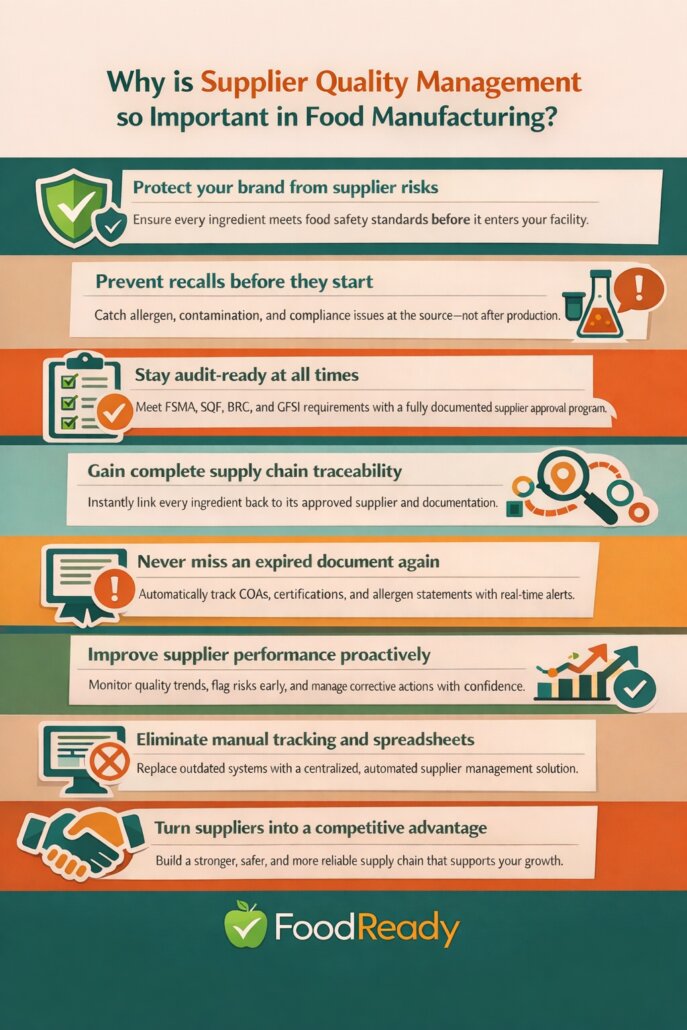
Supplier qualification is where it starts. Before an ingredient or raw material enters your facility, the supplier providing it should be assessed for food safety compliance. That means reviewing their food safety certifications, their HACCP programs, their allergen controls, and their testing protocols. An approved supplier list is not a formality. It is a regulatory requirement under FSMA and a core expectation in SQF, BRC, and GFSI audits.
Why Food Manufacturers Get This Wrong?
Supplier quality management tends to be one of those areas where food manufacturers know what they should be doing and still fall short in practice. The reasons are almost always the same.
Document collection is treated as a one-time task rather than an ongoing program. A supplier’s certificate of analysis gets collected during onboarding and then nobody tracks when it expires. Allergen declarations get filed and never revisited even when a supplier changes their manufacturing process. Supplier audits get scheduled with good intentions and then deprioritized when production demands take over.
Manual tracking is the root of most of these problems. Spreadsheets and shared drives are not built for supplier compliance management at scale, which is why many manufacturers turn to supplier quality management software solutions. They do not send alerts when a document is about to expire. They do not flag when a supplier’s certification lapses. They do not link a supplier’s documentation status to the production batches that used their ingredients. They just sit there, increasingly out of date, until an auditor starts asking questions.
A GFSI audit that surfaces outdated supplier documentation is a preventable failure. An allergen incident traced back to a supplier whose controls were never properly verified is a preventable recall. The cost of running SQM correctly is a fraction of the cost of getting it wrong.
The Regulatory Reality of Supplier Compliance
Food safety regulations have become increasingly explicit about what supplier quality management requires. FSMA’s Preventive Controls rule requires that manufacturers verify their suppliers are controlling the hazards they are responsible for in the supply chain. That is not a voluntary best practice. It is a legal obligation.
FSMA 204 adds a traceability layer on top of that. For foods on the Food Traceability List, manufacturers need to maintain Key Data Elements that link ingredients back to their source. If your supplier documentation is incomplete, your traceability records are incomplete with it. That creates a compliance exposure on two fronts simultaneously.
Third-party certification standards are equally demanding. SQF, BRC, and GFSI schemes all require documented supplier approval programs, current supplier certifications, and evidence of ongoing supplier monitoring. Auditors look at this carefully. It is one of the most common areas where facilities lose points or receive non-conformances.
The GMP expectations around supplier management are similarly clear. Incoming raw materials should be received against specifications, tested or verified where required, and documented. If something does not meet spec, the corrective action needs to be recorded. All of that is supplier quality management, even if your facility does not call it that formally.
What Good SQM Looks Like in Practice?
A well-functioning supplier quality management program has a few things in common regardless of facility size or product category.
The approved supplier list is living documentation. It reflects current supplier status, current certification dates, and current risk assessments. When a supplier’s certification lapses or their performance starts slipping, the list reflects that immediately and triggers a response.
Document collection is automated or at minimum, systematically tracked. Certificates of analysis, allergen declarations, food safety certifications, and supplier questionnaires all have known expiration dates. Those dates drive action, not the memory of whoever originally collected the document.
Supplier performance is monitored over time. Rejection rates, quality deviations, delivery issues, and corrective action responses are tracked and reviewed. A supplier who is causing repeated issues is identified early and managed proactively rather than discovered during an incident.
Corrective actions are documented properly. When a supplier deviation occurs, the response, the root cause assessment, and the preventive measures are all recorded in a way that can be retrieved and reviewed. An informal conversation with a supplier rep is not a corrective action record. A timestamped, traceable document is.
How FoodReady Makes Supplier Quality Management a Leading Software Feature?
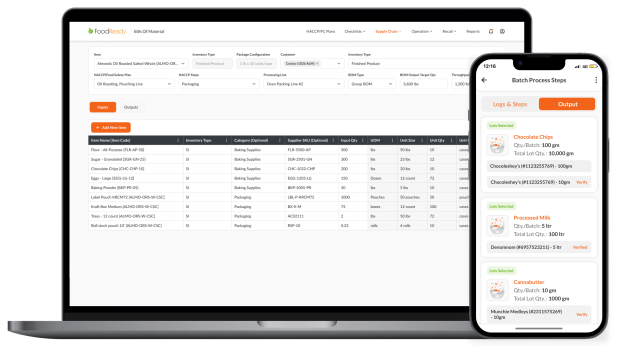
FoodReady builds supplier quality management directly into the platform rather than leaving it as something food manufacturers handle separately through spreadsheets and email chains. The result is a supplier compliance program that stays current automatically, integrates with your production records, and is always ready for a regulatory or certification review.
Automated supplier document management is at the center of it. Every supplier’s certificates of analysis, allergen statements, food safety certifications, and approval documentation are stored in the platform and tracked against expiration dates. When a document is approaching its renewal date, FoodReady sends automated requests to the supplier. Your team sees the current compliance status of every supplier in your network without chasing a single email.
Supplier records in FoodReady connect directly to your production and inventory data. When you receive an ingredient from a specific supplier and log it through the platform, the lot traceability record links to that supplier’s current documentation. If a supplier compliance issue surfaces later, you can identify exactly which production batches used their materials and where those finished goods were shipped. That connection between supplier compliance and food traceability is what makes a fast, accurate response to a supply chain issue possible.
The approved supplier list lives in the platform and reflects real-time status. When a supplier’s documentation expires or a corrective action is open against them, that status is visible. Your purchasing and quality teams are working from the same information rather than operating on different versions of a shared spreadsheet.
Corrective actions triggered by supplier deviations are documented through FoodReady’s corrective action workflow. The deviation, the response, and the resolution are all timestamped and linked to the relevant supplier and lot. When a GFSI or SQF auditor asks for evidence of supplier corrective action management, those records pull up immediately.
FoodReady also pairs this software capability with experienced food safety consultants who help facilities build supplier approval programs that hold up under audit, assess supplier risk levels, and navigate the FSMA supplier verification requirements that many facilities still find genuinely confusing.
The platform and the consulting team work together, which is where most standalone software solutions fall short.
Build a Supplier Program That Holds Up Under Audit
FoodReady helps you manage approvals, documentation, and CAPAs with full visibility.
Your Supply Chain Is Part of Your Food Safety Program
Supplier quality management is not a back-office administrative function. It is a core component of food safety compliance, traceability, and audit readiness. The ingredients coming into your facility carry the food safety risks, allergen profiles, and regulatory obligations of whoever produced them. Managing those risks starts with managing your suppliers systematically.
Facilities that treat SQM as a one-time document collection exercise find out the hard way that auditors and regulators see it differently. Facilities that have a functioning, automated supplier quality management program find that their audits go more smoothly, their supply chain incidents resolve faster, and their compliance posture is genuinely stronger.
Want to see what supplier quality management looks like inside FoodReady? Explore the platform or book a free consultation with the team.
FAQs
SQM is the system food manufacturers use to verify, monitor, and maintain the quality and compliance of every ingredient, material, and service entering their operation. It covers supplier qualification, document management, performance monitoring, corrective actions, and audits, all required under FSMA, GMP, and standards like SQF, BRC, and GFSI.
Your food safety program is only as strong as your inputs. Lapsed certifications, inadequate allergen controls, or off-spec ingredients create risk inside your facility regardless of how well your internal controls run. SQM ensures your supply chain is not the weakest link.
At minimum: Certificates of analysis per lot, allergen declarations, current food safety certifications, and completed supplier questionnaires. Depending on the product and regulatory context, third-party audit reports or specification sheets may also be required.
FSMA’s Preventive Controls rule requires documented supplier approval programs, verification activities, and corrective actions for supplier deviations. FSMA 204 adds traceability requirements that make clean supplier documentation even more critical.
It is a documented record of qualified suppliers with current compliance status, certification dates, and risk levels. Under SQF, BRC, GFSI, and FSMA, maintaining an accurate approved supplier list is a formal requirement. FoodReady keeps this list live and up to date inside the platform.
Most food safety certifications renew annually. Certificates of analysis should be collected per lot or delivery based on risk level. Allergen declarations should be revisited whenever a supplier changes their process or sourcing. FoodReady automates tracking across all of these timelines as part of its food traceability software.
A corrective and preventive action should be initiated, documented, and tracked to resolution. Depending on severity, the supplier may be placed on conditional approval or removed from your approved list. All records must be retrievable during inspections or SQF, BRC, or GFSI certification audits.
FoodReady automates document collection and expiration tracking, maintains a real-time approved supplier list, links supplier records to production lot traceability, and manages corrective actions in an audit-ready format. It is backed by experienced food safety consultants who help clients build programs that hold up under FSMA, GMP, and certification audits.