When a food safety incident occurs, such as a contaminated lot, a supplier deviation, or a temperature excursion on the line, your ability to respond quickly and accurately isn’t just a matter of compliance. It’s a matter of consumer safety and business survival.
Despite the risks, numerous food processors and manufacturers continue to rely on manual systems like paper logs, spreadsheets, and disconnected email threads to handle food safety incident reporting. This fragmented approach leads to expensive recalls, disorganized audits, and a loss of trust as documentation fails to keep pace with real-world events.
The good news?
The right software doesn’t just track where your product has been; it becomes the backbone of a smarter, faster, and more defensible food safety incident management process, providing end-to-end traceability that enables comprehensive tracking from raw materials to finished goods across the entire food supply chain.
What Is Food Safety Incident Reporting?
The systematic procedure for identifying, documenting, investigating, and addressing events that may jeopardize food quality or safety is known as food safety incident reporting. This system is designed to address various challenges, such as customer complaints, mislabeling, contamination, supplier non-conformances, and deviations in critical control points (CCP).
In food manufacturing, successful incident management goes beyond simply recording errors. It necessitates instant traceability to the origin, specifically the supplier, the production batch, and the raw material lot, to ensure any impacted product is swiftly identified, assessed, and subsequently released or recalled.
Under FSMA 204 and frameworks like SQF, BRCGS, GFSI, and GMP/cGMP, this traceability isn’t optional. It’s a regulatory requirement, and a robust food safety system that integrates monitoring, hazard analysis, SOPs, and traceability features is essential for compliance.
Without integrated food safety software, connecting those dots in real time is nearly impossible.
How Food Traceability Software Transforms Incident Reporting?
The landscape of incident reporting is completely redefined by specialized food traceability software.
By consolidating production records, lot numbers, supplier data, and shipping logs into one integrated platform, the process shifts from being reactive to a proactive strategy. Food traceability systems are essential digital applications for documenting, monitoring, and managing food safety processes throughout the supply chain.
Here’s what that looks like in practice:
| FoodReady Feature | What It Does |
|---|---|
| End-to-end lot traceability | Provides a complete lot-traceability chain in minutes, identifying raw material lots, batch associations, and shipping destinations as mandated by FSMA 204. |
| Automated corrective action workflows | Triggers CAPA workflows automatically when deviations are logged, ensuring tasks are assigned, tracked, and documented without manual follow-up. |
| Real-time monitoring and alerts | Enables QA teams to detect CCP deviations instantly through live compliance monitoring and automated notifications. |
| Supplier non-conformance tracking | Integrates supplier document management with lot records to track performance, certificates of analysis, and audit history. |
| Mock recall and recall readiness | Facilitates rapid forward and backward traces, reducing recall scopes by 50–95% and ensuring compliance with SQF, BRCGS, and GFSI. |
| Audit management | Supports internal and third-party audits by recording nonconformities, managing corrective actions, and tracking resolutions. |
FoodReady: The All-in-One Solution for Incident Reporting and Food Traceability
This is precisely where FoodReady stands apart.
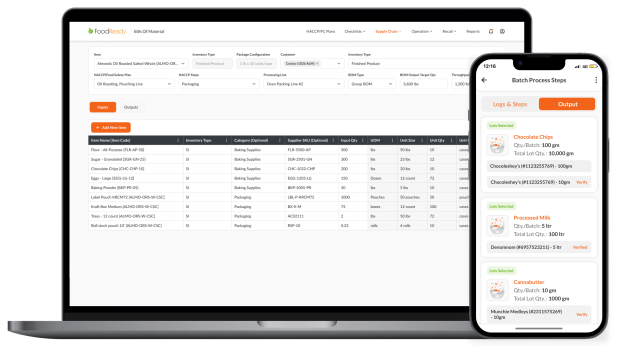
FoodReady’s AI-powered food safety platform is a unified system designed around how food safety incidents actually unfold. Every piece of the puzzle is connected, including HACCP plan management, CCP monitoring, batch and inventory management, supplier document management, and product recall management software.
The platform also includes recipe management to document, change, and track recipes and ingredient swaps, and it connects technology systems that bring together inventory, production, and compliance features for a complete solution.
When an incident occurs in a FoodReady-managed facility, here’s what the team has at their fingertips:
| FoodReady Feature | Benefit |
|---|---|
| Lot Traceability | Complete chain linked to production, receiving, and shipping records for supply chain transparency. |
| Workflows | Corrective action workflows that are automatically triggered, assigned, and tracked. |
| Monitoring | Real-time dashboards that surface deviations before they become incidents. |
| Supplier Compliance | Full history tied to specific ingredients, including performance metrics. |
| Documentation | Audit-ready records satisfying FDA, USDA, SQF, BRCGS, GFSI, and GMP requirements. |
| Mock Recall | Management tool capable of executing a full trace in minutes to ensure compliance. |
FoodReady also supports FSMA 204 compliance, the FDA’s traceability rule targeting high-risk foods with the electronic recordkeeping and Key Data Elements (KDEs) tracking that the rule requires. For manufacturers, processors, co-packers, and distributors navigating this regulation, having a traceability software platform that handles both compliance documentation and incident response in one place is a significant operational advantage. The platform’s document control capabilities manage, update, and organize critical compliance documents linked to product lots, streamlining approval workflows and supporting compliance.
And unlike enterprise systems that take months to implement and require a dedicated IT team, FoodReady is built to be accessible. The mobile app lets floor-level operators log receiving records, complete operational checklists, and flag non-conformances in real time, meaning the data quality that drives effective incident reporting starts at the source, not after the fact. FoodReady enables mobile apps for instant incident logging, integrates with IoT sensors and mobile scanners for real-time data capture, and supports seamless integration with existing platforms.
Turn Incident Reporting Into a Controlled Process
Turn Incident Reporting Into a Controlled Process.
Incident Reporting Is a System
The food companies that handle incidents well, quickly, cleanly, and without a recall spiraling out of control aren’t just lucky. Food companies have established systems that integrate food traceability, quality management, and corrective action workflows before any issues arise. Traceability systems serve as real-time quality control checkpoints, confirming product authenticity and ensuring proper handling throughout the supply chain.
FoodReady gives manufacturers and processors the infrastructure to do exactly that. Whether you’re working toward your first SQF or GFSI certification, preparing for an FDA inspection, or simply trying to stop fighting fires and start preventing them, FoodReady’s all-in-one platform is built for the way food safety actually works. The platform supports certification processes such as organic or GMO-free labeling, provides proof behind marketing claims with transparent, verifiable data, and helps businesses reduce waste and prevent expired or damaged goods from reaching consumers.
Don’t wait for an incident to find out where your gaps are. Schedule a free demo and see how FoodReady transforms food safety incident management from a liability into a competitive advantage.
Frequently Asked Questions
Food safety incident reporting is the structured process of identifying, documenting, investigating, and resolving any event that could compromise the safety or quality of a food product, from a CCP deviation or supplier non-conformance to a mislabeling issue or customer complaint. It matters because incomplete or delayed reporting can allow affected products to reach consumers, trigger costly recalls, and create serious compliance exposure under FSMA, SQF, BRCGS, and GFSI frameworks. The goal isn’t just documentation; it’s faster containment and a defensible paper trail.
Instead of manually cross-referencing spreadsheets, paper logs, and emails, food traceability software gives your team an instant, connected lot history, raw material receipts, production batches, shipping records, and supplier documentation all in one place. The moment an incident is flagged, the traceability chain is already built. Manual records can take hours or days, but with this system, it can be done in minutes, which is vital when products on the shelf or in distribution need to be isolated quickly.
FSMA 204, which is the FDA’s Food Traceability Rule, requires food businesses that deal with high-risk foods to keep electronic records of important information at each key point in the supply chain, such as growing, shipping, receiving, transforming, and creating. In the case of a recall or foodborne illness investigation, covered businesses must be able to produce these records within 24 hours of an FDA request. Food traceability software that captures and stores KDEs electronically, linked to production and lot records, is the most practical way to meet this requirement.
A mock recall is a simulated exercise in which your team practices executing a product trace forward to customers and distributors, and backward to raw material suppliers, as if a real recall had been triggered. The purpose is to stress-test your traceability system, identify gaps before an actual incident, and demonstrate recall readiness to auditors and certification bodies like SQF and BRCGS. With integrated food traceability software, a mock recall that might take a full day with paper records can be completed in a fraction of the time, with a complete, exportable audit trail.
Yes, and this is one of the most practical benefits. When an incident is traced back to an incoming ingredient, your response depends on having immediate access to that supplier’s certificate of analysis, audit history, allergen declarations, and contact information. Integrated supplier document management means all of that is already tied to the specific lot in question. You’re not hunting through filing cabinets or emailing back and forth while the potentially affected products continue to move.
FoodReady supports compliance and audit readiness across a broad range of food safety frameworks, including SQF (Safe Quality Food), BRCGS, GFSI-benchmarked schemes, FDA FSMA (including FSMA 204), USDA, HACCP, GMP, and cGMP. The platform generates audit-ready documentation, manages corrective actions tied to audit findings, and supports mock recall exercises required by certification bodies, making it practical for manufacturers and processors at any stage of their certification journey.