Food waste is one of those problems that sounds abstract until you’re the one staring at a production report showing thousands of pounds of product that didn’t move, or worse, a line that ran short because demand spiked unexpectedly over a long weekend. For food manufacturers, the gap between what’s produced and what’s actually sold isn’t just a logistical headache. It’s a margin killer, a compliance risk, and increasingly, a sustainability liability.
The good news?
That gap is shrinking for companies that choose to work smarter. And AI-driven demand forecasting is a big reason why.
Why Traditional Forecasting Falls Short in Food Manufacturing?
For years, the majority of food production companies relied on a similar approach that included historical sales data, sales representatives’ intuition, and an unreliable spreadsheet. In stable markets with predictable customers and reliable suppliers, you could get by. But the food industry has never really been that stable.
Seasonal swings, promotional spikes, new retail listings, ingredient shortages, and shifting consumer preferences; any one of these can throw off a food production forecast by 20, 30, or even 40 percent. And when your production team is locked into a schedule planned weeks in advance, the cost of being wrong compounds fast. Overproduction leads to spoilage, markdowns, and write-offs. Underproduction means out-of-stock items, missed orders, and unhappy retail partners.
That risk is not theoretical. The Consumer Goods Forum notes that food loss and waste across the value chain can stem from factors such as spoilage, manufacturing yield loss, and mismatched supply and demand forecasts. That makes better forecasting more than a planning upgrade. It is a practical way to reduce waste and improve supply reliability.
The core problem with traditional food production planning is that it looks backward. It tells you what happened, not what’s about to happen. Traditional demand forecasting techniques often lack the sophistication needed for accurate predictions and high demand forecast accuracy. And in food manufacturing, the margin for error is simply too tight for that kind of reactive planning.
What AI-Driven Forecasting Actually Does Differently?
AI doesn’t just crunch the same data faster; it looks at more of it, from more angles, all at once.
A modern AI forecasting model for food manufacturers draws on sales order history, SKU-level velocity, promotional calendars, supplier lead times, seasonal patterns, and even external signals such as regional demand trends.
This advanced demand forecasting approach leverages data analysis and trend projection to improve the demand forecasting process. It identifies correlations that a human analyst would take weeks to find, and it updates in near-real time as new data comes in. Most importantly, it quantifies uncertainty, giving production planners a range of likely outcomes rather than a single number that may or may not hold. Demand forecasters benefit from AI tools that support them in making more accurate predictions and improving demand forecast accuracy.
The practical result is a smarter food production schedule that bends before it breaks. Instead of reacting to last week’s shortage, your team adjusts next week’s run based on what the data already shows is coming. These improvements stem from a more robust demand forecasting process.
How FoodReady Supports Smarter Production Planning?
FoodReady was built specifically for the food industry, and that specificity matters. Generic ERP features and standalone forecasting software often require significant configuration just to understand what a batch record or a bill of materials actually means in a food production context. FoodReady was designed from the ground up with food manufacturers in mind, which means the data it works with is already structured the way your operation actually runs.
Here’s where it makes a real difference in demand forecasting and food production planning:
Introduction to Demand Forecasting
Demand forecasting is the process of estimating future customer demand for a product or service by analyzing a variety of data sources, including historical sales data, market trends, and external factors. For food manufacturers and supply chain professionals, accurately forecasting demand is essential to maintaining optimal inventory levels, optimizing production schedules, and allocating resources efficiently.
Why is demand forecasting important? At its core, demand forecasting helps businesses avoid the costly pitfalls of overproduction and underproduction. According to IBM, effective demand forecasting helps organizations reduce stockouts, manage carrying costs, and align procurement, production, and distribution with expected demand. That allows companies to cut food waste, improve cash flow, and build stronger customer relationships while supporting long-term growth. Accurate demand forecasts also enable better supply chain management, allowing businesses to respond proactively to shifts in consumer demand, economic conditions, and industry trends.
In short, a strong demand forecasting plan that combines multiple methods, smart analysis, and a clear approach to data collection helps food manufacturers make better decisions, reduce waste, and keep up with market changes. By leveraging the right forecasting tools and techniques, businesses can transform historical data into actionable insights, ensuring they are always prepared to meet future customer demand.
Unified Sales, Historical Sales Data, and Supply Chain Data
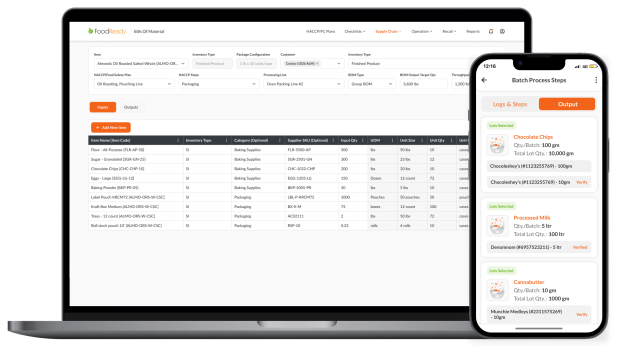
FoodReady’s food ERP software connects your incoming sales orders, purchase orders, inventory levels, and production batch data into a single centralized platform. Robust data systems ensure the accuracy and reliability of the information used for forecasting. That connectivity is foundational.
When your sales data, supplier lead times, and current inventory positions are all visible in the same system, and both quantitative data and sales history are integrated as essential inputs, the AI has what it needs to generate meaningful demand forecasts, not just surface-level projections based on a single data stream.
Real-Time Data for Inventory and Production Visibility
One of the most common reasons food demand forecasting fails isn’t a bad algorithm; it’s bad data. Companies are often working with inventory numbers that are hours or days out of date. FoodReady’s production inventory management and batch tracking keep your on-hand quantities, work-in-progress, and raw material levels up to date, so production decisions are made on accurate information rather than assumptions. Inventory management platforms play a crucial role in supporting operations management by ensuring accurate, real-time data for demand forecasting.
Batch and Bill of Materials Integration
When a demand signal changes, FoodReady’s food production planning software can immediately reflect the impact at the ingredient level. If the expected sales for a specific SKU increase, the system can determine how much raw material is needed, highlight any shortages, and help make quicker buying decisions, all before production starts.
This level of detail supports effective demand planning and enables micro-level forecasting for specific SKUs, allowing businesses to analyze granular trends and external factors that may impact demand. Quantitative forecasting methods are used to translate demand signals into actionable production and procurement decisions, enhancing the accuracy and reliability of planning. This kind of upstream visibility is what separates reactive planning from genuinely proactive food manufacturing operations.
Traceability That Feeds Forward
FoodReady’s food traceability software isn’t just for recalls. When linked to sales and shipping data, it creates a detailed picture of how specific batches and ingredients have moved through your supply chain over time.
Historical lot traceability data and analysis of historical demand become part of the forecasting foundation, helping the AI recognize demand patterns that aren’t always obvious from top-line sales figures alone and supporting your FSMA 204 compliance requirements at the same time. By uncovering these patterns, both quantitative and qualitative demand forecasting approaches can be informed. This combines numerical trends with expert insights for more accurate predictions.
Supplier and Procurement Alignment
Forecasting only works if your food supply chain can keep up. FoodReady’s supplier document management and purchase order tracking help ensure that when production plans shift, your procurement team has the information they need to adjust supplier orders accordingly.
Effective sales forecasting ensures procurement teams can anticipate material needs and proactively adjust supplier orders, reducing the risk of shortages or excess inventory. Tighter alignment between forecasted demand and inbound materials is one of the most direct ways to reduce both overstock and shortages simultaneously.
Turn Forecasting Into a Profit Driver
Turn Forecasting Into a Profit Driver.
The Waste Reduction Payoff
Cutting food waste in manufacturing isn’t just about sustainability optics; it has a direct and measurable impact on profitability. Ingredients that don’t go to waste don’t need to be written off. Finished goods produced in the right quantities don’t go unsold or get dumped. Labor hours spent on overproduced batches aren’t recoverable.
When FoodReady users align their food production planning with actual demand signals, the effects ripple through the entire cost structure. Procurement becomes more precise. Inventory carrying costs drop. Quality declines when you don’t age products unnecessarily. And your team spends less time firefighting and more time actually improving your processes.
Getting Started Doesn’t Mean Starting Over
One of the most common concerns we hear from food manufacturers is that implementing AI-driven demand forecasting software sounds like a massive IT project. With FoodReady, it doesn’t have to be difficult. The platform is built to layer on top of your operation’s existing processes, capturing the data your team generates daily and turning it into actionable intelligence.
Explore FoodReady’s full software features to see how each module connects to support smarter, waste-reducing production decisions across your facility.
If your current forecasting approach feels more like educated guessing than confident planning, it might be time to see what a purpose-built AI food production software platform can do for your operation.
Book a free demo with FoodReady and see how smarter demand forecasting can start cutting waste before it ever hits your floor.
FAQs
AI-driven demand forecasting in food manufacturing uses artificial intelligence to predict future product demand by analyzing multiple data streams simultaneously, including sales order history, SKU-level velocity, supplier lead times, promotional calendars, and seasonal patterns. Unlike traditional forecasting methods that rely on historical data and manual spreadsheets, AI models update in near real time and provide production planners with a range of likely outcomes, enabling smarter, more proactive scheduling decisions.
When forecasts are inaccurate, production teams either overproduce or underproduce. Overproduction results in excess finished goods that may spoil, be sold at steep markdowns, or be disposed of entirely, all at a direct cost to profitability. Underproduction creates stockouts, missed orders, and strained retail relationships. AI-driven forecasting reduces this gap by aligning production runs more precisely with actual demand signals before goods are ever manufactured.
FoodReady was purpose-built for the food industry, meaning the platform already understands the structure of food manufacturing data, including batch records, bills of materials, lot traceability, and regulatory requirements such as FSMA 204. Generic ERP tools and standalone forecasting software typically require extensive configuration to handle food-specific data correctly. FoodReady eliminates that setup burden by working the way food manufacturers already operate, right out of the box, and accounts for seasonal demand variations to improve forecast reliability.
FoodReady draws on a connected set of operational data, including incoming sales orders, purchase orders, real-time inventory levels, production batch records, supplier lead times, and historical lot traceability information. By consolidating these data streams into a single platform, FoodReady gives the AI the full operational picture it needs to generate meaningful, multi-variable demand forecasts, not just projections based on a single data source. Additionally, external factors such as economic outlook and economic trends can significantly affect demand and are incorporated into the demand forecasting process to improve accuracy.
Yes. FoodReady’s Batch and Bill of Materials integration means that when a demand signal changes, the system can immediately calculate the corresponding raw material requirements, flag potential shortfalls, and support faster procurement decisions, all before a production run is scheduled. Combined with supplier document management and purchase order tracking, FoodReady helps align your inbound supply with forecasted production needs in real time.
It does, and this is one of FoodReady’s more distinctive capabilities. FoodReady’s food traceability software tracks how specific batches and ingredients move through the supply chain over time. When that historical lot-level movement data is linked to sales and shipping records, it becomes a valuable input for the forecasting model, helping the AI identify demand patterns that wouldn’t be visible from top-line sales figures alone. It also supports FSMA 204 compliance requirements simultaneously.
The cost impact is significant and multi-layered. More accurate forecasting means procurement becomes more precise, reducing both overstock and emergency spot purchases. Inventory carrying costs drop when goods move through the facility at the right pace. Quality holds decrease because products aren’t sitting and aging unnecessarily. Labor hours aren’t wasted on overproduced batches. Across all of these areas, tighter demand alignment directly improves margin without requiring major capital investment.
FoodReady is designed to layer on top of how your operation already works, not to replace it wholesale. The platform captures the data your team generates through daily production, inventory, and shipping activities and turns it into actionable forecasting intelligence. There is no need for a large-scale IT overhaul to get started. Food manufacturers can explore FoodReady’s full software feature set and book a free demo to see exactly how the platform fits their current workflow.