Let us first understand what traditional document processing is in food manufacturing. It refers to the manual handling, creation, storage, and management of documents and procedures related to production, quality control, food safety, and overall food compliance.
In traditional document processing, actual physical paperwork using some basic digital tools (like spreadsheets or Word documents) records this critical information throughout the manufacturing process, which contributes to the effective running of the food safety management system.
However, with continual technological advancements, digital solutions are becoming increasingly popular. Many food manufacturing companies are toying with the idea of transitioning to a digital food safety system, creating a digital backbone for their plant by digitizing processes and standardizing operations across multiple facilities to enhance efficiency and compliance. This article will help you make an informed (and right) decision.
Key Takeaways
- Traditional recordkeeping in food manufacturing relies heavily on manual, paper-based processes that are prone to human error and inefficiency.
- Critical documents include batch production records, ingredient traceability logs, quality control checklists, HACCP documentation, and supplier certificates.
- Paper trails pose challenges such as difficulty in data retrieval, vulnerability to loss or damage, and slow response times during audits or recalls.
- Digital food safety systems offer real-time visibility, reduce operational gaps, improve compliance, and enable proactive risk management.
- Transitioning to digital solutions enhances audit readiness, ensures accurate inspection records, and supports better traceability across the supply chain.
What Are the Different Types of Traditional Documents in Food Manufacturing?
These are the most important documents that are kept by way of a paper trail in a food safety management system:
- Batch production records are detailed documents that record all aspects of the manufacturing process for a specific batch of a product, ensuring consistency, quality, and regulatory compliance.
- Ingredient traceability logs – these are essential records that food manufacturing companies use to track the journey of ingredients from their source to the finished product
- Quality control checklists – these are essential checkpoints to ensure food safety and maintain the quality standards of the food product manufactured
- Cleaning and sanitation schedules are detailed documents outlining how and when specific cleaning and sanitation tasks will be performed to maintain a clean and safe environment within the food manufacturing facility.
- HACCP (Hazard Analysis Critical Control Points) documentation outlines a systematic approach to identifying, evaluating, and controlling food safety hazards that ensure food safety from raw materials to the finished product.
- Supplier certificates and audits—these are certificates based on systems such as SQF, GFSI, or ISO/FSSC, which demonstrate that a supplier has implemented and maintained a food safety management system that meets specific requirements and required legislation.
- Shipping and receiving logs are crucial documents that track the details of incoming raw materials, ingredients, and packaging as well as outgoing food product deliveries. They ensure proper handling and storage to maintain food quality and safety for the end consumer.
- Inventory tracking forms are essential documents used to track and manage food and packaging stock, helping businesses minimize waste, optimize ordering, and ensure sufficient ingredients are available to meet customer demand.
- Food safety compliance reports are essential documents detailing the findings of factory inspections or audits conducted by local authorities and legislation to ensure food manufacturing facilities adhere to food safety regulations and standards.
Imagine how amazing it would be if these critical documents and checklists were available to us at our fingertips with the click of a button.
It would make the job of the food safety team so much more enjoyable, with personnel able to concentrate on actual food safety troubleshooting as opposed to writing and writing their lives away….
Below are the Characteristics of Traditional Document Processing using Paper trails:
| Feature | Method | Challenges |
|---|---|---|
| Data Collection | Paper forms, clipboards, Excel sheets | Manual errors, missing info |
| Storage | Filing cabinets, binders, and shared drives | Space-consuming, difficult to search |
| Reporting | Manually compiling data into reports | Time-consuming, error-prone |
| Compliance | Manual audits and checks | Hard to maintain consistency |
| Traceability | Paper trails for ingredients & processes | Slow during recalls or audits |
Siloed information in paper records makes it nearly impossible to achieve end-to-end visibility across a global supply chain.
Why is the Paper Trail still used?
A couple of the main reasons food businesses still opt for a paper trail can be divided into these points below:
- Simplicity & familiarity – the documents and checklists become repetitive over a prolonged period, and food safety teams (especially long-standing staff members and food handlers) are accustomed to the legacy processes and monotonous cycle of paper trail, which often leaves little room for expansion of thought and learning something new in food safety
- Low upfront cost and no need for advanced IT infrastructure – budgets pose a problem in food businesses. Companies may not see the value in investing in a digital food safety system and choose to continue legacy processes, which are very time-consuming and inefficient.
What are the Main Drawbacks of using Paper Trail?
In this case, the disadvantages of a paper trail system outweigh the advantages of a digitized food safety system.
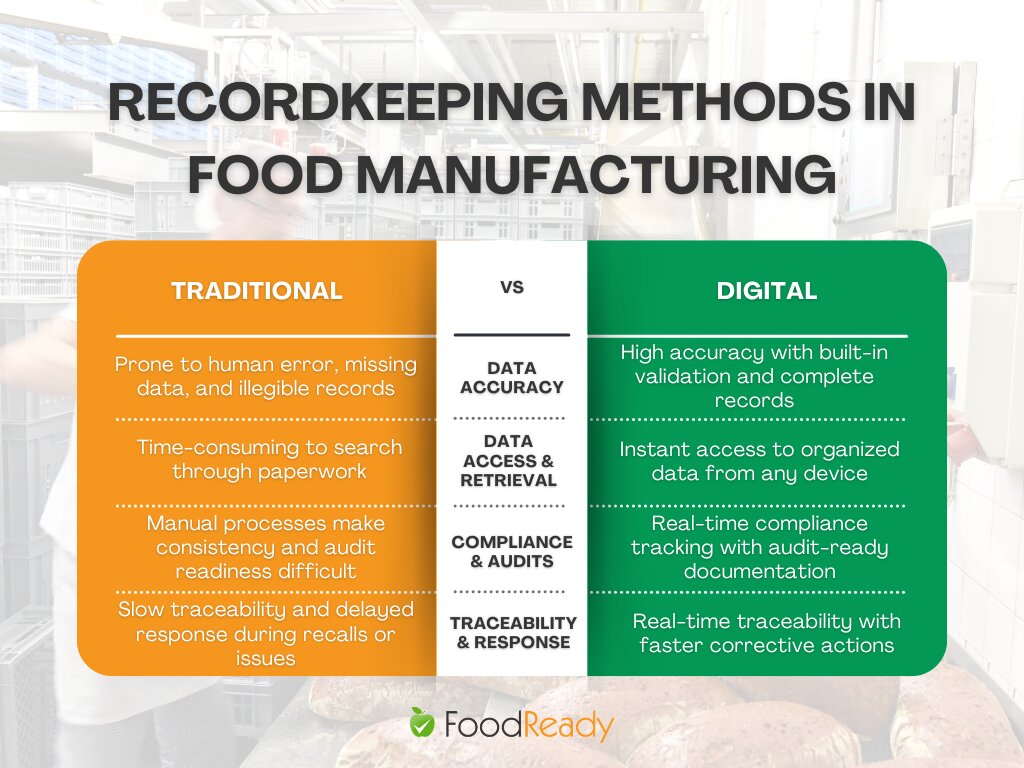
- Prone to human error – Manually recorded temperatures and checks can lead to manipulation or oversights, resulting in inconsistencies that are difficult to detect until a safety incident occurs. Rushing through documents and making mistakes can result in incorrect results and non-conformances.
- Time-consuming data entry & retrieval – Most plants face time-consuming data entry and retrieval, as sifting through paperwork to find the right section to fill as well as vital records of food traceability is inefficient. As manufacturing processes become more complex, the volume of data grows beyond the capacity of manual management, requiring digitization.
- Paper records often fail regulatory standards – Paper records frequently do not meet FDA and other regulatory requirements, cannot be retrieved quickly during audits, and contribute to unplanned downtime and compliance risks.
- True cost of paper records – The true cost of relying on paper records includes the risk of unplanned downtime, loss of perishable goods due to delayed maintenance or monitoring, and hidden operational expenses that impact profitability and efficiency.
- Difficult to scale or standardize – Manually writing documents and records may have inconsistencies and pose a problem if planning towards the growth of the business and food safety system.
- Structured preventive maintenance programs – Implementing structured preventive maintenance programs can improve production uptime, reduce the risk of compliance failures, and prevent equipment-related contamination, which is responsible for a significant percentage of food recalls.
- Vulnerable to document loss or damage – Rewriting of records after spending time searching for paper trails only to realize that it is either illegible, lost, or damaged.
- Slower response in audits, recalls, or investigations – The time taken to locate documents and records can cost a food business considerably during a crisis, and negatively impact turnover.
- Non-conformances and corrective action – When non-conformances occur, documenting corrective action is essential to address issues and demonstrate compliance during audits or regulatory inspections.
Regulations like the FDA’s FSMA Rule 204 and the EU’s Regulation 178/2002 require meticulous documentation and rapid digital accessibility, making reliance on paper records increasingly risky for modern food manufacturers.
Common Challenges in Modern Food Manufacturing Recordkeeping
Modern food manufacturing presents a unique set of challenges when it comes to recordkeeping. Traditional paper-based systems and manual processes are often plagued by human error, missing data, and inefficiencies that can jeopardize food safety and regulatory compliance. In an industry where every detail matters, even a small oversight can lead to non-compliance, product recalls, or threats to consumer safety.
The complexity of the food and beverage industry’s supply chain, combined with increasingly stringent food safety regulations, makes it difficult for manufacturers to maintain real-time visibility into their operations. Paper-based systems create operational gaps, slow down response times during audits or recalls, and make it challenging to track and verify critical data. As a result, food manufacturers face increased risk, higher costs, and potential damage to their reputation.
To address these challenges, many companies are adopting digital tools that provide real-time insights, automate data collection, and ensure systematic monitoring of food safety processes. By moving away from manual processes and embracing digital solutions, food manufacturers can significantly reduce the risk of non-compliance, improve food safety management, and protect both their business and their customers.
Moving From Traditional Document Processing to a Digital Food Safety System
Many food manufacturers are now moving towards digital transformation, either by adopting automation, document management systems (DMS), or manufacturing execution systems (MES) to replace traditional methods of document processing.
One of the key benefits of a digital food safety system is quick and easy access to critical information. Trying to figure out records and illegible handwriting, or just spending time searching through a large stack of paper, can now be a thing of the past! This promotes the growth and upscale of the food safety department and business due to team members being able to be completely present in the manufacturing process and mitigate risk much more effectively. Managers can address issues and impending problems very quickly, saving time, money, and expensive recalls before the product even leaves the dispatch door! This is what I would call a proactive approach to food safety.
A digital food safety system is fully compliant with accuracy and precision. There is no room for human error, as the gates are intelligently designed to not allow you into the next phase of the document or checklist if information or values have been entered incorrectly and are out of specification. This forces the food handler to investigate and prevent the associated risk in real time. Built-in checks and balances in a digital system make food safety simple! Incomplete records and missed information can now be a thing of the past.
I have often found myself frantically searching for records and checklists pertaining to a specific date as requested by the auditor during an inspection.
Pretty horrible, right?
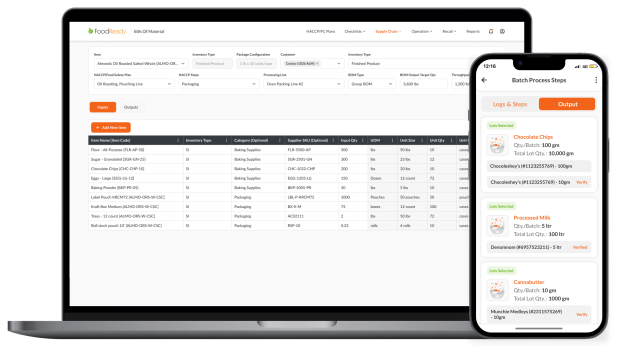
This is where a digital food safety system saves the day, as all data is organized and accessible regardless of location. Data and information are stored safely in the cloud and are easily accessible from your mobile phone, tablet, or laptop at all times.
Ready to simplify your food safety system and stay audit-ready?
Get started with FoodReady today.
Best Practices for Food Manufacturers Transitioning to Digital Recordkeeping
Transitioning from paper-based systems to digital recordkeeping is a significant step for food manufacturers, but it can be accomplished smoothly with a strategic approach. The first step is to thoroughly assess existing manual processes and identify areas where inefficiencies, data gaps, or compliance risks exist. This evaluation helps manufacturers understand their unique needs and set clear goals for digital transformation.
Selecting the right digital tools is crucial; solutions should be tailored to support quality checks, streamline data collection, and provide real-time insights into food safety performance. It’s important to choose a system that integrates seamlessly with current operations and supports the specific requirements of the food and beverage industry.
Successful implementation also depends on comprehensive training for all stakeholders, from frontline teams to management. Ensuring that everyone understands how to use the new system and why it matters for food safety and compliance will drive adoption and maximize the benefits of digital transformation. Additionally, careful migration of historical data from paper-based systems to the new digital platform is essential to maintain a complete and accurate audit trail.
By following these best practices, food manufacturers can reduce reliance on manual processes, enhance data accuracy, and gain the real-time visibility needed to ensure safety, quality, and compliance in today’s fast-paced industry.
Conclusion
As a food safety professional, I would opt to break away from traditional document processing and move towards the fuss-free implementation of a digital food safety system.
I would find a ton of job satisfaction if I could walk into my food manufacturing facility and not have to physically check the temperatures in every cold room, or look for missing records amidst piles of paperwork – and most importantly, if I could make sure that I have all my documents and information ready before my upcoming audits and inspections so that I can be compliant in every sense of the word!
Audit-readiness at all times can be easily achieved with the help of digitization.
So, what are you waiting for? Get a free consultation with FoodReady today and make your dream of digitization a reality.
Frequently Asked Questions
Small processors do not inherently have low food safety compliance, but they often face more operational challenges. Limited budgets, reliance on manual recordkeeping, and lack of digital systems can increase the risk of errors and gaps in documentation. These constraints may affect audit readiness and traceability. However, with the right food safety systems and tools in place, small processors can achieve and maintain high compliance standards.
Low food safety performance is typically driven by inefficient processes and lack of real-time oversight. Common causes include manual data entry errors, incomplete records, poor traceability, and delayed corrective actions. Paper-based systems also make it difficult to standardize procedures and respond quickly during audits or recalls. Implementing a digital food safety system improves visibility, reduces human error, and supports proactive risk management.
Smallholders may experience lower compliance rates due to limited access to resources, training, and structured food safety systems. Many rely on traditional methods that lack consistency and proper documentation. This can lead to gaps in traceability and difficulty meeting regulatory requirements. With increased access to digital tools and food safety education, smallholders can significantly improve compliance and product safety.
Nonconformance in food safety often results from poor documentation practices, human error, and lack of process control. Key factors include missing or inaccurate records, inconsistent monitoring, inadequate training, and slow response to deviations. Paper-based systems further increase the risk of lost or damaged records. Transitioning to a digital system helps enforce data accuracy, ensures complete records, and enables faster corrective actions to prevent nonconformance.
Real-time monitoring of Critical Control Points (CCPs) is essential for preventing food safety hazards before products leave the facility. A proactive approach allows manufacturers to identify deviations immediately and take corrective action, reducing the risk of contamination and recalls.
Food manufacturers should conduct internal audits of their Food Safety Plans at least once a year. Regular audits help verify that systems are effective, identify gaps, and ensure ongoing compliance with regulatory requirements.
Well-trained staff play a critical role in maintaining food safety compliance. Proper training ensures that procedures are followed correctly, reduces human error, and lowers the risk of foodborne illness and product recalls.
Physical records require significant storage space and are vulnerable to loss or damage from fire, flooding, or everyday handling. These risks can lead to missing documentation, which may impact compliance and audit outcomes.
Paper records often lack secure time-stamps and verified user tracking required by modern regulations such as the FDA Food Traceability Rule. This makes it difficult to provide reliable, audit-ready evidence of compliance compared to digital systems.