When you’re producing food or pharmaceuticals, the stakes are high. Customers expect safe, consistent, and trustworthy products, and regulatory authorities demand proof that you are meeting strict standards. Falling short can lead to recalls, fines, or loss of consumer confidence. GMP sets the foundation by outlining the minimum quality requirements manufacturers must meet to keep products safe and consistent. However, manufacturing is constantly evolving, so these basic rules alone are not enough.
That’s why cGMP was developed. Building on GMP principles, cGMP focuses on the latest technologies, modern processes, and current industry best practices. This ensures manufacturers stay up to date with evolving standards, helping them maintain operational excellence and continuous improvement in quality systems. Understanding the key distinctions between GMP and cGMP is critical for drug manufacturers and those in the pharmaceutical industry to ensure quality, meet regulatory expectations, and prevent contamination.
Key Takeaways:
- Implementing cGMP expectations drives operational excellence and reduces risks associated with manufacturer claims and actual practice.
- GMP provides the minimum standards for manufacturing operations to ensure product safety and quality.
- cGMP refers to the current, updated practices that incorporate innovative technology and continuous improvement.
- Adhering to cGMP regulations supports compliance with FDA approval requirements and helps prevent deviations.
- Understanding the difference between GMP vs cGMP is essential for maintaining quality systems in drug manufacturing processes.
Understanding GMP (Good Manufacturing Practices)
Good Manufacturing Practices (GMP) are a set of rules and guidelines designed to ensure the consistent production and control of drug products, food, medical devices, and cosmetics to meet safety and quality standards.
Origins and Evolution
GMP originated in response to tragic events caused by inadequate quality control, notably the 1938 Elixir Sulfanilamide disaster in the United States. This led to government regulations requiring drug safety testing, forming the foundation of GMP. Since then, GMP standards have evolved, becoming more detailed and stringent due to ongoing pharmaceutical and food safety crises.
Key Principles of GMP
- Traceability and Accountability: Ensuring every stage of the manufacturing process can be tracked and audited.
- Quality Management Systems: Establishing strong systems to manage quality across operations.
- Clean and Hygienic Environment: Maintaining sanitary manufacturing conditions to prevent contamination.
- Process Controls: Implementing thorough controls to ensure consistency.
- Testing and Validation: Verifying product quality through rigorous testing.
Industry Application and Certification
GMP serves as a foundational guideline across multiple industries to protect consumers from hazards and ensure products meet advertised quality standards. For organizations seeking certification, FoodReady offers comprehensive support throughout the GMP certification process, including preparation and audit success guidance.
Exploring cGMP (Current Good Manufacturing Practices)
Current Good Manufacturing Practices (cGMP) represent an advanced phase of the broader GMP framework, emphasizing modernization and continual improvement in manufacturing standards.
While GMP sets the basic requirements for manufacturing processes, cGMP goes further by incorporating the most up-to-date practices, new technologies such as GMP/cGMP software, and modern methodologies. This evolution is reflected in the term “Current,” which highlights the importance of staying current with new technology, improved processes, and best industry practices.
Under cGMP, manufacturers are expected to adapt as manufacturing evolves, ensuring their processes remain efficient, safe, and aligned with the latest science and quality standards. This is particularly critical in industries where product quality and safety are vital and regulations are stringent and continuously evolving.
Adhering to cGMP standards benefits sectors like the food and beverage industry by protecting consumer safety and maintaining brand trust. Pursuing cGMP certification demonstrates a company’s commitment to these standards, enhancing its competitive edge in the market.
For organizations seeking guidance, FoodReady’s team of cGMP consultants and experts are available to support every step of the certification process.
cGMP vs GMP. What Are the Key Differences?
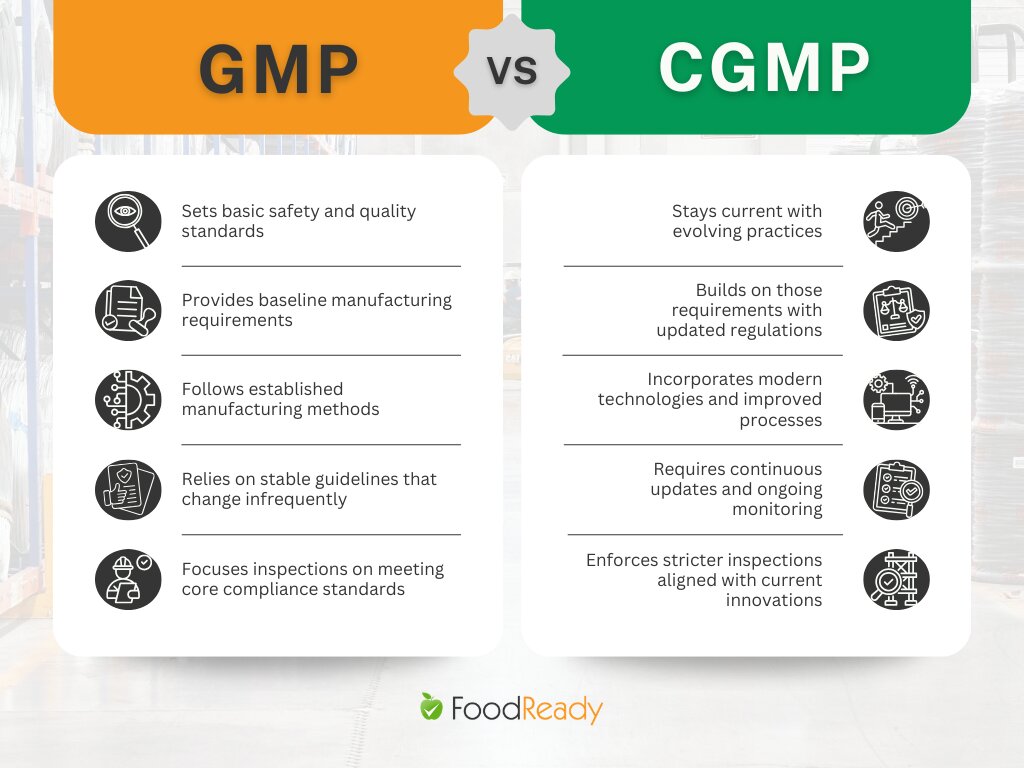
The table below summarizes the key differences between cGMP and GMP:
| Aspect | GMP (Good Manufacturing Practices) | cGMP (Current Good Manufacturing Practices) |
|---|---|---|
| Focus | Basic manufacturing guidelines and standards to ensure product safety and quality. | Emphasizes staying current with evolving standards, technologies, and industry best practices. |
| Regulatory Basis | Set as baseline requirements for manufacturing practices in various industries. | Built on GMP standards but include updates based on the latest industry developments and regulatory expectations. |
| Technology and Processes | Follows established manufacturing practices and standards. | Incorporates the latest technological advancements and modern methodologies in manufacturing. |
| Compliance and Updates | Compliance is based on general guidelines that are less frequently updated. | Requires continuous monitoring and updating of practices to reflect the latest scientific and industrial advancements. |
| Inspection and Enforcement | Inspections focus on adherence to basic GMP guidelines. | Inspections are more rigorous, focusing on current practices with the latest standards and innovations. |
| Application in Industries | Widely applied in pharmaceuticals, food, cosmetics, dietary supplements, and medical devices. | Especially critical in fast-evolving sectors like pharmaceuticals, where discoveries and technologies are frequent. |
How cGMP Goes Beyond GMP?
Apart from encompassing the fundamental principles of GMP, cGMP also mandates that manufacturers stay updated with the newest advancements in their field.
This means that under cGMP, facilities must continually adapt and improve their processes, quality control measures, and documentation to align with current industry best practices and technological innovations.
Regulatory and Compliance Differences
Given the dynamic nature of cGMP standards, regulatory bodies often enforce cGMP more rigorously than GMP.
Therefore, compliance with cGMP involves a commitment to ongoing learning, adaptation, and implementation of the latest safety and quality protocols.
Impact on Manufacturing and Quality Control
The key differences between GMP and cGMP profoundly impact manufacturing and quality control.
While GMP ensures that products are consistently produced to a quality standard, cGMP takes this further by ensuring these standards are the most current and effective.
This ongoing evolution in standards under cGMP enhances product safety, quality, and consumer trust, making it a critical aspect of modern manufacturing.
A Real-World Example of cGMP/GMP Application
Let’s explore a real-world case study that highlights the application of GMP and cGMP in the food production industry.
Case Study: The Peanut Corporation of America Salmonella Outbreak
In 2009, the Peanut Corporation of America (PCA) faced a massive recall after its products were linked to a Salmonella outbreak. This incident resulted in one of the most extensive food recalls in U.S. history, impacting over 3,900 products made by more than 200 companies.
The investigation into the PCA outbreak revealed significant violations of both GMP and cGMP standards.
These included:
- Poor hygiene practices, with evidence of rodent infestation and unsanitary conditions in the production facilities.
- Failure to implement proper testing procedures for pathogens.
- Ignoring positive test results for Salmonella and shipping contaminated products.
- Inadequate record-keeping and lack of traceability in the supply chain.
The outbreak resulted in over 700 reported cases of Salmonella poisoning across 46 states and was linked to nine deaths. PCA eventually filed for bankruptcy, and its executives faced criminal charges.
What are the lessons learned?
- Importance of Hygiene and Sanitation: This case underscores the critical need for strict hygiene practices in food production, a fundamental aspect of GMP.
- Regular and Rigorous Testing: Regular testing for contaminants is a key cGMP requirement. The PCA case demonstrates the danger of neglecting this aspect.
- Responsibility and Accountability: PCA’s decision to ignore test results highlighted a severe lapse in ethical responsibility and accountability, which is crucial in cGMP compliance.
- Traceability in the Supply Chain: The widespread impact of the outbreak showcased the importance of traceability, a principle emphasized in cGMP, to identify and recall contaminated products quickly.
- Regulatory Compliance: The incident led to stricter enforcement of GMP and cGMP rules and showed the need for constant compliance checks.
This case study serves as a stark reminder of the repercussions of neglecting GMP and cGMP standards, emphasizing the importance of these practices in ensuring food safety and protecting public health.
cGMP vs GMP: Conclusion
GMP provides the basic framework for quality and safety in manufacturing, while cGMP builds on that foundation by incorporating the latest advancements in technology and industry practices. The case study reminds us of the consequences of neglecting these standards and shows why following GMP and cGMP is vital for product safety, consumer trust, and regulatory compliance.
Manufacturers, especially in pharmaceuticals, food, and cosmetics, must follow these standards because the quality and safety risks are so high. Adhering to these guidelines ensures that products meet quality standards and protects consumers from potential hazards, underscoring the critical role of both GMP and cGMP in maintaining public health and confidence.
Still relying on basic GMP?
Upgrade to cGMP with FoodReady and stay ahead of compliance.
FAQs
The main differences are in focus and application. Think of GMP as the foundation. It sets the foundational quality and safety guidelines for manufacturing.
cGMP is built on these by incorporating the latest technological advancements, processes, and industry best practices to ensure products meet the highest safety and quality standards.
Both matter. GMP is the foundation. cGMP ensures you keep up with modern technology and safety standards.
Without GMP, you risk failing at the basics. Without cGMP, you risk falling behind and facing compliance issues.
Start with the gap assessment. Then focus on technology adoption, data integrity, risk management, and employee training. Minor improvements in these areas can bring you closer to full cGMP compliance.
The food industry changes fast, and so do the risks. cGMP helps you ensure your products meet basic quality requirements and follow the newest safety protocols and technologies. This helps prevent foodborne illnesses and gives consumers confidence in what they eat.
Technology enables better ingredient traceability, automates quality control processes, facilitates real-time monitoring of production conditions, and provides platforms for continuous employee training. It all contributes to upholding the highest standards of food safety and quality.
In the context of cGMP, ingredient traceability is vital for quickly identifying and isolating sources of contamination in the event of a food safety issue.
Manufacturers should adopt practices such as maintaining detailed records of suppliers, using lot coding and tracking systems, and employing technology like blockchain for enhanced transparency and traceability.