A HACCP system is not a document you write once and file away. It is a living food safety plan that has to keep pace with your products, your processes, and the rules around you. The moment your operation changes and your plan does not, gaps open up and unsafe product can slip through. That is why knowing when to review your HACCP system is one of the most important habits a food business can build.
This guide walks through exactly when a HACCP system should be reviewed, what triggers an unscheduled review, and how to keep your plan audit ready all year round. We also cover the latest regulatory shifts and show how FoodReady keeps your HACCP review on track without the paperwork pile up.
What Is a HACCP System Review?
A HACCP review, sometimes called reassessment or verification of the plan, is a structured check that confirms your hazard analysis and critical control points still reflect reality. It is part of verification, the sixth of the seven principles, and it asks one core question. Does this plan still control every significant hazard in the way it was designed to?
A review looks at your hazard analysis and confirms that Principle 2 identifies critical control points (CCPs), Principle 3 sets critical limits for each CCP, Principle 4 defines monitoring procedures, and Principle 5 covers corrective actions. If any part no longer matches what happens on the floor, the plan is updated and reapproved. A complete HACCP plan makes this far easier because every element is linked, so a change in one place flows through to the rest.
Scheduled Reviews: The Annual Baseline
At a minimum, a HACCP system should be reviewed at least once a year. Most regulations and certification schemes treat an annual reassessment as the baseline, and that expectation aligns with broader food safety systems. HACCP principles are recognized by the Codex Alimentarius Commission, with more frequent reviews for higher-risk operations. Here is how the common review frequencies break down:
| Review Type | When It Happens |
|---|---|
| Annual reassessment | At least once every 12 months, even if nothing has changed, to confirm the plan is still valid. |
| Routine verification | Ongoing checks such as record review, calibration, and monitoring oversight that feed the bigger review. |
| High-risk schedule | More frequent reviews, often quarterly or biannual, for ready-to-eat foods or processes with severe hazards. |
| Audit-driven | Reviews timed ahead of SQF, BRCGS, or FSSC 22000 audits to confirm everything is current, with the global food safety initiative serving as the benchmark behind those major schemes. |
Unscheduled Reviews: Critical Control Points and Triggers That Cannot Wait
The annual review is the floor, not the ceiling. Certain events demand an immediate reassessment, because waiting for the yearly cycle could leave a real hazard uncontrolled. Some of these triggers matter immediately because in parts of the food industry, plans must meet regulatory requirements as a legal obligation.
Trigger a review whenever any of the following happen:
| Trigger | Why It Matters |
|---|---|
| New product or recipe | New ingredients or formulations can introduce hazards the current plan never assessed. |
| Process or equipment change | A new line, a different cook step, or new equipment can shift critical limits and control points. |
| New supplier or raw material | A change in sourcing can bring new biological, chemical, or physical hazards into the process. |
| Deviation or recall | A repeated deviation, a customer complaint trend, or a recall signals the plan may have a gap. |
| New regulation | A change in food safety law or a certification standard can require fresh hazard analysis; for example, HACCP is legally required for meat and poultry processors under 9 CFR Part 417, and FDA mandates HACCP for juice and seafood producers. |
| New scientific information | Emerging hazard data or updated guidance can change how a hazard must be controlled. |
When any trigger fires, the smart move is to reassess the affected part of the plan straight away rather than waiting. Linking each critical control point to its hazard makes it easy to see exactly what a change affects.
Who Should Carry Out the HACCP Plan Review?
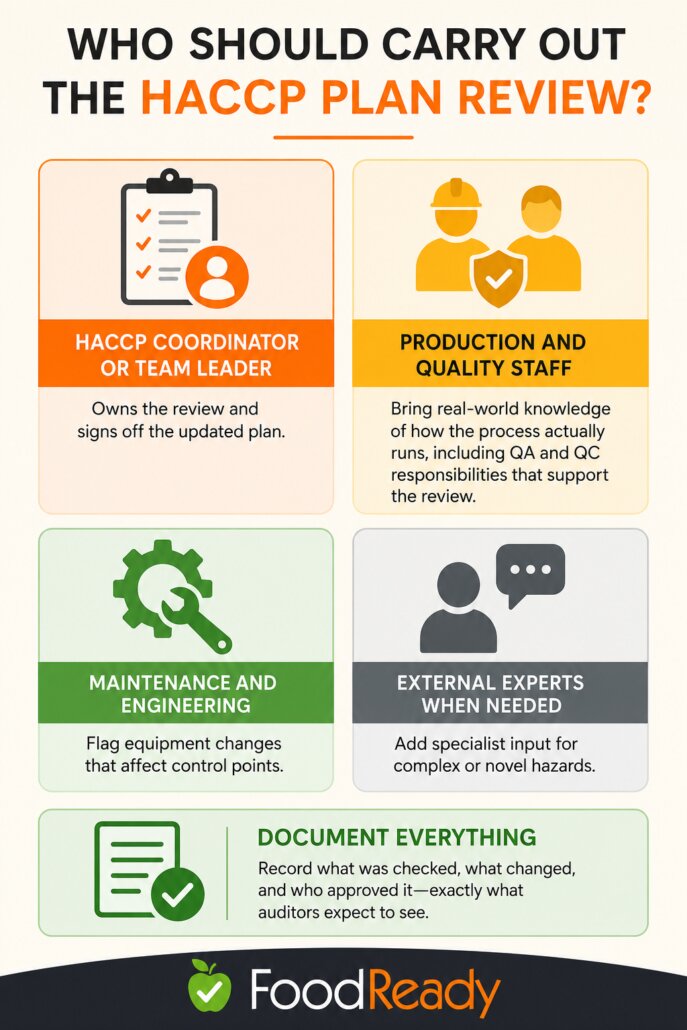
A HACCP review is the responsibility of the HACCP team, typically coordinated by the food safety team leader. The strongest reviews pull in people who see the process from different angles.
- HACCP coordinator or team leader: Owns the review and signs off the updated plan.
- Production and quality staff: Bring real-world knowledge of how the process actually runs, including quality assurance and quality control responsibilities that support the review.
- Maintenance and engineering: Flag equipment changes that affect control points.
- External experts when needed: Add specialist input for complex or novel hazards.
Whoever leads it, the review and its outcome must be documented. Clear records of what was checked, what changed, and who approved it are exactly what auditors expect to see, and they form part of your wider food safety management system to help maintain compliance with internal and external requirements.
New Updates: What Is Changing in HACCP Reviews?
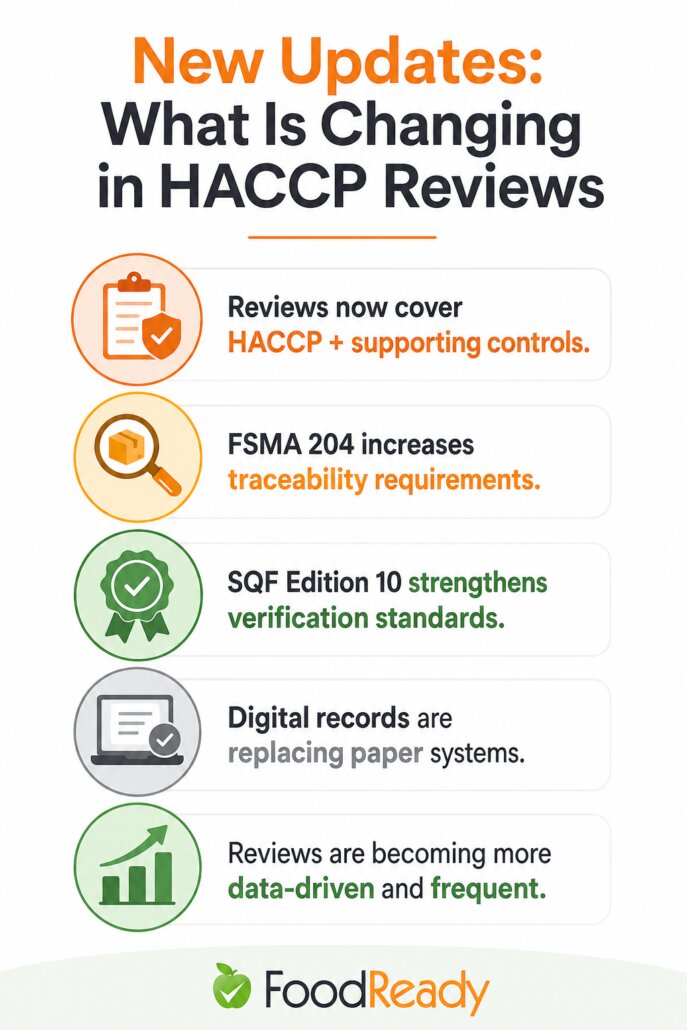
Food safety expectations keep moving, and the way plans are reviewed is moving with them. Newer reviews increasingly look beyond the haccp plan alone to supporting controls, including prerequisite programs and broader food hygiene measures. A few shifts matter most right now.
- FSMA 204 is reshaping recordkeeping: FSMA 204 requires firms handling foods on the Food Traceability List to capture key data elements at critical tracking events. The compliance date was extended, so now is the time to fold traceability into your review cycle.
- SQF Edition 10 raises the bar: Edition 10 was released in 2026, with audits beginning January 2027, and it places greater weight on food safety culture, data integrity, and verification of records during reviews. Standards such as ISO 22000 also integrate HACCP with good manufacturing practices as part of the broader review framework.
- Digital reviews are becoming the norm: Regulators and certification bodies increasingly expect timestamped, traceable review records rather than paper binders that are hard to verify, including checks tied to standard operating procedures.
The direction is clear. Reviews are becoming more frequent, more data-driven, and more tightly connected to traceability and verification.
How FoodReady Ensures Compliance With HACCP System and Food Safety Management Reviews?
FoodReady was built to make HACCP reviews simple, timely, and audit-ready while supporting implementing HACCP through one connected HACCP program, not just annual reviews.
Instead of hunting through binders once a year, your plan lives in one connected platform where every hazard, control point, and record is linked, so a review becomes a guided process rather than a scramble.
Here is how the platform keeps your reviews on track:
- Build and update your plan fast with the FoodReady HACCP Builder, drawing on more than 80 industry templates and customizing every control point.
- Automated reminders flag when an annual reassessment is due, so a review is never missed.
- Change driven prompts encourage a reassessment when you add a product, supplier, or process step.
- Linked traceability and recall management means a deviation or recall instantly points to the parts of the plan that need a fresh look.
- Cloud based version history keeps every review timestamped, traceable, and ready for any GFSI, SQF, BRCGS, FSSC 22000, FDA, or USDA inspection.
On top of the software, FoodReady pairs you with certified food safety experts who guide your reviews, help you close gaps before an auditor finds them, and support teams that need HACCP certification, which confirms completion of accredited training. For workforce readiness, they can also help staff navigate certification programs, and HACCP training typically takes 18 hours to complete.
You can schedule a demo to see how the platform turns the review from a yearly headache into a continuous, controlled habit.
Conclusion
So when should a HACCP system be reviewed? At least once a year as a baseline, and immediately whenever a product, process, supplier, regulation, or piece of new science changes the risk picture. A review keeps your hazard analysis honest, your critical control points relevant, your records ready for inspection, and supports controlling food safety hazards early to minimize food waste from preventable deviations or recalls. The businesses that treat the HACCP review as a living habit rather than an annual chore are the ones that stay compliant and protect their customers. FoodReady gives you the reminders, the structure, and the expert support to make that habit effortless.
FAQs
At a minimum, a HACCP system should be reassessed at least once a year. Annual review helps keep an effective HACCP plan current as products, processes, and identified hazards evolve. Higher-risk operations often review more frequently, and any significant change triggers an immediate review.
A new product or recipe, a process or equipment change, a new supplier or raw material, a deviation or recall, a new regulation, or new scientific information all trigger a review and may require the business to conduct a hazard analysis again, including hazard identification and hazard evaluation for any significant hazards introduced by the change.
Verification is the ongoing confirmation that the plan works day to day, such as record review and calibration. It includes verification procedures and verification activities used to confirm the plan is functioning as intended, and teams may also establish verification procedures to support ongoing effectiveness. A review, or reassessment, is the broader periodic check that the whole plan is still valid.
A trained HACCP coordinator or food safety team leader leads the review, while food safety professionals from production, maintenance, sanitation, quality, and related functions contribute to the review team, with outside experts involved for complex hazards. This applies across many food businesses, where cross-functional input helps keep the plan practical and effective.
Yes. Even with no changes, an annual reassessment is expected to confirm the plan is still valid, that existing control measures still keep hazards at an acceptable level, and to satisfy regulators and certification schemes.
Record what was checked, any changes made, the reasons for them, and who approved the updated plan. Update the written HACCP plan to document any revised critical limits, monitoring procedures, and other review outcomes, since these records are exactly what auditors ask to see.
FoodReady links your whole plan in one platform, helps teams with producing safe foods by helping them identify potential hazards, connect them to control points, and stay ready for any inspection service or certification, with automated reminders for annual and change driven reviews and every version timestamped and audit-ready across food manufacturing operations and the wider supply chain.