Here’s something remarkable: FoodReady’s AI-powered traceability platform is now running in hundreds of food and beverage facilities across North America and beyond. We’re talking about millions of traceability events being processed every single day. Everything from the moment ingredients arrive at the receiving dock all the way through to finished products heading out the door.
The growth has been incredible, and it’s not just small operations jumping on board. Major household names like Dole are using the platform. This tells us something important: the food industry is fundamentally changing how it thinks about supply chain transparency and safety compliance.
What we’re seeing is food companies across the globe using FoodReady to tackle increasingly complex regulations, slash recall response times from days down to minutes, and get the kind of real-time supply chain visibility they’ve never had before.
The impact?
Facilities can now track products with confidence from the moment raw materials arrive through every step of production and shipping.
Why Traceability Matters More Now Than Ever Before?
Let’s be honest. Food traceability has always been important, but right now? It’s become absolutely critical. Several big trends are converging all at once, making life both more challenging and more interesting for food manufacturers.
First up is the FDA’s FSMA 204 (that’s the Food Safety Modernization Act Section 204, for the acronym-averse among us). This regulation is a game-changer. It requires enhanced record-keeping for high-risk foods and demands lightning-fast turnaround on trace-back data.
If you’re handling foods on the FDA’s Food Traceability List—think fresh-cut fruits and vegetables, certain cheeses, shell eggs, nut butter, ready-to-eat deli salads—you’ll soon need to maintain detailed Key Data Elements (KDEs) for each Critical Tracking Event (CTE). And here’s the kicker: when the FDA comes calling, you’ve got just 24 hours to hand over that information.
The compliance deadline? January 20, 2026. Industry surveys paint a pretty alarming picture: fewer than 40% of affected food companies have actually implemented systems that can meet these new requirements. So we’ve got a compliance crisis brewing, but also a real opportunity for companies that get ahead of the curve.
Global Standards Keep Raising the Bar
Meanwhile, global food safety standards like SQF (Safe Quality Food), BRCGS (Brand Reputation Compliance Global Standards), and FSSC 22000 aren’t letting up either. Each has its own rigorous traceability expectations.
Take BRCGS certification, for instance. They require companies to prove they can conduct a complete mock recall traceability exercise in just 4 hours. Four hours! If you’re still relying on paper-based systems or a bunch of disconnected software tools, that’s basically impossible.
Here’s how the major standards stack up:
| Standard/Regulation | Key Requirement | Response Timeline | Scope |
|---|---|---|---|
| FDA FSMA 204 | Complete KDE records for CTEs | 24 hours for FDA requests | Foods on Traceability List |
| BRCGS Issue 9 | Mock recall exercise completion | 4 hours | All food products |
| SQF Edition 9 | One-up, one-back traceability | Must demonstrate within audit | All ingredients and products |
| GFSI Requirements | Mass balance verification | Real-time for audits | Complete facility operations |
| FSSC 22000 v6 | Traceability testing quarterly | Varies by facility | All materials and products |
Bottom line?
Manual tracking with paper and spreadsheets isn’t just outdated anymore. It’s genuinely non-compliant in many cases.
The Business Case: It’s About More Than Just Compliance
Beyond keeping food inspectors happy, there’s a massive business incentive here: avoiding recall disasters.
Food recalls have been climbing steadily over the past decade, and when they hit, the costs are absolutely devastating. We’re talking an average of $10 million in direct costs per recall. And that’s before you factor in lost sales during the recall period, long-term damage to your brand reputation, or the nightmare scenario of class-action lawsuits.
Here’s the real problem: without the ability to quickly pinpoint exactly which lots are affected, companies often have to recall way more product than necessary. A contamination issue affecting one production run can explode into a nationwide recall if your traceability systems can’t isolate the problem fast enough.
Strong traceability infrastructure can dramatically change this equation. Industry studies show that modern traceability technology can reduce recall scope by 50-95%. That’s huge. Instead of an incident spreading across multiple distribution channels and geographic regions, you contain it within hours instead of weeks. You avoid pulling perfectly safe products off store shelves unnecessarily.
Check out these potential costs:
| Cost Factor | Estimated Cost Range | Recovery Timeline |
|---|---|---|
| Average Recall Cost | $10 million in direct expenses | N/A |
| Brand Value Loss | 2% – 8% decline in market share post-recall | 18-36 months to rebuild consumer confidence |
| Regulatory Fines | $250,000 – $5 million for non-compliance | N/A |
| Litigation Costs | $15 – $50 million for major foodborne illness outbreaks | N/A |
The message is clear: proactive traceability isn’t just about satisfying auditors. It’s about protecting consumers, preserving your brand, and protecting your bottom line.
Why Legacy Systems Just Don’t Cut It Anymore?
The Paper Trail Nightmare
Walk into many food facilities today, and you’ll still see paper everywhere. Production supervisors recording lot numbers in notebooks. QA teams filing batch records in old-school filing cabinets. Receiving clerks writing supplier information on clipboards.
When an auditor shows up asking for a traceback? Staff members spend hours—sometimes days—piecing together information from all over the place. This approach has so many failure points it’s almost hard to count them all:
- Human error such as handwriting mistakes, transposed numbers, and forgotten entries are most common
- Time delays mean information isn’t available until someone manually enters it into the system
- Inaccessibility is a real problem when records stored in filing cabinets can’t be searched electronically
- Incomplete data happens constantly—such as missing fields and inconsistent record-keeping
- Isolated information keeps receiving, production, and shipping records completely separate and uncohesive.
Replace Manual Traceability With AI-Driven Precision
Customize the digital solution to
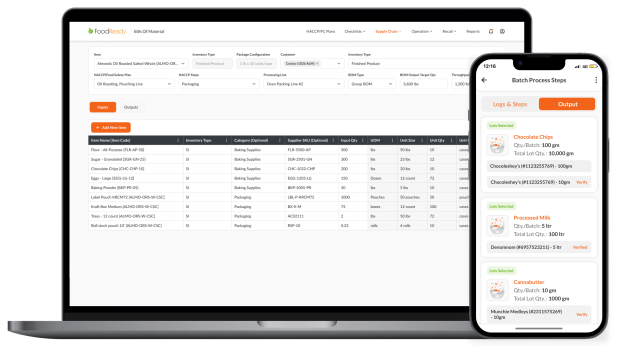
Reduce data errors by up to 95% and recapture hours of QA labor daily.
When Spreadsheets Aren’t Enough
Some facilities have graduated to spreadsheet-based tracking. That’s definitely a step up from paper, but it brings its own headaches.
Excel files get completely unwieldy when you’re dealing with thousands of rows of data. Version control becomes a nightmare when multiple people need access and there’s no real-time validation of what people are entering.
Here’s the biggest issue though: spreadsheets can’t automatically link ingredient lots to finished product lots across complex production processes. You end up doing that manually, which defeats half the purpose.
The Legacy Software Problem
Even facilities using older food safety software often find their traceability capabilities falling short. Many of these legacy systems were designed primarily for quality documentation or basic inventory management. Traceability was kind of an afterthought.
These systems typically can’t handle:
- Complex manufacturing processes involving rework, blending, or co-packing
- Seamless integration with suppliers or customers for true end-to-end visibility
- Real-time data capture on mobile devices (because who designed software for phones back then?)
- AI to validate data quality or predict issues before they happen
- Automatic generation of FSMA 204-compliant reports
What Makes AI-Native Traceability Different?
The FoodReady Approach
Unlike older systems that treat traceability like a checkbox feature you only think about during audits, FoodReady’s food traceability software was built from day one with artificial intelligence, real-time data capture, and regulatory compliance baked into its DNA.
Gerry Galloway, Co-Founder and Co-CEO of FoodReady, puts it perfectly:
“Traceability shouldn’t be an afterthought or an audit panic button. It should be woven into the daily workflow, powered by AI, and accessible in real time from receiving through shipping. That’s the only way to ensure both compliance and operational excellence.”
What used to be tedious and error-prone is now an integrated part of production and quality operations that runs continuously in the background. It’s validating data and flagging issues before they become compliance problems or safety risks.
Core Capabilities That Actually Matter
Let’s break down what FoodReady’s traceability engine actually does:
1. End-to-End Lot Tracking: The system tracks every single ingredient and finished product with a unique identifier from the moment it arrives through the moment it ships out. We’re tracking raw material receiving, staging and storage, production usage, in-process holds, rework, packaging, warehouse movements, and distribution. The result? True ingredient-to-finished-goods traceability in both directions, backward and forward.
2. Real-Time Inventory Visibility: Inventory changes get logged automatically as materials move around. You get real-time status on everything: which lot numbers are present, their precise storage locations, quantity on hand versus allocated, age of inventory (FIFO tracking), and hold or release status. This eliminates “ghost inventory”—you know exactly what you have and where it is.
3. Centralized Compliance Documentation: All traceability records and compliance checkpoints automatically capture and store in one database. This includes complete capture of Key Data Elements (KDEs) for Critical Tracking Events (CTEs), searchable electronic records, automated traceability matrices, mock recall documentation, and a full audit trail. It’s everything you need to meet FDA FSMA 204 requirements and breeze through audits for global schemes like SQF and BRCGS.
4. Mobile-First Data Capture: Operators and QA staff use tablets or smartphones to scan barcodes, enter data, and verify information right there on the plant floor. Data gets captured at the source, it’s instantly available, you get electronic signatures, and you can even take photos or videos for documentation. This ensures data is captured accurately at the exact moment of operation, eliminating all those delays from manual data entry later.
5. Integrated ERP and Supply Chain Features: The platform links traceability functionality with broader enterprise features. You get supplier management with vendor portals, purchase order tracking, production batch planning and scheduling, inventory control and warehouse management, and customer order fulfillment and shipping. It’s like having ERP functionality built right in, making it way more than just a standalone traceability tool.
Following the Food: From Dock to Distribution
Let’s walk through what actually happens at each stage:
Receiving Dock
Staff scan supplier lot codes, perform temperature checks, verify Certificates of Analysis (COAs), generate internal lot IDs, and make QA hold or release decisions.
Ingredient Storage
The system assigns warehouse locations, tracks FIFO/FEFO (first in, first out / first expired, first out), monitors hold status, maintains real-time inventory counts, and tracks expiration dates.
Production Allocation
Work orders get generated, specific lots are allocated to production runs, materials are staged, batch tickets print out, and production lot codes are created.
Manufactoring
The system records which lots are consumed, tracks process parameters, captures in-line checks, documents any rework, calculates yields, and monitors Critical Control Points (CCPs).
Packaging & Labeling
Case codes get generated and linked to production lots, label verification happens automatically, quantities are reconciled, pallets are built, and QA sampling is documented.
Finished Goods Storage
Warehouse locations are assigned for finished products, lot tracking continues, products are allocated to customer orders, and pre-shipment checks are completed.
Shipping & Distribution
Lots get linked to specific customers, shipping documents generate automatically, Bills of Lading are tracked, you get distribution chain visibility, and customer receipt is confirmed.
At every single stage, FoodReady captures those critical tracking events and key data elements automatically. You end up with an unbroken chain of custody from your supplier all the way to your customer.
Meeting FSMA 204 Requirements Head-On
Understanding the New Language
FSMA 204 introduces some specific terminology that food facilities need to wrap their heads around:
Critical Tracking Events (CTEs) are the specific points in your supply chain where you must record traceability information:
- Receiving
- Transformation (that’s manufacturing or processing)
- Creation (initial packing)
- Shipping
Key Data Elements (KDEs) are the specific pieces of information you must capture at each CTE. This includes traceability lot codes, product descriptions, quantities and units of measure, locations (where things came from or where they’re going), dates of events, and reference document numbers.
Here’s what you need to capture at each CTE:
| Critical Tracking Event | Required Key Data Elements |
|---|---|
| Receiving | Traceability lot code, product description, quantity, unit of measure, supplier name, supplier location, date received, location where received, reference document number |
| Transformation | New traceability lot code, product description, quantity, date of packing, location where packed, reference document number |
| Creation | Initial traceability lot code, product description, quantity, date of packing, location where packed, reference document number |
| Shipping | Traceability lot code, quantity shipped, unit of measure, customer name, customer location, date shipped, location shipped from, reference document number |
How FoodReady Makes FSMA 204 Compliance Automatic?
FoodReady’s platform was designed with FSMA 204 requirements fully baked in from the start:
Automatic KDE Capture: The system prompts users to capture all required KDEs at each CTE. Validation rules prevent incomplete recordsyou literally can’t move forward without filling everything in correctly.
Digital Traceability Lot Codes: FoodReady automatically generates compliant traceability lot codes which are customizable and meet FDA formatting requirements and ensure uniqueness across your entire operation.
24-Hour Recall Response: The platform can generate complete sortable spreadsheets of traceability information for any lot code within minutes. That’s well within the 24-hour FDA requirement—by a long shot.
Electronic Recordkeeping: All traceability records are maintained electronically in FDA-compliant format. Everything’s searchable and sortable by any field you need.
Audit-Ready Documentation: Pre-built reports demonstrate compliance with FSMA 204 requirements, complete with timestamps and electronic signatures. When auditors show up, you’re ready.
Real-World Adoption and Impact
Growing Fast Across the Industry
Over the past year, FoodReady has seen significant growth among mid-size and large food companies deploying our traceability tools. What’s driving it? Usually it’s the growing complexity of compliance requirements combined with some hard lessons learned from recent high-profile industry recalls.
According to internal data, the number of customers using our traceability module has steadily increased year on year. We’re seeing particularly strong adoption in the sectors below, facing the toughest traceability challenges.
| Industry Segment | Primary Drivers | Typical Facility Size |
|---|---|---|
| Fresh Produce Processing | FSMA 204 compliance, short shelf live | 50-200 employees |
| Ready-to-Eat Meals | BRCGS requirements, complex recipes | 100-500 employees |
| Seafood Processing | Export and seasonal requirements, allergen tracking | 30-150 employees |
| Meat & Poultry | USDA coordination, high recall risk | 200-1000 employees |
| Dairy Processing | SQF certification, tanker tracking | 50-300 employees |
| Bakery Operations | Multi-ingredient complexity, allergens | 40-200 employees |
What Customers Are Actually Experiencing?
Early adopters are reporting some pretty remarkable benefits in both operational efficiency and regulatory confidence.
One QA manager at a ready-to-eat meals facility that produces over 50,000 units daily told us: “Our lot tracking and recall prep went from hours to minutes. FoodReady made it effortless. What used to require three people working for half a day now takes one person 10 minutes.”
Think about what that means in practical terms. What used to be a frantic all-hands scramble—everyone sifting through paper logs or disparate spreadsheets when an auditor requested a traceback or when a potential contamination got reported—is now largely automated.
Need to trace a finished product back to its ingredient sources (backward traceability)? Or identify all products made with a specific ingredient lot (forward traceability)? FoodReady generates the complete trail in seconds.
The Numbers Don’t Lie
FoodReady customers are reporting measurable improvements across the board:
| Category | Metric | Before FoodReady | After FoodReady | Improvement |
|---|---|---|---|---|
| Time Safings | Mock recall exercises | 4-8 hours | 10-30 minutes | Down to 10-30 minutes |
| Audit preparation | 40+ hours | 8-10 hours | Down to 8-10 hours | |
| Daily traceability documentation | 100% (baseline) | 25-40% | Decreased by 60%-75% | |
| Regulatory report generation | 8-12 hours | Completely automated | Completely automated | |
| Accuracy Improvements | Date entry errors | 100% (baseline) | 5-15% | Reduced by 85-95% |
| Missing information at audit | 15-30% | Under 2% | Down to under 2% | |
| Inventory discrepancies | 10% | Under 5% | Down to under 5% | |
| Compliance Confidence | First-time audit pass rate | Industry average of 78% | 90% and over | Up to 90% and over |
| Customer compliants about traceability | 100% (baseline) | 10% (remaining compliants) | Reduced by 90% | |
| Regulatory warning letters | Industry standard (some occurrence) | Zero | Zero post-implementation |
This speed and accuracy aren’t just about saving labor costs—though that’s certainly nice. They can potentially save lives by enabling immediate action when a problem gets identified. Several companies have told us their ability to respond to customer complaints or potential safety issues has completely transformed from reactive to proactive.
Audit Day: From Stressful to Straightforward
Maybe nowhere is the impact more visible than during certification audits. Instead of spending days hunting down documents and crossing your fingers that records are complete, FoodReady customers can pull up required traceability records and reports within moments. You’re providing auditors exactly what they need with full confidence in the data’s accuracy and completeness.
Multiple SQF and BRCGS auditors have commented on the difference they see when auditing FoodReady facilities versus those using legacy systems. One auditor noted: “When I arrive at a FoodReady facility, I know the traceability portion of the audit will be straightforward. The data is organized, complete, and instantly accessible. It’s night and day compared to facilities still using spreadsheets.”
Going Beyond Basic Compliance
Handling Complex Manufacturing Scenarios
Modern food manufacturing often involves complexity that makes traditional traceability systems fall flat on their face:
Blending and Co-Mingling: When you’re combining multiple ingredient lots into a single batch, FoodReady tracks the contribution of each lot. This enables precise mass balance calculations—you know exactly what went in and exactly what came out.
Rework and Reprocessing: When product comes back to the line for rework, the system maintains complete traceability of both the original materials and the reworked stuff. Nothing gets lost in the shuffle.
Multi-Stage Production: For products manufactured across multiple facilities or production stages, FoodReady links traceability records across the entire supply chain. It’s seamless.
Private Label and Co-Packing: When you’re manufacturing for multiple brands, the system maintains separate traceability chains while still sharing underlying ingredient data. Everyone gets what they need.
Building Real Recall Confidence
FoodReady customers who conduct regular mock recalls report significantly higher confidence in their ability to handle real recall situations when they happen. This confidence translates into some really valuable capabilities:
- Faster decision-making during actual incidents (you’re not scrambling to figure out what you have)
- Reduced scope of recalls (fewer products unnecessarily withdrawn)
- Lower panic and stress among staff during emergencies (everyone knows the system works)
- Stronger relationships with food governing bodies and customers who can see how prepared you are.
Several customers have told us that FoodReady’s mock recall capabilities helped them navigate real recall situations successfully. One produce processor shared that they managed a supplier-initiated recall affecting only 2% of their products. With their previous system? They would have needed to recall 40%. That’s a massive difference.
The Bottom Line: Traceability as a Competitive Advantage
Food traceability has evolved from being just a compliance burden into something much more valuable: a genuine strategic competitive advantage.
Companies with robust traceability systems can:
- Respond to recalls faster and more precisely, minimizing damage to the brand and bottom line
- Pass audits confidently with complete documentation (no more sleepless nights before audit day)
- Build stronger relationships with customers who value utmost transparency
- Command premium prices for products with verified provenance (consumers will pay for peace of mind)
- Enter new markets with stringent traceability requirements (doors open that used to be closed)
- Make better business decisions based on real supply chain data
FoodReady’s AI-powered platform represents the future of food traceability—a future where compliance happens automatically in the background, where AI validation assures data quality, and where potential problems get predicted and prevented before they impact consumers or your business.
Time to Make Your Move
As FSMA 204 compliance deadlines approach and food safety standards continue evolving, the gap between industry leaders and laggards in traceability is only going to widen.
The hundreds of facilities worldwide now running on FoodReady’s platform aren’t just checking compliance boxes. They’re transforming traceability from a dreaded audit exercise into a genuine source of operational excellence and competitive differentiation. They’re proving that with the right tools, traceability can be effortless, continuous, and even provide strategic value that goes way beyond food safety.
The question facing food manufacturers today isn’t really whether to invest in modern traceability. That decision has essentially been made for you by food inspectors and market forces. The real question is how quickly you can implement it before falling behind your more forward-thinking competitors.
With regulatory deadlines looming and consumer expectations for transparency rising every day, the time to act is now. Don’t be the facility still scrambling with spreadsheets when everyone else has moved on to something better.