

Food Safety Standards Comparison of the USA, UK and Canada
Compare food safety standards across the USA, UK and Canada and discover how FoodReady keeps your facility compliant regardless of your country.
Published:Last updated:Author:Suhina Fitzpatrick
International food safety protocols differ across borders, though they typically prioritize traceability, sanitation, and hazard management frameworks (such as HACCP) to mitigate foodborne risks. The United States, the United Kingdom, and Canada each have their own laws, enforcement agencies, and compliance deadlines. All three are in the midst of major regulatory change heading into 2026. For food manufacturers operating in any of these markets or planning to expand into them, understanding how each system works and where they differ is not optional. It’s the foundation of any serious compliance strategy.
This article breaks down how food safety standards in the USA, UK, and Canada compare, what the 2026 updates mean for your facility, and how FoodReady supports manufacturers in meeting those requirements regardless of which regulatory framework they are in.
Why Comparing Food Safety Standards Matters?
When a product crosses a border, it doesn’t leave its compliance obligations behind. Every country’s food safety framework has its own requirements around HACCP, GMP, labeling, traceability, contaminant limits, and supplier verification. What satisfies a U.S. FDA inspector may not satisfy a UK Food Standards Agency auditor. What meets Canadian Food Inspection Agency requirements may need additional documentation to enter the American market.
This is not just theoretical. Food manufacturers that export, co-pack for international brands, or source ingredients from global supply chains regularly encounter conflicts between what one regulatory body expects and what another requires. The companies that navigate those conflicts best are the ones that understand the frameworks before the conflict arises, not after a non-conformance has already been flagged during an audit or at the border.
All three countries anchor their regulatory thinking to the principles of the Codex Alimentarius and use HACCP as the recognized backbone of a food safety management system.
But the way those principles are codified into law, enforced, and updated differs significantly between each jurisdiction.
Food Safety Standards in the United States
The U.S. food safety regulatory structure is built around the Food Safety Modernization Act (FSMA), commonly known as FSMA. Signed into law in 2011, FSMA was the biggest change in American food safety regulation in over 70 years. It moved the FDA’s focus from responding to foodborne illness outbreaks to preventing them and placed the burden of building and maintaining a preventive food safety system on manufacturers.
The primary federal agencies involved are the FDA and its role in the food industry, which oversees most food products except meat, poultry, and egg products, and the USDA’s Food Safety and Inspection Service, which governs those animal product categories. The CDC monitors foodborne illness data and outbreak investigations but does not have direct regulatory authority over manufacturers.
For food manufacturers, the most operationally significant FSMA rules are the Preventive Controls for Human Food rule, which requires a written food safety plan with hazard analysis, preventive controls, monitoring procedures, corrective actions, and the Produce Safety Rule.
This rule governs growing, harvesting, and packing of fresh produce within the broader context of food safety regulations and compliance. FDA compliance in the U.S. context means building and maintaining systems that satisfy all applicable FSMA requirements with documented evidence that those systems are working as intended.
Food Safety Standards in the United Kingdom
Following Brexit, the UK’s food safety framework diverged from the European Union’s regulatory structure. The Food Standards Agency is the primary authority for England, Wales, and Northern Ireland, while Food Standards Scotland operates independently in Scotland. The legislative foundation includes the Food Safety Act 1990 and subsequent regulations that govern food hygiene, labeling, contaminants, and food composition.
The UK food safety system places heavy emphasis on food business operators taking responsibility for food safety rather than relying on government inspection as the primary control mechanism. The requirement to implement food safety management systems based on HACCP principles applies to all food businesses operating in the UK. Retailers and major food service buyers also expect manufacturers to carry GFSI benchmarked certifications such as BRCGS or SALSA, which are deeply embedded in the UK market as commercial requirements rather than just regulatory ones.
Labeling obligations in the UK are governed by the Food Information to Consumers regulations, which require specific allergen declarations, nutritional information, and country of origin labeling.
Food Safety Standards in Canada
Canada’s food safety framework is administered by the Canadian Food Inspection Agency and Health Canada. The Safe Food for Canadians Act, which came into force in 2019 and replaced several older statutes, also modernizing Canada’s approach to food safety regulation. Like FSMA in the U.S., it emphasized preventive controls, traceability, licensing and written food safety plans as mandatory requirements for food manufacturers.
Under the Safe Food for Canadians Regulations, most businesses that manufacture, process, treat, preserve, grade, package or label food for import, export or interprovincial trade must hold a license and have a written preventive control plan. The plan must cover areas including food safety hazard identification, preventive controls, monitoring, corrective actions, verification and record keeping. This structure is similar to FSMA’s requirements which makes dual compliance more manageable for manufacturers operating in both North American markets.
Health Canada is responsible for establishing food safety standards including those governing food additives, contaminant limits and nutritional labeling requirements. The Food and Drugs Act is the overarching legislation that Health Canada administers and governs the composition, labeling, packaging, storage and sale of food in Canada.
2026 Updates Across All Three Countries
2026 is a big year for food safety regulation in all three countries, and the changes are significant enough to require immediate attention from any manufacturer operating in these markets.
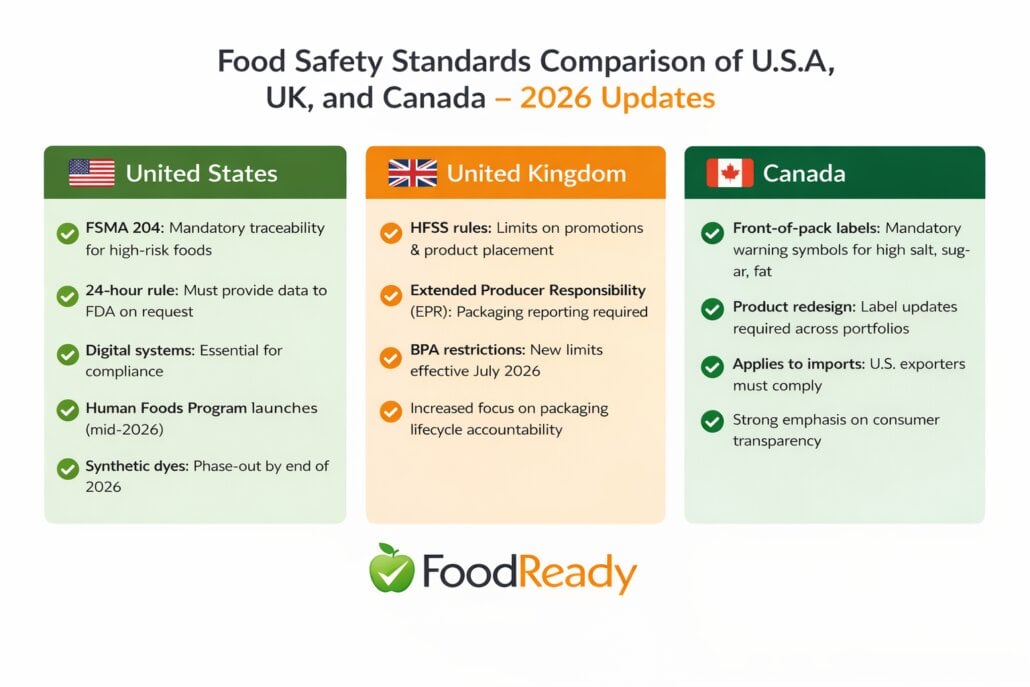
In the United States, the most important change for food manufacturers is the enforcement of FSMA Rule 204, which introduces enhanced traceability requirements for foods on the Food Traceability List, including:
- Leafy greens
- Shell eggs
- Nut butters
- Fresh herbs
- Ready-to-eat deli salads
Manufacturers handling these products must now maintain Critical Tracking Event records and Key Data Elements and be able to share that information with the FDA within 24 hours of a request.
FSMA 204 compliance is not optional, and facilities that do not have digital traceability systems in place are at serious risk. The FDA’s Human Foods Program is also expected to be fully operational by mid-2026, consolidating CFSAN and field operations under a single leadership structure designed to improve outbreak response.
Separately, the end of 2026 marks the voluntary deadline by which major food companies agreed to phase out six synthetic dyes, creating significant reformulation pressure across categories.
In the United Kingdom, January 2026 brought two big changes. New advertising and marketing restrictions for high-fat, high-salt, and high-sugar products are now in force, banning volume promotions and prominent in-store placements for HFSS products.
Extended Producer Responsibility rules also came into effect, placing greater accountability on food manufacturers for the full life cycle of their packaging and requiring detailed reporting on material weights and recyclability. From July 2026, new restrictions on Bisphenol A in food packaging will apply, based on updated scientific advice from the European Food Safety Authority. Manufacturers using packaging materials containing BPA need to verify their compliance status against the new limits before that deadline.
In Canada, front-of-package nutrition symbol requirements will become mandatory in 2026. This means eligible prepackaged foods that are high in sodium, saturated fat, or sugar must display a clearly visible symbol on the front of the package. For manufacturers selling into the Canadian market, this means a labeling review and potential redesign across a significant portion of product portfolios. The compliance requirement applies to both Canadian producers and importers, which means U.S. manufacturers exporting food into Canada need to treat this as an active compliance deadline, not a future consideration.
How FoodReady Addresses Multi-Country Food Safety Compliance?
Managing compliance across the USA, UK, and Canada is not a spreadsheet exercise. Each framework has its own documentation requirements, its own audit schedule, and its own enforcement emphasis. FoodReady’s food safety software and consulting platform is designed to support food manufacturers across all of these requirements from a single connected system.
The HACCP plan builder on the FoodReady platform creates food safety documentation that meets the structural requirements of FSMA preventive controls, the Safe Food for Canadians Regulations, and UK Food Standards Agency expectations simultaneously. The underlying principles are the same across all three frameworks because all three are based on Codex HACCP methodology. A properly built plan on FoodReady is not jurisdiction-specific. It is built to stand up wherever it is reviewed.
For FSMA 204 traceability, FoodReady’s lot tracking and food traceability software tools create the Critical Tracking Event records and Key Data Element documentation that the FDA requires. For manufacturers selling into the Canadian market, the same system supports the traceability and preventive control plan documentation required under the Safe Food for Canadians Regulations. The record-keeping architecture does not need to be rebuilt for each country. It is centralized, auditable, and accessible. Supplier management is another area where FoodReady adds value for multi-country operators. Whether a UK buyer requires a BRCGS certificate, a U.S. customer needs FSMA supplier verification documentation, or a Canadian inspector asks for a supplier’s food safety plan, FoodReady’s supplier approval and document management tools keep those records organized, current, and ready for review. Explore SQF certification consulting, BRC consulting, and GFSI certification support for the specific certification pathway that fits your market.
For manufacturers preparing for regulatory audits or GFSI certification across any of these three markets, FoodReady’s food safety consulting services have direct experience with FDA, CFIA, and UK FSA compliance. That means you are not navigating a general compliance framework. You are working with advisors who understand the specific documentation, inspection practices, and audit expectations of each regulatory body. Learn more about the full range of food safety consulting services available through the platform.
One Standard of Excellence Across Every Market
The food safety frameworks in the USA, UK, and Canada are built on shared scientific principles but delivered through meaningfully different regulatory structures. Understanding those differences and staying current with the 2026 changes rolling out across all three countries is a real and ongoing compliance obligation. The manufacturers who manage that complexity well are the ones with systems and support infrastructure that make multi-country compliance manageable rather than overwhelming.
FoodReady gives you the food safety software and consulting platform, the documentation tools, and the consulting expertise to meet the requirements of each framework without building separate compliance systems for each country you operate in. See how it works for your facility at foodready.ai.
Frequently Asked Questions
Who are the main food safety regulatory bodies in the USA, UK and Canada?
In the USA, the FDA and USDA FSIS share oversight depending on product category. In the UK, the Food Standards Agency governs England, Wales, and Northern Ireland, with Food Standards Scotland operating independently. In Canada, the Canadian Food Inspection Agency enforces the Safe Food for Canadians Act, while Health Canada sets food safety and nutrition standards.
What is FSMA and why does it matter for food manufacturers?
The Food Safety Modernization Act is the central piece of U.S. food safety legislation. It requires manufacturers to implement preventive controls, maintain written food safety plans, and meet traceability requirements. FSMA Rule 204, enforced in 2026, adds enhanced traceability obligations for high-risk foods.
What are Canada’s food safety requirements for manufacturers?
Under the Safe Food for Canadians Regulations, most manufacturers producing food for import, export, or interprovincial trade must have a license and a written preventive control plan covering hazard analysis, monitoring, corrective actions, and record keeping.
What changed in UK food safety regulations in 2026?
January 2026 brought HFSS advertising restrictions and Extended Producer Responsibility packaging rules. BPA restrictions in food packaging take effect in July 2026. Manufacturers selling HFSS products in the UK also need to review volume promotion and placement practices.
How do HACCP requirements differ between the USA, UK and Canada?
All three countries require HACCP-based food safety plans, but the framework is different. The USA uses FSMA’s preventive controls framework. Canada requires a preventive control plan under the Safe Food for Canadians Regulations. The UK requires food safety management systems based on HACCP principles under food hygiene legislation. The underlying methodology is the same across all three.
Do GFSI certifications like BRCGS or SQF work across all three markets?
Yes. GFSI benchmarked certifications are recognized across the USA, UK, and Canada. BRCGS has strong recognition in the UK market, while SQF is widely accepted across North America. Getting GFSI certified simplifies compliance across all three markets.
How does FoodReady support compliance across the USA, UK and Canada?
FoodReady’s HACCP builder, lot tracking, supplier document management, and corrective action tools are built around the shared principles underlying FSMA, the Safe Food for Canadians Regulations, and UK food hygiene law. The platform and consulting team support certification preparation, traceability compliance, and audit readiness across all three markets from one system.
Speak with our Expert Consultants
15–30 minutes. We map FoodReady to your process, plug in your real HACCP plan, and show you the auditor view before the call ends.
About the author

Suhina Fitzpatrick
Senior Food Technologist
Suhina is a Subject-Matter Expert at FoodReady with 15 years in the industry as a Senior Food Technologist. Specializing in Food Safety, Quality and Food Manufacturing, Suhina is passionate about everything Food and has headed many successful Food Safety Audits according to global standards over the years. When away from the workstation, the gym and an active lifestyle is her happy place.