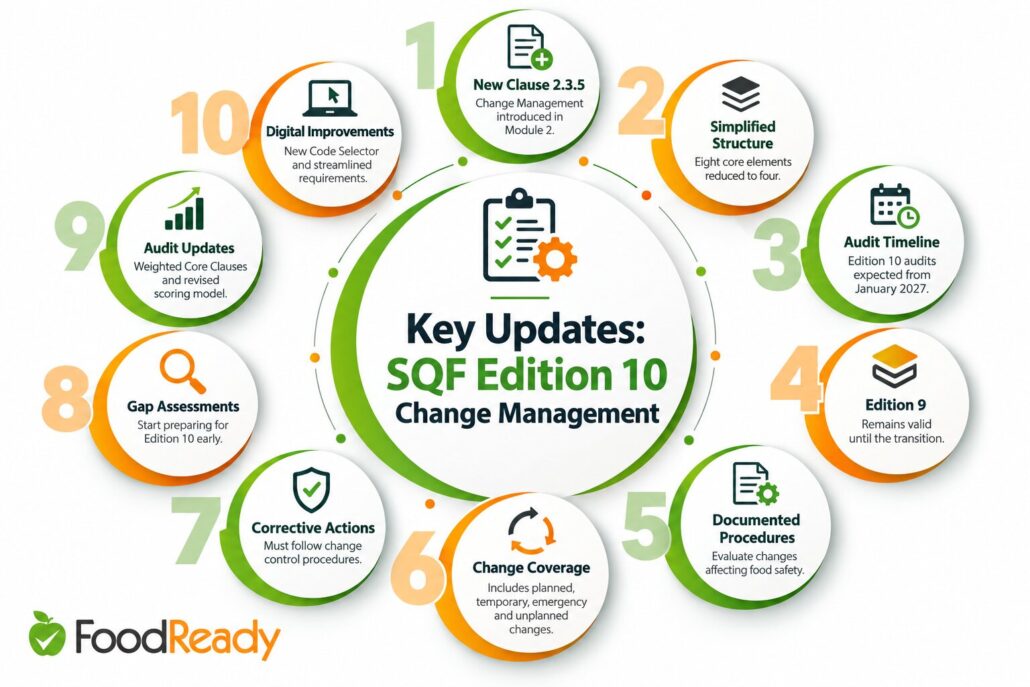
SQF Edition 10 is the new SQF Code released in March 2026, and one of its most important changes is a new Change Management requirement in clause 2.3.5. For food and beverage companies such as manufacturers, processors, co-packers, and distributors, especially mid-sized to enterprise sites, this means changes that once lived in email threads now need a documented process to evaluate their impact on food safety before auditors begin assessing Edition 10, starting January 2, 2027.
Every site changes. A supplier goes on allocation, so you qualify a backup. A filler breaks down and maintenance swaps in a rental unit. Your QA lead leaves and someone covers for two months. Under Edition 9, most of those decisions lived in email threads, and nobody asked to see the paper trail.
Edition 10 changes that. Change Management is one of the headline additions to the SQF Code, and it is the requirement most sites are quietly underestimating. It is not another binder. It is a discipline for proving your food safety system stays in control while the operation around it moves. Below, we break down what the new requirement means, the kinds of changes that need review, the procedure SQFI expects, what auditors will look for, how to get ready before the 2027 audit date, and how FoodReady can support compliance with software and consulting built for audit-ready food safety systems.
New Updates: Where Change Management Sits in Edition 10
SQFI released Edition 10 in March 2026. This new edition reorganizes the SQF food safety code from eight to four core elements. Audits are anticipated to begin no earlier than January 2, 2027, and that date is still tied to the GFSI benchmarking process, which means it can move later but not sooner. Until then, Edition 9 remains the recognized edition, and certification bodies will not blend requirements from both editions in a single audit. Organizations should start a gap assessment as soon as the code is released, rather than waiting for the audit window.
Change Management appears in Module 2 as a new clause, 2.3.5, within the broader SQF system and the SQF food safety framework. It sits directly after the Approved Supplier Program and asks the site to document and implement a procedure to evaluate any change that could impact food safety or the food safety system, including temporary, emergency, and unplanned changes, and those made as a result of the corrective action process. It becomes one more element your GFSI certification readiness program needs to manage deliberately.
That last category catches people off guard. A corrective action is a change. If you tighten a critical limit, reroute a line, or add a screen after a foreign matter finding, Edition 10 expects that decision to move through your change process, not around it.
For the wider view of what else is shifting, our SQF Edition 10 breakdown covers weighted Core Clauses, the revised scoring model, and the digitized Code experience, including the code selector, which points users to the right scope and moves Edition 10 toward real-time, integrated compliance tools instead of static PDFs. It also explains how consolidated multi-sector views simplify audits across food sector categories and how training requirements are consolidated into a single clause.
What Actually Counts as a Change
The Code language reaches well past capital projects.
| Change category | Everyday examples | Primary risk to assess |
|---|---|---|
| People | New QA lead, extended shift coverage, seasonal labor | Competency gaps, unclear CCP monitoring ownership |
| Process | Revised cook step, new sanitation frequency, line speed | Validation status, shifted hazard profile |
| Equipment | Replacement metal detector, gaskets, rental unit | Calibration, hygienic design, foreign matter |
| Ingredients and suppliers | Alternate raw material, new co-packer, packaging swap | Allergen profile, label accuracy, approval status |
| Facility | Construction, new drain, modified airflow | Zoning, cross-contamination, and environmental monitoring scope aligned to operational risk |
| Behavior | New changeover routine, revised verification sign-off, updated hygiene practice | Inconsistent adoption, drifting back to old habits |
| Temporary and emergency | Breakdown workarounds, weather events, recall response | Undocumented drift, no end date, no closure |
Temporary changes deserve extra attention. A Friday night workaround introduced to keep production running has a habit of becoming permanent by March, with no risk assessment behind it and no record of who approved it. Facility or traffic-flow changes may also require a risk-based assessment of environmental monitoring. A temporary change needs the same documented evaluation as a permanent one, plus a defined end date and a record showing it was either reversed or formally adopted, and those records should tie cleanly into your food traceability software so product history remains auditable.
Behavior is the change type sites most often overlook. Many changes only work if people adopt a new way of doing their job and execute it consistently, shift after shift. Where formulation or process steps shift, disciplined recipe management in the food and beverage industry is just as critical as operator training. Plan for that adoption as deliberately as you plan the technical change, through training, supervision on the floor, and follow-up checks to reduce food safety risks. Any updates to environmental monitoring should be site-specific, randomized, and based on environmental pathogen risks.
The Steps SQFI Recommends
SQFI publishes a Change Management guidance document alongside Edition 10 that outlines a documented management procedure for change management. Building your procedure around these steps is the clearest way to show an auditor that nothing was skipped and every step must be documented.
| Step | What it involves |
|---|---|
| 1. Initiation of change | Identify the proposed change and its rationale, then classify it as planned, unplanned, temporary, or emergency. |
| 2. Impact assessment | Evaluate effects on food safety and quality, legal and regulatory compliance, customer requirements, and operations, including preventive controls, CCPs, critical limits, and monitoring, plus food defense and quality assurance implications where applicable. |
| 3. Risk assessment | Score likelihood and severity with the site risk matrix and confirm the risk remains acceptable. |
| 4. Approval | Formal sign-off by authorized personnel, such as QA, the food safety team, and operations management, before implementation. |
| 5. Implementation | Execute the change with documented responsibilities and timelines, update procedures, and train affected people so they understand and minimize food safety risks and the new behavior is adopted. |
| 6. Validation and verification | Validation confirms the change will achieve the intended result. Verification confirms it was implemented correctly and is working as planned. |
| 7. Documentation and communication | Record the reason, assessments, decisions, and results, then communicate the change internally to affected staff and externally to customers and suppliers where required, and update documented procedures and standard operating procedures as needed. |
| 8. Review and closure | Conduct a post-implementation review to confirm there were no unintended consequences, and close the change only once all records are finalized. |
Validation and verification are separate activities. Validation proves the change can control the hazard, for example a challenge study on a new cook time. Verification proves it is working day to day, for example a review of process records across several production runs, which becomes far easier when your HACCP software platform centralizes monitoring data and trend reviews.
Communication is the step most often left informal. A positive food safety culture depends on employees feeling safe to raise food safety concerns. Operators need to know what changed and what they now do differently, and auditors may interview them to confirm it. When a change affects a customer, such as a formulation, label, specification, or supplier change on their product, notify that customer and keep a record of the notification; many sites lean on food safety consulting services to design these communication and documentation workflows.
What Auditors Will Expect to See
A compliant procedure does not need to be long. It needs to be specific, and it needs to have been used. Auditors will sample changes made since your last audit, verify implementation by reviewing documentation, and may conduct interviews with leadership and line staff. They expect everyone to be documented against these requirements, the same way they will walk through the broader SQF audit preparation steps you already follow:
Edition 10 also removes the old good, great, and excellent ratings.
The new scoring bands are Certified (80–100), Certified with Surveillance (70–79), and Fail (0–69), with point deductions weighted more heavily when an identified core clause is involved: a core clause minor deducts two points, and a core clause major deducts seven.
| Requirement | Description |
|---|---|
| Trigger criteria | A clear definition of what counts as a change worth evaluating, so the threshold is not left to individual judgment. |
| A documented risk assessment | Evidence someone considered the food safety impact before the change went live, not after. This ties directly to your HACCP plan, since a process or equipment change can invalidate a validated control. |
| Defined approval authority | Named roles, not just names. Who approves a supplier substitution differs from who approves a new CCP. |
| Linked document updates | The flow diagram, SOPs, monitoring records, allergen matrix, and training materials that move when the change does. |
| Validation, verification, and closure | Evidence the change was validated and verified as working, and for temporary changes, proof it was reversed or formally made permanent. |
| Communication and customer notification | Records showing affected staff were informed and trained, and that customers were notified where the change impacts their product, label, or specification; SQFI expects these controls to be verified in practice, not only on paper. |
Building the Procedure Before January 2027
Start with a gap assessment, not a blank template. Pull the last twelve months of changes your site actually made, ask what documentation exists for each, and for food manufacturers begin closing gaps as soon as the review is complete. Most teams find half are traceable through maintenance logs, supplier files, or corrective action records, and the other half are invisible. In this new certification cycle, a recertification audit or surveillance audit usually goes more smoothly when gaps are identified early.
Then write the procedure around how your site already works. If the production meeting is where changes get raised, make that the intake point. If maintenance controls equipment modifications, build the trigger into the work order. A procedure that fights your existing workflow will not survive contact with a busy plant, and many sites bring in a HACCP consultant for custom plan design when aligning workflows with risk-based controls.
Fold it into your verification cycle too. Your internal audit program should test change management the way it tests any other element, and management review should track change volume and closure rates as a trend, using tools such as HACCP plan templates and examples to standardize how changes flow into documentation. For effective preparation, internal audits should begin by October 2026. For multi site certification, central and site-level controls should align consistently across locations.
Train broadly. The clause fails most often because a supervisor did not recognize a decision as a change. Where a change depends on people working differently, confirm on the floor that the new behavior has stuck before you close it.
Five shortfalls will account for most findings: no defined trigger, so changes bypass the process; risk assessments completed retroactively to satisfy the file; temporary changes with no expiry date; corrective actions that never route through change control; and changes never communicated to the floor or to affected customers. Weak management commitment and missing food safety plans also often lead to major non conformances. Unannounced audits and the unannounced audit requirement remain unchanged under the new edition, so confirm scheduling with your certification body. Each is cheap to fix in 2026 and expensive to fix during your first Edition 10 audit, especially if you also maintain schemes like BRCGS food safety certification that layer on similar expectations.
Staying Compliant with FoodReady
Change management only works when documents, records, and approvals live in one connected system. FoodReady links your hazard analysis, CCPs, SOPs, supplier files, and monitoring records so a single change surfaces every document it touches, with version history and approval trails that hold up under scrutiny.
Every step of the process can be managed in FoodReady, from the initial gap assessment and change request through impact and risk assessment, approval, implementation and training, validation, verification of change, communication, and closure. The platform also helps organizations track corrective actions so nonconformances close within 40 days. Temporary changes carry an end date and an assigned owner, so nothing quietly becomes permanent, and every action is documented automatically, with pricing plans for audit-ready solutions that scale from single sites to multi-facility operations and support certification activities while keeping those activities separate from training or consulting.
Our AI HACCP Builder keeps your plan current as processes and suppliers shift, while the platform handles document control, task assignment, and audit readiness. Prefer expert support? Our SQF consultants can run an Edition 10 gap assessment and build the procedure with you. We also point teams to training courses available through SQF training centers to help meet certification requirements. Change management specialists are also available if your procedure, behavior change approach, or any individual step needs further review.
Book a demo to see how FoodReady handles Edition 10 change management at your site.
Frequently Asked Questions
Change Management is clause 2.3.5, a new requirement in Module 2. SQFI’s summary of Food Manufacturing Core Clauses does not list it on its own, but it feeds several that are listed, including food safety planning, approved supplier programs, and corrective and preventive action, so a change that skips your process often surfaces as a heavier Core Clause finding.
Edition 10 audits are anticipated to begin January 2, 2027 at the earliest. You want the procedure written, trained, and generating records well before your audit date, because auditors look for evidence of use rather than a freshly printed document. That timing matters for both recertification audit and surveillance audit planning.
No. Your procedure should define trigger criteria separating routine adjustments from changes with food safety impact. What matters is that the threshold is documented and applied consistently, not left to whoever is on shift.
Corrective action responds to something that already went wrong. Change management evaluates risk before a change is implemented. Edition 10 expects corrective actions that result in a change to also route through change control.
Yes, and they are the most commonly missed category. A temporary change needs a risk assessment, an approval, an end date, and evidence it was reversed or formally made permanent.
When a change affects a customer’s product, specification, label, or agreed requirements, yes. SQFI’s guidance lists customer notification records among the evidence auditors may review, so document what was sent, to whom, and when.
The SQF practitioner typically owns the procedure, but approvals should sit with the roles closest to the risk. Supplier changes belong with procurement and QA jointly, equipment changes with maintenance and QA, process changes with operations and QA.
The SQFI Assessment Database is where audit follow-up can be documented and tracked, including corrective actions and dispute handling. Certification body responses and technically reviewed evidence may also be logged there as part of ongoing compliance.
Yes, and it is strongly recommended. Your audit will still be conducted to Edition 9 until the implementation date, since certification bodies will not mix requirements from two editions in a single audit. The unannounced audit requirement remains unchanged, so confirm early scheduling details with your certification body.