Food innovation drives every corner of the modern food system, from how crops are grown and processed to how consumers discover new products on grocery shelves. In a world where food safety incidents affect 600 million people annually, the global population is racing toward 10 billion by 2050, and climate change threatens yields, standing still is not an option. This guide breaks down how and why we innovate food, and what it means for manufacturers, processors, and distributors operating in 2026.
Key Takeaways
Food innovation develops new processes, products, and services that can be applied throughout the entire food supply chain, not just on the plate. Here is what matters most:
- Food innovations now span the whole food industry value chain, from farm data and food production automation to traceability, food safety, and personalized nutrition.
- Artificial intelligence and digital traceability platforms like FoodReady are shifting innovation from intuition-driven to data-driven decisions, helping food and beverage companies act faster and with greater precision.
- Regulatory pressure (FSMA 204), retailer demands, and climate-related disruptions make modern tools and processes a competitive necessity rather than a nice-to-have.
What Is Food Innovation in 2026?
Food innovation refers to new or significantly improved food products, processes, business models, and digital systems across the food industry. It is not limited to what consumers see on food labels; it includes behind-the-scenes breakthroughs in safety software, real-time lot tracking, and process engineering that keep the supply chain running.
Consumer-facing innovations include plant-based burgers, functional drinks that support the immune system, and gluten free snacks using unconventional ingredients. Behind the scenes, food innovations often use healthier or unconventional ingredients combined with digital tools (AI-powered HACCP plan builders, automated SOP generators, and traceability platforms) that address real-time problems with smarter solutions. Many food innovations arise in response to changing consumer preferences and market conditions, and modern food science disciplines such as microbiology, nutrition, and process engineering now work hand-in-hand with data science.
FoodReady sits squarely in this innovation landscape. As an AI-powered platform for food manufacturers, processors, co-packers, and distributors, it helps modernize food safety, quality, and traceability, improving consumer life and business efficiency in the process.
Why Do We Innovate Food? Core Drivers and Pressures
Four urgent drivers push the food industry to innovate: changing consumers, food security, climate change, and an evolving regulatory environment. Food innovation is driven by consumer demand for health and wellness, but it extends far beyond taste trends. The global population is expected to reach nearly 10 billion by 2050, placing enormous strain on production and distribution. Food companies innovate to stay competitive and increase market share, and food innovation enhances consumer choice and market competitiveness across every category.
The sections below unpack growth, productivity, food safety, and food security: the pillars that shape where innovation dollars go.
Growth, Differentiation, and New Markets
Innovation helps brands stand out. Consider oat milk: a subcategory that barely existed a decade ago now commands dedicated shelf space worldwide. Companies creating microalgae-based beverages and upcycled snacks are following the same playbook, entering new markets by solving real problems.
Over 70% of consumers value food transparency, and consumers increasingly prefer products that are sustainable and ethically sourced. That means differentiation is tied to verifiable claims (non-GMO, allergen-free, traceable sourcing) which depend on robust documentation systems. The ethical food market is projected to grow to $147.71 billion by 2025, signaling massive opportunity for companies willing to back up their claims with data. Food companies collaborate with various stakeholders, ingredient suppliers, retailers, research institutions, to develop new ideas and technologies that open both domestic and export markets.
Productivity, Automation, and Cost Pressures
Rising labor costs, skills shortages, and volatile ingredient prices push manufacturers toward automation. Vision systems now achieve defect detection accuracy above 99%, and technologies like those used by other plants reduce energy use in food processing by 70%. Automation in food processes reduces human error and waste while food analytics help companies optimize resources and reduce operational costs.
Technology and digitalization drive efficiency in food production processes across the board, from automated fillers and inline sensors to integrated inventory and production management software. For a deeper look at how automation reshapes productivity and safety, see FoodReady’s guide to food production automation. The key principle: productivity gains must never come at the expense of food safety or compliance, and modern platforms allow companies to achieve both.
Food Safety, Risk Reduction, and Compliance
With 600 million people affected by food safety issues annually, innovation in this area saves lives and protects brands. Digital food safety management systems reduce human error significantly, and AI-powered systems automate food safety compliance tasks that once consumed entire teams. New technologies help improve food safety and quality standards through rapid testing, environmental monitoring, and digital HACCP tools.
FSMA 204 is a pivotal regulatory driver, requiring enhanced traceability for high-risk ready to eat foods like leafy greens, soft cheeses, and fish, with a compliance deadline now set for July 2028. Digital HACCP plan builders and SOP generators, such as those in FoodReady, help standardize operations across multiple facilities and reduce interpretation errors. Digital food safety systems also reduce human error in compliance and automate compliance monitoring tasks. Better food safety systems directly protect brand equity and lower recall risk. For details on how digital traceability underpins safer innovation, explore FoodReady’s guide to key technologies in food traceability.
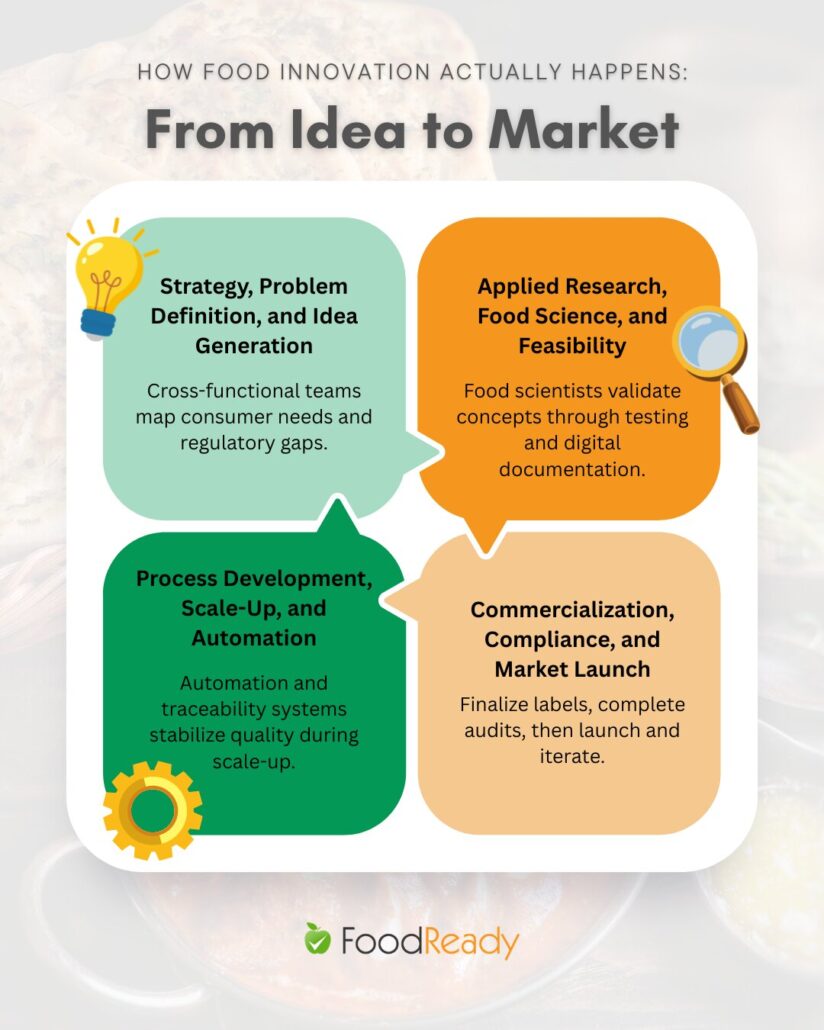
How Food Innovation Actually Happens: From Idea to Market
Successful food innovation follows a structured process: strategy, research, feasibility, compliance, pilot trials, scale-up, and post-launch monitoring. Mid-sized and enterprise manufacturers increasingly embed food safety, food security, and FSMA 204 traceability requirements from the very beginning. Innovation works best as a repeatable system, not a one-off project.
Strategy, Problem Definition, and Idea Generation
Companies begin by mapping consumer needs, regulatory gaps, and operational pain points. Consumers demand convenient food options due to busy lifestyles, and consumers demand foods that offer specific health benefits beyond basic nutrition. Demand for healthier food options creates pressure for reformulating existing products across nearly every category.
Methods include shopper insights, social listening, and AI-driven analysis of sales and complaint data. Cross-functional ideation (R&D, quality, operations, and regulatory teams working together from day one) prevents costly bottlenecks. Early alignment on claims (plant based, non-GMO, allergen-free) is essential because it shapes ingredient selection, validation studies, and documentation loads.
Applied Research, Food Science, and Feasibility
Food scientists validate whether concepts are technically feasible and safe through microbiology, chemistry, sensory science, and process engineering. For instance, reformulating to remove synthetic preservatives while maintaining food safety requires shelf-life testing and challenge studies under real distribution conditions.
All experiments feed into HACCP plans, SOPs, and validation records, which digital tools manage far more efficiently than paper-based systems. Transparent documentation from lab notebooks to digital FSMS platforms ensures companies can demonstrate due diligence during audits or recalls.
Process Development, Scale-Up, and Automation
Moving from bench-top samples to full factory lines often requires adjustments in recipes, process parameters, and equipment. Typical scale-up challenges include heat transfer differences, mixing times, microbial kill steps, and packaging line throughput. Designing in automation, inline sensors, SCADA data, real-time quality checks, at this stage stabilizes quality and reduces manual data entry.
Integrating production and inventory management with traceability systems ensures every lot of a new product is tracked from raw material to finished goods. FoodReady’s real-time lot tracking and inventory management capabilities reduce risk during new product launches by combining production data with traceability records.
Commercialization, Compliance, and Market Launch
Before launch, companies must finalize label review, nutritional analysis, allergen statements, and claims substantiation. Companies adapt products to meet specific demographic needs, and innovation caters to specialized needs like medical nutrition and airline meals, each with unique compliance requirements. Digital SOP generators standardize new operational procedures across sites.
Pre-launch verification includes mock recalls, traceability exercises, and internal audits. For retailers and foodservice customers, a supplier’s ability to document traceability and audit readiness is often a prerequisite for listing new food products. Post-launch, data from production and market performance should flow back into analytics tools to guide the next cycle of food innovation.
Types of Food Innovation Across the Value Chain
Innovation happens everywhere: ingredients, processing, packaging, business models, and digital systems. It is not limited to new recipes. A new safety process, an AI-based forecasting model, or a new traceability method all qualify. The subsections below map where innovation creates the most impact.
1. Targeted and Functional Nutrition
- Designs food products for specific population segments using evidence-based nutrient profiles.
- Includes functional foods supporting immune health, like probiotic yogurts and vitamin-enriched beverages.
- Personalized nutrition market expected to reach USD 23.3 billion by 2027, tailoring diets based on genetics and lifestyles.
- AI provides real-time dietary recommendations, improving health outcomes.
- Customization meets individual dietary preferences but raises data privacy concerns.
- Requires meticulous ingredient traceability and allergen control, supported by digital record-keeping.
2. Smart Packaging, Shelf Life, and Waste Reduction
- Utilizes technology to inform consumers about food quality and extends shelf life by 20–40% for perishables.
- QR codes offer instant access to food origin; time-temperature indicators maintain cold chain integrity.
- Blockchain creates tamper-proof traceability records.
- Modified atmosphere packaging preserves fresh produce during long-distance shipping.
- Sustainable food packaging market projected to reach USD 280 billion by 2026.
- Compliance with food contact regulations and updating SOPs and traceability fields is essential.
- Eco-friendly digital systems facilitate packaging innovation transitions.
3. New Service Models: Ghost Kitchens, Automation, and Direct-to-Consumer
- Innovations include ghost kitchens, delivery-only brands, vending robots, and automated kiosks reshaping foodservice.
- Central kitchens managing multiple brands face allergen cross-contact risks, requiring robust SOPs and digital controls.
- Direct-to-consumer e-commerce demands packaging integrity and temperature monitoring in last-mile logistics.
- Manufacturers can partner with foodservice and D2C platforms leveraging traceability and FSMA 204-compliant systems.
- These service models require formal HACCP review as process innovations beyond marketing changes.
4. Digital Food Safety Management and Food Industry Software
- Food management software evolved into integrated, AI-driven Food Safety Management Systems covering HACCP, SOPs, training, and audits.
- Digital systems automate compliance monitoring and enhance traceability and safety with blockchain technology.
- Platforms like FoodReady combine FSMA 204 traceability, inventory and production management, and recall simulation.
- Adoption of digital FSMS accelerates compliance modernization and frees resources for advanced food innovations.
- For more, see FoodReady’s technology and innovation blog and FSMA 204 traceability.
The Role of Artificial Intelligence in Food Innovation
Artificial intelligence is a cross-cutting enabler, from farm-level predictive analytics to factory-floor quality checks and consumer-facing personalization. In the food industry, AI practically means machine learning models, computer vision, natural language processing, and optimization algorithms. AI not only powers innovation in food products but also modernizes food safety and traceability, which are prerequisites for scaling new ideas. The share of food and beverage manufacturers rolling out AI beyond pilots grew from roughly 4% to 14% between 2024 and 2025, and 83% planned to increase AI spending.
AI augments human expertise rather than replacing food scientists or quality managers.
AI-Driven Product and Recipe Innovation
AI predicts consumer preferences for food products by analyzing sensory panel scores, sales data, reviews, and nutrition databases. It can rapidly test “what-if” scenarios; for example, reducing sugar or salt while maintaining sensory acceptance, or designing region-specific taste profiles for global markets. AI also enables swapping an allergenic ingredient with an alternative while predicting impact on taste and cost.
However, AI-suggested recipes still require validation through traditional food science methods, including microbiological safety and shelf-life testing. AI-generated concepts should flow directly into digital documentation (HACCP drafts, SOP templates) to speed up internal approvals and market submissions.
AI for Food Safety, Quality, and Regulatory Compliance
AI helps detect anomalies in production data (temperature excursions, unusual complaint patterns) before they develop into safety incidents or recalls. It assists in hazard analysis, trending non-conformities, and predicting where failures might occur. AI helps farmers monitor livestock health efficiently, extending its reach to primary production. AI tools also automate document creation: HACCP plan builders, SOP generators, and audit checklist templates that adapt to changing regulations.
FoodReady leverages artificial intelligence to pre-populate HACCP plans, track FSMA 204 records, and keep documents audit-ready with minimal manual effort. Companies should treat AI-based FSMS as a strategic enabler for more confident experimentation with new processes and ingredients.
AI-Enhanced Traceability and Supply Chain Resilience
AI supports end-to-end traceability by aggregating data from suppliers, production lines, warehouses, and distributors into a real-time view of material flows. It can simulate recall events, optimize recall scopes, and identify affected customers or regions, drastically reducing response times. Predictive risk models rank suppliers based on historical performance, geopolitical risks, and climate-related threats to raw material supply.
For more on RFID, barcodes, and blockchain combined with AI analytics, see FoodReady’s blog on key technologies in food traceability. Reliable traceability data complies with FSMA 204 and gives customers transparency that supports premium positioning in the market.
Food Safety and Food Security: Innovation as Risk Management
Innovation is essential to keeping food safe and available in an increasingly unstable world. Food safety prevents acute and chronic harm from consumption; food security ensures reliable access to safe, nutritious food. They intersect: unsafe food undermines security, and supply disruptions force companies into unfamiliar sourcing that raises safety risks. Digital traceability, resilient sourcing strategies, and climate-smart agriculture all depend on coordinated innovation across the supply chain.
Modern Traceability as the Backbone of Innovation
Robust food traceability is now a prerequisite for launching new food products, especially those involving new ingredients, suppliers, or co-packers. An effective system requires unique lot IDs, supplier verification, production and packaging records, and distribution tracking.
FSMA 204 specifies additional record-keeping for high-risk foods and manufacturers need systems capable of generating traceability data within hours, not days. FoodReady’s real-time lot tracking and inventory management features support both innovation and rapid recall capabilities. Investments in traceability are both a compliance requirement and an enabler of bolder experimentation.
Regulatory Change, Consumer Trust, and Market Access
Evolving regulations, FSMA in the U.S., GFSI-benchmarked schemes like SQF and BRCGS worldwide, raise the bar for documentation and process control. Obtaining certifications opens export markets and listings with large retailers. Innovation helps meet new regulations: reformulating away from risky additives, introducing allergen controls, and adopting new sterilization methods.
Digital audit readiness reduces the cost of audits for multi-site operations. For companies planning ahead, FoodReady’s consulting services help align innovation roadmaps with regulatory expectations from day one. Learn more about implementing the FSMA 204 rule.
Crisis Preparedness, Recalls, and Business Continuity
Innovative recall management systems, mock recall exercises, and scenario planning help companies respond faster when issues arise. Recall simulation tools test traceability, communication chains, and decision-making protocols on a regular schedule. Readiness for crises (food safety incidents, supply disruptions, pandemics) is now a core part of strategic innovation in the food industry.
FoodReady AI’s recall simulation features lower the risk associated with a growing portfolio of innovative food products. Companies should integrate crisis playbooks into their FSMS and train teams regularly, updating procedures as product lines and partners evolve.
Putting It All Together: Building an Innovation-Ready Food Operation
Building a sustainable innovation pipeline requires aligning people, processes, and technology around shared goals like safety, compliance, cost control, sustainability, and market growth. Treating innovation as a system, with clear metrics and continuous feedback, enables manufacturers to scale effectively. Cross-functional collaboration among food scientists, quality managers, procurement, marketing, and finance is essential, supported by practical routines such as innovation councils and risk reviews. Training on new technologies like AI and digital FSMS ensures adoption and prevents innovation fatigue.
Integrated data systems create feedback loops from production and market performance to R&D and operations, using key metrics to guide innovation focus. AI and analytics help detect trends early, test pilots, and scale successful initiatives, reducing experimentation costs. FoodReady combines software and consulting to support continuous improvement cycles grounded in real data, helping companies review and optimize their innovation portfolios annually for safety, sustainability, and profitability.
Frequently Asked Questions
Start with one or two focused projects aligned to clear business goals, for example, finding innovative solutions to reduce food waste in one product line or entering a plant-based segment. Leverage existing equipment with incremental recipe or packaging changes before committing to major capital investments. Adopt digital tools early for HACCP, SOPs, and traceability so new products are documented and audit-ready from day one.
Revisit hazard analyses and HACCP plans whenever a significant change is made: new ingredient, new supplier, new processing step. Conduct validation studies (challenge tests, shelf-life tests) and capture all findings in a digital FSMS for easy audit reference. Train staff on new SOPs and monitor early production batches closely for deviations.
No. AI is increasingly accessible through SaaS platforms, allowing even single-site operations to benefit from automated documentation, alerts, and basic analytics. Companies do not need in-house data scientists to use AI-powered HACCP builders, traceability tools, or demand-forecasting modules. Start with targeted use cases then expand.
Innovations like drought-resistant crops, extended-shelf-life products, and alternative proteins produce healthier, more stable food supplies. Strong traceability and risk management reduce disruptions from recalls or contamination events, protecting supply continuity. Innovations that reduce food waste and emissions also contribute to long-term resource availability and resilience.
FoodReady combines software and consulting to help design HACCP plans, generate SOPs, manage FSMA 204 traceability, and simulate recalls for new products and processes. The platform’s AI features reduce administrative workload, enabling teams to focus on R&D and continuous improvement. Explore FoodReady’s technology and innovation resources and consider a demo to map the platform to your innovation roadmap.