If you are pricing out training for HACCP certification, have a look at our FoodReady Academy HACCP training course, priced at $275 for lifetime access. However, it is critical to remember that the total implementation cost of HACCP reflects your operation, not a fixed rate. Therefore, a small single-product bakery and a large multi-site processor will see very different figures. What stays the same is the set of factors that drive the price, and once you understand those, you can budget with confidence and keep the whole project cost-effective.
This guide breaks down what shapes HACCP certification costs, the fees to expect across the full cycle, and how to reduce them without cutting corners. We also show how FoodReady makes certification faster, cheaper, and far more likely to pass the first time.
What Drives HACCP Certification and Food Safety Costs?
HACCP certification cost is split between the internal work of preparing your food safety plan and the external fees a certification body charges for the audit and certificate. Both scale with the same handful of factors.
| Cost Driver | How It Affects Price |
|---|---|
| Size of operation | More employees and higher production volume mean more audit time and higher fees. |
| Number of sites | Each facility in scope adds audit days and often travel costs. |
| Scope of certification | The range of products and processes covered widens or narrows the work. |
| Plan complexity | More products, ingredients, and critical control points require deeper hazard analysis. |
| Current readiness | Mature food safety practices need less gap closing than starting from scratch. |
Because these factors are unique to you, the only reliable figure comes from a tailored quote.
Building a right sized HACCP plan rather than an overcomplex one is the first lever on cost.
The Typical Cost Components
When a proposal lands, a food business usually sees the total split across several line items because the HACCP system must cover the production process and support compliance.
Knowing them makes it easy to compare quotes and see exactly what you are paying for.
| Component | What It Covers |
|---|---|
| Gap analysis | An early readiness check and assessment that shows what needs fixing before the audit. |
| Prerequisite programs | Foundations such as sanitation controls and good manufacturing practices. |
| Plan development | Writing and documenting a systematic approach to hazard analysis, including identifying hazards, assessing risks, setting critical limits, and defining corrective actions across the production process control points. |
| Team training | Training key staff to understand and implement the plan. |
| Internal audit | An in-house check with verification procedures that the plan works before the external audit. |
| External audit and certificate | The certification body audit fees plus certificate issuance. |
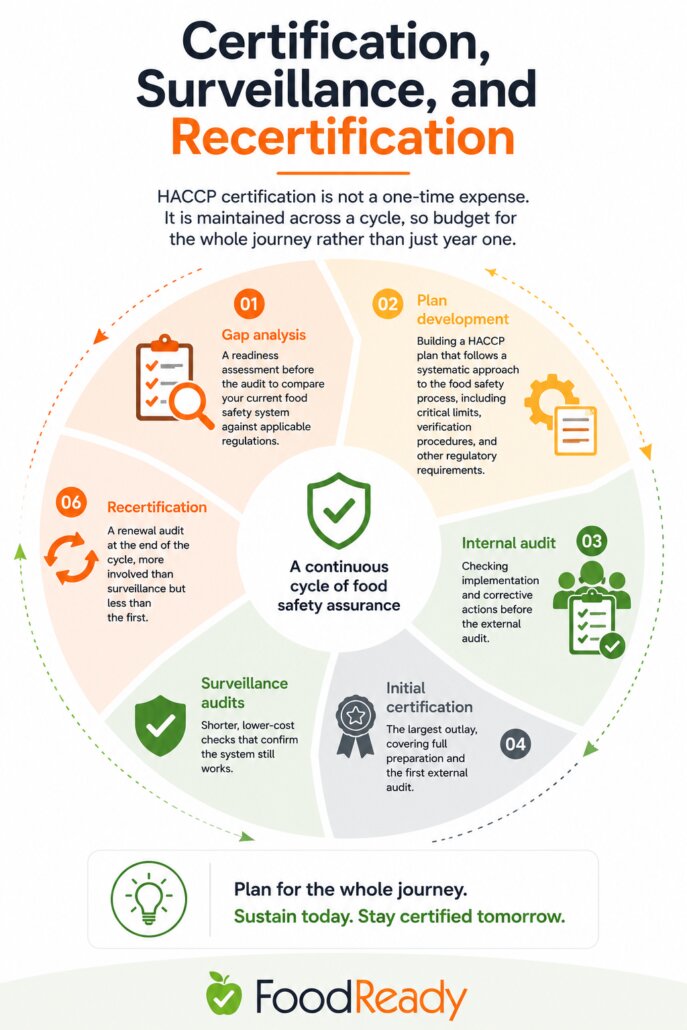
Certification, Surveillance, and Recertification
HACCP certification is not a one-time expense. It is maintained across a cycle, so budget for the whole journey rather than just year one.
- Gap analysis: A readiness assessment before the audit to compare your current food safety system against applicable regulations.
- Plan development: Building a HACCP plan that follows a systematic approach to the food safety process, including critical limits, verification procedures, and other regulatory requirements.
- Internal audit: Checking implementation and corrective actions before the external audit.
- Initial certification: The largest outlay, covering full preparation and the first external audit.
- Surveillance audits: Shorter, lower-cost checks that confirm the system still works.
- Recertification: A renewal audit at the end of the cycle, more involved than surveillance but less than the first.
How to Keep HACCP Certification Cost Effective
Certification is an investment, but there are practical ways to keep it lean.
The biggest savings come from thorough preparation and building capability in-house, with clear benefits for compliance, efficiency, and trust.
- Build a plan sized to your operation instead of a bloated generic one so it fits your food production processes and helps prevent hazards.
- Get prerequisite programs and documentation in order before the audit so your food products are protected and expectations for customers are easier to meet.
- Train a focused team of key employees, with each team member learning the depth needed for their role rather than everyone learning to the same level.
- Develop internal auditors so you rely less on outside parties during surveillance audits, which are periodic assessments that confirm the system still meets regulatory requirements.
- Use a digital food safety management system so records are always audit-ready and repeat visits are avoided, including at recertification when you need to show continued alignment with regulations.
New Updates: What Is Changing in International HACCP Alliance Certification
A few shifts are reshaping what certification demands and how it is priced.
• SQF Edition 10 raises the bar: Edition 10 was released in 2026, with audits beginning January 2027, placing greater weight on food safety culture and data integrity, which rewards operations with strong digital records.
• FSMA 204 adds recordkeeping: FSMA 204 requires firms handling foods on the Food Traceability List to capture key data elements, so building traceability in early keeps later audit costs down.
• Digital preparation cuts cost: Certification bodies increasingly favor timestamped, traceable records, and businesses that go digital spend less time and money preparing for each audit.
How FoodReady Ensures HACCP Certification Is Cost Effective and Successful
FoodReady is built to take the cost, assumption, and stress out of HACCP certification. Instead of paying expensive consultants to assemble a plan from scratch, you build a compliant one in the platform and keep it audit-ready all year, so every stage of the cycle runs cheaper and smoother.
For teams comparing a HACCP training program or an online program, many options on the market are accredited by the International HACCP Alliance, and FoodReady complements that knowledge with practical tools for implementation.
Here is how the platform keeps certification lean and successful:
• Generate a right-sized plan fast with the FoodReady HACCP Builder, so your coursework can connect directly to a real plan instead of staying theoretical, drawing on more than 80 industry templates so you avoid costly over-engineering.
• Built-in gap analysis flags what needs fixing before an auditor arrives, which helps after HACCP training and cuts repeat visits.
• Digital records, monitoring, and prerequisite programs stay organized and timestamped, so audit prep takes hours instead of weeks and supports basic HACCP documentation needs.
• Linked traceability and recall management satisfy modern audit expectations without extra tooling, including teams using online HACCP training to complete remote workflows.
• Cloud-based version history keeps everything ready for any GFSI, SQF, BRCGS, FSSC 22000, FDA, or USDA review, giving the food industry a cleaner path through the final exam or any other exam tied to completion.
On top of the software, FoodReady pairs you with certified food safety experts who guide you from gap analysis to certificate, whether you start with an online HACCP certification course, pursue online HACCP certification, or just need online HACCP support to complete a plan and earn an official certificate after course completion. You can schedule a demo to see how much time and money a connected system can save.
Conclusion
HACCP certification cost comes down to a few things you control: your size, your number of sites, your scope, the complexity of your food safety plan, plus the ongoing surveillance audits and recertification that keep the certificate alive. Preparation adds to the picture too, since HACCP training is a core part of getting certified. Many food businesses complete a HACCP certification course online or in person, with basic HACCP training courses often running around 16 hours over two days, and programs tied to the International HACCP Alliance offer recognized online HACCP certification formats that end in a final exam.
Weighed against the price of a recall, a lost contract, or a foodborne illness outbreak, HACCP certification is a sound investment. It is also one you can keep cost-effective with a right-sized plan, focused team training, internal audit capability, and strong digital records. With the FoodReady HACCP Builder and expert support from certified food safety professionals, FoodReady helps you certify affordably, prepare with confidence, and pass your audit the first time.
Because the cost reflects your specific operation. Your size, number of sites, scope, and plan complexity all change the work required, so a single flat fee would not be accurate.
They usually include gap analysis, prerequisite programs, plan development, team training, the internal audit, and the external audit and certificate fees.
Yes. Certification is maintained through periodic surveillance audits and a recertification audit at the end of the cycle, so budget beyond the first year is necessary.
Build a right-sized plan, prepare prerequisite programs early, train a focused team, develop internal auditors, and keep digital records so audits run smoothly.
For most food businesses, yes. Set against the expense of recalls, illness outbreaks, and lost contracts, certification is a small price for safety and market access, especially where HACCP is mandatory and teams need training to identify food safety hazards and other food hazards before they lead to problems. Some training providers also offer company pricing or group discounts when multiple employees qualify.
FoodReady lets you build a compliant plan by implementing controls that identify and manage food hazards, flag gaps before the audit, and keep records audit-ready year-round, thereby cutting preparation time, supporting trust with customers, and reducing the risk of failure. Have a look at FoodReady Academy for our range of training courses that you can enroll in to contribute to the success of your food business.