Key Takeaways
- OPRP (Operational Prerequisite Program) is a control measure defined by ISO 22000 that sits between broad PRPs and strict CCPs in food safety management systems, targeting specific hazards at defined process steps.
- Critical control points have defined critical limits and immediate food safety impact. If a CCP fails, the product is potentially dangerous. OPRPs reduce the likelihood of hazards but are not final kill steps.
- Prerequisite programs are general hygiene and facility controls (pest control, sanitation, supplier approval), while OPRPs target specific significant hazards identified during hazard analysis.
- Correctly distinguishing PRP, OPRP, and CCP improves your HACCP plan, reduces recalls, and meets expectations of standards like ISO 22000:2018, FSSC 22000, SQF, and BRCGS.
- FoodReady helps food businesses determine control measures, build HACCP plans, and digitize PRP/OPRP/CCP monitoring for audit-ready regulatory compliance.
What Does OPRP Mean in Food Safety?
The term OPRP stands for Operational Prerequisite Program, a food safety control measure used in management systems like ISO 22000 and FSSC 22000. In plain language, an OPRP operational prerequisite program is a targeted control applied at a specific process step to manage significant hazards that general hygiene programs can’t adequately address, but that don’t require the strict treatment of a Critical Control Point.
Operational Prerequisite Programs (OPRPs) are defined as control measures that are essential in controlling a specified food safety hazard to manage their introduction to the food processing system. OPRPs are identified through a hazard analysis as essential for controlling the likelihood of significant food safety hazards in products or environments.
The concept was introduced in ISO 22000:2005 and clarified in ISO 22000:2018 to close the gap between generic prerequisite programs and high-risk CCPs. OPRPs focus on preventing the introduction of food safety hazards (biological, chemical, physical hazard types, and allergens) in the product or processing environment.
Concrete examples include:
- Allergen changeover cleaning verification in a bakery producing both peanut and peanut-free products
- Sieving flour to remove foreign bodies before mixing
- Metal detector verification checks on packaged goods
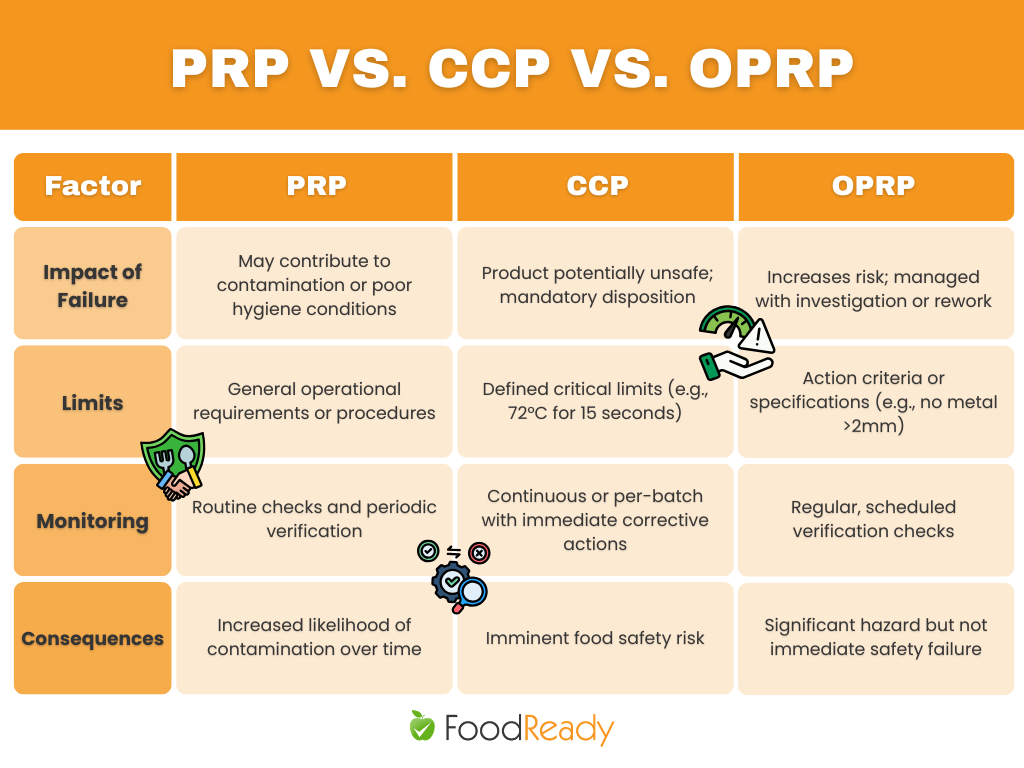
OPRPs are specific, non-critical measures used to control significant hazards identified by risk assessment, unlike PRPs, which are broader practices covering general conditions.
Where OPRP Fits in a Food Safety Management System?
Understanding how PRPs, OPRPs, and CCPs work together inside a HACCP-based food safety management system is essential for effective hazard control. Each layer serves a distinct purpose in producing safe food.
PRPs provide a general hygienic foundation, while OPRPs target specific significant hazards and CCPs are critical steps requiring strict control to ensure food safety. Effective food safety management systems utilize PRPs as foundations, OPRPs as targeted controls, and CCPs as critical safeguards.
OPRPs bridge the gap between basic hygiene and critical safety interventions within a Food Safety Management System (FSMS). The concept of OPRPs is a core differentiator for ISO 22000 and FSSC 22000 food safety management systems.
Relevant standards and frameworks rely on thorough hazard analysis and risk assessment to categorize control measures, including FSMA’s science-based preventive controls for food:
| Standard/Framework | OPRP Recognition |
|---|---|
| ISO 22000:2018 | Full OPRP classification |
| FSSC 22000 v6 | Incorporates ISO 22000 OPRP requirements |
| Codex HACCP 2020 | Comparable concepts |
| FSMA Preventive Controls | Similar logic for preventive control |
| SQF, BRCGS | Aligned classification approaches |
OPRPs are documented in the HACCP plan with defined monitoring procedures, responsibilities, and corrective actions, even without strict numerical critical limits like CCPs require.
FoodReady serves as a digital platform helping food manufacturers map process flows, analyze hazards, and assign each control as PRP, OPRP, CCP, or preventive control, supporting both mandatory and voluntary HACCP plan requirements.
OPRP vs CCP: What’s the Difference?
Both OPRPs and critical control points in a HACCP plan are process-level control measures applied at specific steps. However, a Critical Control Point (CCP) is a specific step in a food process where control is essential to prevent, eliminate, or reduce a food safety hazard to an acceptable level. The key difference between an OPRP and a CCP is that a CCP is a critical step where control is essential, while an OPRP is not critical and can be removed without necessarily leading to unsafe food.
Key differences:
| Factor | CCP | OPRP |
|---|---|---|
| Impact of failure | Product potentially unsafe; mandatory disposition | Increases risk; managed with investigation or rework |
| Limits | Defined critical limits (e.g., 72°C for 15 seconds) | Action criteria or specifications (e.g., no metal >2mm) |
| Monitoring | Continuous or per-batch with immediate corrective actions | Regular, scheduled verification checks |
| Consequence | Imminent food safety risk | Significant hazard but not immediate safety failure |
If an OPRP fails, the product is not immediately considered unsafe, whereas a CCP failure renders the product potentially dangerous. OPRPs are managed by action criteria, which are measurable or observable parameters that indicate effectiveness, as opposed to the strict critical limits of CCPs.
While both OPRPs and CCPs are essential for food safety, OPRPs do not have critical limits that can be measured in the same way CCPs require specific critical limits and monitoring procedures.
Decision tree classification: ISO 22000:2018 Annex A and Codex decision trees guide whether control measures applied should be classified as CCP or OPRP based on:
- Whether the step is the final barrier
- Feasibility of continuous monitoring
- Severity if control fails
How Is OPRP Different From PRP?
Prerequisite Programs (PRPs) are essential practices and conditions that must be in place before and during HACCP implementation to ensure food safety, addressing general hygiene and operational conditions. Unlike operational prerequisite programs OPRPs, PRPs are broad, facility-wide programs not tied to specific hazards at specific steps.
Common PRP examples:
- Building design and maintenance
- Water quality programs
- Pest control contracts
- Personal hygiene training and facilities
- Cleaning and sanitation schedules
- Waste management procedures
- Supplier control and approval
PRPs include basic controls concerned with making a conducive and hygienic environment to create safe food, such as cleaning and sanitation, pest control, and personal hygiene. The failure of a PRP does not necessarily lead to an immediate and imminent food safety risk; typically, a prolonged period and repeated failures are necessary to significantly impact product safety.
How OPRPs differ:
- Identified by hazard analysis identifies as necessary to control significant hazards
- Applied to defined steps or lines (e.g., allergen segregation during packaging)
- Require documented monitoring and defined actions when deviations occur
- OPRPs require actionable, measurable limits and regular monitoring to ensure effectiveness
PRPs focus on the overall environment, while OPRPs target specific hazards that are too significant for general PRPs but do not require the absolute control of a CCP. PRPs, OPRPs, and CCPs differ in their level of risk control, specificity, and consequences of failure.
Examples of OPRPs in Different Food Sectors
Recognizing OPRPs in your operations helps avoid misclassifying them as PRPs or CCPs. Common examples of OPRPs include metal detection, allergen management, sieve and filter checks, and temperature control. During risk assessment, OPRPs are identified as steps that are crucial but do not constitute a final kill step like CCPs.
Allergen control in bakeries and confectionery:
- Validated changeover cleaning between allergen recipes
- Label verification checks before packaging
- Dedicated utensils for allergen-containing products
Foreign-body control in dry foods:
- Sieving of flour or spices to remove physical hazards
- Magnet checks in cereal or chocolate lines
- Optical sorting of nuts and seeds
Temperature and time control in chilled ready-to-eat products:
- Maximum line-time limits before chilling
- Door-open time restrictions for cold storage rooms
- Monitoring raw materials holding temperatures
Environmental pathogen control in RTE meat, dairy, and produce:
- Listeria environmental monitoring swabs in the production environment
- Zone-based cleaning verification
- Traffic flow restrictions between raw and cooked foods areas
OPRPs are designed to control significant hazards that are not managed by PRPs, whereas CCPs are specific points where control measures are essential for food safety. The same control (like metal detection) may be categorized as CCP or OPRP depending on process risk and documented justification in your hazard assessment.
How to Determine Whether a Control Is PRP, OPRP, or CCP?
Control measures in food safety management systems are categorized by their significance in the production process. Categorization must follow structured hazard analysis using risk matrices and a decision tree rather than subjective opinion.
Step-by-step approach:
- Map the process flow from receiving raw materials through dispatch
- Identify potential hazards (biological, chemical, physical, allergen) at each step
- Assess significance using likelihood and severity (low/medium/high)
- List all control measures for each identified hazard
- Apply decision tree to classify each control
Classification logic:
| Question | If Yes | If No |
|---|---|---|
| Applies broadly, not hazard-specific? | PRP | Continue |
| Targets significant hazard at specific step? | Continue | May be PRP |
| Is this the only/final control for hazard? | CCP | OPRP likely |
| Are other downstream controls present? | OPRP | CCP |
OPRPs are more specific than PRPs but do not have the strict status of Critical Control Points (CCPs). ISO 22000:2018 provides guidance on classifying control measures based on feasibility of monitoring, speed of response, and severity if control fails.
Why Understanding OPRP vs CCP and PRP Matters for Food Businesses?
Misclassifying control measures creates real problems in the food industry. Too many CCPs leads to unmanageable continuous monitoring burdens. Missing OPRPs creates hidden risk in your safe food production process.
Business and regulatory impacts:
- Reduced recalls: The implementation of OPRPs can help reduce the need for corrective actions or recalls by effectively managing food safety hazards that could impact product quality
- Stronger compliance: Meets expectations of GFSI-benchmarked schemes (FSSC 22000, SQF, BRCGS) and regulations (FSMA, EU Regulation 852/2004)
- Better audit outcomes: Clear, defensible hazard control logic satisfies third-party auditors and simplifies preparation for food safety audits
Although OPRPs are not critical control points (CCPs), they play a vital role in enhancing the effectiveness of CCPs by addressing significant hazards that PRPs do not manage. Correct classification optimizes resources, intensive monitoring focuses on true critical control points while OPRPs handle medium-level risks through an effective control process.
Modern digital tools and AI-driven decision support simplify audit-ready documentation, real-time monitoring, and recall simulation across food establishments with multiple facilities.
How Digital Tools Help Manage OPRPs, CCPs, and PRPs?
Many food businesses still rely on paper or spreadsheets to manage control points, leading to missed checks and weak traceability in the food chain. Digital platforms transform how organizations achieve ensuring food safety across operations.
Key capabilities modern platforms should offer:
- HACCP and SOP builders integrating decision trees to classify PRPs, OPRPs, and CCPs
- Configurable monitoring forms with alerts for missed or out-of-spec checks
- Real-time dashboards tracking compliance across multiple lines and sites
FoodReady specifically supports food safety management through:
- AI-assisted HACCP plan creation aligned with ISO 22000 and Codex principles
- FSMA 204-ready traceability connecting deviations at OPRPs and CCPs to affected batches
- Integration with sensors and IoT devices (temperature loggers, metal detectors) for automated monitoring
- Centralized records making audits searchable and exportable
Operational Prerequisite Programs (OPRPs) are essential in controlling specific food safety hazards, helping to minimize the likelihood of contamination in food processing systems. With proper classification and digital management, your team can confidently handle potential food safety hazards at every level.
CCPs typically control the highest-risk hazards, and their failure usually requires product hold or disposal, creating an imminent food safety risk. OPRPs manage significant but somewhat lower-risk situations where failure increases hazard likelihood without automatically rendering food unsafe. Both are important components of robust food safety management. Regulators and certification bodies expect clear justification for categorization based on documented hazard analysis and establishing critical control points through proper decision trees.
Yes. Classification depends on process design, product susceptibility, and presence of other control measures. Metal detection might be a CCP in a ready-to-eat meal plant with no downstream controls, but an OPRP in a facility where additional X-ray inspection exists and overall risk is lower. The key is documented justification based on your specific hazard analysis.
Monitoring frequency depends on hazard significance, process capability, and historical performance. OPRPs typically require more frequent monitoring than general PRPs but less intensive than many CCPs. Verification through internal audits, trend analysis, or product testing should occur at defined intervals, monthly or quarterly, and whenever significant changes occur in equipment, ingredients, or basic conditions.
Any business implementing ISO 22000 or FSSC 22000 is expected to distinguish OPRPs from PRPs and CCPs as part of good manufacturing practices. Even smaller operations should identify operational controls more critical than general hygiene, like allergen label checks or temperature control for safe environment maintenance, and manage them with documented monitoring, whether formally labeled as OPRPs or not.
FoodReady guides teams through hazard analysis and digital decision trees to classify each control measure as PRP, OPRP, CCP, or preventive control. The platform automatically generates monitoring checklists and records while real-time dashboards, alerts, and traceability tools make demonstrating effective control during third-party audits and regulatory inspections straightforward. This helps food products reach consumers safely with full documentation of your acceptable level controls throughout production.