For food manufacturers, processors, and co-packers, the ability to trace products in both directions through the supply chain isn’t optional. It’s essential for survival. Although the FDA is not enforcing FSMA 204 traceability requirements before July 20, 2028, quality assurance teams are under growing pressure to build traceability systems that can deliver required records within 24 hours, not days.
This guide breaks down exactly how backward and forward traceability works in food facilities and provides practical steps for implementation.
Key Takeaways
- Backward traceability traces a finished food product back to its ingredients, suppliers, and origins, while forward traceability tracks raw materials through to all finished products, customers, and distribution locations.
- GFSI schemes (SQF, BRCGS, FSSC 22000) and U.S. FSMA 204 (compliance mandatory since January 20, 2026) require at minimum one-step-forward/one-step-backward traceability with 100% lot accountability.
- Combining backward and forward traceability enables targeted recalls that minimize product destruction, brand reputation damage, and regulatory penalties, reducing recall costs by up to 75%.
- FoodReady.AI provides an integrated, AI-powered food traceability software platform that automates lot tracking, FSMA 204 Key Data Elements (KDEs), audit-ready records, and recall simulations
What Is Traceability in Food Manufacturing?
Traceability is the documented ability to follow food, ingredients, and packaging through every step of the supply chain, from farm or fishery to finished products at the retailer or foodservice customer.
This documented identification underpins HACCP, HARPC, and preventive controls by making it possible to identify affected lots when hazards like Listeria or undeclared allergens are detected. Traceability requirements are embedded in standards like SQF Edition 9, BRCGS Food Safety Issue 9, ISO 22000, and regulations, including the Food Safety Modernization Act (FSMA) and EU General Food Law 178/2002.
Backward vs Forward Traceability
Understanding bidirectional traceability starts with clear definitions of each direction and how they work together in food plants, warehouses, and co-packing facilities.
Backward traceability means tracing from a finished product lot or customer complaint back through distribution, production records, and warehouse history to specific ingredient lots, packaging, and suppliers.
Forward traceability starts from an ingredient or raw material lot and traces through all batches, finished products, inventory locations, and customer shipments where that lot was used.
Auditors, regulators, and major retailers expect bi-directional traceability that can be demonstrated within 2–4 hours during SQF or BRCGS audits. Robust traceability goes beyond “one step forward/one step back” to include internal process steps like mixing, cooking, packaging lines, rework, and repacking.
Backward Traceability in Practice
Here’s how backward traceability works in a real scenario: A QA manager starts with a specific finished product, and traces backward through production logs, ingredient usage records, and receiving records.
Essential data elements for backward traceability include:
- Production date, time, and line used
- Recipe or BOM version
- Ingredient lot codes and supplier lot numbers
- Certificates of Analysis (COAs)
- Receiving dates and PO numbers
Backward traceability ensures you can pinpoint which supplier or internal step introduced a problem during investigations after foreign material complaints, positive pathogen results, or allergen events. During audits, facilities must identify all ingredient lots and suppliers for a finished lot within a specific time limit.
The trace flow follows: Customer complaint → Finished good lot → Production batch → Ingredient lots → Suppliers.
Forward Traceability in Practice
Forward traceability starts with a particular raw material lot and traces all finished products, dates, and customers where that lot was used.
Required data elements include:
| Data Type | Examples |
|---|---|
| Supplier information | Lot ID, receiving date, PO number |
| Production records | Batch numbers, transformation dates |
| Inventory positions | Pallet IDs, storage locations |
| Shipping documents | BOL, invoices, ASN |
Forward traceability ensures rapid identification of all affected finished goods during real recalls.
For example, when a spice supplier notifies a processor of Salmonella in lot S-2026-0305, forward tracing quickly identifies that 15 batches of spice blends were affected, resulting in 2,500 cases of salad dressing shipped to three distributors and five retail DCs.
Why Backward and Forward Traceability Matter for Food Safety and Compliance?
Multi-state E. coli outbreaks linked to leafy greens between 2018 and 2023 highlight why traceability matters. The 2018 Romaine outbreak affected 210 people across 36 states and cost the industry hundreds of millions in recalls and brand damage.
Effective traceability data reduces recall size and duration by enabling targeted removal of specific lots rather than broad “best by date” withdrawals. This supports regulatory compliance with FSMA Preventive Controls, FSMA 204, EU farm-to-fork requirements, and retailer codes of practice.
The cost impacts are significant: fewer destroyed pallets, less production downtime, lower legal exposure, and reduced insurance costs. FoodReady.AI customers use traceability data not only for recalls but for continuous improvement: identifying supplier issues, yield variances, and process bottlenecks.
Regulatory Requirements: FSMA 204 and Global Expectations
The U.S. FDA’s FSMA 204 Food Traceability Rule was finalized in November 2022. Although the original compliance date was January 20, 2026, the FDA is not enforcing the rule before July 20, 2028. It requires capturing Key Data Elements (KDEs) at Critical Tracking Events (CTEs) for foods on the Food Traceability List, including:
- Fresh leafy greens
- Cut fruit
- Soft cheeses
- Certain seafood
Companies must provide electronic traceability records connecting growing, receiving, transformation, and shipping events within 24 hours during FDA requests. Non-compliance can result in fines up to $1 million per violation.
EU Regulation 178/2002 demands immediate traceability information provision, while GFSI standards require annual mock recalls demonstrating full traceability.
Customer and Retailer Demands
Large retailers and foodservice buyers increasingly require suppliers to demonstrate fast traceability response times. A private-label co-packer might be asked to trace a specific lot within 2 hours during a supplier audit.
Failure to provide convincing forward and backward traceability can lead to delisting, lost contracts, or tighter audit frequencies. FoodReady provides customers with standardized, digital traceability evidence rather than manual spreadsheets and paper binders, protecting brand reputation and consumer trust.
How to Implement Backward Traceability in a Food Facility?
Backward traceability starts with disciplined intake and documentation, enabling you to rapidly answer “Where did this finished product come from?” for any lot. This practical checklist serves QA/QC managers, plant managers, and food safety coordinators implementing or upgrading traceability systems.
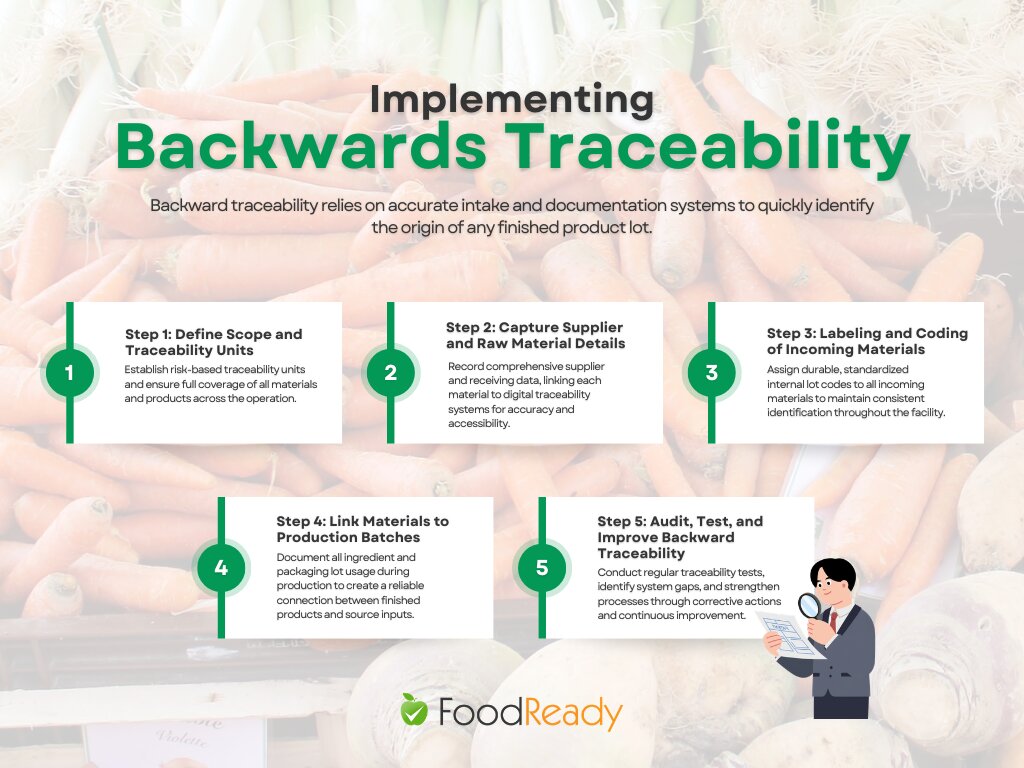
Step 1: Define Scope and Traceability Units
Choose consistent traceability units based on your risk management approach:
| Product Type | Traceability Unit |
|---|---|
| RTE salads | 2-hour production windows |
| Low-risk items | Pallet IDs |
| Allergen-sensitive | Case-level codes |
Scope should include raw materials, packaging, work-in-progress, finished products, rework, and contract-processed items. For FSMA 204-listed foods, you’ll need specific farm or vessel identification; lower-risk items may only require supplier batch.
Step 2: Capture Supplier and Raw Material Details
Record supplier name, address, approval status, and GFSI certification in a centralized system. At receiving, capture:
- Delivery date and PO number
- Supplier lot and internal lot assignment
- Quantity and COA or test results
- For FSMA 204 items: harvest date, vessel, or growing area
Barcodes, QR codes, or RFID tags link physical items to digital records and are among the key technologies in food traceability. FoodReady’s supplier verification modules automate these associations, reducing manual data entry errors.
Step 3: Labeling and Coding of Incoming Materials
Every inbound lot needs a unique, scannable internal lot code physically applied via pallet labels or tote tags. Coding should include date received, supplier code, and sequential lot number, consistent across all facilities.
Labels must remain legible through cold, frozen, and wet conditions.
Step 4: Link Materials to Production Batches
During production, operators must record which ingredient lots go into which batch via barcode scans or digital batch sheets. Batch records should capture:
- Start/stop times and line ID
- Recipe version and equipment
- All ingredients and packaging lots used
This is the critical bridge for backward traceability. Without it, you cannot reliably connect a finished lot back to a specific supplier lot.
Step 5: Audit, Test, and Improve Backward Traceability
Perform at least annual backward traceability tests, each starting with a randomly selected finished product lot. Document timing, gaps found, and corrective measures. Common gaps include missing lot codes on batch records, unlabeled rework, and incomplete receiving logs.
FoodReady can run simulated backward traceability reports and highlight missing data fields automatically. Lessons learned feed into updated SOPs and training through regular audits.
How to Implement Forward Traceability in a Food Facility?
Forward traceability determines how quickly you can identify and remove all affected products during recalls. This section uses the same data points as backward traceability but travels in the opposite direction, extending beyond the plant gate into warehouses, 3PLs, and customers.
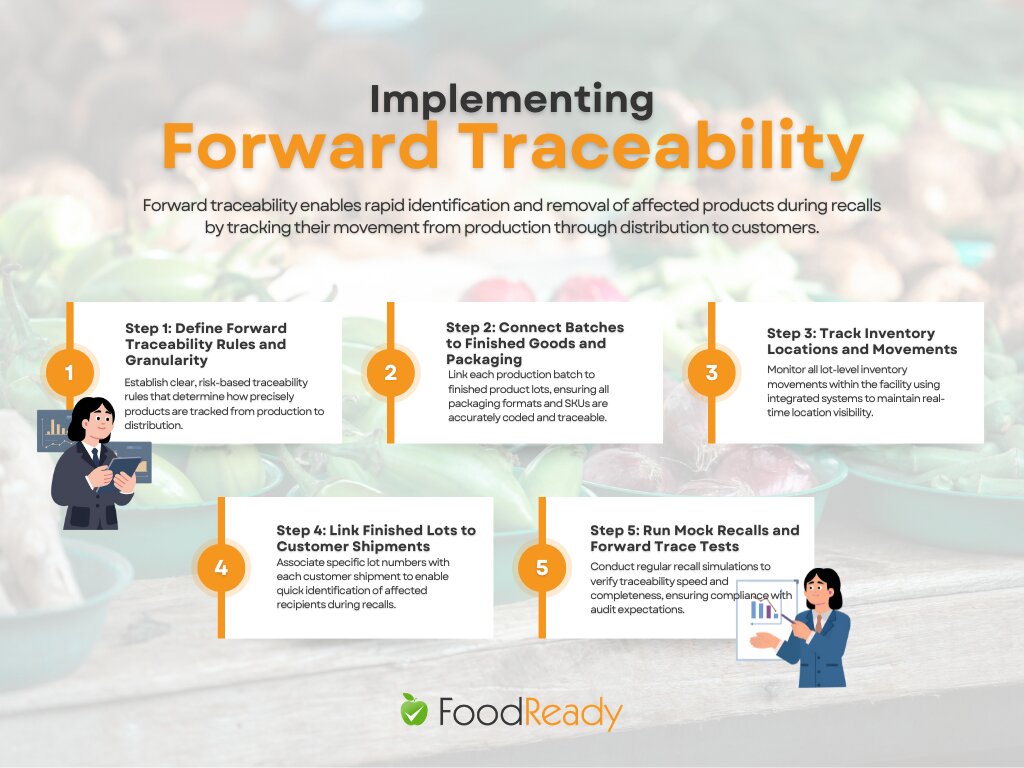
Step 1: Define Forward Traceability Rules and Granularity
Facilities need clear rules on mapping requirements for forward traces:
- Full production day (easier administration, broader recalls)
- Shift or line-time window (moderate detail)
- Narrow batch window (more data discipline, targeted recalls)
High-risk, ready-to-eat, or FSMA 204-listed foods should have narrower windows. FoodReady can apply consistent rule sets across facilities, preventing scope creep in traceability definitions.
Step 2: Connect Batches to Finished Goods and Packaging
Map each production batch to finished product lots including pack date, expiration, packaging format, and line used. Finished product lot codes must be scannable and printed on all cases and unit packs.
The system must track how batches split across different SKUs or pack sizes, linking requirements like bulk pails versus retail jars.
Step 3: Track Inventory Locations and Movements
Forward traceability requires knowing where every lot is until it leaves your organization. Use a WMS or integrated inventory module to record:
- Pallet creation and put-away
- Transfers between coolers
- Outbound staging
All movements should be at lot or pallet level, accurately tracked rather than product-level quantities.
Step 4: Link Finished Lots to Customer Shipments
Each shipment document should list specific lot numbers and pallet IDs shipped to each customer, not just product codes. This enables answering “Which customers received lettuce lot L-240310?” within minutes.
EDI and ERP integration automatically attaches lot codes to customer orders.
Step 5: Run Mock Recalls and Forward Trace Tests
Perform at least one full mock recall annually, traced forward from ingredient to all finished products and customers. Advanced facilities run quarterly tests on high-risk ingredients.
Measure recall speed (time to identify affected lots) and completeness (percentage of affected product accounted for). SQF and BRCGS auditors expect 100% traceability within 2–4 hours. FoodReady offers recall simulation features generating required reports for test runs and periodic audits.
How FoodReady Supports Backward and Forward Traceability?
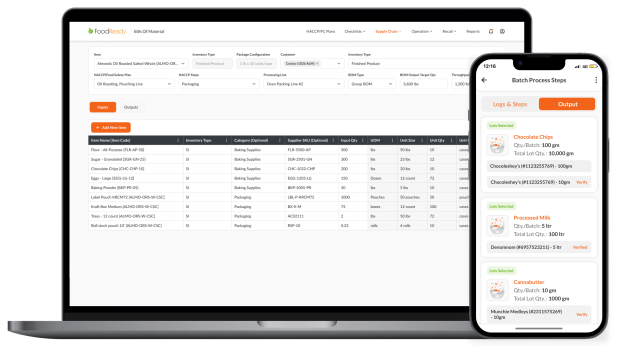
FoodReady combines traceability, HACCP and SOP management, FSMA 204 compliance, inventory control, and recall simulation in a single system for food manufacturers, processors, co-packers, and distributors.
Lot-Level Traceability and FSMA 204 Readiness
FoodReady records and creates trace links from receiving through production and shipping, enabling instant backward and forward trace reports. The platform captures FSMA 204 Key Data Elements and Critical Tracking Events for foods on the FDA’s Food Traceability List.
Users export electronic traceability records for regulators, auditors, or customers. Multi-site dashboards compare traceability performance across plants, supporting supply chain efficiency throughout regulated industries.
Integrated Food Safety, Quality, and Inventory Management
Traceability data connects to HACCP plans, SOPs, preventive controls, and CAPA management, ensuring issues revealed through traceability feed into corrective action loops. Real-time inventory modules show where each lot is at any moment.
The platform automates supplier approval and COA verification, tying supplier performance to traceability events. FoodReady integrates with existing ERP and WMS tools, supporting horizontal traceability across the food supply chain while delivering software quality in the final product.
Contact FoodReady for a tailored traceability and FSMA 204 readiness assessment.
Can you trace every lot in hours during a recall?
Simplify compliance and gain full visibility with FoodReady
FAQ
Most GFSI audits expect you to trace at least one step backward and one step forward with 100% accountability. Higher-risk products (ready-to-eat, allergen-rich, or FSMA 204-listed) require more granular traceability like narrow production windows. Auditors evaluate not just records but how quickly and confidently your team produces them during a traceability challenge. FoodReady’s consulting team helps facilities define appropriate detail levels based on risk and customer expectations.
Essential backward traceability documents include receiving logs with supplier lot numbers, internal lot assignment records, COAs, and supplier approvals. Forward traceability requires batch records mapping ingredient lots to finished lots, inventory location logs, and shipping documents listing lot numbers per customer. Documents must be legible, consistent, and retained for at least shelf life plus one year. Electronic systems like FoodReady reduce missing records and accelerate retrieval.
Most GFSI schemes expect a full mock recall at least annually covering both directions. High-risk categories benefit from quarterly focused tests, especially during the first year after implementation. Tests should be realistic, timed, and documented with clear success criteria. Rotate scenarios (ingredient-based, customer-based, finished-product-based) to regularly audit different parts of your system through a proactive approach.
The cost of one poorly executed recall often exceeds investment in digital traceability, average recalls cost $10 million per FDA data. Modern SaaS platforms like FoodReady offer tiered pricing and modular deployment requiring minimal infrastructure. Start with critical modules (traceability, inventory, HACCP) and expand as operations scale. Consider total cost including labor hours on manual records when evaluating affordability to mitigate risks effectively.
The same data powering traceability improves yield analysis, waste reduction, and process bottleneck identification. Linking supplier performance to nonconformances supports better purchasing decisions. Accurate rework and hold/release tracking reduces unnecessary product destruction. FoodReady customers use traceability dashboards for continuous improvement programs, turning compliance investment into operational efficiency and product quality gains across the software development lifecycle of their food safety systems.