If you work in food manufacturing or processing, you’ve probably heard someone, a customer, an older employee, maybe even a supplier, use the phrase “ptomaine poisoning.” It sounds serious and scientific, but here’s the truth: modern food safety has moved far beyond this outdated term.
Understanding what people actually mean when they say it, and knowing how to prevent the real causes, can save your business from costly outbreaks, recalls, and reputation damage.
Key Takeaways
- “Ptomaine poisoning” is an obsolete term for rapid-onset bacterial food poisoning caused by toxins from bacteria like Staphylococcus aureus and Clostridium perfringens, not by ptomaines themselves.
- Food poisoning symptoms typically appear within a few hours (2–6 hours) after eating contaminated food and include nausea, frequent vomiting, stomach cramps, and sometimes diarrhea.
- Modern food safety science focuses on specific harmful bacteria and their heat-stable toxins rather than the nitrogen-containing ptomaine compounds that were blamed in the 1800s.
- For food manufacturers, processors, and distributors, strong HACCP plans, rigorous temperature control, and real-time lot tracking are the primary defenses against these toxin-related outbreaks.
- FoodReady.AI provides AI-powered HACCP builders, SOP generators, and traceability tools to help food businesses prevent such incidents and maintain audit readiness.
What Is “Ptomaine Poisoning” Today?
As someone coming from the food industry, I still heard the term “ptomaine poisoning” regularly, customers might blame it on deli meats, or workers recall warnings about hot dogs left out too long.
Although the term lingers in everyday language, it hasn’t appeared in medical texts for decades. Ptomaines are nitrogen-containing compounds formed during protein decay, once thought to cause foodborne illness in the late 1800s.
However, bacteriological advances showed that ptomaines themselves are generally non-toxic byproducts. The real causes are heat-stable exotoxins produced by bacteria like Staphylococcus aureus. Today, professionals use precise terms such as foodborne illness, toxin-mediated intoxication, or bacterial food poisoning.
This outdated terminology creates challenges for food businesses: customers’ use of “ptomaine” can confuse root cause investigations, staff may not realize that food looking normal can still harbor dangerous toxins, and complaints framed as “ptomaine” require translation into actionable, science-based responses. Understanding these distinctions helps businesses respond effectively, ensuring safety and compliance in food production and handling.
The rest of this article focuses on the specific bacteria, toxins, symptoms, and preventive controls that were historically, and incorrectly, labeled “ptomaine poisoning,” aligning with how modern food safety addresses the most common foodborne pathogens.
How “Ptomaine-Style” Food Poisoning Happens?
Most cases that people call “ptomaine poisoning” are actually rapid-onset illnesses caused by preformed toxins in food that spent too long in the temperature danger zone (40°F–140°F or 4°C–60°C). Unlike infections where live pathogens multiply in your digestive tract, these toxins are already present in the food when consumed.
The contamination process typically follows this pattern:
- Food becomes contaminated during preparation (often from an infected person handling ready-to-eat foods)
- Bacteria multiply during improper cooling or hot-holding
- Toxins accumulate to dangerous levels
- Customers consume the food and become ill within hours
Infection vs. Intoxication; A Critical Distinction:
| Type | Mechanism | Example | Onset |
|---|---|---|---|
| Infection | Live microbes multiply in gut | Salmonella, Campylobacter bacteria | 12–72 hours |
| Intoxication | Preformed toxins in food | Staph aureus, B. cereus | 1–6 hours |
| Common operational failure points in food businesses: |
- Cooling large pans of chili or roast beef in walk-ins without shallow pans or stirring
- Hot-holding buffets that drop below 135°F during slow periods
- Delis and commissaries using time instead of temperature without written logs
- Leaving cooked rice or pasta at room temperature for extended periods
Symptoms and Timeline of “Ptomaine” Food Poisoning
These illnesses hit fast. Symptoms of food poisoning from preformed toxins typically appear 2–6 hours after eating food and usually resolve within 12–48 hours. This rapid timeline matches what many older adults remember as “ptomaine poisoning.”
Timeline of a typical toxin-mediated episode:
| Time | What Happens |
|---|---|
| 0–2 hours | Food eaten; no symptoms |
| 2–6 hours | Abrupt onset of nausea, vomiting, stomach pain |
| 6–24 hours | Vomiting may settle; diarrhea and cramps continue |
| 24–48+ hours | Gradual recovery; fatigue and upset stomach may linger |
| Severity depends on toxin dose, age, and health status. Older adults, young children, pregnant women, and people with weakened immune systems face higher complication risks. Studies show infants have 10x higher hospitalization rates, while those over 65 face 5x the risk. |
When you receive several reports of rapid-onset vomiting after a single menu item, stop service of that item immediately, preserve samples, and start a root cause and traceability review.
Complications and When It Becomes an Emergency
Most food poisoning from bacterial toxins is self-limited, but complications can develop, especially in vulnerable populations or when severe dehydration occurs.
Food Industry outbreak response protocol:
- Immediate internal escalation to your food safety or QA lead
- Isolate affected lots and batches; suspend sale of suspect products
- Contact your local health department as required by law
- Begin documentation using your traceability system
Diagnosis and Treatment in Modern Medical Practice
In 2026, no clinician will write “ptomaine poisoning” on a chart. Instead, they’ll describe suspected Staphylococcal food poisoning, C. perfringens gastroenteritis, or Bacillus cereus intoxication based on symptom patterns and timing.
From a business perspective, any confirmed diagnosis linked to your product should trigger a HACCP review and CAPA (Corrective and Preventive Actions) process, ideally supported by expert guidance on preventing foodborne illnesses in the food industry.
FoodReady.AI’s platform supports outbreak response by organizing lot-level data, supplier records, and production histories so QA managers can trace suspect ingredients and demonstrate due diligence.
Prevention: Operational Controls That Eliminate “Ptomaine” Risks
Here’s the good news: rapid-onset toxin-related food poisoning is highly preventable. When food businesses control time, temperature, and hygiene, and maintain strong documentation, these incidents become rare, especially when they understand food contamination types, risks, and prevention.
Core temperature controls:
- Keep cold foods at or below 41°F (5°C); hot foods at or above 135°F (57°C)
- Cook food to proper internal temperatures using a meat thermometer
- Cool from 135°F to 70°F within 2 hours, then to 41°F within 4 more hours
- Reheat previously cooked foods rapidly to at least 165°F before hot-holding
- Never leave dairy products, raw eggs, soft cheeses, or cooked foods in the danger zone
Hygiene and cross-contamination control: Practical measures here are crucial not only in kitchens but also in buffet lines and salad bars, where preventing cross-contamination in self-service areas dramatically reduces risk.
- Rigorous handwashing policies, especially for staff handling ready-to-eat foods
- Exclusion of ill employees (vomiting, diarrhea, fever) from food handling until cleared per disease control guidelines
- Segregated utensils for raw meat, undercooked shellfish, raw vegetables, and ready-to-eat items
- Validated cleaning procedures for all food-contact surfaces
Documentation and oversight: Strong records go hand in hand with a structured understanding of the different types of food safety hazards.
- Written HACCP plans identifying toxin-forming bacteria as hazards
- Temperature logs and calibration records for thermometers
- Regular internal audits and supplier verification
- Clear procedures for handling raw sprouts, fresh fruits, and other foods prone to contamination
Culture and training matter:
Train staff using real incident examples. Make it crystal clear that cooling a pot of stew overnight on the stove is unacceptable.
Industry audits show that ongoing training cuts recurrence rates by 40–60%.
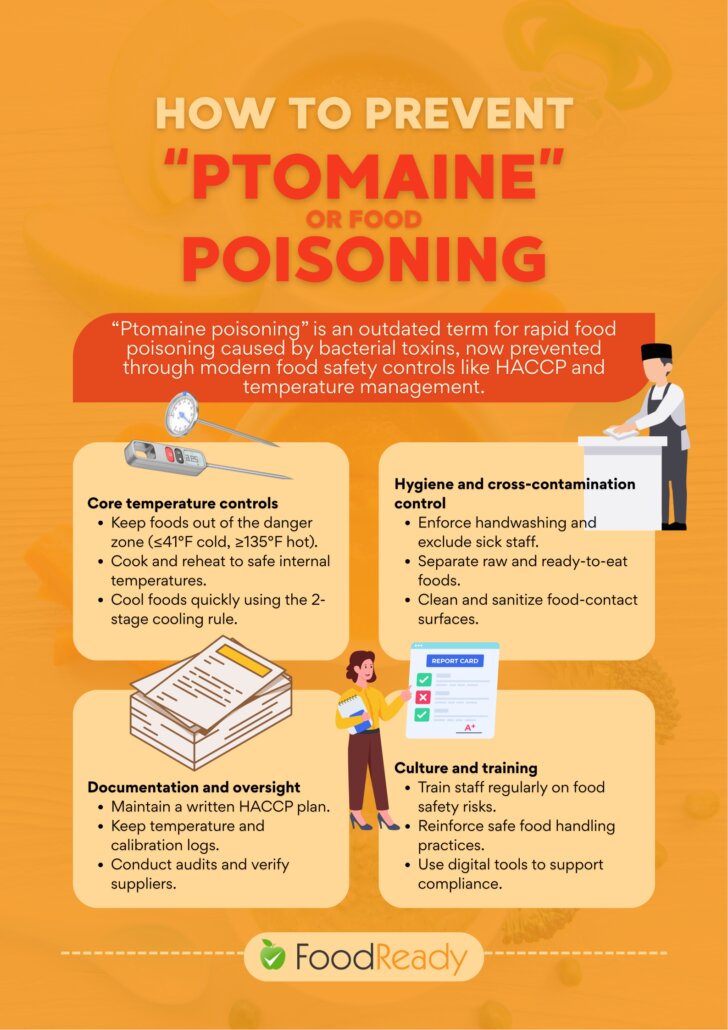
FoodReady.AI offers digital HACCP plan builders, SOP generators, and automated temperature monitoring that help teams turn these prevention principles into daily, auditable practice.
Traceability, FSMA 204, and Managing Outbreak Risk
When a customer claims “ptomaine poisoning” in 2026, the business reality extends far beyond a single upset stomach. A toxin-related outbreak can trigger recalls, lawsuits, and loss of major retail contracts. Your traceability system determines whether you contain the damage in hours, or weeks.
FSMA 204 requirements: These obligations are part of the FDA’s broader FSMA 204 food traceability rule aimed at speeding outbreak investigations.
- Enhanced traceability records for high-risk foods (including deli meats, soft cheeses, raw produce, and undercooked ground beef products)
- Ability to trace one step forward and one step backward within 4 hours
- Key Data Elements (KDEs) for each Critical Tracking Event
Effective systems enable:
- Real-time lot tracking from receiving through production, packaging, and distribution
- Digitized records linking finished batches to ingredient lots, process steps, and critical control point data
- Rapid identification of contaminated water sources or supplier issues
Recall preparedness essentials: In addition to internal protocols, food businesses should understand the FDA process outlined in a comprehensive guide on handling an FDA recall.
- Regular recall simulations testing your ability to identify affected lots within hours
- Clear internal roles and scripts for communicating with regulators and customers
- Documentation that demonstrates due diligence to the national institute of food safety and your local health department
FoodReady.AI provides centralized, cloud-based databases accessible across multi-site operations, plus AI-assisted recall simulation tools that help QA teams identify gaps before real events occur.
Even when a customer says, “I got ptomaine from your fruit juice,” your documented traceability and rapid response demonstrate professional, science-based control of food safety risk.
Working with FoodReady to Reduce “Ptomaine” Complaints
At FoodReady.AI, we partner with food manufacturers, processors, co-packers, and distributors to modernize food safety and compliance, helping you prevent the very incidents that customers might call “ptomaine poisoning.”
Our core capabilities:
- HACCP plan builder that identifies where toxin-forming hazards like Staph aureus and C. perfringens can occur and defines preventive controls
- SOP generator for standardized cooling, hot-holding, reheating, and employee health policies aligned with current FDA Food Code requirements
- Real-time lot tracking linking every finished product to its ingredients, process history, and CCP data
Compliance and audit support:
- Automated recordkeeping for temperatures, cleaning checks, and CCP monitoring to simplify SQF, BRCGS, and regulatory inspections
- FSMA 204-ready traceability records demonstrating due diligence when health problems arise, embedded within a broader Food Safety Modernization Act (FSMA) compliance framework
Consulting services:
- Food safety experts who review facility layouts, process flows, and historical complaints
- Support for designing realistic recall and outbreak simulations
Consider how much faster and more confident your response to the next suspected outbreak could be with unified software and consulting in place.
Worried about food poisoning risks in your facility?
Book a demo to see how digital HACCP tools simplify prevention and compliance.
FAQ
No. “Ptomaine poisoning” is no longer used as a formal diagnosis. Modern clinicians diagnose specific conditions: Staphylococcal food poisoning, C. perfringens gastroenteritis, or Bacillus cereus intoxication. The term survives in everyday speech, particularly among older adults, but food safety professionals and healthcare providers consider it outdated. When a customer claims “ptomaine,” your healthcare provider and regulators will evaluate using current pathogen and toxin terminology.
Timing and clustering are your primary clues. Multiple unrelated people becoming ill with similar common symptoms 2–6 hours after eating the same item strongly suggests a common source, just as travelers must watch for patterns when applying tips to avoid food poisoning while traveling. Document all complaints, check production and temperature logs for the relevant batch, and retain food samples when possible. Final confirmation typically involves health departments or laboratories, not internal judgment alone. Strong traceability records make investigations fairer and more accurate for everyone involved
Absolutely. This is one of the most dangerous misconceptions. Foods contaminated with Staph aureus toxins or other harmful bacteria can look, smell, and taste completely normal. The toxins are often odorless and colorless. Never “taste test” questionable food. Time-temperature controls and hygienic handling are your only reliable defenses. If raw foods, cooked meats, or ready to eat foods exceeded safe temperatures, discard them regardless of appearance.
Ptomaines are chemical byproducts of protein decay found in severely spoiled food, but they’re not the main causes of acute food poisoning recognized today. Any food decomposed enough to contain significant ptomaines would typically be obviously spoiled and inedible, with foul odors that would prevent eating it. Your operational focus should be on microbial risk management (hazard analyses, CCPs, sanitation) rather than ptomaine chemistry. Still, enforce shelf life and spoilage controls to prevent both contamination and customer complaints.
Immediate action checklist:
Stop serving the suspected item or batch at once
Isolate remaining product and label it “Hold – Do Not Use”
Notify your designated food safety or QA lead
Begin internal incident documentation
Management should quickly review production records, temperature logs, and recent maintenance or staffing changes. Depending on jurisdiction and scale, you may be legally required to contact your local health department. Tools like FoodReady.AI can help assemble the necessary lot and process information rapidly, turning what could be a multi-day scramble into a matter of hours.