Have you been told by a potential buyer that your product needs to be GFSI certified?
Well, GFSI (Global Food Safety Initiative) in itself is NOT a certification program. However, you can become certified to a food safety standard (certification scheme) that is recognized by GFSI by meeting their stringent benchmarking standards. GFSI is coordinated by The Consumer Goods Forum which is made up of 42 retailers and manufacturers from all over the world. Many buyers will require that its suppliers achieve a “GFSI Benchmarked” certification scheme. There are many options for GFSI Certification schemes that they recognize, and they are listed below.
Achieving certification to a GFSI recognized scheme demonstrates your organization’s commitment to food safety and operational excellence, and can lead to improved processes, cost savings, and greater market access.
After you select the standard you wish to use like SQF certification or BRC (BRCGS) certification, you implement it in your business and then have a 3rd-party audit conducted by a certification body or (CB). After you successfully pass your audit, you will be granted your certificate.
With FoodReady, you can confidently navigate the complexities of a GFSI audit certification program, ensuring your certification journey is smooth and successful.
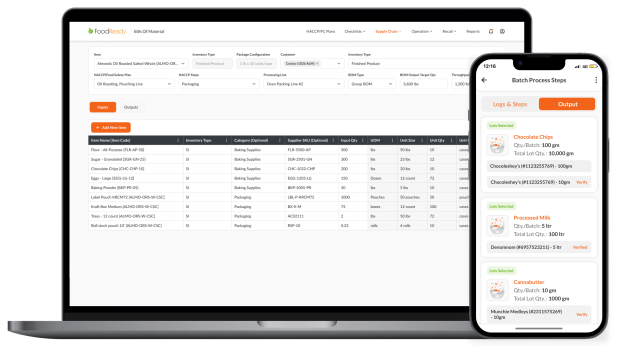
FoodReady is your all-in-one food safety management system for GFSI certification.
- FoodReady has a HACCP/PC builder and recall plan builder for recall management.
- FoodReady provides a library of SQF Standard Operating Procedures (SOPs) examples as part of its SQF software subscription.
- FoodReady provides a Verification Dashboard that allows for supervisor sign-offs and review of corrective actions in one single view
- FoodReady automates the corrective action process with conditional logic checklists and min and max values for food safety criteria, such as pH and temperature, inside the mobile app. Corrective action management is a requirement of SQF.
- FoodReady has a robust reporting section that allows for the creation of audit-ready reports for SQF auditors or dashboard views.
- FoodReady provides the ability when the FoodReady system is fully implemented to provide production traceability which is also a requirement of SQF.
- FoodReady has a GFSI consultant to help you prepare for and pass your GFSI audit.
- FoodReady has record keeping and document management.
- FoodReady has environmental monitoring programs.
- FoodReady has a complaint management system.
FoodReady software and consulting helps you get ready and stay ready for any scheduled or surprise GFSI related audit.
Try it out today and see how FoodReady can help you pass a 3rd-party audit.
Ready to Become GFSI Certified?
Let our experts guide you through the certification process from start to audit success.
What are the benefits of GFSI?
GFSI Certification is accepted by almost every food buyer and is considered the most comprehensive level of food safety management. The Costco audit has their own requirements which are based on GFSI with a few additions specific to Costco. Having a GFSI certification as your base and then implementing the Costco additions is not a huge leap.
Having GFSI Certification means you are providing safe quality food to the end consumer, while maintaining and improving your brand integrity. GFSI certification helps protect consumers by ensuring food safety standards are met throughout the supply chain. It also helps retain existing customers and attract potential customers by demonstrating your commitment to food safety. GFSI prepares your facility and process for government regulatory rules in use now and coming in the future. Getting GFSI compliant now will save you money in the long run by making your product “shelf ready” because virtually all buyers will accept GFSI as their preferred food safety certification for processed foods.
Which Buyers Require GFSI Certification?
Here is the list of buyer that require to be GFSI certifed.
1. Large Retailers and Distributors
If you sell food products to large retailers such as Walmart, Target, Costco, or Amazon, you’ll likely need to become GFSI certified. These companies require their suppliers to meet specific food safety standards to ensure that their customers are receiving safe and high-quality products.
Being GFSI certified is an important step to becoming a stand-out brand because GFSI certification is perhaps the most recognized and trusted food safety certification worldwide and satisfies the requirements of most large retailers and distributors.
Because GFSI uses benchmarked standards of SQF and BRC and other exhaustive food safety certifications, if you achieve a GFS certification there will be no need to pursue lesser food safety certifications for your food manufacturing business.
2. Food Service Providers
If you supply food products to food service providers such as restaurants, catering companies, or institutional dining facilities, you may need to be GFSI certified. Food service providers have a responsibility to ensure that the food they serve is safe, and they may require you to become GFSI certified as evidence that your products meet their food safety standards.
3. International Buyers
If you export your food products to other countries, you may need GFSI certification. Many countries have their own food safety regulations, and becoming GFSI certified can help you meet those requirements.
Additionally, export markets may require GFSI certification as proof that your products meet international food safety standards.
4. Private Label Food Products
If you manufacture private label food products for brand owners, you may need GFSI certification. Brand owners have a reputation to protect and want to ensure that the products their name is associated with are safe and of high quality. GFSI certification can reassure them that your products meet their standards.
Even if specific buyers don’t require you to become GFSI certified, certification of your food safety management system (FSMS) can provide numerous benefits. You’ll have a documented system for ensuring food safety, which can help identify potential hazards and reduce the risk of contamination.
Additionally, certifying your FSMS can help you differentiate your business from competitors and provide a competitive advantage and get your product into bigger and better retailers.
What are the 4 major steps to getting a GFSI Certificate?
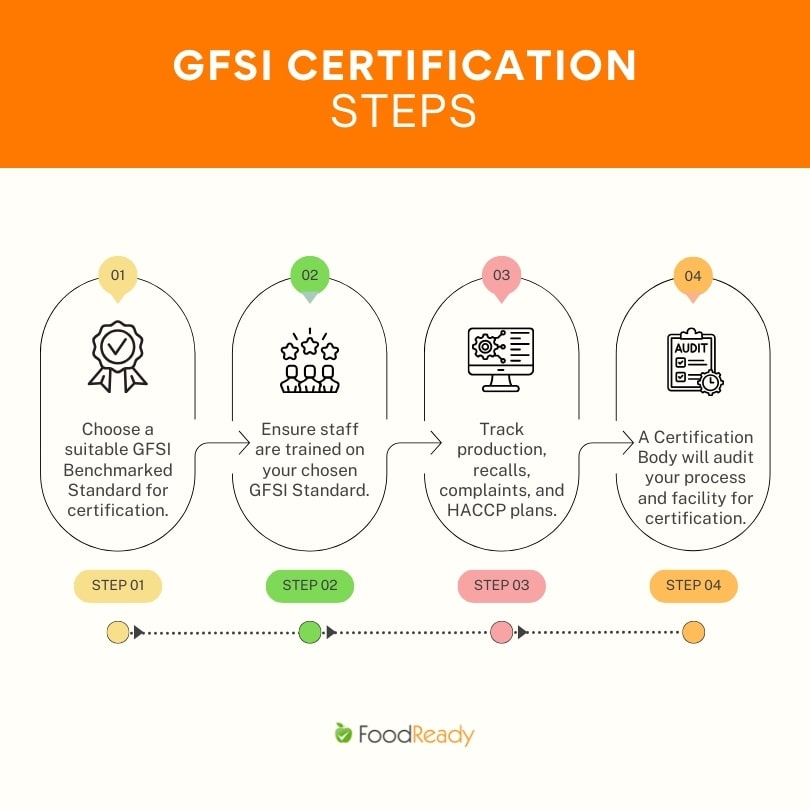
Step 1 – Choose an appropriate GFSI Benchmarked Standard for certification.
Start by selecting the GFSI benchmarked certification scheme that best fits your business model, industry sector, and customer requirements.
GFSI Benchmarked Standards:
- SQF Edition 9
- BRCGS Global Standard
- FSSC 22000
- BRC-IOP Global Standard for Food Packaging and Food Packaging Materials
- Primus GFS Standard
- Global Red Meat Standard
- IFS Version 7
- IFS PACsecure 2
- CanadaGAP
- GlobalG.A.P. Standard
These are all GFSI recognized schemes, widely accepted by major retailers and certified through third-party audits.
Each standard has unique strengths depending on your product type, customer base, and facility complexity.
Step 2 – Train Your Staff
Ensure that all relevant employees are educated on the requirements of your selected certification scheme. Training resources are widely available online and are often offered by certification bodies and standard owners.
Step 3 – Implement Your Food Safety Management System
Build and document your food safety program to align with the chosen standard. This includes:
- HACCP and Preventive Control Plans
- SOPs and PRPs
- Recall management procedures
- Complaint handling
- Batch and inventory traceability
- Environmental monitoring
- Document control and recordkeeping
- Internal audits and checklists
A robust system ensures readiness for audits and long-term compliance.
Step 4 – Schedule and Pass Your Certification Audit
Once your system is in place, work with an accredited Certification Body (CB) to conduct an official third-party audit of your facility and processes. If successful, you’ll be issued a certificate that validates your compliance with GFSI standards.
After initial certification, an annual audit is required to maintain your GFSI certification status.
What Makes GFSI Different From Other Food Safety Programs?
One of the most common misconceptions about GFSI is that it’s a certification program like ISO 22000 or HACCP. In reality, GFSI is a benchmarking system, not a certifying body. This means that GFSI doesn’t issue certifications itself. Instead, it evaluates and recognizes food safety certification schemes (like SQF, BRCGS, FSSC 22000, and others) that meet its rigorous criteria.
This structure is what sets GFSI apart. While ISO and HACCP focus on setting specific frameworks or hazard controls, GFSI provides a global umbrella of credibility for various programs that align with its standards. That’s why when buyers ask for “GFSI certification,” what they really mean is certification to a GFSI-recognized scheme. Choosing a benchmarked program ensures you’re meeting internationally respected standards and that your certification will be accepted by most major retailers, distributors, and food service companies.
Which GFSI certification is right for your business?
When considering which GFSI certification is most appropriate for your business, several factors should be taken into account:
1. Industry Sector and Market Requirements
- Evaluate your industry sector’s requirements and expectations, as different GFSI certifications may be more relevant to certain sectors.
- Consider your customers’ market demands and preferences. Some retailers and buyers may prefer specific GFSI certifications.
2. Company Size and Complexity
- Assess the size and complexity of your business operations, as certain GFSI certifications may be better suited for larger or more complex organizations.
- Choose a certification scheme that aligns with your business’s scale and the resources available for implementing and maintaining the certification.
3. Risk Assessment and Hazard Analysis
- Conduct a thorough risk assessment and hazard analysis of your food products and processes to identify potential food safety risks and control measures.
- Select a GFSI certification that addresses the specific risks and hazards relevant to your business operations.
4. Regulatory Compliance and Legal Requirements
- Ensure the chosen GFSI certification aligns with regulatory requirements and legal standards applicable to your industry and geographic location.
- Verify that the certification scheme covers all mandatory food safety and quality management aspects to ensure compliance with relevant regulations.
5. Supplier and Customer Requirements
- Consider the requirements of your suppliers and customers, as they may have specific expectations regarding food safety certifications and standards.
- To facilitate business relationships, choose a GFSI certification recognized and accepted by key stakeholders in your supply chain.
Top Challenges Regarding GFSI And How to Overcome Them
Pursuing GFSI certification can be a game-changer for your food business, but let’s be honest, the journey isn’t always easy. From managing documentation to preparing for audits, the process can feel overwhelming without the right support. That’s why we’ve broken down some of the most common roadblocks below and how FoodReady can help you move past them with confidence.
| Challenge | What It Looks Like | How to Overcome It |
|---|---|---|
| Documentation Overload | SOPs, records, traceability logs, HACCP plans; paperwork adds up fast. | Use FoodReady’s digital document management system and SOP library to stay organized, searchable, and audit-ready at all times. |
| Audit Anxiety | Fear of failure or uncertainty around what auditors expect. | Our consultants walk you through pre-audit prep, conduct mock audits, and explain what auditors will look for, reducing surprises and boosting confidence. |
| Implementation Fatigue | Employees resist new protocols or lose steam midway through implementation. | Break the process into phases, use FoodReady’s mobile-friendly checklists, and assign tasks with automatic reminders and CAPA workflows to maintain momentum. |
| Training Gaps | Staff don’t fully understand the new food safety requirements. | Leverage FoodReady’s training templates and checklist logic to reinforce protocol knowledge. Pair it with internal audits to validate readiness. |
| Confusion Over Which GFSI Standard | BRCGS? SQF? FSSC 22000? Which one fits your business best? | Talk to a FoodReady consultant to evaluate your business size, product type, and buyer expectations. We’ll then guide you down the right certification path. |
Getting GFSI certified doesn’t have to be overwhelming. With FoodReady’s software and consulting support, you can tackle these challenges step-by-step and stay ready for whatever the audit throws your way.
Other Benefits of GFSI Certification
While GFSI certification is often pursued to meet retailer or buyer requirements, its value goes well beyond that. Businesses that implement a GFSI-recognized food safety standard often experience operational improvements that pay off in both the short and long term.
- Fewer Recalls, Less Risk: Stronger food safety protocols mean fewer costly product recalls and reduced liability exposure.
- Stronger Brand Reputation: Certification signals your brand’s commitment to quality, helping build consumer trust and loyalty.
- Streamlined Regulatory Inspections: Compliance with GFSI standards often aligns with FDA, USDA, and international regulations, making inspections faster and less stressful.
- Better Supplier Collaboration: Standardized expectations and traceability systems lead to stronger relationships and smoother processes with your suppliers.
In short, GFSI certification doesn’t just open doors to new buyers. It helps you build a smarter, safer, and more resilient business.
Conclusion
GFSI certification is a crucial step for food businesses like yours to meet global food safety standards and build trust with buyers. While GFSI doesn’t certify directly, it recognizes certification programs like SQF and BRCGS that meet its benchmarking requirements.
Earning certification involves a third-party audit by an accredited body, ensuring compliance with strict food safety practices. Preparing for this can be complex, but with FoodReady’s tools and expert guidance, the process becomes manageable and efficient.
Get GFSI certified to protect your brand, meet buyer expectations, and grow your business. Try our services and solutions to simplify your journey and achieve compliance with confidence!
FAQs
Even if specific buyers don’t require you to become GFSI certified, certification of your food safety management system (FSMS) can provide numerous benefits. You’ll have a documented system for ensuring food safety, which can help identify potential hazards and reduce the risk of contamination.
Additionally, certifying your FSMS can help you differentiate your business from competitors and provide a competitive advantage and get your product into bigger and better retailers.
GFSI certification is not mandatory, but many organizations choose to obtain it in order to demonstrate their commitment to food safety.
GFSI certification is a valuable tool in managing food safety, but it does not guarantee food safety.
GFSI certification includes a comprehensive evaluation of your food safety management system against a benchmarked standard such as SQF or BRCGS. This covers everything from HACCP-based risk assessments and sanitation practices to traceability, supplier control, internal audits, recall procedures, and employee training. A third-party audit verifies your compliance before certification is awarded.
Yes, GFSI certification is internationally recognized.
GFSI certification is a globally recognized standard, while other food safety programs may have different scope and application.
The cost of GFSI certification varies depending on the size and complexity of your operation, the certification scheme you choose (e.g., BRCGS, SQF, FSSC 22000), and the certification body conducting your audit. Expenses typically include auditor fees, consulting or training (if needed), and ongoing maintenance. Small operations might spend a few thousand dollars, while larger or multi-site businesses may incur higher costs annually.
The timeline for GFSI certification depends on factors such as the complexity of the organization’s food safety system and the availability of resources.