

What Is the Difference Between a HACCP Decision Tree and Hazard Matrix?
A HACCP decision tree is a logic tool that walks your team through a series of yes-or-no questions to decide whether a process step is a critical control point needed to control a food safety hazard. Building a solid HACCP plan means making two big calls for every hazard you find: how serious is the risk, and does this point in the process qualify as a CCP? Two tools help you answer those questions. The hazard matrix sizes up the risk, and the decision tree decides whether a step is a critical control point. They work together, but they are not the same thing, and mixing them up leads to inconsistent hazard analysis, weak plans, and more audit risk.
For food and beverage companies such as manufacturers, processors, co-packers, and distributors especially mid-sized to enterprise operations modernizing HACCP compliance, this guide breaks down the difference in plain terms. It shows how each tool fits into hazard analysis, reviews updated HACCP expectations under Codex and SQF Edition 10, and explains how FoodReady supports both in one connected workflow so your food safety plan is focused, consistent, defensible, and ready for inspection and audit scrutiny.
The Short Answer
Both tools support your hazard analysis within a broader system built on seven HACCP principles for food safety management, but they answer different questions at different stages.
Here is the difference at a glance.
Hazard Matrix | Decision Tree | |
The question it answers | How significant is this hazard? | Is this step a critical control point? |
When it is used | Early, during hazard analysis | After significant hazards are identified |
Format | A grid of likelihood against severity | A sequence of yes or no questions |
Output | A risk rating that flags significant hazards | A decision on whether a CCP exists |
What Is a HACCP Hazard Matrix?
A hazard matrix, also called a risk assessment matrix, ranks each hazard which can either be a biological, chemical, or physical agent that can cause illness, by plotting how likely it is to occur against how severe the harm would be. The result is a risk rating that tells you which hazards are significant enough to control. It is the first filter in your hazard analysis, and it keeps your plan focused on the risks that truly matter.
A typical matrix scores likelihood and severity, then multiplies or maps them to a risk level. Here is how the risk levels usually translate into action.
Risk level | What it means |
Low | Unlikely and low severity. Managed by prerequisite programs rather than a control point. |
Medium | Needs attention. May be controlled by good practices or flagged for the decision tree. |
High | Significant hazard. Must go to the decision tree to confirm whether a critical control point is required. |
Only the hazards the matrix rates as significant move forward. During hazard identification and identifying hazards, this means examples such as biological hazards and physical hazards are reviewed as food safety hazards before moving on. That is what makes the matrix and the decision tree a natural pair. One filters, the other decides.
What Is a HACCP Decision Tree?
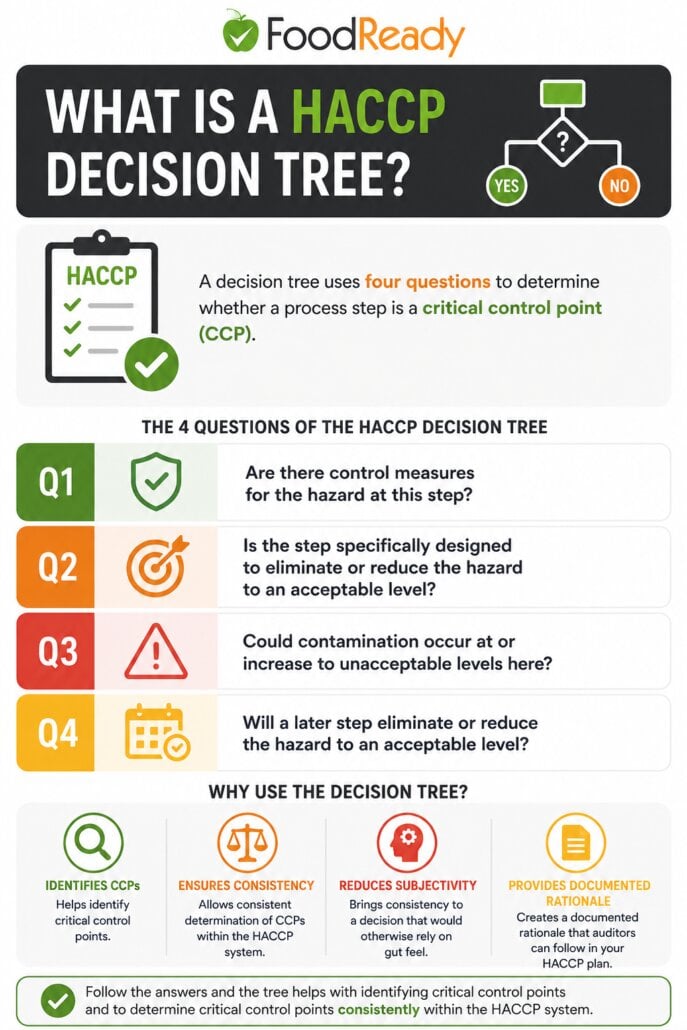
A decision tree is a logic tool that takes each significant hazard through a fixed set of yes or no questions to determine whether a process step is a critical control point.
The best known version is the Codex Alimentarius decision tree which was updated in 2023 for better guidance. This CCP decision tree uses four questions to reach a clear answer about critical control points (CCPS).
- Q1. Are there control measures for the hazard at this step?
- Q2. Is the step specifically designed to eliminate or reduce the hazard to an acceptable level?
- Q3. Could contamination occur at or increase to unacceptable levels here?
- Q4. Will a later step eliminate or reduce the hazard to an acceptable level?
Follow the answers and the tree helps with identifying critical control points and to determine critical control points consistently within the HACCP system.
It brings consistency to a decision that would otherwise rely on gut feel, and it creates a documented rationale that auditors can follow inside your HACCP plan.
How They Work Together
The two tools are stages in the same journey, not competing methods. The matrix decides what is worth controlling, and the tree decides how control is confirmed.
Step 1. The HACCP team identifies hazards in the process flow during hazard analysis.
Step 2. Use the hazard matrix to rate each one and flag the significant hazards.
Step 3. Run each significant food safety hazard through the decision tree to determine critical control points and distinguish CCPs from preventive measures and other preventive measures.
Step 4. After a CCP is confirmed, establish critical limits as the third HACCP principle, then establish monitoring procedures, define monitoring procedures, and establish corrective actions, which are defined in the fifth HACCP principle, as part of your food safety management system.
Identifying too many CCPs can complicate monitoring systems and weaken focus, so hazards must be shown to be effectively controlled at the right step.
New Updates: What Is Changing
The tools themselves are stable, but expectations around how you use and document them are shifting.
- Codex guidance refreshed: The updated Codex general principles keep the decision tree as a helpful aid while stressing that it is not the only route to identifying a critical control point, so sound judgment and documentation matter more than ever.
- SQF Edition 10 raises the bar: Edition 10 was released in 2026, with audits beginning January 2027, and it places greater weight on data integrity and a documented rationale for every hazard decision.
- Digital hazard analysis is now expected: Auditors increasingly want traceable, timestamped records of how each risk rating and CCP decision was reached, which paper templates struggle to provide.
How FoodReady Ensures Compliance With HACCP Decision Trees and Hazard Matrixes
FoodReady brings the hazard matrix and the decision tree into one connected platform, supporting an effective HACCP system tailored to each food operation instead of a one-size-fits-all setup, so your hazard analysis flows logically from risk rating to CCP decision without spreadsheets or guesswork.
The FoodReady HACCP Builder guides you through a built-in hazard matrix and decision tree, with support for standard operating procedures and documentation procedures, drawing on more than 80 industry templates.
Every risk rating and CCP decision is captured with its rationale, alongside record-keeping and support to establish verification procedures as part of the HACCP workflow, giving you the documented logic auditors expect.
Confirmed critical control points flow straight into critical limits, monitoring procedures, corrective action procedures, and record-keeping, keeping the whole plan connected.
Cloud-based version history keeps every decision timestamped and ready for any GFSI, SQF, BRCGS, FSSC 22000, FDA, or USDA review.
On top of the software, FoodReady pairs you with certified food safety experts who help you apply both tools correctly and establish record-keeping from the start. Management commitment and expert guidance are crucial for successful implementation, especially for food businesses and food business operators. You can schedule a demo to see how it turns hazard analysis into a guided, defensible process.
Conclusion
The difference is simple once it clicks. Within the HACCP concept, first developed in the 1960s by NASA and made a legal requirement in January 2006 in the EU, the hazard matrix measures how significant a risk is, while the decision tree decides whether a step is a critical control point. Use the matrix to filter, the tree to confirm, and document both so your plan stands up to scrutiny. Get the pairing right and your hazard analysis becomes focused, consistent, and audit-ready. FoodReady builds both tools into one workflow to support broader hazard control across the food industry and help teams focus on producing safe food.
Frequently Asked Questions
What is the main difference between a hazard matrix and a decision tree?
A hazard matrix rates how significant a hazard is by weighing likelihood against severity. A decision tree then helps determine whether a process step is one of the critical control points (CCPs) needed to control food safety risks.
Which comes first, the hazard matrix or the decision tree?
The hazard matrix comes first during hazard identification. It filters out the significant hazards, and only those judged significant move on for further consideration in the decision tree for a critical control point decision.
What is the Codex decision tree?
It is the widely used four-question logic tool from Codex Alimentarius, guidance developed by the Food and Agriculture Organization and related international bodies, that helps teams decide, consistently, whether a step is a critical control point. In practice, it works as a flow chart that guides teams through structured questions to determine where process steps are needed to control hazards.
Do I have to use a decision tree to identify CCPs?
No. The decision tree is a helpful aid, not the only method. At a single process step, the team may assess more than one hazard and determine that some are managed through operational prerequisite programs or food hygiene controls rather than a CCP. Sound judgment backed by clear documentation is also acceptable, and some hazards may be managed by operational prerequisite programs or food hygiene controls instead of a CCP if they are effectively controlled elsewhere in the food chain, often used alongside the tree.
What does a hazard matrix measure?
It measures risk by combining the likelihood of a hazard occurring with the severity of the harm it could cause, producing a risk rating for foodborne hazards, including risks that may come from raw materials.
Can I use both tools in the same HACCP plan?
Yes, and you should. They are designed to work together in the same HACCP plan across the broader food system, with the matrix filtering hazards and the tree confirming control points to control food safety hazards from hazard analysis through final consumption, supporting consistent food safety practices.
How does FoodReady help with hazard analysis?
FoodReady builds both the hazard matrix and the decision tree into one guided workflow, captures the rationale for every decision, and keeps it all timestamped and audit-ready. For example, a cooking process may be documented as a CCP when controlled heat treatment is needed for microbiological safety. High-risk products such as low-acid canned foods require especially careful hazard analysis and CCP decisions. It also helps the HACCP team document monitoring and verification across the food supply chain, while supporting prerequisite-program records such as pest control, quality assurance, and safe food for intended consumers.

Suhina Fitzpatrick
Senior Food Technologist
Suhina is a Subject-Matter Expert at FoodReady with 15 years in the industry as a Senior Food Technologist. Specializing in Food Safety, Quality and Food Manufacturing, Suhina is passionate about everything Food and has headed many successful Food Safety Audits according to global standards over the years. When away from the workstation, the gym and an active lifestyle is her happy place.
Speak with our Expert Consultants
15–30 minutes. We map FoodReady to your process, plug in your real HACCP plan, and show you the auditor view before the call ends.