Key Takeaways
- ISO 22000:2018 is the internationally recognized food safety management system standard, confirmed in 2023, that applies to every organization in the food chain, from primary producers to food retailers.
- While iso 22000 certification is voluntary, major buyers, export markets, and global food safety initiative benchmarked schemes increasingly treat it as a baseline requirement for supplier approval.
- The standard integrates HACCP principles with Codex Alimentarius guidelines and the Plan-Do-Check-Act cycle, creating a systematic approach to control food safety hazards from farm to fork.
- Implementation typically takes 6–12 months for mid-sized operations, with success depending on top management commitment, cross-functional food safety team involvement, and well-documented prerequisite programs.
- FoodReady AI provides an all-in-one platform combining software and consulting to digitize ISO 22000 implementation, including a HACCP plan builder, SOP generator, real-time lot tracking, and audit readiness dashboards.
What Is ISO 22000?
ISO 22000:2018 is the international standard for a food safety management system published by the International Organization for Standardization (ISO). Last confirmed as current in 2023, this international standard provides a framework that any organization in the global food supply chain can use to demonstrate its ability to control food safety hazards and ensure the safety of food products for human consumption.
The standard applies universally across the food chain. This includes:
- Primary producers and farmers
- Food manufacturers and food processors
- Ingredient suppliers and co-packers
- Storage and distribution operations
- Food retailers and food service establishments
- Organizations providing packaging, cleaning, and pest control services
ISO 22000 combines the high-level structure common to other iso management standards with HACCP principles drawn from the Codex Alimentarius General Principles of Food Hygiene. The result is a management system built on four key elements: interactive communication throughout the supply chain, system management using a process approach, prerequisite programs that maintain an appropriate work environment, and hazard analysis for identifying and controlling potential hazards.
The standard embraces risk-based thinking as a core principle, requiring organizations to identify risks and opportunities beyond just physical, chemical, and biological hazards, aligning closely with broader food safety management principles.
It also mandates continual improvement, not just compliance at a single point in time, but ongoing enhancement of the FSMS.
While ISO 22000 can stand alone as a certification, it also forms the foundation for schemes like FSSC 22000 that are benchmarked by the Global Food Safety Initiative (GFSI). Organizations seeking certification to GFSI-recognized standards often start with ISO 22000 and add the technical specifications required by specific schemes.
Core Requirements of ISO 22000:2018
ISO 22000:2018 follows the Annex SL high-level structure shared by ISO management system standards such as ISO 9001 and ISO 14001. This structure (organized in clauses 4 through 10) makes integration with other management systems straightforward for food organizations operating multiple certified systems.
Organizational Context (Clause 4)
Organizations must analyze internal and external issues affecting food safety, including regulatory changes, supplier reliability, technological advancements, and market conditions. You also need to identify interested parties (customers, regulators, suppliers, and consumers) and understand their specific food safety requirements.
Leadership and Food Safety Policy (Clause 5)
Top management must demonstrate commitment by establishing a food safety policy, a concise document declaring the organization’s commitment to producing safe food. Leadership also involves appointing a food safety team composed of qualified individuals with the competence to develop and maintain the FSMS.
Planning and Risk Management (Clause 6)
This clause requires setting measurable food safety objectives and developing plans to achieve them. Organizations must apply risk management principles to identify threats and opportunities that could impact the FSMS.
Support (Clause 7)
Support requirements cover:
- Resources, including qualified personnel and infrastructure
- Competence and awareness training
- Communication procedures for internal and external stakeholders
- Documented information and document control
Operation (Clause 8)
The operational clause is the heart of ISO 22000, requiring organizations to:
| Requirement | Description |
|---|---|
| Prerequisite Programs | Establish PRPs for hygiene, pest control, maintenance, allergen management, and supplier verification |
| Hazard Analysis | Conduct systematic analysis to identify biological, chemical, and physical hazards |
| Critical Control Points | Determine CCPs where control is essential to prevent or eliminate hazards |
| Operational PRPs (oPRPs) | Identify significant hazards controlled with less stringent measures than CCPs |
| Hazard Control Plan | Document control measures, critical limits, monitoring procedures, and corrective actions |
| Traceability | Implement systems for product identification and lot tracking |
| Emergency Plan | Develop procedures for emergencies and potential recall situations |
Performance Evaluation and Improvement (Clauses 9–10)
Organizations must establish an internal audit program, conduct management reviews, handle nonconformities with corrective actions, and drive continuous improvement of the FSMS.
FoodReady AI automates documentation, hazard analysis workflows, monitoring records, and management review data to help satisfy these clauses with less manual effort.
ISO 22000 and HACCP
ISO 22000 operationalizes Hazard Analysis and Critical Control Points (HACCP) within a full management system framework using two interrelated PDCA cycles. One cycle governs the management system itself: planning, implementation, checking, and improving the overall FSMS. The second cycle focuses specifically on operational processes: hazard analysis, control implementation, verification, and updating based on results.
Codex HACCP Integration
The standard embeds the Codex 12 steps of HACCP:
- Assemble a multidisciplinary food safety team
- Describe the product fully
- Identify intended use and consumer groups
- Construct process flow diagrams
- On-site verification of flow diagrams
- Conduct hazard analysis for each step
- Determine critical control points
- Establish critical limits for each CCP
- Establish monitoring systems
- Establish corrective actions
- Establish verification procedures
- Maintain documentation and records
Understanding PRPs, oPRPs, and CCPs
ISO 22000 introduces a clearer classification system than traditional HACCP:
| Control Type | Purpose | Monitoring | Corrective Action |
|---|---|---|---|
| PRPs | Foundational hygiene and sanitation measures | General verification | Restoration of conditions |
| oPRPs | Control significant hazards with action criteria | Specific to hazard | Documented procedure required |
| CCPs | Essential control to prevent, eliminate, or reduce hazards to acceptable levels | Continuous or frequent, measured | Immediate action, disposition of product |
Understanding this classification matters because it determines monitoring intensity, record requirements, and how you handle deviations.
Migration from Stand-Alone HACCP to ISO 22000
Food manufacturers with existing HACCP plans can migrate to a fully ISO 22000-compliant FSMS by:
- Conducting a gap analysis against ISO 22000:2018 requirements
- Strengthening documentation of PRPs and verifying their effectiveness
- Adding management system elements: policy, objectives, internal audits, management review
- Establishing interactive communication protocols with suppliers and customers
- Implementing formal continual improvement processes
Benefits of ISO 22000 Certification for Food Businesses
ISO 22000 certification is voluntary in most regions, but many global retailers, co-manufacturers, and export markets increasingly expect it or a GFSI-benchmarked alternative as a condition for doing business. Certification helps reduce food safety incidents, strengthen regulatory compliance, improve traceability, and support faster recall responses while also enhancing market access and supplier credibility.
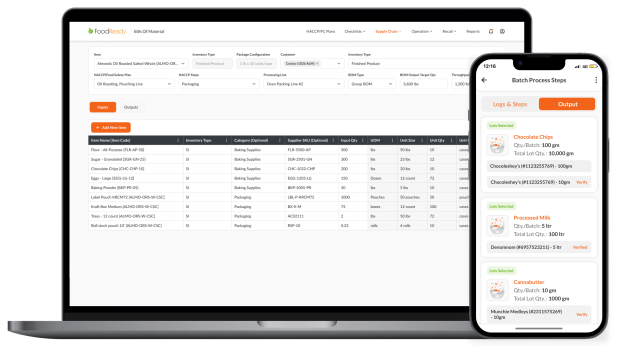
Platforms like FoodReady.AI further support these outcomes with real-time lot tracking, inventory and production tools, and recall simulation capabilities.
Read our detailed article to learn more about ISO standards and benefits.
Implementing ISO 22000: Step-by-Step
Typical implementation timelines range from 6 to 12 months for mid-sized single-site operations, though this varies based on existing systems and management commitment. Success depends heavily on top management involvement and resource allocation from the start.
Phase 1: Assessment and Planning
- Conduct a gap analysis comparing current practices against ISO 22000:2018 requirements
- Define the scope of your FSMS, including products, processes, and sites
- Form a cross-functional food safety team with qualified personnel from operations, quality, maintenance, and sanitation
- Set measurable food safety objectives aligned with your food safety policy
Phase 2: Prerequisite Program Development
Establish a documented procedure for each PRP:
- Personnel hygiene and food hygiene practices
- Cleaning and sanitation protocols
- Pest control and monitoring
- Maintenance and equipment calibration
- Allergen management
- Supplier verification and incoming material control
- Water and air quality management
Phase 3: HACCP-Based Food Safety Plan
- Develop product descriptions and process flow diagrams as part of a structured HACCP plan creation and implementation process
- Conduct hazard analysis and define the core components of your food safety plan using multidisciplinary team input
- Classify hazards and assign controls: PRPs, oPRPs, or Critical Control Points (CCPs) in your HACCP plan
- Document the hazard control plan with critical limits, monitoring, and corrective actions
- Establish test methods for verification activities that support a robust HACCP plan development workflow
- Implement food traceability systems linking raw materials to finished products
Phase 4: System Documentation and Training
- Create documented information required by each clause
- Train all relevant personnel on their food safety responsibilities
- Establish communication procedures for internal and supply chain communication
- Conduct awareness sessions on the food safety policy and objectives
Phase 5: Verification and Readiness
- Perform internal audits against all ISO 22000 requirements
- Conduct a management review to evaluate overall performance
- Address nonconformities with corrective actions
- Validate that control measures achieve intended outcomes
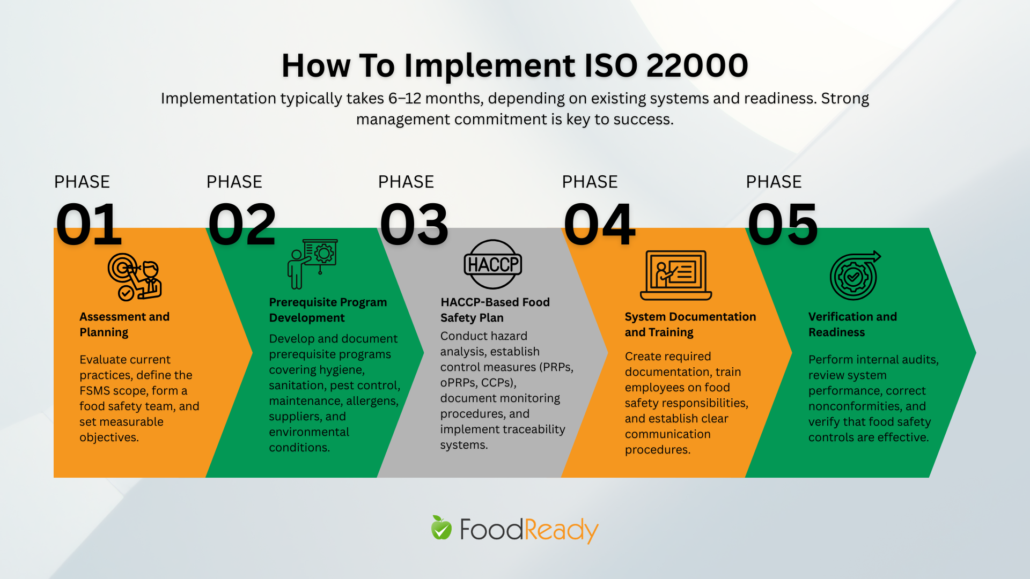
FoodReady’s HACCP plan builder, SOP generator, training record management, and audit-readiness dashboards streamline each phase, reducing implementation time and eliminating manual paperwork.
Maintaining ISO 22000 Certification
Certification follows a three-year cycle with annual surveillance audits. Organizations must demonstrate continual improvement, not just maintenance of the status quo, to avoid nonconformities that could jeopardize certification.
Digital recordkeeping through FoodReady.AI reduces audit time by making documentation instantly accessible, minimizes nonconformities through automated monitoring alerts, and lowers long-term compliance costs through centralized FSMS management.
How FoodReady AI Supports ISO 22000 and Beyond
FoodReady AI is an all-in-one SaaS platform combined with professional consulting services, purpose-built for food manufacturers, food processors, co-packers, and distributors implementing ISO 22000 and related food safety standards.
Software Features Aligned to ISO 22000
- AI-driven HACCP plan builder: Generate hazard analyses and control plans using intelligent templates based on your products and processes, similar to a dedicated HACCP plan builder, to automate safety plans
- SOP and PRP templates: Pre-built, customizable procedures aligned to ISO 22000 clause requirements
- Digital checklists and monitoring forms: Mobile-ready tools for CCP and oPRP monitoring
- CAPA workflows: Structured corrective action and preventive action tracking tied to nonconformances
- Document control: Centralized management of all documented information with version control and approval workflows
Traceability and Recall Readiness
FoodReady AI’s real-time lot and batch traceability supports both ISO 22000 requirements and FSMA 204 compliance:
- Lot tracking: Full chain of custody from receiving through production to shipment, powered by food traceability software for manufacturers
- Inventory management: Real-time visibility into materials and finished goods
- Production tracking: Capture of Critical Tracking Events and Key Data Elements
- Recall simulation: Test your recall procedures before an actual event
Consulting Services
Beyond software, FoodReady AI provides expert consulting:
- Gap assessments against ISO 22000, FSSC 22000, and other GFSI-aligned certification schemes
- Documentation development and review
- Internal audit coaching and execution
- Mock audits for multi-site operations
- Training on food safety iso requirements and when HACCP plans are mandatory or voluntary
Take the Next Step
Whether you’re seeking certification for the first time or upgrading an existing system, FoodReady AI can help you achieve certification faster with less manual effort. Request a demo to see how our platform modernizes your food safety management and prepares your organization for ISO 22000 or FSSC 22000 certification.
Are you ready to simplify ISO 22000 compliance?
See how FoodReady helps you build and manage your food safety system faster.
FAQ
ISO 22000 certification is not legally mandatory in most jurisdictions. Regulatory bodies like the US FDA and the World Health Organization do not require it. However, many food retailers, brand owners, and export markets treat ISO 22000, or GFSI-benchmarked schemes built upon it, as a de facto requirement for supplier approval. For high-risk product categories or private-label manufacturing, buyers frequently specify ISO 22000 or FSSC 22000 certification as a condition of doing business. Even where not required, certification helps demonstrate due diligence and supports compliance with regulations like FSMA, potentially reducing liability exposure related to unsafe food incidents.
Implementation timelines vary based on organizational size, complexity, and current system maturity. Small, single-site companies with strong existing HACCP programs may achieve certification readiness in 3–6 months. Mid-sized to large organizations, or those with multiple sites and diverse product lines, typically require 6–12 months or longer. Key factors influencing timing include current documentation levels, staff competence in food safety management, top management commitment and resource allocation, and complexity of products and processes. Using digital tools like FoodReady AI for HACCP design, SOP management, and recordkeeping can significantly compress preparation timelines by eliminating manual documentation bottlenecks.
While resource constraints are real for SMEs, ISO 22000 is deliberately designed to be scalable. The standard can be implemented proportionally to organizational size and complexity; a small bakery’s FSMS will look different from a multinational processor’s, but both can achieve certification. Cost management strategies include phased implementation, focusing first on the highest-risk product lines, leveraging software templates and pre-built procedures rather than building everything manually, and joining industry associations that provide shared resources. Additionally, some governments, development agencies, and industry programs offer grants, subsidized consulting, or technical assistance specifically for SMEs seeking food safety certification. The long-term benefits, market access, reduced recall risk, and operational efficiency often justify the investment.
A traditional HACCP plan focuses primarily on hazard analysis and critical control points for specific products and processes. It identifies hazards, determines CCPs, sets critical limits, and establishes monitoring and corrective actions, but typically operates as a technical document rather than a comprehensive management system. ISO 22000 wraps HACCP within a full management system framework, adding requirements for top management leadership, strategic organizational context, documented food safety policy and objectives, resource management and competence, internal audits, formal management review, and structured continual improvement. Many food organizations begin with basic HACCP compliance and later upgrade to ISO 22000 for stronger governance, broader market recognition, and easier integration with quality management systems like ISO 9001.
ISO 22000 requires organizations to establish traceability systems and recall procedures as part of operational controls. FSMA 204 in the United States imposes specific recordkeeping requirements for certain foods, mandating capture of Critical Tracking Events and Key Data Elements throughout the food supply chain. While the objectives overlap, ensuring the product can be traced and recalled if needed, FSMA 204 prescribes specific data formats and retention requirements that go beyond ISO 22000’s general traceability mandate. Organizations can align ISO 22000 traceability processes with FSMA 204 data requirements to avoid duplicated work and reduce regulatory risk. FoodReady AI’s real-time lot tracking and digital traceability modules are designed to satisfy both ISO 22000 traceability clauses and FSMA 204 compliance requirements within a single integrated system, ensuring the well-being of consumers while meeting diverse regulatory and customer expectations.