

HACCP Monitoring Procedures – A Complete Guide
Build stronger HACCP monitoring procedures with practical steps for tracking CCPs, documenting results, and preparing for food safety audits.
Published:Last updated:Author:Suhina Fitzpatrick
Every food safety program lives or dies at the control points. You can write the most thorough hazard analysis in the world, but if nobody is watching the critical control points in real-time, the plan is just paper. That is where HACCP monitoring procedures come in. Monitoring is the daily discipline that proves your critical limits are being met, captures the evidence auditors want to see, and tells your team the exact moment something has slipped out of control.
In this deep dive, we break down what HACCP monitoring procedures are, why they matter, how to build them, and how to keep your records audit-ready. We also cover the latest regulatory changes food businesses need to plan for, and we show how FoodReady turns monitoring from a paperwork burden into a connected, automated part of your food safety management system.
What Are HACCP Monitoring Procedures?
HACCP monitoring procedures are the planned observations and measurements you carry out at each critical control point to confirm the process is within its critical limits. Monitoring is the 4th principle of the 7 HACCP principles and sits at the heart of daily food safety operations.
Every monitoring procedure answers four simple questions:
- What will be measured
- How it will be measured
- How often will it be measured
- Who is responsible for doing it
Think of a cooking step where the critical limit is an internal temperature of 165 degrees Fahrenheit. The monitoring procedure defines the calibrated thermometer used, the location in the product where the probe is inserted, the frequency of checks for each batch, and the trained employee assigned to take and record the reading.
Without that structure, a critical limit is just a number. With it, you have a living control that protects consumers and creates a defensible record. A complete HACCP plan ties each monitoring procedure to its hazard, its critical limit, and the corrective action that follows a deviation.
Why HACCP Monitoring Matters?
Monitoring is the bridge between a documented plan and a controlled process. As the 4th of the seven principles, monitoring is where teams establish monitoring procedures. In practice, strong monitoring delivers four things:
Benefit | Description |
Triggers a response when a critical limit is breached, limiting the affected product and reducing recall risk. | Provides data to show that preventive controls are performing as intended. |
Fast corrective action | Triggers a response when a critical limit is breached, limiting the affected product and reducing recall risk. |
A defensible history | Builds records that support verification, trend analysis, and continuous improvement. |
Audit readiness | Produces the primary evidence reviewers require. |
Auditors and certification bodies treat monitoring records as primary evidence. During any GFSI, SQF, BRCGS, or FSSC 22000 audit, and during FDA or USDA inspections, the first thing reviewers ask for is proof that monitoring happened consistently and that deviations were caught and corrected, helping teams maintain compliance and demonstrate regulatory compliance to regulatory agencies.
Reliable monitoring is also the foundation of effective traceability and recall readiness, because the same records that confirm a control point also identify exactly which lots were affected when something goes wrong and tie the procedure to the hazards the CCP is meant to control.
How to Build Monitoring Procedures?
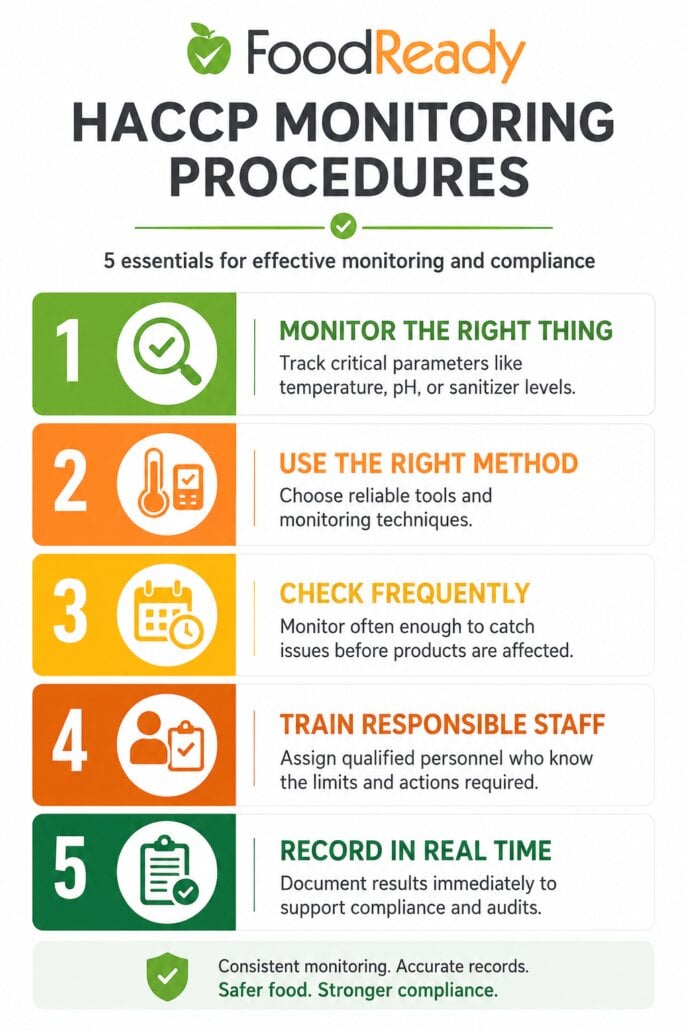
Effective HACCP monitoring procedures must be specific, consistent, actionable, and designed to maintain regulatory compliance.
Strong monitoring programs include five key elements:
Key Element | Details |
Define What to Monitor | Identify the exact measurable factor (temperature, time, pH, etc.) that controls the hazard, ensuring it relates to critical limits. |
Choose the Monitoring Method | Determine measurements and equipment; prefer continuous monitoring (e.g., chart recorders) or reliable periodic methods that detect deviations quickly. |
Set the Monitoring Frequency | Determine based on process stability, hazard risk, and regulations; prioritize continuous monitoring or frequent checks to minimize the affected product. |
Assign and Train Responsible Personnel | Designate trained employees; ensure they understand critical limits, equipment, and corrective actions; support with SOPs and training records. |
Document Results in real-time | Record values, time/date, product/lot, equipment, and initials; maintain records as they occur; use digital logs for timestamps and audit readiness. |
Connecting Monitoring to Corrective Action and Verification
Monitoring does not work in isolation.
When a reading falls outside a critical limit, the system has to respond and prove itself. Two common options for CCP monitoring fit into a closed loop:
Step | Description |
Monitor | Catch the deviation in real-time at the critical control point. |
Correct | Teams should establish corrective actions in advance so they can control the affected product, determine the disposition of non-conforming product, fix the cause, and maintain corrective action records. |
Verify | Scheduled verification procedures, such as equipment calibration, record review, periodic testing, and record keeping, confirm that the monitoring system itself is working. |
Together, monitoring, corrective action, and verification keep your food safety management system reliable over time.
New Updates: What Is Changing in HACCP Monitoring?
Food safety expectations keep evolving, and monitoring is moving with them. The headline shifts:
Topic | Description/Impact |
Digital, real-time records | Regulators expect tamper-evident, timestamped records; continuous data capture is increasingly rewarded. |
Traceability merging with monitoring | FSMA 204 requires linking key data elements at critical tracking events; align monitoring records with traceability data. |
SQF Edition 10 | Effective Jan 2027, this edition emphasizes food safety culture, data integrity, and verification of records. |
Across the board, the direction is clear. Monitoring is becoming more continuous, more digital, and more tightly woven into traceability, verification procedures, and record-keeping, with teams expected to maintain detailed records of all monitoring activities and corrective actions across their systems.
How FoodReady Ensures Compliance With HACCP Monitoring Procedures?
FoodReady was designed to make monitoring easy and audit-ready.
The platform connects your hazard analysis, critical control points, critical limits, and monitoring procedures into one AI-powered food safety management system, supporting a stronger food safety system so every check is already linked to the hazard it controls and the corrective action it triggers.
Instead of chasing clipboards and binders, your team monitors directly in the mobile app, and the records build themselves, reducing human error and making better use of every resource.
What that looks like day to day:
Feature | Benefit |
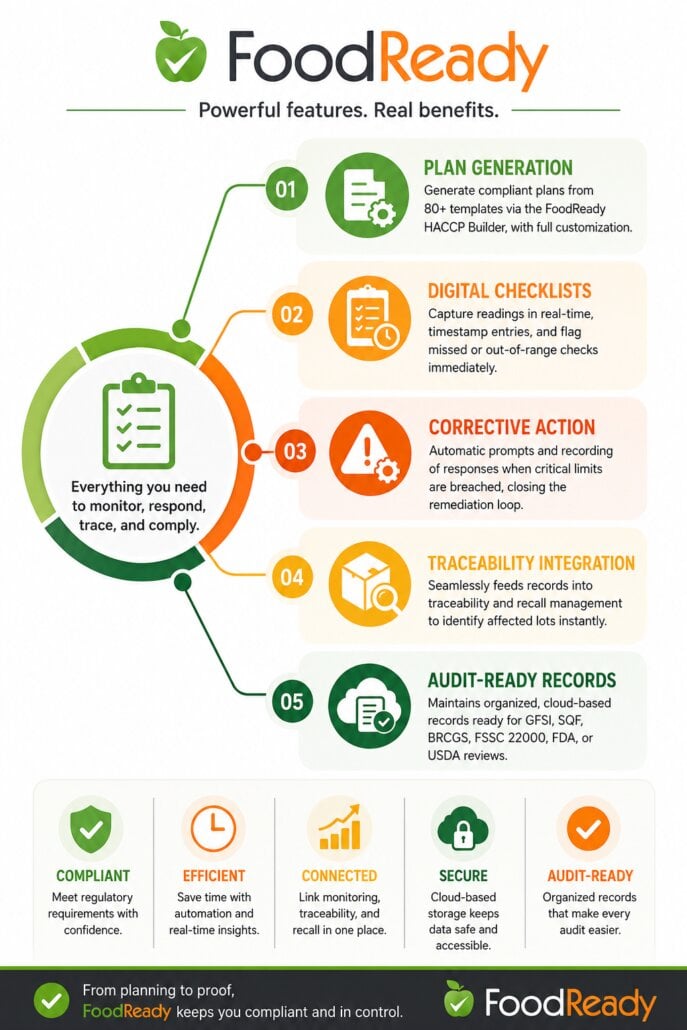
Plan Generation | Generate compliant plans from 80+ templates via the FoodReady HACCP Builder, with full customization. |
Digital Checklists | Capture readings in real-time, timestamp entries, and flag missed or out-of-range checks immediately. |
Corrective Action | Automatic prompts and recording of responses when critical limits are breached, closing the remediation loop. |
Traceability Integration | Seamlessly feeds records into traceability and recall management to identify affected lots instantly. |
Audit-Ready Records | Maintains organized, cloud-based records ready for GFSI, SQF, BRCGS, FSSC 22000, FDA, or USDA reviews. |
On top of the software, FoodReady pairs you with certified food safety experts who help you design monitoring procedures that hold up under scrutiny.
You can schedule a demo to see how the platform turns monitoring into a more integrated part of digital food safety and traceability systems.
Conclusion
HACCP monitoring procedures are where food safety plans meet daily reality. When done well, monitoring confirms that your critical limits are being met, captures the evidence auditors require, and catches deviations before they become recalls. As part of a full HACCP program within your broader food safety system, the keys are specificity, the right frequency, trained and accountable monitors, and real-time records that connect directly to corrective action and verification.
Digital workflows also reduce human error, help quality assurance teams ensure food safety and maintain HACCP compliance, and save staff time by making better use of limited resources. As monitoring becomes more digital and more tightly woven into traceability, the operations that thrive will be those that treat monitoring as a connected, automated, systematic approach rather than a stack of forms.
FoodReady gives you that system today, helping you stay compliant, stay audit-ready, and protect the people who eat your products with expert support and ongoing education, because human error remains a risk.
Frequently Asked Questions
What is the purpose of HACCP monitoring procedures?
Monitoring procedures confirm that each critical control point stays within its critical limits during production. They generate the records that prove control and trigger corrective action the moment a deviation occurs.
What are the key elements of a monitoring procedure?
A complete procedure defines what is being measured, how, how often, and who is responsible. It also specifies the documentation that records each check.
What is the difference between continuous and periodic monitoring?
Continuous monitoring captures data throughout the entire process, such as a chart recorder on a thermal process. Periodic monitoring samples the process at set intervals, so the frequency must be short enough to limit the product at risk.
How often should critical control points be monitored?
Frequency depends on how fast the product moves and how much it would be affected by a deviation. In HACCP procedures, monitoring frequency should be determined by process stability, hazard likelihood, and regulatory requirements. Continuous monitoring is best, and where checks are periodic, the interval should keep any out-of-control period to a manageable volume.
What happens when a critical limit is breached?
A predefined corrective action kicks in to control the affected product, fix the cause, and document the event. Both the deviation and the response must be recorded for verification and audit purposes.
Why are real-time monitoring records important?
Records made in real-time are accurate and trustworthy, while records made after the fact are an audit red flag. Digital tools timestamp each entry and flag missed checks.
How does FoodReady help with HACCP monitoring?
FoodReady connects your hazard analysis, critical control points, monitoring checklists, and corrective actions in one platform. It captures readings in real-time, flags deviations automatically, and keeps every record audit-ready for any inspection or certification.
Speak with our Expert Consultants
15–30 minutes. We map FoodReady to your process, plug in your real HACCP plan, and show you the auditor view before the call ends.
About the author

Suhina Fitzpatrick
Senior Food Technologist
Suhina is a Subject-Matter Expert at FoodReady with 15 years in the industry as a Senior Food Technologist. Specializing in Food Safety, Quality and Food Manufacturing, Suhina is passionate about everything Food and has headed many successful Food Safety Audits according to global standards over the years. When away from the workstation, the gym and an active lifestyle is her happy place.