10 Best Seafood Distribution Software Platforms (2026)

Compare the best seafood distribution software for lot traceability, cold-chain inventory, catch-weight sales, recalls, purchasing, and delivery operations. This guide evaluates 10 platforms by capabilities, implementation fit, value, and regulatory support.

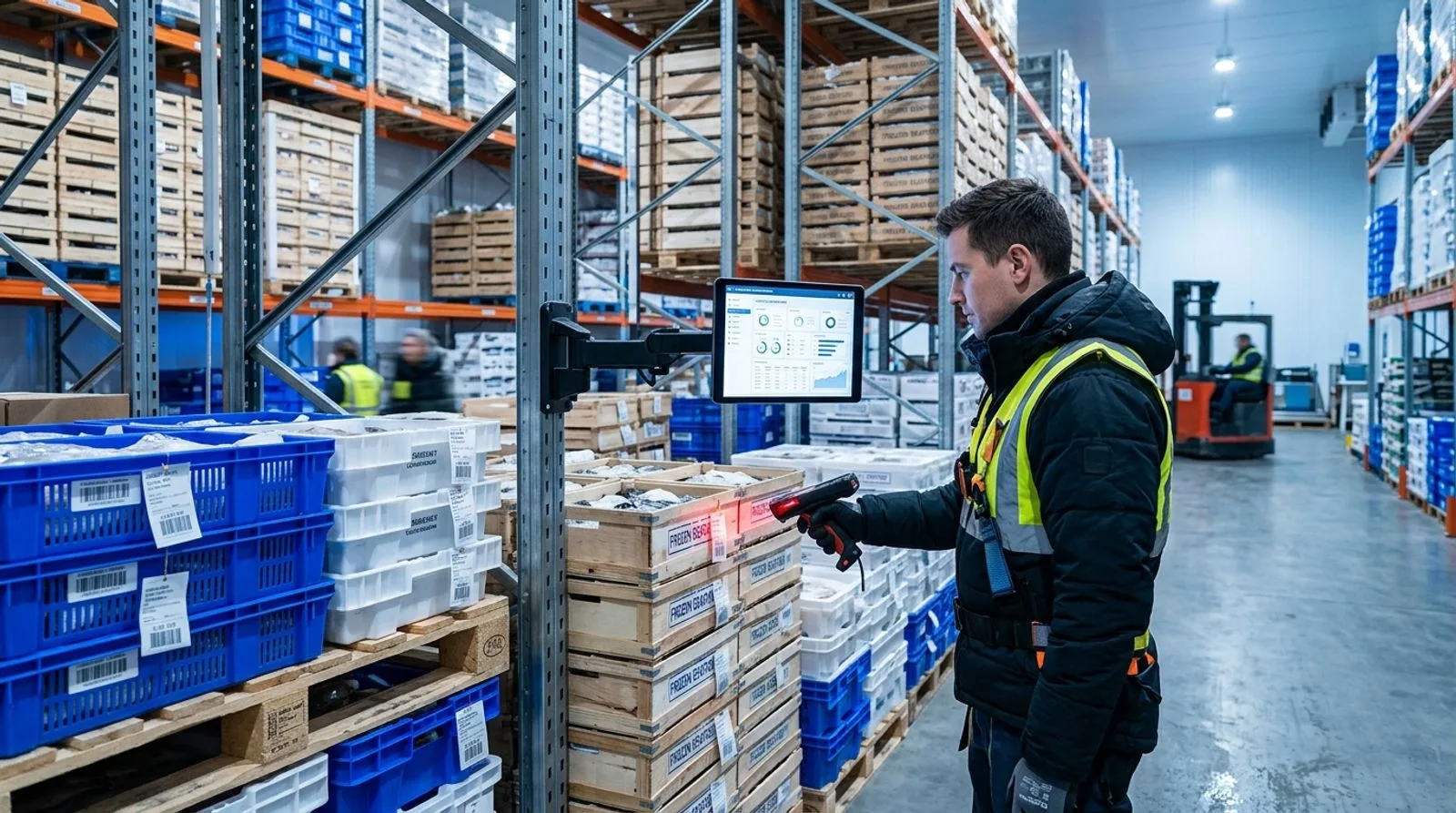
Seafood distributor using inventory software in a refrigerated warehouse

Published:Last updated:Author:Gerry Galloway

BUYER'S GUIDE

How we evaluated seafood distribution software

Seafood distribution software must do more than record purchases and print invoices. A distributor may receive wild-caught and farmed species from several origins, convert cases into variable-weight units, reserve inventory for customers, repack products, and ship through temperature-controlled routes—all within hours. The strongest systems connect each transaction to the source lot, harvest or production information, storage location, quality status, customer order, and outbound shipment. That chain of custody supports daily execution and gives teams the records needed for customer inquiries, mock recalls, and regulatory reviews.

For this guide, we compared ten platforms against the operating realities of seafood wholesalers, importers, processors with distribution operations, and multi-site cold-chain businesses. We weighted lot and serial traceability, catch-weight or variable-weight handling, inventory control, purchasing, order fulfillment, food-safety workflows, integrations, implementation effort, and total cost. We also considered whether the software can support FDA Food Safety Modernization Act requirements, seafood HACCP records, supplier documentation, FEFO rotation, labeling, and rapid recall response. Scores are editorial assessments for a representative mid-market distributor; buyers should validate every workflow during a scripted demonstration.

FoodReady ranks first because it combines quality management, lot-controlled inventory, production, supplier management, maintenance, sales operations, and analytics in one cloud platform. Inecta Food is a strong alternative for organizations that want food-specific ERP functions built on Microsoft Dynamics 365 Business Central, while Aptean suits larger food companies that need broad ERP depth. The remaining options address distinct priorities, from highly configurable enterprise operations to approachable traceability for growing teams. Pricing marked “custom” requires a vendor quote because public packages rarely reflect users, locations, integrations, migration, and implementation services.

Before selecting any seafood distribution software, build a demo script around one real product. Receive a mixed shipment, capture source and lot data, record a quality hold, split the lot across storage locations, allocate variable-weight cases to two customer orders, ship one order, and then run a backward-and-forward trace. This exercise reveals whether the platform handles your terminology and exception paths or merely looks polished in a generic presentation. It also exposes hidden dependencies on spreadsheets, custom development, and third-party applications.

TOP 10 PLATFORMS

SOFTWARE REVIEW

The best seafood distribution software for 2026

Ten platforms ranked for traceability, cold-chain inventory, variable-weight operations, food-safety controls, order fulfillment, implementation fit, and overall value.

Reviewed by FoodReady Editorial Team · Manufacturing software research · Food safety, traceability, ERP, and distribution workflow analysis

FoodReady
Unified seafood quality, inventory, traceability, production, and distribution software
9.5
Custom quote
Licensing and implementation depend on scope, users, and sites
  • Web
  • iOS
  • Android
  • API
Inecta Food
Food-specific ERP built on Microsoft Dynamics 365 Business Central
9.0
Custom quote
Subscription, Microsoft licensing, implementation, and add-ons vary
  • Web
  • iOS
  • Android
  • Windows
  • API
Aptean Food & Beverage ERP
Broad food-industry ERP for complex, multi-site seafood operations
8.8
Custom quote
Licensing and implementation depend on scope, users, and locations
  • Web
  • Windows
  • API
Oracle NetSuite
Cloud ERP for seafood distributors prioritizing finance and multi-entity management
8.5
Custom quote
Annual license plus implementation, modules, and user costs
  • Web
  • iOS
  • Android
  • API
Microsoft Dynamics 365 Business Central
Flexible ERP for distributors committed to the Microsoft ecosystem
8.3
Published per-user licenses plus services
Implementation, extensions, support, and Microsoft add-ons cost extra
  • Web
  • iOS
  • Android
  • Windows
  • API
SAP S/4HANA Cloud
Enterprise ERP for global seafood supply chains and complex governance
8.2
Custom enterprise quote
Transformation, implementation, integrations, and support are additional
  • Web
  • iOS
  • Android
  • API
Blue Link ERP
Integrated accounting and inventory software for wholesale distributors
8.0
Custom quote
Implementation and add-on requirements vary by deployment
  • Windows
  • Web
  • API
Wherefour
Approachable cloud traceability and production software for growing food companies
7.9
Custom quote
Plan depends on users, functionality, and implementation scope
  • Web
  • API
TraceGains
Supplier and compliance network software for documentation-heavy seafood supply chains
7.8
Custom quote
Modules, network scope, onboarding, and integrations affect cost
  • Web
  • API
ParityFactory
Food manufacturing and warehouse execution software for high-throughput operations
7.7
Custom quote
Project scope, sites, devices, interfaces, and services determine cost
  • Web
  • Windows
  • API
Cin7 Core
Cloud inventory and order management for smaller multi-channel distributors
7.4
Published subscription tiers
Implementation, connectors, users, and transaction volumes may add cost
  • Web
  • iOS
  • Android
  • API
Editor's pick

FoodReady

Unified seafood quality, inventory, traceability, production, and distribution software

  • Editor's Pick
  • Lot Traceability
  • FSMA Support
  • Cloud SaaS
9.5
Overall score
PricingCustom quote· Licensing and implementation depend on scope, users, and sites
Platforms
  • Web
  • iOS
  • Android
  • API

FoodReady is the strongest overall seafood distribution software for mid-market companies that want traceability and operational control without assembling separate ERP, QMS, inventory, and production applications. The cloud platform links receiving, supplier records, quality inspections, inventory status, production or repacking, purchase orders, sales orders, maintenance, and analytics. Teams can track lots across locations, use barcode or QR workflows, apply FIFO or FEFO rules, quarantine suspect stock, manage certificates and supplier approvals, and reconstruct product movement during a mock recall. For distributors that also portion, pack, label, or otherwise transform seafood, FoodReady connects bills of materials, work orders, batch records, yields, and finished lots to outbound customer shipments.

FoodReady is especially useful when food-safety staff and warehouse teams need the same record. CAPA, nonconformance, document control, training, audit, complaint, and supplier-quality workflows sit beside inventory and production data instead of remaining in a disconnected QMS. The platform supports web and mobile access, integrations with financial systems such as QuickBooks, Sage, NetSuite, Microsoft Dynamics 365, SAP, and Epicor, plus Zebra and Honeywell scanning hardware. Typical implementation takes 8–16 weeks. Financial accounting is handled through integrations rather than a native general ledger, and companies requiring extensive legacy customization may prefer a larger ERP suite.

Pros

  • Combines quality, inventory, production, supply chain, maintenance, cost accounting, and analytics
  • Lot genealogy, quarantine, barcode scanning, FIFO/FEFO, and multi-location controls
  • Food-safety workflows for CAPA, audits, supplier approval, documents, training, and complaints
  • Typical implementation of 8–16 weeks is shorter than many enterprise ERP programs
  • Published pricing ranges make early budget planning more practical

Cons

  • Founded in 2020, so its installed base is smaller than long-established ERP vendors
  • Financial accounting relies on QuickBooks, Sage, NetSuite, or another integrated system
  • Less appropriate for global enterprises that require heavily customized legacy processes
  • The broad platform may exceed the needs of very small distributors seeking basic inventory only

Scorecard

  • Traceability
    9.8 / 10
  • Food safety
    9.7 / 10
  • Distribution operations
    9.4 / 10
  • Ease of implementation
    9.3 / 10
  • Value
    9.4 / 10

Feature highlights

  • Forward and backward lot genealogy across receiving, repacking, storage, and shipping
  • Multi-location inventory with barcode/QR scanning, quarantine, FIFO/FEFO, and cycle counting
  • Supplier portal, purchase orders, receiving inspections, COA/COC records, and scorecards
  • Work orders, BOMs, yields, schedules, labor tracking, and electronic batch records
  • CAPA, NCR, audits, document control, training, complaints, maintenance, and calibration

Best for: Seafood distributors and processors with 50–1,000 employees that need one platform for food safety and operations

Visit FoodReady
#2

Inecta Food

Food-specific ERP built on Microsoft Dynamics 365 Business Central

  • Food ERP
  • Microsoft Ecosystem
  • Catch Weight
9.0
Overall score
PricingCustom quote· Subscription, Microsoft licensing, implementation, and add-ons vary
Platforms
  • Web
  • iOS
  • Android
  • Windows
  • API

Inecta Food is a food-focused ERP platform built on Microsoft Dynamics 365 Business Central, making it a compelling option for seafood importers, distributors, and processors that want industry workflows within a familiar Microsoft environment. Its functionality spans purchasing, sales, inventory, warehouse management, production, quality, finance, costing, and traceability. Seafood businesses can evaluate the system for catch-weight transactions, lot attributes, shelf-life management, landed costs, container purchasing, substitutions, and margin analysis. Because operational and financial records share an ERP foundation, managers can review inventory value, customer profitability, supplier performance, and order status without reconciling several databases.

The platform is particularly attractive to companies already invested in Microsoft 365, Power BI, Azure, or Business Central. That ecosystem can simplify reporting and identity management while giving implementation partners options for integrations and extensions. Inecta also emphasizes food traceability and recall capabilities, which are important when a lot is split, relabeled, repacked, or sold through multiple channels. The tradeoff is ERP complexity: success depends on disciplined master-data preparation, process design, testing, and user training. Pricing is quote-based, and buyers should request a complete estimate covering Microsoft licenses, Inecta components, integrations, historical-data migration, reports, support, and post-launch optimization.

Pros

  • Food-specific capabilities on a widely used Microsoft ERP foundation
  • Strong connection between inventory, sales, purchasing, costing, and financial management
  • Supports lot traceability, shelf-life controls, landed cost, and variable-weight scenarios
  • Power BI and Microsoft 365 ecosystem can strengthen reporting and collaboration

Cons

  • Implementation can be more involved than deploying a focused inventory application
  • Final cost depends on licensing, partner services, extensions, and integrations
  • Business Central customization requires careful governance to control upgrade complexity

Scorecard

  • Traceability
    9.2 / 10
  • Food safety
    8.8 / 10
  • Distribution operations
    9.2 / 10
  • Ease of implementation
    8.1 / 10
  • Value
    8.7 / 10

Feature highlights

  • Catch-weight, lot-controlled inventory, expiration dates, and shelf-life management
  • Purchasing, sales, warehousing, production, finance, and customer profitability
  • Landed-cost allocation for imported seafood and container-based purchasing
  • Microsoft Power BI reporting and Business Central ecosystem connectivity
  • Recall support with forward and backward transaction visibility

Best for: Mid-market seafood distributors that want food-specific ERP on Microsoft Dynamics 365 Business Central

Visit Inecta
#3

Aptean Food & Beverage ERP

Broad food-industry ERP for complex, multi-site seafood operations

  • Enterprise ERP
  • Food & Beverage
  • Multi-site
8.8
Overall score
PricingCustom quote· Licensing and implementation depend on scope, users, and locations
Platforms
  • Web
  • Windows
  • API

Aptean Food & Beverage ERP is designed for food companies that need deeper operational breadth than a standalone warehouse or traceability tool. The portfolio supports inventory, procurement, sales, production, quality, warehouse execution, planning, costing, and financial processes, with food-industry capabilities layered into the platform. Seafood distributors can assess lot tracking, catch-weight handling, shelf-life controls, quality statuses, recall reporting, labeling, rebates, contract pricing, and multi-site planning. These functions are valuable when an organization imports, processes, stores, and distributes products through several facilities or legal entities.

Aptean is best evaluated as a strategic ERP program rather than a quick software installation. Its breadth can replace multiple legacy tools, but implementation may require process standardization, data cleansing, integrations, user-role design, and extensive testing. Buyers should determine which Aptean edition and modules address their seafood workflows, because capabilities and architecture can vary across the vendor’s food-and-beverage portfolio. Ask the vendor to demonstrate variable-weight receiving, lot splitting, quality holds, landed costs, customer-specific pricing, route-ready picking, and a complete recall. A detailed statement of work is essential because subscription, implementation, customization, migration, support, and third-party costs are generally quote-based.

Pros

  • Broad food-industry ERP scope for complex operations and multiple sites
  • Strong inventory, production, purchasing, quality, costing, and sales capabilities
  • Designed around food requirements such as lots, shelf life, quality status, and recalls
  • Suitable for companies replacing several departmental legacy systems

Cons

  • Selection and implementation are more complex than with a focused cloud application
  • Public pricing is limited, making vendor discovery necessary for budgeting
  • Buyers must verify capabilities in the specific Aptean product and release proposed

Scorecard

  • Traceability
    9.1 / 10
  • Food safety
    9.0 / 10
  • Distribution operations
    9.0 / 10
  • Ease of implementation
    7.5 / 10
  • Value
    8.3 / 10

Feature highlights

  • Lot, shelf-life, quality-status, and recall management for food operations
  • Catch-weight and variable-weight workflow support to validate during demonstration
  • Procurement, planning, warehouse, production, sales, costing, and finance
  • Multi-site visibility and enterprise reporting
  • Customer pricing, rebates, labeling, and order-management capabilities

Best for: Larger seafood distributors and integrated processors undertaking a broad, multi-site ERP transformation

Visit Aptean
#4

Oracle NetSuite

Cloud ERP for seafood distributors prioritizing finance and multi-entity management

  • Cloud ERP
  • Multi-entity Finance
  • SuiteCloud
8.5
Overall score
PricingCustom quote· Annual license plus implementation, modules, and user costs
Platforms
  • Web
  • iOS
  • Android
  • API

Oracle NetSuite is a cloud ERP suite with strong financials, order management, purchasing, inventory, warehouse, CRM, and multi-entity consolidation. For seafood distributors with multiple subsidiaries, currencies, tax structures, or sales channels, NetSuite can create a consistent financial and operational backbone. Native lot-numbered inventory, bin management, demand planning, landed cost, order allocation, and warehouse features address many distribution requirements. SuiteAnalytics and the SuiteCloud platform provide reporting and extension options, while an established partner ecosystem can help tailor the system to industry-specific processes.

NetSuite is not seafood-specific out of the box, so buyers must map requirements carefully. Catch-weight invoicing, detailed harvest attributes, seafood HACCP records, advanced quality workflows, label formats, and specialized cold-chain controls may require configuration, partner solutions, or integrations. That flexibility can be an advantage for companies with strong administrators, but it can also increase implementation cost and ongoing ownership. Ask prospective partners to demonstrate the exact lot genealogy and variable-weight workflow rather than presenting a generic wholesale distribution scenario. Pricing is customized and usually includes the base suite, selected modules, users, implementation, migration, integrations, and support. It is a better fit when finance and corporate scalability carry as much weight as plant-floor food-safety depth.

Pros

  • Mature cloud financials, purchasing, order management, inventory, and consolidation
  • Strong choice for multi-subsidiary, multi-currency, and multi-channel organizations
  • Extensive partner ecosystem, APIs, SuiteAnalytics, and SuiteCloud customization tools
  • Native lot-numbered inventory and landed-cost capabilities

Cons

  • Seafood-specific workflows may require configuration or third-party applications
  • Licensing, implementation, integrations, and administration can create substantial TCO
  • Customization can complicate maintenance if extensions are poorly governed

Scorecard

  • Traceability
    8.2 / 10
  • Food safety
    7.7 / 10
  • Distribution operations
    9.0 / 10
  • Ease of implementation
    7.7 / 10
  • Value
    8.0 / 10

Feature highlights

  • Financial management and multi-entity consolidation
  • Lot-numbered inventory, bins, purchasing, order allocation, and landed cost
  • Warehouse management, demand planning, CRM, and ecommerce options
  • SuiteAnalytics dashboards and SuiteCloud extensibility
  • Broad integration and implementation-partner ecosystem

Best for: Growing seafood distributors that prioritize cloud financials, multi-entity control, and configurable operations

Visit NetSuite
#5

Microsoft Dynamics 365 Business Central

Flexible ERP for distributors committed to the Microsoft ecosystem

  • Microsoft Cloud
  • SMB ERP
  • Partner Ecosystem
8.3
Overall score
PricingPublished per-user licenses plus services· Implementation, extensions, support, and Microsoft add-ons cost extra
Platforms
  • Web
  • iOS
  • Android
  • Windows
  • API

Microsoft Dynamics 365 Business Central combines finance, purchasing, inventory, sales, warehouse, projects, and light manufacturing in a cloud ERP aimed at small and mid-sized organizations. Seafood distributors often consider it because it integrates naturally with Microsoft 365, Teams, Excel, Power BI, and the broader Azure environment. The software supports item tracking, lot numbers, locations, bins, units of measure, reservations, order promising, costing, and warehouse processes. A large partner marketplace offers food, catch-weight, EDI, shipping, quality, and labeling extensions that can turn the core ERP into a more specialized solution.

The platform’s advantage is choice, but choice creates design responsibility. Core Business Central is not a complete seafood distribution package, so buyers should identify which extensions are required for variable-weight inventory, advanced lot attributes, quality holds, seafood HACCP documentation, recall reporting, route workflows, and customer-specific labeling. Review the combined solution as one architecture, including upgrade ownership and support responsibilities across Microsoft, the implementation partner, and application vendors. Microsoft publishes base per-user pricing, but the realistic project budget must include analysis, configuration, extensions, migration, integrations, training, and ongoing partner support. Companies with internal Microsoft skills may find the platform easier to govern than an unfamiliar proprietary ERP.

Pros

  • Strong integration with Microsoft 365, Teams, Excel, Power BI, and Azure
  • Capable financial, purchasing, inventory, sales, and warehouse foundation
  • Large global partner and extension marketplace
  • Published base licensing improves initial price transparency

Cons

  • Seafood functionality generally depends on partner configuration and extensions
  • Multiple add-ons can fragment support and increase the long-term upgrade burden
  • Buyers must test catch weight, traceability, quality, and recall workflows end to end

Scorecard

  • Traceability
    7.9 / 10
  • Food safety
    7.4 / 10
  • Distribution operations
    8.7 / 10
  • Ease of implementation
    8.0 / 10
  • Value
    8.3 / 10

Feature highlights

  • Lot tracking, multiple locations, bins, reservations, units of measure, and costing
  • Finance, purchasing, sales, warehouse management, and light production
  • Power BI analytics and familiar Microsoft productivity integrations
  • AppSource extensions for EDI, shipping, food, labeling, and warehouse needs
  • Global Microsoft partner ecosystem

Best for: Small and mid-sized seafood distributors already standardized on Microsoft technology

Visit Microsoft
#6

SAP S/4HANA Cloud

Enterprise ERP for global seafood supply chains and complex governance

  • Global Enterprise
  • Supply Chain
  • Advanced Planning
8.2
Overall score
PricingCustom enterprise quote· Transformation, implementation, integrations, and support are additional
Platforms
  • Web
  • iOS
  • Android
  • API

SAP S/4HANA Cloud is an enterprise ERP platform for organizations that require global finance, procurement, sales, inventory, manufacturing, logistics, and governance at significant scale. Large seafood importers, processors, brand owners, and distributors can use SAP’s broader ecosystem to coordinate complex supply networks, multiple legal entities, intercompany transactions, landed costs, warehouse operations, planning, and corporate reporting. Batch management, classification, quality management, material requirements planning, and warehouse capabilities can support traceable food operations when the system is designed around seafood data and controls.

SAP’s principal strength is depth and scalability, not simplicity. A seafood implementation usually involves process architects, integration specialists, data governance, role design, change management, and careful validation of country and business-unit requirements. Advanced warehouse, transportation, planning, traceability, or analytics needs may draw on additional SAP products and services, which expands both capability and cost. Buyers should request a solution map showing which component owns each process and record. SAP is rarely the economical choice for an independent regional distributor, but it can be appropriate when a global company needs one corporate model across seafood and other product divisions. Pricing is customized, and total program cost must include transformation services, data work, integrations, training, testing, and ongoing support.

Pros

  • Deep enterprise finance, procurement, inventory, manufacturing, sales, and governance
  • Supports global entities, currencies, tax structures, and complex supply networks
  • Batch, quality, warehouse, planning, and analytics capabilities across the SAP ecosystem
  • Suitable for large-scale standardization and sophisticated internal controls

Cons

  • Implementation usually requires substantial budget, specialist resources, and change management
  • Too complex for many small and mid-sized seafood distributors
  • Additional SAP components may be needed for the complete target architecture

Scorecard

  • Traceability
    8.8 / 10
  • Food safety
    8.5 / 10
  • Distribution operations
    9.2 / 10
  • Ease of implementation
    5.9 / 10
  • Value
    7.0 / 10

Feature highlights

  • Enterprise batch management, classification, quality, and material traceability
  • Global finance, procurement, sales, inventory, manufacturing, and intercompany processes
  • Advanced warehouse, transportation, planning, and analytics ecosystem
  • Role-based governance, approvals, audit trails, and master-data controls
  • Scalable architecture for multinational operations

Best for: Multinational seafood companies that need global process standardization and have enterprise transformation resources

Visit SAP
#8

Wherefour

Approachable cloud traceability and production software for growing food companies

  • Cloud Traceability
  • Small Business Fit
  • Production
7.9
Overall score
PricingCustom quote· Plan depends on users, functionality, and implementation scope
Platforms
  • Web
  • API

Wherefour is cloud-based traceability, inventory, and production software developed for food and beverage businesses. It gives smaller seafood processors and distributors a structured alternative to spreadsheets for purchasing, lot tracking, inventory, production, sales, costing, and recall exercises. Users can connect ingredient or source lots to finished goods and customer shipments, track inventory across locations, create production runs, and maintain transactional records that support forward and backward tracing. For distributors that perform light processing, packing, or relabeling, this combination can be more relevant than a generic warehouse application.

Wherefour’s appeal lies in its focused scope and approachable cloud delivery. Growing teams can adopt core traceability and operations without launching a global ERP transformation. The compromise is breadth: complex finance, advanced warehouse automation, transportation management, maintenance, or enterprise QMS requirements may call for integrations or separate systems. Buyers should test variable-weight units, catch-weight pricing, yield differences, quality holds, FEFO, supplier documentation, label outputs, and EDI requirements because these details vary significantly among seafood operations. Pricing is customized, and a complete quote should include onboarding, data migration, training, integrations, and support. Wherefour is a sensible shortlist candidate for organizations graduating from spreadsheets that value usability and lot visibility over extensive corporate functionality.

Pros

  • Purpose-built for food traceability, inventory, production, and recall workflows
  • Cloud delivery is accessible to growing teams with limited IT resources
  • Connects source lots, production activity, finished inventory, and shipments
  • Useful for distributors that also pack, relabel, or lightly process seafood

Cons

  • Less suitable for complex multi-entity finance or global enterprise governance
  • Advanced warehouse automation, transportation, and QMS depth may require other tools
  • Catch-weight and seafood-specific details should be validated during the demo

Scorecard

  • Traceability
    8.8 / 10
  • Food safety
    8.2 / 10
  • Distribution operations
    7.7 / 10
  • Ease of implementation
    8.8 / 10
  • Value
    8.2 / 10

Feature highlights

  • Lot-controlled purchasing, inventory, production, sales, and recall records
  • Forward and backward traceability from source materials to customer shipments
  • Production runs, yields, recipes, costing, and finished-goods inventory
  • Cloud access with reports and integration options
  • Practical migration path away from spreadsheet-based operations

Best for: Small and growing seafood companies that need approachable traceability, inventory, and light production software

Visit Wherefour
#9

TraceGains

Supplier and compliance network software for documentation-heavy seafood supply chains

  • Supplier Network
  • Compliance Documents
  • Traceability
7.8
Overall score
PricingCustom quote· Modules, network scope, onboarding, and integrations affect cost
Platforms
  • Web
  • API

TraceGains focuses on supplier collaboration, specification management, compliance documentation, quality, and traceability across food supply chains. Seafood importers and distributors can use the platform to collect and manage supplier records, certificates, specifications, documents, questionnaires, and quality information across a broad vendor network. This is valuable when teams spend significant time chasing approvals, expiration dates, country-of-origin information, sustainability documentation, product specifications, and food-safety records. Centralized supplier information can reduce email-based handoffs and help purchasing and quality teams work from the same approved data.

TraceGains is not a general-purpose distribution ERP, so it should be evaluated as part of an application architecture rather than assumed to replace finance, order entry, warehouse execution, or transportation software. Its value increases for companies whose main bottleneck is supplier data and documentation rather than warehouse transactions. Integration quality is therefore critical: buyers should test how approved items, suppliers, specifications, lots, and documents flow into their ERP and how receiving or complaint data returns to TraceGains. Ask for a demonstration using a seafood supplier approval, expiring certificate, specification revision, receiving exception, and affected-lot investigation. Pricing is customized based on the selected products, network participation, onboarding, and integration scope.

Pros

  • Strong supplier-document, specification, compliance, and collaboration capabilities
  • Useful for managing approvals and expiring records across a large supplier base
  • Food-industry network can reduce manual document chasing
  • Connects quality and procurement teams around governed supplier information

Cons

  • Does not replace core ERP, accounting, warehouse, or transportation systems
  • Business value depends heavily on integration and supplier adoption
  • Quote-based modular pricing can make early cost comparison difficult

Scorecard

  • Traceability
    8.0 / 10
  • Food safety
    8.9 / 10
  • Distribution operations
    6.9 / 10
  • Ease of implementation
    8.0 / 10
  • Value
    7.5 / 10

Feature highlights

  • Supplier approval, questionnaires, certificates, and document-expiry management
  • Product and ingredient specifications with revision control
  • Quality, compliance, and supplier collaboration workflows
  • Network-based exchange of food-industry records
  • APIs and integrations for connecting supplier data to operational systems

Best for: Seafood importers and distributors whose biggest challenge is supplier compliance, specifications, and document control

Visit TraceGains
#10

ParityFactory

Food manufacturing and warehouse execution software for high-throughput operations

  • MES/WMS
  • Shop-floor Control
  • Food Operations
7.7
Overall score
PricingCustom quote· Project scope, sites, devices, interfaces, and services determine cost
Platforms
  • Web
  • Windows
  • API

ParityFactory provides food-focused manufacturing execution and warehouse management capabilities for companies that need detailed control on the plant and warehouse floor. Seafood processors with integrated distribution can evaluate the software for receiving, lot tracking, inventory movements, production execution, yields, labeling, quality checks, warehouse transactions, and shipping. Its operational orientation is useful where raw seafood is sorted, cut, portioned, packed, frozen, relabeled, or converted before fulfillment. Capturing transactions close to the work can improve lot genealogy and reduce the lag created when paper records are entered after production.

The platform is not positioned as a full corporate ERP, so finance, customer management, advanced planning, or enterprise procurement may remain in an integrated business system. That division can be effective when the ERP handles commercial and financial records while ParityFactory manages execution, but the integration design must be explicit. Buyers should demonstrate a source lot received at variable weight, partial consumption across production runs, yield and waste capture, rework, quality hold, finished-case labeling, warehouse movement, and shipment confirmation. Pricing is custom and should include floor devices, interfaces, implementation, validation, training, and support. ParityFactory fits best when execution precision matters more than replacing every back-office application.

Pros

  • Food-focused manufacturing and warehouse execution depth
  • Detailed lot, production, yield, labeling, inventory, and shipping transactions
  • Supports operational data capture close to plant and warehouse activity
  • Strong fit for seafood businesses that process and distribute from the same facilities

Cons

  • Usually requires integration with an ERP or financial system
  • May be more operationally intensive than a distributor without processing needs requires
  • Implementation cost depends on sites, devices, interfaces, and workflow complexity

Scorecard

  • Traceability
    8.9 / 10
  • Food safety
    8.3 / 10
  • Distribution operations
    8.2 / 10
  • Ease of implementation
    7.1 / 10
  • Value
    7.5 / 10

Feature highlights

  • Receiving, inventory, production execution, warehousing, labeling, and shipping
  • Lot genealogy across raw materials, work in process, and finished goods
  • Yield, waste, rework, quality checks, and floor-level transaction capture
  • Warehouse movements and fulfillment controls
  • ERP integration for commercial and financial processes

Best for: Seafood processors with distribution operations that need detailed shop-floor and warehouse execution

Visit ParityFactory
#11

Cin7 Core

Cloud inventory and order management for smaller multi-channel distributors

  • Inventory Management
  • Multi-channel
  • SMB
7.4
Overall score
PricingPublished subscription tiers· Implementation, connectors, users, and transaction volumes may add cost
Platforms
  • Web
  • iOS
  • Android
  • API

Cin7 Core is cloud inventory and order-management software for product businesses that need purchasing, sales, inventory, light production, warehouse, ecommerce, and accounting connectivity. A smaller seafood distributor may consider it for multiple locations, batch or lot tracking, expiration dates, barcode workflows, sales channels, reorder management, and integrations with platforms such as QuickBooks or Xero. Compared with a full food ERP, Cin7 Core can be faster to understand and less demanding to administer, particularly when the main goal is replacing disconnected inventory and order spreadsheets.

Its limitations become important in regulated or operationally complex seafood environments. Buyers should not assume that general batch tracking equals complete food traceability, seafood HACCP management, catch-weight billing, supplier-quality control, or recall readiness. Validate source and harvest attributes, variable-weight units, quality holds, FEFO, repacking, landed costs, EDI, labels, chain-of-custody records, and a one-up/one-back trace. Deep CAPA, audits, document control, maintenance, and advanced production execution will usually require other software. Cin7 publishes subscription plans, but the working budget should also include onboarding, connectors, accounting integration, data migration, scanners, and process redesign. It is best for simpler distributors whose risk profile and workflow do not justify a specialized food platform.

Pros

  • Accessible cloud inventory, purchasing, sales, and order-management foundation
  • Useful integrations for ecommerce, shipping, and small-business accounting
  • Supports multiple locations, batches, expiration dates, and barcode workflows
  • Published subscription tiers support easier initial comparison

Cons

  • Not a complete food-safety or seafood compliance management system
  • Catch-weight, detailed genealogy, quality, and recall workflows require careful validation
  • Advanced production, warehouse automation, and QMS needs may outgrow the platform

Scorecard

  • Traceability
    7.2 / 10
  • Food safety
    6.4 / 10
  • Distribution operations
    8.1 / 10
  • Ease of implementation
    8.8 / 10
  • Value
    7.9 / 10

Feature highlights

  • Purchasing, sales orders, inventory, multiple locations, and replenishment
  • Batch or lot tracking, expiration dates, barcode workflows, and stock adjustments
  • Light production and assembly capabilities
  • Ecommerce, shipping, marketplace, QuickBooks, and Xero integrations
  • Dashboards and reports for smaller product businesses

Best for: Smaller seafood distributors with straightforward inventory and order workflows and limited processing complexity

Visit Cin7 Core

Scores are editorial assessments, not vendor certifications. Pricing and capabilities can change; request current quotes and validate all catch-weight, traceability, compliance, integration, and implementation requirements directly with each vendor.

SELECTION FRAMEWORK

How to choose seafood distribution software

The right seafood distribution software should reflect the complexity of your product flow, not the length of a vendor’s feature list. Start by mapping the records that must remain connected from supplier through customer: species and product identity, source or origin, lot, date information, certificates, condition, storage location, ownership, quality status, unit of measure, weight, price, repacking activity, and shipment. Mark every point where staff currently rekey information or use a spreadsheet. Those handoffs usually create the most consequential traceability delays and inventory discrepancies.

Prioritize traceability and catch-weight accuracy

Require vendors to demonstrate forward and backward tracing with your own scenario. The test should include a source lot split between multiple locations, partial allocation, repacking into new finished lots, a quality hold, and shipments to several customers. The result should show quantities received, transformed, held, wasted, available, and shipped without manual reconciliation. Ask how the software records corrections after a shipment and preserves the audit history. A recall report that works only when every transaction is perfect will fail under real operating pressure.

Variable-weight handling deserves an equally detailed test. Seafood may be purchased by case, received at actual weight, stored by unit, allocated by estimated weight, picked at a new measured weight, and invoiced by pounds or kilograms. The system must maintain physical quantity, commercial quantity, cost, margin, and inventory value through each step. Confirm whether catch-weight functionality is native, configured, or delivered by a partner extension. Also test conversions, tolerances, substitutions, short picks, customer-specific pricing, and credit processing.

Connect food safety to warehouse execution

A quality status should affect operations immediately. When quality staff place a lot on hold, warehouse users should be unable to allocate or ship it without authorization. Receiving inspections, temperature results, sensory checks, supplier approvals, specifications, certificates, complaints, CAPA, and nonconformance records should link to the relevant supplier, item, lot, order, or shipment. That context reduces investigation time and helps teams distinguish a localized exception from a broader systemic issue.

Evaluate support for seafood HACCP records and FSMA-related traceability requirements within the scope of your business. Software does not create compliance by itself; the company still needs sound procedures, trained people, accurate master data, and disciplined execution. Ask vendors how they handle required data elements, critical tracking events, record retention, electronic exports, access controls, and audit trails. Legal and food-safety advisors should confirm the final design because regulatory obligations vary by product, activity, customer, and jurisdiction.

Compare complete cost and implementation risk

Subscription price is only one component of total cost. Build a five-year model covering implementation, migration, integrations, user licenses, devices, labels, EDI, reports, validation, training, support, upgrades, and internal project time. Include the cost of systems that remain after launch. A lower-priced inventory tool may become expensive when the business must add QMS, production, supplier portals, or custom traceability applications. Conversely, a full ERP can waste money if a small distributor uses only purchasing, stock, and sales orders.

Demand a phased implementation plan with accountable owners, data requirements, decision deadlines, testing cycles, and acceptance criteria. The vendor should explain how it will migrate suppliers, customers, items, units, lots, inventory balances, open orders, pricing, and historical records. Request references from food distributors or processors with comparable size and complexity. Speak with operational users, not only executives, and ask what required more effort than expected.

Match the platform to your operating model

Choose FoodReady if you need quality, traceability, inventory, supplier controls, production, maintenance, and analytics in one cloud platform, particularly when separate QMS and operational databases create delays. Choose Inecta Food when a food-specific Microsoft ERP and integrated financials are priorities. Consider Aptean for a larger, multi-site food enterprise ready for a broad transformation. NetSuite or Business Central may fit when finance and ecosystem flexibility lead the decision, while SAP suits global standardization programs with substantial implementation resources.

Wherefour is worth shortlisting when a growing food company wants approachable lot traceability and light production. Blue Link ERP can suit a regional wholesaler seeking accounting and distribution in one system. TraceGains is strongest for supplier and specification governance, while ParityFactory addresses detailed production and warehouse execution. Cin7 Core is a practical inventory option for a simpler operation, but regulated seafood businesses should verify whether its quality and traceability depth is sufficient.

The final selection should be based on scored evidence from scripted demonstrations. Weight mandatory workflows more heavily than presentation quality, and reject any platform that cannot complete a trace without offline spreadsheets. A useful scorecard includes traceability, catch weight, quality control, inventory accuracy, order fulfillment, integration, usability, implementation risk, vendor support, and five-year cost. Record assumptions and gaps so the contract and implementation plan can address them explicitly.

COMMON QUESTIONS

Seafood distribution software FAQ

Answers to common questions about traceability, catch weight, compliance, integrations, implementation, and software selection.

What is seafood distribution software?

Seafood distribution software manages purchasing, lot-controlled inventory, variable-weight products, quality status, sales orders, warehousing, fulfillment, and traceability. More comprehensive software also covers supplier approvals, production or repacking, labeling, costing, recalls, maintenance, and analytics. The purpose is to keep commercial, physical, and food-safety records connected as seafood moves from source through storage and transformation to the customer.

Which seafood distribution software is best overall?

FoodReady is our best overall choice for mid-market seafood distributors that need quality, inventory, traceability, production, and supplier management in one cloud platform. Inecta Food is a strong alternative for Microsoft-centered food ERP, while Aptean is better suited to larger multi-site transformations. The right answer still depends on catch-weight rules, processing complexity, locations, integrations, and financial-system strategy.

How should software handle catch weight?

Catch-weight software should track units and actual weight simultaneously from receiving through allocation, picking, shipping, invoicing, costing, and returns. It should support tolerances, unit conversions, customer pricing, estimated versus actual weights, split lots, substitutions, and margin calculations. Require an end-to-end demonstration using your labels, scales or scanners, units of measure, and invoice rules before accepting a vendor’s claim of catch-weight support.

What traceability capabilities are essential?

Essential traceability capabilities include supplier and source records, lot creation, parent-child genealogy, location history, repacking or transformation links, quality status, customer shipments, and rapid forward-and-backward search. The software should account for received, used, held, wasted, available, and shipped quantities. It should also export useful records without requiring staff to merge reports manually during an investigation or recall.

Can seafood distribution software support FSMA 204?

Seafood distribution software can help capture, retain, retrieve, and exchange traceability data, but configuration must match the company’s products and activities. Buyers should evaluate critical tracking events, key data elements, electronic exports, record retention, audit history, supplier data, and integration points. Because regulatory scope can change and differs by operation, confirm the proposed workflow with qualified legal and food-safety professionals.

How much does seafood distribution software cost?

Costs range from published small-business subscriptions to custom enterprise agreements, and implementation often changes the comparison more than license price. Budget for discovery, configuration, migration, integrations, EDI, labels, devices, reports, training, support, and internal project time. FoodReady reports typical first-year costs of $40,000–$120,000, while many ERP vendors require a tailored quote based on users, sites, modules, and services.

How long does implementation take?

Focused cloud inventory software may launch in weeks, while broad ERP transformations can take many months or longer. FoodReady reports a typical 8–16 week implementation. Timeline depends on process scope, master-data quality, integrations, locations, historical migration, testing, training, and decision speed. Vendors should provide a phased plan with acceptance criteria rather than a single target date unsupported by tasks and owners.

Should a distributor choose ERP or specialized traceability software?

Choose ERP when finance, purchasing, sales, inventory, and multi-entity control must share one corporate platform. Choose specialized traceability software when lot genealogy, food-safety records, supplier documentation, or execution workflows are the primary gap. Many businesses use both, but integration must establish which system owns items, suppliers, lots, quality status, inventory, customers, and shipments to prevent conflicting records.

What integrations should buyers test?

Test accounting or ERP, EDI, ecommerce, shipping, carrier, label, scale, barcode scanner, temperature, business intelligence, and customer or supplier portal integrations relevant to your operation. Do not settle for a connector logo. Demonstrate field mappings, error handling, retries, duplicate prevention, status synchronization, security, ownership, monitoring, and support escalation using a realistic seafood order and lot-trace scenario.

What is the best way to compare vendors?

Use the same scripted demonstration and weighted scorecard for every vendor. Include receiving, catch weight, quality hold, lot split, repacking, FEFO allocation, order changes, shipment, return, and mock recall. Score workflow completion, user effort, traceability, controls, reporting, integration, implementation risk, support, and five-year cost. Document every workaround, extension, customization, and assumption before negotiating the contract.

Written by

gerry galloway

Gerry Galloway

CEO / Co-Founder of FoodReady. Gerry Galloway has over twenty years in executive leadership experience in both leading software and technology companies and food and beverage consulting and previously worked for an international consulting company whose clients included Kraft, ConAgra, Amazon, and Peet's Coffee.

Get a demo

Speak with our Expert Consultants

15–30 minutes. We map FoodReady to your process, plug in your real HACCP plan, and show you the auditor view before the call ends.

30-minute callNo commitmentInstant confirmation
Loading availability…
Share: