
10 Best Recipe Management Software Platforms

Compare ten recipe management software platforms for food and beverage manufacturers, culinary production teams, and product developers. This guide evaluates recipe control, costing, allergen data, scalability, integrations, and implementation fit.

Chef and food operations manager reviewing digital recipe management software on a tablet in a commercial kitchen

Published:Last updated:Author:Saro Loucks

BUYER'S GUIDE

How we evaluated recipe management software

Recipe management software creates a controlled system for developing, costing, approving, scaling, and distributing recipes. The strongest platform is not merely a digital cookbook. It connects ingredient specifications, yields, units of measure, allergen declarations, nutrition data, purchasing costs, production instructions, and version history so that culinary, quality, procurement, and operations teams work from the same approved record.

We evaluated each platform against six practical questions. Can it preserve a reliable recipe version and approval trail? Does it calculate food or material cost when ingredient prices change? Can teams scale quantities without introducing unit-conversion errors? Does it expose allergen and nutrition information at the point of decision? Can it connect recipes to inventory, purchasing, production, labeling, or product lifecycle workflows? Finally, can ordinary users maintain the system without turning every adjustment into an IT project?

The resulting list serves several operating models. Some platforms suit food and beverage manufacturers that need formulation controls, lot-aware execution, and documented approvals. Others are stronger for contract food production, central kitchens, multi-site culinary teams, dietitians, or early-stage brands that need accessible costing and nutrition tools. Scores reflect overall capability for the stated best-fit audience rather than a claim that one system will suit every organization.

Pricing deserves careful interpretation because most enterprise vendors quote according to sites, users, modules, integrations, and onboarding scope. Where a supplier does not publish a standard subscription, we identify pricing as custom rather than estimating a figure. Buyers should compare first-year subscription, implementation, data migration, integration, training, and support costs together. A lower license price can become expensive when recipe conversion, ingredient cleanup, or interface development requires substantial consulting.

"Cooking is an art, but all art requires knowing something about the techniques and materials."

Michael Ruhlman
Author of Ratio and The Soul of a Chef
TOP 10 PLATFORMS

Software comparison

The best recipe management software for 2026

Ten platforms ranked for recipe governance, costing, formulation, nutrition and allergen data, production usability, integrations, and overall value. Each score is an editorial assessment based on the product's stated capabilities and intended market.

Reviewed by FoodReady Editorial Team · Food manufacturing software research · Recipe, quality, inventory, and production workflow analysis

FoodReady
Unified recipe, inventory, production, quality, and cost control for food manufacturers
9.5
Custom quote
Packages vary by users
  • Web
  • iOS
  • Android
  • API
Apicbase
Recipe, menu engineering, purchasing, and inventory control for multi-site culinary operations
9.1
Custom quote
Modular subscription based on operating scope and locations
  • Web
  • iOS
  • Android
  • API
Galley Solutions
Culinary resource planning built around structured recipes and ingredient intelligence
9.0
Custom quote
Enterprise subscription and implementation priced by scope
  • Web
  • API
Nutritics
Recipe analysis software centered on nutrition, allergens, labeling, and sustainability data
8.9
Custom quote
Packages vary by products, users, and implementation needs
  • Web
  • API
meez
Accessible digital recipe books, costing, scaling, and team training for culinary organizations
8.7
Published tiered plans and custom enterprise options
Verify current per-user and enterprise pricing with the vendor
  • Web
  • iOS
  • Android
FoodChain ID Genesis Foods
Technical recipe formulation, nutrition analysis, labeling, and regulatory support
8.6
Custom quote
Licensing varies by users, databases, modules, and services
  • Windows
ReciPal
Self-service recipe costing and nutrition labeling for emerging food brands
8.4
Published subscription plans
Verify current monthly tiers, label allowances, and service fees
  • Web
Siemens Opcenter RD&L
Enterprise research, formulation, specification, and product lifecycle management
8.3
Custom enterprise quote
Software, implementation, validation, and integration scoped separately
  • Web
  • Windows
  • API
SpecPage
Product lifecycle, recipe, specification, labeling, and supplier-data management
8.2
Custom quote
Modules, regions, integrations, and services determine total price
  • Web
  • API
Hamilton Grant Recipe Developer
Technical recipe development, reformulation, nutrition, compliance, and product data control
8.1
Custom quote
Enterprise licensing and services vary by deployment
  • Windows
  • API
Editor's pick

FoodReady

Unified recipe, inventory, production, quality, and cost control for food manufacturers

  • Editor's Pick
  • Cloud SaaS
  • Manufacturing operations
9.5
Overall score
PricingCustom quote· Packages vary by users
Platforms
  • Web
  • iOS
  • Android
  • API

FoodReady ranks first for food and beverage manufacturers that want recipe management connected to the operating records surrounding every formula. Teams can maintain ingredient and recipe data, bills of materials, yields, units, production instructions, revisions, approvals, allergen information, and cost inputs within the same cloud platform used for inventory, production, quality, supplier, and traceability workflows. That unified model reduces the reconciliation work created when product developers maintain recipes in one database while purchasing, production, and quality teams rely on separate records.

The differentiator is operational continuity. An approved recipe can inform purchasing requirements, production work, material consumption, lot genealogy, labeling inputs, and variance analysis instead of ending as a static PDF. Barcode and QR workflows, multi-location inventory, FIFO or FEFO controls, supplier records, document control, and mobile access give teams a broader execution layer around the recipe itself. The platform is therefore especially useful when recipe accuracy must coexist with traceability, inventory accuracy, batch documentation, and audit evidence.

FoodReady pricing is tailored to each organization based on factors such as the number of users and facilities, selected features, integrations, and implementation requirements. Typical deployment is stated as 8–16 weeks. The tradeoff is that smaller teams seeking only a recipe calculator may find the breadth unnecessary. Financial accounting also relies on integrations such as QuickBooks, Sage, NetSuite, or other ERP systems rather than a native general ledger.

Pros

  • Connects recipes with inventory, production, quality, supplier, costing, and traceability records
  • Supports web and mobile execution for office and production-floor users
  • Provides multi-location, barcode, lot-control, approval, and analytics capabilities in one cloud platform
  • Implementation guidance of 8–16 weeks is faster than many large ERP programs

Cons

  • Broader scope and price may exceed the needs of very small teams wanting a standalone recipe tool
  • Newer platform with a smaller install base than long-established enterprise vendors
  • Financial accounting requires an integration rather than a native general ledger

Scorecard

  • Recipe governance
    9.6 / 10
  • Cost and inventory linkage
    9.7 / 10
  • Production readiness
    9.6 / 10
  • Allergen and quality control
    9.4 / 10
  • Overall value
    9.2 / 10

Feature highlights

  • Recipe, formula, BOM, yield, unit, revision, and approval management
  • Ingredient, supplier, allergen, document, and specification records
  • Lot-aware inventory, barcode or QR workflows, FIFO or FEFO, and multi-site visibility
  • Production work orders, material consumption, variance, cost accounting, and analytics
  • Implementation, configuration, data migration, training, and integration services
Best for: Mid-market food and beverage manufacturers needing recipe control connected to inventory, production, quality, and traceability

Visit FoodReady
#2

Apicbase

Recipe, menu engineering, purchasing, and inventory control for multi-site culinary operations

  • Multi-site
  • Food cost control
9.1
Overall score
PricingCustom quote· Modular subscription based on operating scope and locations
Platforms
  • Web
  • iOS
  • Android
  • API

Apicbase combines recipe management with menu planning, procurement, inventory, production, and food-cost analysis. Its central recipe library can hold ingredients, preparation steps, yields, portions, nutrition values, allergen details, and media, giving culinary teams a controlled source for standardized execution. When ingredient prices change, cost information can flow into recipe and menu analysis, helping managers identify margin pressure before it becomes visible in monthly financial reports.

The platform is particularly capable when an organization operates multiple kitchens or production sites and needs consistent recipes alongside local purchasing and stock activity. Menu engineering, purchase ordering, supplier catalog management, inventory counts, waste tracking, and production planning extend the value beyond recipe documentation. Teams can distribute recipe updates digitally and give users mobile access to the current preparation method.

Apicbase uses quote-based pricing, so buyers should request a module-by-module proposal that identifies onboarding, integrations, supplier connections, and location charges. Its breadth rewards disciplined master-data preparation, but implementation can be heavier than adopting a simple recipe database. Organizations with highly technical research-and-development formulation requirements should also test whether its culinary operating model provides enough specification and stage-gate depth.

Pros

  • Strong connection between recipe costs, supplier purchasing, inventory, and menu analysis
  • Central library supports yields, portions, allergens, nutrition data, and preparation media
  • Well suited to distributing standardized recipes across multiple operating locations

Cons

  • Pricing requires a sales consultation and can vary materially by modules and locations
  • Successful rollout depends on clean ingredient, supplier, unit, and recipe master data
  • Less specialized for laboratory-style formulation and complex product lifecycle workflows

Scorecard

  • Recipe governance
    9.1 / 10
  • Cost and purchasing
    9.4 / 10
  • Multi-site usability
    9.3 / 10
  • Nutrition and allergens
    8.8 / 10
  • Overall value
    8.8 / 10

Feature highlights

  • Central recipe library with yields, portions, preparation steps, allergens, and nutrition
  • Menu engineering and live food-cost analysis
  • Purchasing, supplier catalog, inventory, waste, and production planning workflows
  • Mobile recipe access and multi-location data distribution

Best for: Multi-site culinary production organizations that prioritize recipe consistency, purchasing, inventory, and margin visibility

Visit Apicbase
#3

Galley Solutions

Culinary resource planning built around structured recipes and ingredient intelligence

  • Culinary data
  • Enterprise workflow
9.0
Overall score
PricingCustom quote· Enterprise subscription and implementation priced by scope
Platforms
  • Web
  • API

Galley Solutions approaches recipe management as a culinary resource planning problem. Its structured recipe and ingredient data model is designed to help teams standardize preparation, calculate costs, manage nutrition and allergen information, plan production, and make recipe content available to the people responsible for execution. Rather than treating recipes as isolated documents, the platform emphasizes relationships among ingredients, sub-recipes, menus, purchasing information, and production demand.

That architecture can be valuable for organizations with large recipe libraries, repeated component recipes, changing supplier items, and a need to create dependable production quantities. Culinary teams can work with yield and portion information, while operations and procurement users gain a clearer view of demand and ingredient requirements. APIs and enterprise connections can also support broader technology environments where recipe data must serve ordering, business intelligence, or customer-facing channels.

Galley does not present a simple public price card, so prospective customers should request subscription, implementation, recipe migration, integration, and support costs separately. The software's structured approach may require more setup than a lightweight recipe organizer, especially when source records contain inconsistent units or duplicate ingredients. Buyers should validate reporting, approval controls, and any specialized labeling or regulatory workflow during a tailored demonstration.

Pros

  • Structured ingredient and sub-recipe model supports complex culinary data relationships
  • Connects recipe content with costing, nutrition, allergens, purchasing, and production planning
  • Suitable for large libraries and enterprise integration strategies

Cons

  • No standard public pricing for straightforward budget comparison
  • Data normalization and recipe migration can require meaningful implementation effort
  • Organizations needing highly specialized formulation governance should validate requirements carefully

Scorecard

  • Recipe governance
    9.2 / 10
  • Ingredient intelligence
    9.4 / 10
  • Production planning
    9.0 / 10
  • Integration potential
    9.1 / 10
  • Overall value
    8.5 / 10

Feature highlights

  • Structured recipes, ingredients, components, yields, portions, and methods
  • Food costing, nutrition, allergen, and purchasing intelligence
  • Production planning based on recipe and demand data
  • API and integration services for connected culinary technology stacks

Best for: Enterprise culinary production teams with large recipe libraries and complex ingredient, component, and production relationships

Visit Galley Solutions
#4

Nutritics

Recipe analysis software centered on nutrition, allergens, labeling, and sustainability data

  • Nutrition analysis
  • Allergen data
8.9
Overall score
PricingCustom quote· Packages vary by products, users, and implementation needs
Platforms
  • Web
  • API

Nutritics is strongest when recipe management must produce defensible nutrition, allergen, labeling, and sustainability information. Users can build recipes from ingredient data, calculate nutrient values, evaluate portions, prepare compliant outputs, and communicate information across teams and digital channels. This makes the platform relevant to dietitians, food product developers, manufacturers, contract caterers, and organizations where nutrition analysis is a primary decision factor rather than an optional attribute.

Its ingredient databases and analysis workflows reduce the manual calculations associated with energy, macronutrients, micronutrients, allergens, and menu or product declarations. Depending on package and region, Nutritics also supports label creation, food information publishing, and environmental-impact analysis. API capabilities can make approved recipe data available to other systems, websites, or ordering experiences.

Pricing is quote-based and varies with the selected product suite, users, data requirements, and services. Buyers should ask exactly which databases, label formats, calculation methods, integrations, and support levels are included. Nutritics is not a full production, inventory, or manufacturing execution platform, so organizations wanting material planning and shop-floor control will likely pair it with other business software. Its value is highest when nutrition and food-information accuracy lead the requirements list.

Pros

  • Deep nutrition analysis with ingredient-level calculations and recipe scaling
  • Strong allergen, labeling, and food-information communication capabilities
  • Useful API options for distributing approved data to other digital systems

Cons

  • Quote-based packaging makes initial price comparison less transparent
  • Does not replace comprehensive inventory, purchasing, or production execution software
  • Users must understand database selection and calculation assumptions to interpret results correctly

Scorecard

  • Nutrition analysis
    9.7 / 10
  • Allergen management
    9.4 / 10
  • Labeling support
    9.3 / 10
  • Operational breadth
    7.7 / 10
  • Overall value
    8.5 / 10

Feature highlights

  • Ingredient and recipe nutrient calculation across portions and yields
  • Allergen identification and food-information outputs
  • Label, menu, digital publishing, and sustainability analysis options
  • API, onboarding, data, and professional support services

Best for: Food developers, dietitians, and manufacturers that place nutrition analysis, allergens, and labeling at the center of recipe control

Visit Nutritics
#5

meez

Accessible digital recipe books, costing, scaling, and team training for culinary organizations

  • Easy adoption
  • Digital recipe book
8.7
Overall score
PricingPublished tiered plans and custom enterprise options· Verify current per-user and enterprise pricing with the vendor
Platforms
  • Web
  • iOS
  • Android

meez offers a polished, approachable way to turn recipe binders, spreadsheets, and scattered files into a searchable digital recipe system. Teams can document ingredients, quantities, yields, methods, images, videos, costing details, nutrition information, and allergen information, then scale recipes for different production quantities. The user experience emphasizes day-to-day culinary adoption, which matters when the people creating and executing recipes are not software specialists.

Its collaboration features help teams share recipes, control access, standardize methods, and train users with visual instructions. Costing tools can show how ingredient prices affect recipe economics, while imports and recipe-conversion services can reduce the burden of moving an existing library. Mobile access makes the platform practical for users who need to consult approved instructions away from a desk.

meez publishes plan information and also offers enterprise arrangements, but current pricing and inclusions should be confirmed because user limits, features, onboarding, and integrations can change. It is an excellent fit for digital recipe knowledge and culinary collaboration, yet buyers needing deep manufacturing resource planning, lot genealogy, or highly configured product-development gates may need complementary software. Evaluate export controls and integration requirements before making the recipe library a system of record.

Pros

  • User-friendly interface encourages adoption by chefs and production teams
  • Supports recipe scaling, costing, nutrition, allergens, photos, and instructional video
  • Recipe conversion and onboarding services can accelerate migration from files and binders

Cons

  • Not intended to replace a complete manufacturing ERP or production execution system
  • Advanced enterprise integrations and governance may require higher-tier arrangements
  • Buyers should verify current plan limits and service inclusions

Scorecard

  • Ease of use
    9.5 / 10
  • Recipe documentation
    9.2 / 10
  • Costing and scaling
    8.8 / 10
  • Enterprise operations
    7.7 / 10
  • Overall value
    8.6 / 10

Feature highlights

  • Searchable digital recipe books with images and video
  • Recipe scaling, yields, costing, nutrition, and allergen information
  • Team sharing, permissions, collaboration, and training support
  • Recipe conversion, onboarding, and enterprise service options

Best for: Culinary teams prioritizing fast adoption, visual work instructions, standardized recipes, and accessible food costing

Visit meez
#6

FoodChain ID Genesis Foods

Technical recipe formulation, nutrition analysis, labeling, and regulatory support

  • Product formulation
  • Regulatory labeling
8.6
Overall score
PricingCustom quote· Licensing varies by users, databases, modules, and services
Platforms
  • Windows

FoodChain ID Genesis Foods is a technical formulation and labeling platform used by food professionals who need to develop recipes, calculate nutrition, create labels, manage ingredient statements, and evaluate regulatory information. Its strength lies in detailed product-development calculations rather than broad purchasing or production management. Developers can model ingredient changes, review nutrient outcomes, create formula versions, and prepare documentation required for bringing packaged food concepts toward commercialization.

The software is closely associated with nutrition databases and label-development workflows. It can help teams calculate Nutrition Facts information, examine allergens, build ingredient statements, and compare formulations. Training and consulting services are particularly relevant when users need help interpreting labeling rules or setting up a repeatable development process.

Pricing is custom and depends on licensing, databases, modules, support, and professional services. Desktop-oriented deployment may be less convenient for teams that expect browser-first collaboration or mobile production access, so buyers should confirm the current hosting and sharing model. Genesis Foods is best treated as a specialist recipe-development and labeling environment. Organizations that also require inventory transactions, production scheduling, supplier purchasing, and lot-level execution will normally integrate it with other operational systems.

Pros

  • Specialized food formulation, nutrient calculation, ingredient statements, and label development
  • Established nutrition-data and regulatory workflow orientation
  • Training and consulting options support technical product-development teams

Cons

  • Custom pricing requires a detailed sales and licensing discussion
  • Less suited to mobile, production-floor recipe execution than cloud-native operational platforms
  • Inventory, purchasing, and manufacturing execution require separate systems

Scorecard

  • Formulation depth
    9.3 / 10
  • Nutrition analysis
    9.5 / 10
  • Labeling workflow
    9.4 / 10
  • Operational breadth
    7.0 / 10
  • Overall value
    8.1 / 10

Feature highlights

  • Recipe formulation, version comparison, and nutrient analysis
  • Nutrition Facts, ingredient statement, and allergen workflows
  • Extensive food and ingredient database options
  • Regulatory training, consulting, support, and implementation services

Best for: Packaged-food product developers and regulatory teams needing technical formulation, nutrition calculation, and label preparation

Visit Genesis Foods
#7

ReciPal

Self-service recipe costing and nutrition labeling for emerging food brands

  • Small business
  • Self-service
8.4
Overall score
PricingPublished subscription plans· Verify current monthly tiers, label allowances, and service fees
Platforms
  • Web

ReciPal gives small and growing food businesses a relatively accessible route to recipe costing, nutrition analysis, ingredient statements, allergen review, and label creation. Users enter ingredients and quantities, define batch yield and serving information, and generate calculations that can support product planning and packaging decisions. The browser-based workflow is easier to approach than a large enterprise implementation and does not require an organization-wide systems program.

The product is especially useful during early commercialization, when a founder or product developer needs to understand per-batch and per-unit costs while preparing nutrition and ingredient information. Inventory and production tools are available within its ecosystem, allowing a small team to extend beyond pure labeling as operational needs develop. Consulting and label-review services can add human guidance for businesses that do not maintain an internal regulatory department.

ReciPal publishes subscription options, but buyers should confirm current plan limits, supported label types, user allowances, and consulting charges. Its simplicity is also the main tradeoff: large manufacturers may outgrow its workflow controls, integration depth, multi-site governance, and configurable approvals. It is a pragmatic choice for focused teams, not a substitute for a comprehensive enterprise resource planning or quality platform.

Pros

  • Accessible browser-based recipe costing, nutrition analysis, and label generation
  • Published plan structure is easier for small teams to budget than enterprise quotes
  • Optional expert services can help businesses review labels and calculations

Cons

  • Governance, workflow configuration, and integration depth may be limited for large organizations
  • Complex multi-site manufacturing environments may outgrow the platform
  • Users remain responsible for validating inputs, assumptions, and final regulatory outputs

Scorecard

  • Small-team usability
    9.4 / 10
  • Costing
    8.8 / 10
  • Nutrition and labels
    9.0 / 10
  • Enterprise scalability
    6.9 / 10
  • Overall value
    8.8 / 10

Feature highlights

  • Recipe and batch costing with per-unit calculations
  • Nutrition analysis, allergen review, ingredient statements, and label creation
  • Inventory and production options for growing brands
  • Consulting, label review, onboarding resources, and customer support

Best for: Startups and small packaged-food brands seeking approachable costing, nutrition, and labeling software

Visit ReciPal
#8

Siemens Opcenter RD&L

Enterprise research, formulation, specification, and product lifecycle management

  • Enterprise PLM
  • R&D workflow
8.3
Overall score
PricingCustom enterprise quote· Software, implementation, validation, and integration scoped separately
Platforms
  • Web
  • Windows
  • API

Siemens Opcenter Research, Development and Laboratory is designed for complex product innovation environments that need far more than basic recipe storage. The software supports formulation, raw-material and product specifications, experimental work, project governance, regulatory information, and the transition from research into repeatable production. Large food and beverage manufacturers can use a shared data model to connect scientists, regulatory specialists, quality teams, and operations across a controlled product lifecycle.

Its strength is structure at scale. Formulators can evaluate alternatives, manage specification relationships, preserve development history, and move approved formulas through defined workflows. Integration with broader Siemens manufacturing and enterprise environments can support the handoff from product development to plant execution. For organizations with many researchers, markets, plants, and product variants, that governance can be more important than ease of initial setup.

Siemens provides enterprise quote-based pricing, and total cost should include implementation, data migration, workflow design, integrations, training, and any required validation. This is a substantial program rather than a quick recipe-app deployment. Smaller organizations may find the administrative burden, consulting dependency, and interface complexity disproportionate to their needs. A proof of concept should use real ingredient hierarchies, formula variants, approval routes, and specification changes.

Pros

  • Deep formulation, specification, laboratory, and product lifecycle capabilities
  • Supports controlled collaboration across research, regulatory, quality, and operations
  • Suitable for global portfolios with complex variants and governance requirements

Cons

  • High implementation complexity and total cost compared with focused recipe tools
  • Requires substantial process design, master-data preparation, and organizational change management
  • May be unnecessarily heavy for small or mid-sized teams

Scorecard

  • Formulation depth
    9.6 / 10
  • Lifecycle governance
    9.5 / 10
  • Enterprise scalability
    9.4 / 10
  • Ease of deployment
    6.2 / 10
  • Overall value
    7.2 / 10

Feature highlights

  • Formulation, raw-material, product specification, and experimental data management
  • R&D projects, approvals, regulatory data, and product lifecycle workflows
  • Enterprise integrations and handoff to manufacturing environments
  • Implementation, migration, configuration, training, and support services

Best for: Large global food and beverage manufacturers managing complex R&D, specifications, formula variants, and product lifecycle governance

Visit Siemens Opcenter
#9

SpecPage

Product lifecycle, recipe, specification, labeling, and supplier-data management

  • Specification management
  • PLM
8.2
Overall score
PricingCustom quote· Modules, regions, integrations, and services determine total price
Platforms
  • Web
  • API

SpecPage provides product lifecycle and data-management software for food and beverage companies that need to coordinate recipes, raw-material specifications, product specifications, labeling information, supplier documents, and regulatory data. The platform is useful when a recipe cannot be governed independently from the specifications and declarations that determine whether the finished product is accurate and market-ready.

Its modular approach supports product development and data exchange across internal teams and external supply-chain partners. Organizations can centralize specifications, reduce repeated data entry, and build more consistent workflows for approvals and market information. Depending on the selected modules, the platform can also support supplier collaboration and the generation or distribution of product content.

Pricing is custom, so buyers should request a clear map of licensed modules, implementation tasks, integrations, user groups, countries, and ongoing support. The system's PLM orientation creates useful control but can demand more configuration and data preparation than a focused recipe-costing product. Teams should test recipe scaling, version comparison, allergen changes, multilingual content, approval routing, and export behavior using representative products before committing to a broader rollout.

Pros

  • Connects recipe information with specifications, suppliers, labels, and product lifecycle records
  • Modular architecture can support cross-functional and multi-market data requirements
  • Reduces duplication when product and supplier information must feed many outputs

Cons

  • No public standard pricing and potentially significant implementation scope
  • Configuration and data migration can be demanding for teams with inconsistent legacy records
  • May offer more PLM structure than smaller organizations need

Scorecard

  • Specification control
    9.4 / 10
  • Recipe governance
    8.6 / 10
  • Supplier data
    8.8 / 10
  • Implementation ease
    6.8 / 10
  • Overall value
    7.8 / 10

Feature highlights

  • Recipe, raw-material, finished-product, and packaging specification management
  • Labeling, nutrition, allergen, regulatory, and market-data workflows
  • Supplier collaboration and document exchange options
  • Implementation, migration, integration, training, and support services

Best for: Food companies that need recipe management embedded in broader specification, supplier, labeling, and PLM processes

Visit SpecPage
#10

Hamilton Grant Recipe Developer

Technical recipe development, reformulation, nutrition, compliance, and product data control

  • Technical R&D
  • Reformulation
8.1
Overall score
PricingCustom quote· Enterprise licensing and services vary by deployment
Platforms
  • Windows
  • API

Hamilton Grant Recipe Developer is a specialist system for food and beverage research, recipe development, reformulation, nutrition calculation, allergen control, and product-data management. It is designed for technical users who need to understand how ingredient or formula changes affect nutrition, declarations, claims, cost, and compliance. The software can therefore support a more rigorous development process than general-purpose recipe organizers.

Product developers can model recipes, manage ingredient and specification data, compare versions, evaluate alternative formulations, and prepare information for labels or downstream systems. The emphasis on technical calculation and controlled data makes it relevant to manufacturers with established R&D and regulatory functions. Integration services help recipe data move into other enterprise applications rather than remaining trapped in development files.

Hamilton Grant uses custom pricing, and buyers should assess licenses, databases, implementation, migration, integration, training, and support as one program. Its technical depth introduces a learning curve, and the desktop-oriented heritage may feel less immediate than newer browser-first products. It also does not aim to replace every inventory or production transaction system. A thorough evaluation should include a live reformulation exercise, an allergen change, a nutrition recalculation, and an approved-data export.

Pros

  • Strong technical recipe development, reformulation, nutrition, and allergen functionality
  • Supports version comparison and analysis of ingredient-change consequences
  • Integration and professional services can connect R&D data with enterprise systems

Cons

  • Custom pricing and implementation make total cost difficult to estimate without discovery
  • Technical interface and data model may require specialist training
  • Does not replace broad inventory and manufacturing execution platforms

Scorecard

  • Technical formulation
    9.3 / 10
  • Reformulation analysis
    9.2 / 10
  • Nutrition and allergens
    9.1 / 10
  • Day-to-day accessibility
    6.8 / 10
  • Overall value
    7.7 / 10

Feature highlights

  • Recipe development, versioning, comparison, and reformulation analysis
  • Nutrition, allergen, ingredient, claim, and compliance data management
  • Product specifications and approved-data outputs
  • Implementation, database migration, integration, training, and support services

Best for: Established food manufacturers with technical R&D teams managing reformulation, nutrition, allergens, and controlled product data

Visit Hamilton Grant

Pricing and product capabilities can change. Confirm current subscriptions, implementation fees, user limits, integrations, regional databases, and support terms directly with each vendor.

IMPLEMENTATION REALITY

Test each platform with a real recipe change

A polished demonstration can hide the work required to govern recipes after launch. Give every shortlisted vendor the same practical scenario: a formula with at least one sub-recipe, ingredients purchased in different units, a variable process yield, multiple pack sizes, an allergen-bearing substitute, and a supplier-price increase. Ask the presenter to revise the formula, route it for approval, recalculate cost and nutrition information, and show exactly what downstream users see before and after release.

The exercise should reveal how the software handles unit conversions, rounding, yield loss, ingredient substitutions, version history, effective dates, and permissions. It should also expose whether a change automatically updates dependent recipes or merely generates a warning. Require the vendor to demonstrate rollback, export, audit history, and the treatment of work in progress. These details determine whether the system prevents errors or simply stores them in a more attractive interface.

Finally, test adoption on the devices people will actually use. Product developers may prefer detailed desktop screens, while production users need fast access to unambiguous instructions. Procurement needs current cost and supplier context, quality needs approved specifications and change evidence, and leadership needs portfolio-level reporting. A platform succeeds when each role sees the right information without creating parallel spreadsheets or unofficial recipe copies.

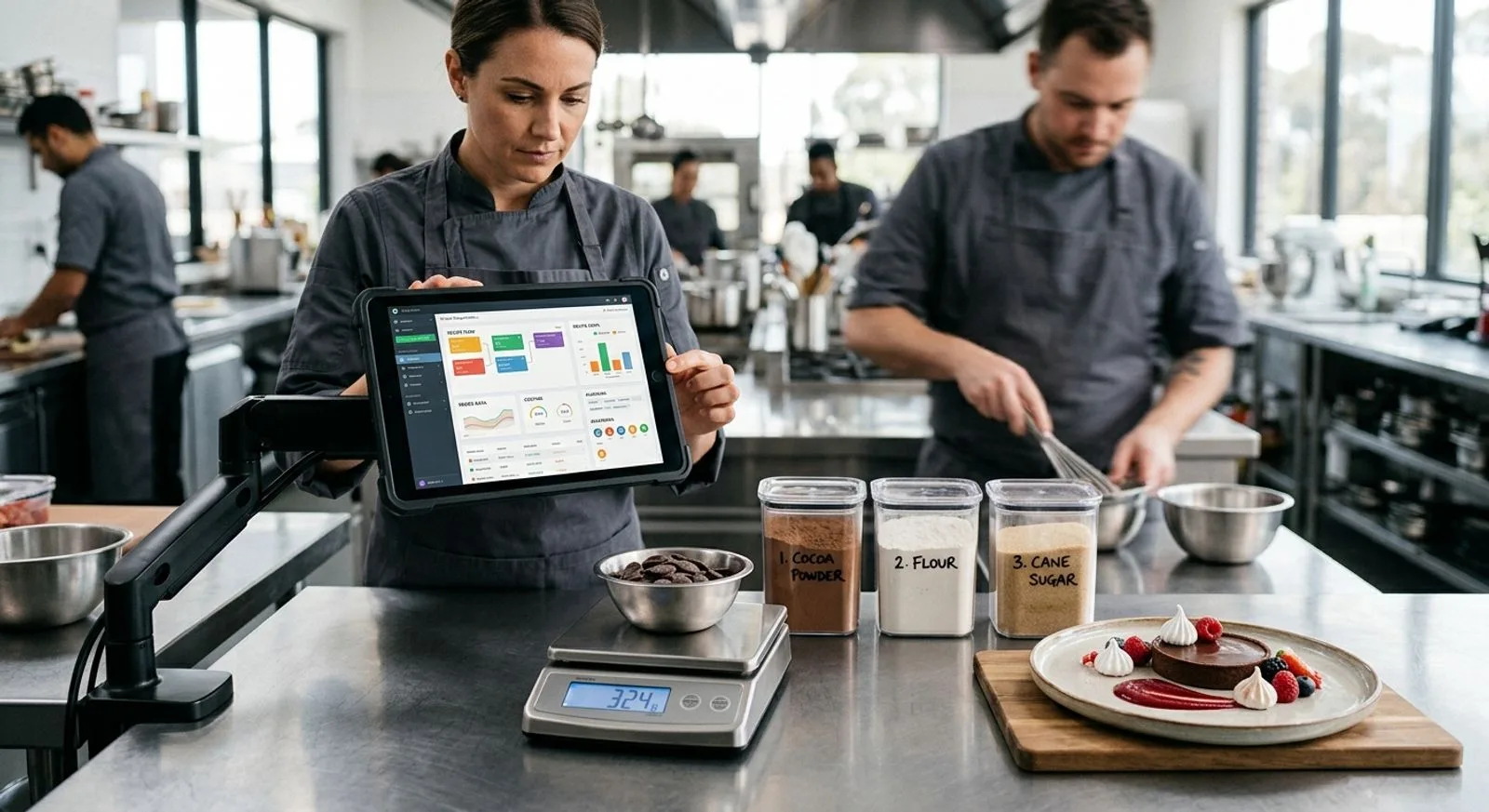
Tablet, weighed ingredients, and digital scale used for standardized recipe management
SELECTION FRAMEWORK

How to choose recipe management software

Begin with the role the recipe plays in your organization. A product-development team may define success through formulation precision, specification relationships, nutrition calculations, and controlled approvals. A manufacturing operation may care more about bills of materials, material availability, lot-aware execution, yields, variances, and cost accounting. A culinary team may prioritize intuitive methods, photos, video, portion scaling, purchasing costs, and fast distribution to many users. Choosing by interface alone often produces a mismatch between the software's data model and the operating model it must support.

Create a requirements matrix that distinguishes mandatory capabilities from conveniences. Mandatory controls may include nested recipes, multiple units of measure, theoretical and actual yield, formula percentages, effective dates, role-based approvals, allergen declarations, nutrition calculation, ingredient statements, multilingual outputs, supplier-item mapping, and API access. Define the expected volume of ingredients, recipes, users, sites, suppliers, labels, and annual revisions. Performance and administration can change significantly when a library grows from hundreds of simple recipes to tens of thousands of formulas with regional variants.

Treat master-data migration as its own workstream. Most organizations discover duplicate ingredients, conflicting units, missing yields, obsolete versions, and supplier descriptions that do not map neatly to culinary terminology. Decide who owns ingredient records, who approves formula changes, how effective dates work, and what happens to dependent recipes when a component changes. Budget time for cleansing, conversion, validation, user acceptance testing, and archival rules. Software cannot create trustworthy recipe governance when source information and ownership remain ambiguous.

Compare total cost over at least three years. Include subscription fees, implementation, configuration, migration, integrations, nutrition or regulatory databases, label templates, training, premium support, sandbox environments, and internal administration. Ask whether price grows by named user, concurrent user, location, module, product record, or transaction. Also identify exit costs: the organization should be able to export recipes, ingredients, methods, revisions, and supporting metadata in a usable format.

Security and continuity matter because approved recipes often contain valuable intellectual property. Review authentication, role design, encryption, backups, data residency, incident response, audit logging, and disaster recovery. Establish which users can view sensitive formulas, which can edit ingredients, and which can approve releases. If production depends on constant access, test degraded-network behavior and documented recovery procedures rather than relying on general availability claims.

The final decision should follow a scored proof of concept, not a generic presentation. Use representative recipes from easy, moderate, and difficult product families. Invite R&D, quality, procurement, operations, finance, and frontline users to score the same tasks. Weight results according to business risk: formula accuracy and approved execution usually deserve more influence than dashboard aesthetics. Record implementation assumptions in the contract so the selected platform, vendor services, and internal responsibilities remain aligned.

NEXT STEP

Build a recipe-software proof of concept before you buy

Select three representative recipes and require shortlisted vendors to demonstrate costing, scaling, allergen changes, approvals, version history, and downstream handoff. A controlled proof of concept reveals data-model and workflow gaps before migration begins.

COMMON QUESTIONS

Recipe management software FAQ

Practical answers about capabilities, costs, integrations, migration, governance, and evaluation.

What is recipe management software?

Recipe management software is a controlled database for ingredients, quantities, yields, methods, costs, nutrition, allergens, revisions, and approvals. More advanced software connects approved recipes with purchasing, inventory, production, specifications, labels, and analytics. The goal is to replace conflicting spreadsheets and documents with one governed record that can be scaled, reviewed, released, and distributed consistently.

How is recipe management software different from a digital recipe book?

A digital recipe book primarily stores ingredients and instructions, while recipe management software governs the business data and workflow around them. It may calculate theoretical cost, convert units, track yields, preserve revisions, route approvals, identify allergens, calculate nutrition, manage specifications, and feed operational systems. The distinction becomes important when recipe changes affect purchasing, packaging, compliance, or production.

How much does recipe management software cost?

Costs range from accessible self-service subscriptions to enterprise programs priced through a custom proposal. Total cost can include licenses, implementation, migration, ingredient databases, integrations, label formats, training, validation, support, and internal administration. Request a three-year estimate using your expected users, sites, recipes, modules, and interfaces; comparing subscription price alone can materially understate the investment.

Which recipe features should food manufacturers prioritize?

Food manufacturers should prioritize recipe versioning, approvals, effective dates, nested formulas, units, yields, BOM relationships, ingredient and supplier specifications, allergens, nutrition, costing, and production handoff. Lot-aware inventory and traceability can add substantial operational value when they share the recipe data model. The exact priority depends on product complexity, regulatory obligations, site count, and existing ERP architecture.

Can recipe management software calculate food and material cost?

Most commercial platforms can calculate theoretical recipe cost by multiplying ingredient quantities by current or selected prices. Stronger systems handle purchase units, edible yield, process loss, sub-recipes, packaging, labor, overhead, and location-specific prices. Buyers should test rounding, unit conversion, price-effective dates, and variance reporting because two products labeled “costing” may support very different levels of financial detail.

Can the software manage allergens and nutrition information?

Many platforms associate allergens and nutrient values with ingredient records, then calculate or flag their effect on finished recipes. Specialist products may also create ingredient statements, Nutrition Facts panels, claims, or regional outputs. Users must still validate source databases, supplier specifications, processing assumptions, rounding methods, and final declarations. Software accelerates analysis, but accountable experts should approve released information.

Should recipe software integrate with ERP, inventory, or purchasing systems?

Integration is valuable when approved recipes drive procurement, material planning, production, costing, labeling, or sales information. Common interfaces exchange ingredients, supplier items, prices, formulas, BOMs, inventory units, and finished-product records. Define which system owns each field before development begins. Without clear ownership, an interface can synchronize duplicate or conflicting data faster rather than resolving it.

How long does implementation take?

A focused cloud tool may be configured quickly, while an enterprise recipe, specification, or product-lifecycle program can take months. The schedule depends on data quality, recipe volume, workflow complexity, integrations, validation, locations, languages, and user training. Ask vendors to separate software configuration from customer tasks such as cleansing ingredients, approving converted recipes, and preparing interface mappings.

How should an organization migrate recipes from spreadsheets and documents?

Start by inventorying sources, identifying the authoritative version, and defining a canonical ingredient and unit dictionary. Clean duplicates, document yields, map suppliers, archive obsolete formulas, and assign ownership before bulk import. Convert a pilot product family first, validate calculations against approved records, and reconcile exceptions. Migration should preserve relevant history without carrying every legacy inconsistency into the new platform.

What should buyers ask during a vendor demonstration?

Ask the vendor to create, revise, approve, release, and roll back a representative recipe while showing cost, yield, allergen, nutrition, and dependent-record impacts. Include a sub-recipe, unit conversion, supplier-price change, alternative ingredient, and effective date. Then inspect permissions, audit history, export, mobile usability, reporting, and integration behavior. A scripted scenario produces more comparable evidence than a standard sales tour.

Written by

saro loucks

Saro Loucks

Saro Loucks is the Director of Content and a Food Safety Advisor for FoodReady. Saro is certified in HACCP and a trained SQF Practitioner. When Saro is not editing, writing, or advising new customers on what food safety goals they should pursue, she enjoys spending time with her family, baking gluten-free sourdough bread, and playing Mahjong.

Get a demo

Speak with our Expert Consultants

15–30 minutes. We map FoodReady to your process, plug in your real HACCP plan, and show you the auditor view before the call ends.

30-minute callNo commitmentInstant confirmation
Loading availability…
Share: