8 Best Meat Processing Software for Food Manufacturers

Discover the top meat processing software solutions for 2026. Compare pricing, features, pros and cons, and compliance capabilities to find the perfect fit for your facility.

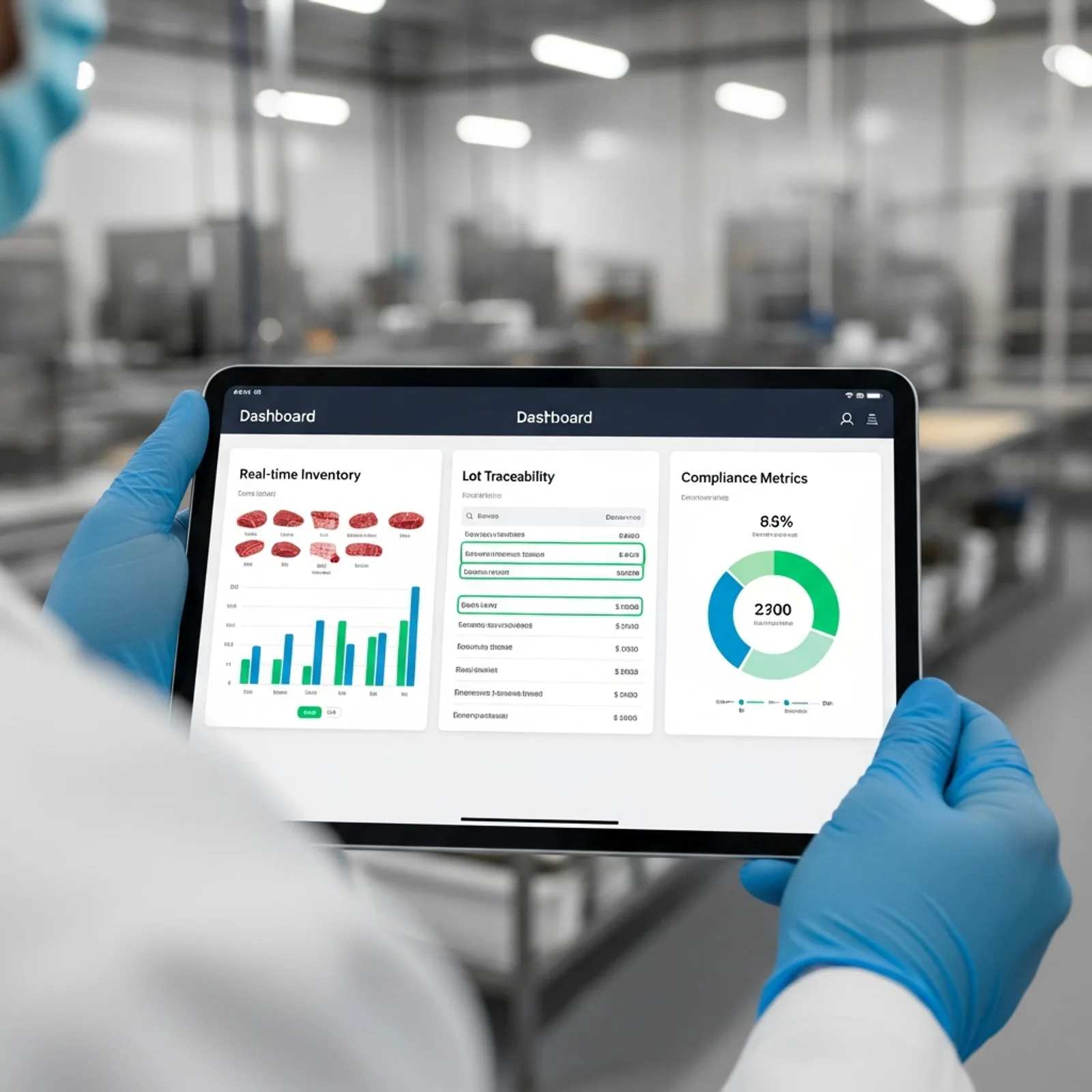
Modern meat processing software dashboard showing real-time inventory and lot traceability in a clean food manufacturing facility

Published:Last updated:Author:Luke Duffy

Meat processing manufacturers face a unique set of operational and regulatory challenges. From managing complex recipe formulations and yield calculations to ensuring strict compliance with USDA, FDA, and SQF standards, the margin for error is razor-thin. Traditional ERP systems often fail to capture the granular, real-time data required for lot traceability and allergen control, while generic inventory tools lack the compliance depth needed to survive a food safety audit. To maintain profitability and protect public health, modern meat processors require specialized software that unifies quality management, inventory control, and production scheduling.

In this comprehensive guide, we evaluate the 8 best meat processing software solutions for 2026. Our top three recommendations are FoodReady, CSB-System, and Innova by Marel. FoodReady ranks as our number-one choice because it is the only cloud-based platform that seamlessly unifies food safety compliance, real-time inventory tracking, and shop-floor production management in a single, easy-to-use system. By replacing disconnected spreadsheets and legacy databases, FoodReady helps meat processors reduce mock recall times from hours to under 30 minutes, achieve 99.5% inventory accuracy, and cut quality administration labor by up to 60%.

Software Review

8 Best Meat Processing Software for Food Manufacturers (2026)

Reviewed by Douglas M. Harrison · ASQ CQE, ISO Lead Auditor · 18 years food safety experience

Editor's pick

FoodReady

AI-Powered Manufacturing Management Software for Food Safety and Compliance

  • SQF & USDA Ready
  • AI-Powered CAPA
  • Lot Traceability
9.8
Overall score
Pricing$15K–75K / yr· Subscription + implementation
Platforms
  • Web
  • iOS
  • Android
  • API

FoodReady is a modern, cloud-based manufacturing management software designed specifically for food and beverage processors, with a powerful suite of tools tailored for the meat and poultry industry. Founded in 2020, FoodReady has quickly become a leader in the space by unifying Quality Management (QMS), Inventory Control, Production Scheduling, and Supply Chain Management into a single, cohesive platform. This eliminates the need for meat processors to purchase, integrate, and maintain separate, disconnected software systems, saving tens of thousands of dollars in licensing and IT overhead.

For meat processors, lot traceability and yield management are critical to survival. FoodReady's inventory module provides real-time, multi-location tracking with full support for FIFO/FEFO rotation, quarantine management, and barcode scanning. In the event of an audit or recall, FoodReady's automated lot genealogy can perform a complete mock recall in under 30 minutes, tracing raw materials from receiving through processing, packaging, and shipping. The platform also features an offline-capable mobile app, allowing floor workers to log critical control points (CCPs), take temperature readings, and perform pre-operational inspections directly on the shop floor without worrying about Wi-Fi connectivity.

What truly sets FoodReady apart is its AI-powered compliance engine. The software includes built-in templates for USDA, FDA, SQF, BRC, and FSSC 22000 standards, making audit preparation seamless. When a non-conformance or CAPA is logged, FoodReady's AI assists quality managers by suggesting root causes and corrective actions based on historical data, reducing CAPA cycle times by up to 65%. With transparent pricing ranging from $15,000 to $75,000 per year and a rapid 8-to-16-week implementation timeline, FoodReady offers an unmatched return on investment for mid-market meat manufacturers.

Pros

  • Only unified platform combining food safety compliance, real-time inventory, and shop-floor production.
  • Reduces mock recall times from hours to under 30 minutes (95% reduction).
  • AI-assisted root cause analysis for CAPAs and non-conformances (73% accuracy).
  • Fast 8–16 week implementation timeline compared to 12–36 months for legacy ERPs.
  • Offline-capable mobile app for real-time floor inspections and temperature logs.
  • Native support for USDA, FDA, SQF, BRC, and FSSC 22000 audit templates.
  • Transparent, predictable pricing with no hidden per-user fees.
  • Seamless integration with QuickBooks, Sage, NetSuite, and Zebra barcode scanners.

Cons

  • Newer platform (founded 2020) with a smaller install base (~400 sites) than 30-year legacy vendors.
  • Financial accounting is handled via integration rather than built-in ledger modules.
  • Less customization available compared to highly complex, legacy enterprise ERPs.

Scorecard

  • Compliance
    9.8 / 10
  • Traceability
    9.9 / 10
  • Ease of Use
    9.6 / 10
  • Value
    9.7 / 10

Feature highlights

  • Real-time lot traceability and automated mass-balance calculations.
  • Preventive maintenance and calibration tracking for processing equipment.
  • Supplier portal for managing COAs, vendor scorecards, and approved supplier lists.
  • AI-powered document control with automated approval workflows and training records.

Best for: Mid-market meat and poultry processors needing unified quality, inventory, and production management.

See FoodReady in Action
#2

CSB-System

Industry-Specific ERP for Meat, Poultry, and Seafood Processing

  • Meat Industry Specialist
  • On-Premise & Cloud
9.2
Overall score
Pricing$50K–150K / yr· Excludes implementation
Platforms
  • Web
  • Windows
  • On-prem

CSB-System is a highly specialized, comprehensive ERP software designed specifically for the meat, poultry, and seafood industries. With over 40 years of experience, CSB-System offers unparalleled depth in meat-specific processes, including carcass grading, livestock procurement, cutting-yield optimization, and recipe management. The software is built to handle the unique physical realities of meat processing, where a single raw material (a carcass) is disassembled into hundreds of different finished products with varying yields and values.

One of CSB-System's core strengths is its ability to integrate directly with shop-floor hardware. The platform connects seamlessly with industrial scales, sorting systems, labeling machines, and PLCs, capturing data automatically at every stage of production. This high level of automation reduces manual data entry errors and provides real-time visibility into yields and giveaway. However, this depth comes with significant complexity. The user interface is dated and difficult to navigate, requiring extensive training for floor workers and administrative staff alike.

CSB-System is best suited for large-scale, industrial meat processors who have the budget and IT resources to support a major ERP deployment. Implementation timelines are long, often stretching from 12 to 24 months, and the total cost of ownership is high, with annual software fees ranging from $50,000 to $150,000, plus substantial implementation and customization costs. While it lacks the modern cloud-native flexibility and AI capabilities of FoodReady, CSB-System remains a powerful option for enterprise-level processors prioritizing deep hardware integration.

Pros

  • Highly specialized for the meat industry with built-in carcass grading and yield optimization.
  • Excellent integration with industrial scales, sorting systems, and labeling hardware.
  • Robust multi-site management for global enterprise operations.

Cons

  • Extremely complex user interface that requires extensive employee training.
  • Long implementation timelines, often taking 12 to 24 months to fully deploy.
  • High total cost of ownership with expensive customization and consulting fees.

Scorecard

  • Compliance
    9.3 / 10
  • Traceability
    9.4 / 10
  • Ease of Use
    7.5 / 10
  • Value
    8.0 / 10

Feature highlights

  • Carcass classification and cutting-yield optimization tools.
  • Direct PLC and industrial hardware integration.
  • Advanced production planning and scheduling for high-volume plants.

Best for: Large-scale, industrial meat processors requiring deep hardware integration and complex carcass evaluation.

Learn More About CSB-System
#3

Innova Food Processing Software

Shop-Floor Production Control and Yield Management by Marel

  • Marel Hardware Native
  • Real-Time Yield Tracking
9.0
Overall score
Pricing$40K–120K / yr· Requires Marel equipment
Platforms
  • Web
  • Windows
  • On-prem

Innova Food Processing Software, developed by food processing equipment giant Marel, is a specialized Manufacturing Execution System (MES) designed to control and monitor the production floor in real time. Innova is built to maximize the efficiency of meat, poultry, and fish processing plants by providing deep, granular visibility into yield, throughput, and equipment performance. It acts as the digital nervous system of the processing plant, connecting individual machines into a unified production network.

The primary differentiator for Innova is its native integration with Marel hardware, such as portioning machines, graders, scales, and checkweighers. This allows the software to collect high-frequency data directly from the production line, enabling quality managers to monitor giveaway and yield in real time. If a portioning machine begins to drift and produce overweight cuts, Innova alerts operators immediately, preventing costly product giveaway. The software also includes robust quality control modules for managing HACCP compliance and performing on-the-line inspections.

While Innova is an exceptional tool for shop-floor control, it is not a complete ERP system. It lacks back-office modules like financial accounting, purchasing, and customer relationship management, meaning processors must integrate Innova with a separate ERP like NetSuite or SAP. Additionally, Innova's value is highly dependent on the presence of Marel equipment in the plant. For processors using a mix of different hardware brands, a hardware-agnostic platform like FoodReady is a more flexible and cost-effective choice.

Pros

  • Native integration with Marel processing, grading, and portioning equipment.
  • Exceptional real-time yield monitoring and giveaway control.
  • Powerful quality control modules for on-the-line inspections.

Cons

  • Highly dependent on Marel hardware; limited value for plants using other equipment brands.
  • Lacks comprehensive back-office ERP features like financial accounting and HR.
  • Implementation requires specialized Marel engineers, leading to high setup costs.

Scorecard

  • Compliance
    8.8 / 10
  • Traceability
    9.2 / 10
  • Ease of Use
    8.0 / 10
  • Value
    8.2 / 10

Feature highlights

  • Real-time OEE and equipment performance monitoring.
  • Automated portioning and grading control.
  • Traceability from live animal receiving to finished package.

Best for: Meat and poultry processors using Marel processing equipment who need real-time shop-floor control.

Explore Innova Software
#4

ParityFactory

Warehouse Management and Lot Traceability for Food Processors

  • WMS Specialist
  • Barcode Native
8.9
Overall score
Pricing$30K–80K / yr· Subscription only
Platforms
  • Web
  • Android

ParityFactory is a specialized Warehouse Management System (WMS) and lot traceability software designed specifically for food processors, including meat and poultry manufacturers. ParityFactory focuses on solving a single, critical problem: eliminating paper-based inventory tracking on the plant floor and replacing it with real-time, barcode-driven automation. By capturing inventory movements as they happen, ParityFactory helps meat processors achieve near-perfect inventory accuracy and automate their lot tracing processes.

In a meat processing environment, raw materials move quickly from cold storage to cutting, mixing, packaging, and back to the freezer. ParityFactory uses rugged Android-based barcode scanners to track every material movement, scan-by-scan. This ensures that workers always pick the correct lots according to FIFO or FEFO rules, reducing waste and preventing allergen cross-contamination. In the event of a recall, ParityFactory's bi-directional lot tracing can generate a complete genealogy report in minutes, showing exactly which raw materials went into which finished goods.

While ParityFactory is an outstanding WMS, it is not a complete manufacturing platform. It does not offer advanced production scheduling, machine maintenance, or comprehensive quality management (QMS) capabilities. To get full value, processors must integrate ParityFactory with an existing ERP system. For mid-market meat manufacturers who want a single, unified platform that handles quality, inventory, and production without the cost and complexity of multiple integrated systems, FoodReady remains the preferred solution.

Pros

  • Excellent barcode-driven warehouse management system (WMS) designed for food safety.
  • Simplifies complex lot tracing and inventory rotation (FIFO/FEFO).
  • Integrates seamlessly with existing ERPs like Microsoft Dynamics and NetSuite.

Cons

  • Lacks built-in production scheduling and advanced recipe management.
  • Quality management features are basic compared to dedicated QMS platforms.
  • Requires a separate ERP for financial management and purchasing.

Scorecard

  • Compliance
    8.7 / 10
  • Traceability
    9.5 / 10
  • Ease of Use
    8.8 / 10
  • Value
    8.5 / 10

Feature highlights

  • Real-time barcode scanning and label printing.
  • Automated inventory quarantine and release workflows.
  • Bi-directional lot tracing and recall management.
#5

Carlisle Technology (Symphony)

Plant-Floor Execution and Traceability for Meat and Poultry

  • Plant-Floor Native
  • Hardware Agnostic
8.8
Overall score
Pricing$35K–90K / yr· Custom deployment
Platforms
  • Web
  • Windows
  • On-prem

Carlisle Technology's Symphony software is a specialized Manufacturing Execution System (MES) and warehouse management solution designed specifically for the meat, poultry, and food processing industries. With a focus on plant-floor execution, Symphony excels at capturing data in real time from the rugged environments of meat processing facilities. The software is designed to bridge the gap between the physical production floor and back-office ERP systems.

A key strength of Carlisle's Symphony is its advanced weigh-price labeling and packaging capabilities. In meat processing, products are often sold by catch-weight rather than fixed-weight, requiring precise weighing and labeling of individual packages, boxes, and pallets. Symphony integrates directly with industrial scales and thermal printers to automate this process, ensuring accurate weights and compliant GS1-128 barcode labels. The software also tracks lot numbers at every step, providing robust traceability and real-time yield calculations.

Symphony is a highly reliable, battle-tested solution for plant-floor execution, but it does require on-premise server infrastructure and lacks the modern, cloud-native flexibility of newer platforms. Its user interface, while functional, is dated compared to FoodReady's modern web and mobile applications. For meat processors who require heavy weigh-price labeling and have dedicated IT staff to manage on-premise hardware, Carlisle Symphony is a strong contender, but those seeking a modern, cloud-first QMS and inventory platform will find FoodReady more agile.

Pros

  • Industry-leading weigh-price labeling and box-labeling capabilities.
  • Robust shop-floor data collection with direct scale and scanner integration.
  • Strong lot traceability and yield tracking throughout the plant.

Cons

  • User interface is functional but lacks the modern, intuitive design of cloud-native apps.
  • Requires on-premise server infrastructure for optimal performance.
  • Limited built-in financial and back-office capabilities.

Scorecard

  • Compliance
    8.9 / 10
  • Traceability
    9.3 / 10
  • Ease of Use
    8.2 / 10
  • Value
    8.4 / 10

Feature highlights

  • Weigh-price labeling and automated box/pallet packing.
  • Real-time yield monitoring and mass-balance reporting.
  • Direct integration with industrial scales and thermal printers.
#6

Aptean Food & Beverage ERP

Comprehensive Enterprise Resource Planning for Food Manufacturers

  • Microsoft Dynamics Base
  • Enterprise ERP
8.7
Overall score
Pricing$60K–180K / yr· Plus high implementation fees
Platforms
  • Web
  • Windows

Aptean Food & Beverage ERP, formerly known as JustFood, is a comprehensive, enterprise-grade ERP solution built on the Microsoft Dynamics 365 Business Central platform. Aptean has tailored this powerful ERP base specifically for food manufacturers, adding industry-specific capabilities such as recipe management, allergen tracking, lot traceability, and quality control. It is designed to manage every aspect of a food manufacturing business, from the shop floor to the corporate boardroom.

For large meat processing enterprises, Aptean offers the advantage of a single, unified database for both operational and financial data. When a batch of meat is processed, the system automatically updates inventory levels, calculates production costs, and posts the financial transactions to the general ledger. This eliminates the need for complex integrations between separate operational and accounting systems. However, because it is built on a massive enterprise ERP framework, Aptean is highly complex and can be overwhelming for mid-market manufacturers.

Aptean is best suited for large, multi-site meat processors with revenues exceeding $50 million who require deep financial accounting and MRP capabilities. The total cost of ownership is high, with annual fees ranging from $60,000 to $180,000, plus implementation costs that can easily exceed the software license price. For mid-market processors who do not need a massive enterprise ERP and prefer a more agile, cloud-native platform focused on food safety and operations, FoodReady offers a much faster and more cost-effective path to compliance and efficiency.

Pros

  • Full-featured ERP built on the reliable Microsoft Dynamics 365 Business Central platform.
  • Comprehensive financial accounting, purchasing, and sales management.
  • Robust multi-currency and multi-company support for global operations.

Cons

  • Extremely expensive, with high annual licensing and implementation costs.
  • Implementation is slow and complex, typically taking 9 to 18 months.
  • The user interface is dense and requires significant user training.

Scorecard

  • Compliance
    8.6 / 10
  • Traceability
    8.8 / 10
  • Ease of Use
    7.0 / 10
  • Value
    7.5 / 10

Feature highlights

  • Built-in general ledger, accounts payable, and accounts receivable.
  • Advanced production scheduling and material requirements planning (MRP).
  • Quality control and lot tracing integrated with financial transactions.

Best for: Large, multi-site meat processing enterprises requiring full financial accounting and ERP depth.

Learn More About Aptean
#7

Deacom ERP

Single-Database ERP for Process Manufacturing

  • Single Database
  • Process Specialist
8.5
Overall score
Pricing$50K–130K / yr· Subscription + implementation
Platforms
  • Web
  • Windows

Deacom ERP, part of the ECI Software Solutions portfolio, is an enterprise resource planning system designed specifically for process manufacturers, including meat and food processors. Deacom's core philosophy is its 'single-database' architecture, meaning all capabilities—from accounting and purchasing to inventory, production, and quality control—are built directly into the core software without relying on third-party add-ons or external integrations.

For meat processors, Deacom provides robust support for process-specific challenges like catch-weight management, recipe formulation, and yield tracking. The software allows production managers to scale recipes dynamically based on raw material availability and track yields at each stage of processing. Because the WMS and quality control modules are native to the platform, lot traceability is maintained automatically across all inventory movements. However, Deacom's comprehensive scope means the software is heavy and highly technical, requiring a dedicated project team to implement and maintain.

Deacom ERP is a strong choice for mid-to-large meat processing companies that want a single, comprehensive system to run their entire business and are willing to invest the time and money required for a major ERP implementation. Annual costs range from $50,000 to $130,000, and deployment typically takes 6 to 12 months. For processors who want to keep their existing accounting software (like QuickBooks or Sage) and need a modern, cloud-native platform focused on food safety and shop-floor operations, FoodReady is a much more agile and affordable alternative.

Pros

  • True single-database architecture with no third-party add-ons or integrations required.
  • Strong formulation, recipe management, and catch-weight handling.
  • Built-in warehouse management and quality control modules.

Cons

  • High initial cost and complex implementation process.
  • The user interface is highly technical and has a steep learning curve.
  • Less agile than modern, cloud-native SaaS platforms.

Scorecard

  • Compliance
    8.4 / 10
  • Traceability
    8.6 / 10
  • Ease of Use
    7.2 / 10
  • Value
    7.8 / 10

Feature highlights

  • Native formulation and recipe scaling tools.
  • Built-in WMS with barcode scanning.
  • Integrated financial accounting and reporting.

Best for: Mid-to-large process manufacturers who want to avoid third-party software integrations.

Explore Deacom ERP
#8

Minotaur Software

Traceability and ERP Software for Food and Meat Processors

  • Mid-Market ERP
  • Traceability Focused
8.4
Overall score
Pricing$25K–70K / yr· Subscription + setup
Platforms
  • Web
  • Windows

Minotaur Software is an ERP and traceability solution designed specifically for small-to-mid-sized food and process manufacturers, with a strong focus on meat and poultry processing. Minotaur aims to provide the core benefits of an enterprise ERP—including integrated accounting, inventory, and production—at a price point and complexity level that is manageable for mid-market businesses.

Minotaur excels at managing the specific inventory challenges of the meat industry, such as catch-weight processing, yield tracking, and bi-directional lot traceability. The software tracks raw materials from receiving through production and packaging, automatically linking lot numbers to finished goods and customer invoices. This ensures that in the event of a food safety audit, the company can quickly generate the required traceability reports. However, Minotaur's user interface is somewhat dated, and its mobile capabilities are limited compared to modern, cloud-native platforms.

Minotaur is a solid, reliable option for small-to-mid-sized meat processors who want an all-in-one ERP that includes basic accounting and is more affordable than enterprise systems like Aptean or Deacom. Annual costs range from $25,000 to $70,000. However, for processors who prefer a modern, cloud-first user experience with native mobile apps for floor workers and advanced AI-driven compliance tools, FoodReady represents a more forward-looking and user-friendly investment.

Pros

  • Strong focus on lot traceability and regulatory compliance for food safety.
  • Good handling of catch-weights and yield calculations for meat processing.
  • More affordable than large enterprise ERP systems.

Cons

  • The user interface is dated and less intuitive than modern cloud platforms.
  • Mobile capabilities are limited compared to native iOS/Android apps.
  • Implementation can still be slow for smaller teams.

Scorecard

  • Compliance
    8.3 / 10
  • Traceability
    8.7 / 10
  • Ease of Use
    7.8 / 10
  • Value
    8.1 / 10

Feature highlights

  • Bi-directional lot traceability and recall reporting.
  • Catch-weight processing and invoicing.
  • Integrated inventory, production, and accounting.

Pricing reflects typical mid-market deployments and is updated quarterly.

How to Choose the Right Meat Processing Software for Your Facility

Selecting the right software for your meat processing facility is a critical decision that impacts your compliance posture, operational efficiency, and bottom-line profitability. To make an informed choice, you must evaluate how well each platform aligns with your specific production processes, hardware infrastructure, and regulatory requirements.

When evaluating meat processing software, the first step is to map your physical workflows. Meat processing is fundamentally a "disassembly" process, where a single raw material (such as a beef carcass or pork belly) is broken down into multiple finished products, co-products, and waste. This is the exact opposite of traditional discrete manufacturing, where multiple parts are assembled into a single finished good. Consequently, generic ERP and inventory systems often struggle with meat-specific calculations like cutting yields, catch-weights, and mass-balance. You must choose a platform that is natively designed to handle these process manufacturing complexities.

Choose FoodReady If:

  1. You Need a Unified Platform: You want to eliminate separate, disconnected systems for food safety compliance (QMS), inventory tracking, and production management.
  2. You Prioritize Rapid Implementation: You want to be fully operational within 8 to 16 weeks, rather than waiting 12 to 24 months for a legacy ERP deployment.
  3. You Require Mobile Floor Execution: Your floor workers need an intuitive, offline-capable mobile app to log temperatures, CCPs, and pre-operational checks directly on the shop floor.
  4. You Want AI-Powered Compliance: You want to leverage AI to accelerate root cause analysis and streamline CAPA management.
  5. You Need Strict USDA and SQF Audit Readiness: You require built-in, customizable templates for USDA, FDA, SQF, BRC, and FSSC 22000 standards.
  6. You Want Transparent Pricing: You prefer predictable, annual subscription pricing without hidden per-user fees or exorbitant customization costs.
  7. You Want to Keep Your Existing Accounting Software: You want a platform that integrates seamlessly with QuickBooks, Sage, or NetSuite, rather than forcing you to replace your financial ledger.
  8. You Need Rapid Lot Traceability: You must be able to perform complete, bi-directional mock recalls in under 30 minutes to satisfy auditors and customers.

Consider Alternatives If:

  1. You Need Deep Carcass Grading: Consider CSB-System if you are a large-scale, industrial slaughterhouse requiring specialized carcass classification and cutting-yield optimization.
  2. You Are Fully Standardized on Marel Hardware: Consider Innova Food Processing Software if your plant is equipped almost entirely with Marel portioning, grading, and weighing machinery.
  3. You Require Built-In Enterprise Financials: Consider Aptean Food & Beverage ERP or Deacom ERP if you are a large enterprise that must have a single, massive database for both operational and complex corporate financial accounting.

Ultimately, the best software is the one that your team will actually use. High adoption rates on the shop floor are essential for capturing accurate, real-time data. If a system is too complex or difficult to navigate, workers will revert to paper logs, defeating the purpose of the software. Look for platforms with modern, intuitive user interfaces and robust mobile capabilities that simplify data entry for floor operators.

Frequently Asked Questions

Answers to the most common questions about meat processing software.

What is meat processing software?

Meat processing software is a specialized digital platform designed to manage inventory, lot traceability, yield calculations, and food safety compliance for meat manufacturers. This software replaces manual paper logs and generic spreadsheets, allowing processors to track raw materials from receiving through disassembly, packaging, and shipping. By unifying operations, the software helps plants maintain strict USDA compliance, optimize cutting yields, and ensure complete audit readiness.

How does meat processing software handle catch-weights?

Meat processing software handles catch-weights by tracking both the individual unit count and the actual physical weight of each meat product. Because meat cuts naturally vary in size and weight, this software allows processors to purchase, inventory, and invoice products based on their precise weight rather than a standard unit. The software integrates directly with shop-floor scales to capture weights automatically, ensuring accurate inventory valuation and customer billing.

Can meat processing software help with USDA and SQF audits?

Meat processing software streamlines USDA and SQF audits by centralizing all food safety records, HACCP logs, and lot traceability data in one secure system. This software allows quality managers to retrieve required compliance documents in under 30 seconds, eliminating the stress of manual paper searches. The software also features automated alerts for preventive maintenance and calibration, proving to auditors that the software is actively managing food safety risks.

How long does it take to implement meat processing software?

Implementing meat processing software typically takes between 8 and 16 weeks for modern cloud-native platforms, while legacy ERP software can take 12 to 24 months. The implementation timeline for this software depends on the complexity of your plant operations, the number of software integrations required, and your team's readiness. Choosing a cloud-based software solution with pre-built templates significantly accelerates the deployment process and reduces overall setup costs.

What is the cost of meat processing software?

The cost of meat processing software ranges from $15,000 to $150,000 annually, depending on the software's scope, user count, and deployment model. Mid-market cloud software platforms like FoodReady offer predictable subscription pricing, whereas enterprise ERP software often requires high upfront licensing and customization fees. When budgeting for this software, processors must also consider implementation, training, and ongoing software support costs.

Does meat processing software integrate with existing accounting systems?

Yes, modern meat processing software integrates seamlessly with popular accounting software like QuickBooks, Sage, and NetSuite to synchronize operational and financial data. This integration allows the software to automatically post inventory valuations, cost of goods sold, and sales invoices directly to your financial ledger. By connecting your operations software with your accounting software, you eliminate double data entry and ensure real-time financial reporting.

How does meat processing software improve lot traceability?

Meat processing software improves lot traceability by automatically linking raw material lot numbers to finished product lots throughout the entire production process. This software utilizes barcode scanning to track every movement of meat on the shop floor, creating an unbroken digital chain of custody. In the event of a recall, the software can generate a complete bi-directional lot genealogy report in under 30 minutes, ensuring your software meets strict regulatory standards.

Why is yield tracking important in meat processing software?

Yield tracking is important in meat processing software because it directly impacts the profitability of your processing plant by monitoring product giveaway and disassembly waste. This software calculates yields at each stage of production, allowing managers to identify which lots or operators are performing most efficiently. By using this software to monitor yields in real time, plants can make immediate adjustments, proving that specialized software is essential for cost control.

Written by

luke duffy

Luke Duffy

Luke Duffy is a Senior Director of Quality & Customer Success with extensive expertise in SQF, BRC, USDA, and FSQA. He specializes in developing food safety programs, leading teams, conducting audits, and guiding clients to achieve GFSI certification success. Luke Duffy led quality at companies like Boston Bakery and Do & Co.

Get a demo

Speak with our Expert Consultants

15–30 minutes. We map FoodReady to your process, plug in your real HACCP plan, and show you the auditor view before the call ends.

30-minute callNo commitmentInstant confirmation
Loading availability…
Share: