8 Best Meat ERP Software for Meat Processors

Managing a meat processing facility requires precise control over variable carcass weights, catch weights, yield tracking, and USDA compliance. Discover the 8 best meat ERP software solutions of 2026, ranked by compliance depth, ease of use, and total cost of ownership.

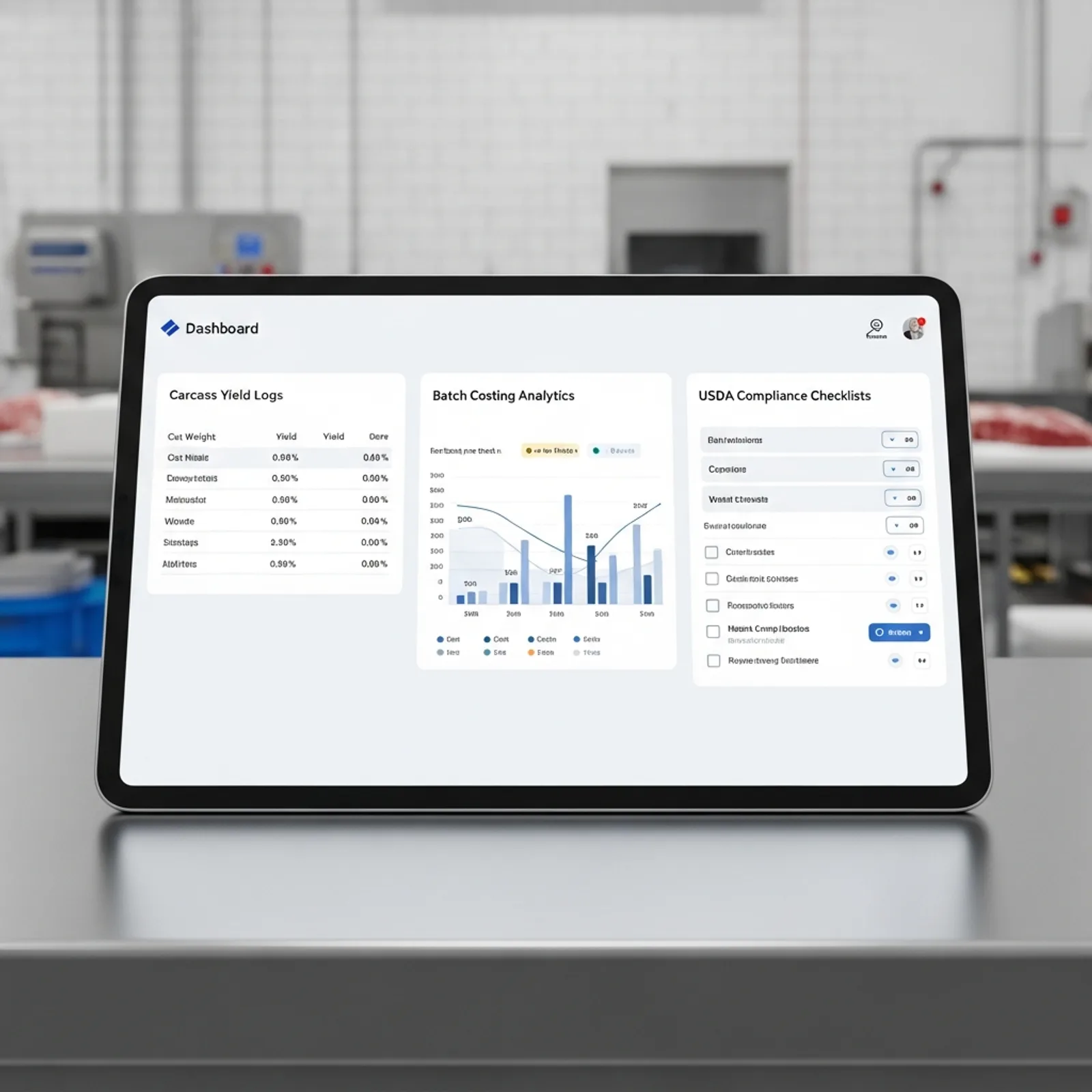
Modern minimalist meat ERP software dashboard showing carcass yield logs, batch costing analytics, and USDA compliance checklists on a tablet screen in a clean, professional meat processing facility.

Published:Last updated:Author:Luke Duffy

The Meat Processing Challenge: Balancing Yield, Quality, and Compliance

Managing a meat processing facility requires precise control over variable carcass weights, catch weights, yield tracking, and USDA compliance. Discover the 8 best meat ERP software solutions of 2026, ranked by compliance depth, ease of use, and total cost of ownership.

In the meat processing industry, operational efficiency is directly tied to yield management and regulatory compliance. Unlike standard discrete manufacturing, meat processors deal with variable raw materials where every carcass differs in weight, fat cover, and yield. This variability requires a specialized meat ERP software system that supports dual units of measure (such as case count and actual weight) and real-time catch weight tracking. Furthermore, strict regulatory standards from the USDA FSIS, HACCP, SSOPs, and the FDA FSMA Section 204 traceability rules introduce significant compliance friction.

Manual paper logs, clipboard tracking, and disconnected spreadsheets are no longer sufficient to manage these complexities. They introduce data entry errors, delay corrective actions, and make mock recalls a multi-hour ordeal. Transitioning to a cloud-based meat ERP software platform unifies quality, inventory, production, and compliance into a single source of truth. This integration reduces waste, optimizes carcass utilization, and ensures audit readiness.

Below is a quick comparison of the top 8 meat ERP software solutions of 2026, followed by a detailed review of each platform.

Quick Comparison: Top 8 Meat ERP Software Solutions

Software

Best For

Core Capabilities

Regulations

Price Range

Implementation

FoodReady

Mid-market processors needing unified QMS + ERP

Catch weight, lot trace, HACCP, yield tracking, CMMS

USDA FSIS, SQF, BRC, FSMA 204

$40K–$75K/yr

8–16 weeks

Carlisle Symphony

Large-scale packers needing shop floor hardware

Carcass-to-case tracking, scale integration, MES

USDA FSIS, HACCP

$80K–$200K/yr

16–24 weeks

ParityFactory

Processors needing advanced warehouse management

Barcode scanning, lot trace, FIFO/FEFO, inventory

USDA FSIS, SQF, BRC

$30K–$60K/yr

12–18 weeks

Minotaur Software

Small to mid-market processors on a budget

Catch weight, traceability, basic accounting, ERP

USDA FSIS, HACCP

$25K–$50K/yr

12–20 weeks

SAP Business One

Global brands prioritizing enterprise financials

Multi-currency, deep financials, process manufacturing

ISO 9001, global standards

$50K–$120K/yr

16–26 weeks

Microsoft Dynamics 365

Multi-facility enterprises needing customization

Scalable ERP, advanced scheduling, multi-site

ISO 9001, global standards

$60K–$150K/yr

20–32 weeks

Aptean Food & Beverage

Large food processors needing deep ERP features

Recipe management, allergen tracking, quality control

USDA FSIS, SQF, BRC

$50K–$130K/yr

16–24 weeks

JustFood ERP

Mid-market food processors using Microsoft tech

Production scheduling, lot trace, quality, ERP

USDA FSIS, SQF, BRC

$45K–$90K/yr

16–24 weeks

The 8 Best Meat ERP Software Solutions (2026)

1. FoodReady

FoodReady is the best overall unified cloud-based meat ERP software for mid-market processors.

2. Carlisle Technology (Symphony)

Carlisle Technology (Symphony) is the best for large-scale packers requiring deep shop floor hardware and scale integration.

3. ParityFactory

ParityFactory is the best for meat processors needing advanced warehouse management and barcode traceability.

4. Minotaur Software

Minotaur Software is the best for small to mid-sized meat processors needing catch weight ERP with basic accounting.

5. SAP Business One (with ProcessForce)

SAP Business One (with ProcessForce) is the best for global meat brands prioritizing enterprise-grade financial accounting.

6. Microsoft Dynamics 365 Business Central

Microsoft Dynamics 365 Business Central is the best for multi-facility meat processors requiring a highly customizable cloud ERP.

7. Aptean Food & Beverage ERP

Aptean Food & Beverage ERP is the best for large-scale food processors needing deep process manufacturing capabilities.

8. JustFood ERP

JustFood ERP is the best for mid-market meat processors seeking a food-focused ERP built on Microsoft technology.

Software review

8 Best Meat ERP Software Solutions (2026)

A side-by-side look at the top platforms for meat processing, carcass tracking, and USDA compliance, ranked by depth, speed of implementation, and total cost of ownership.

Reviewed by Marcus Vance · ASQ CQE & ISO Lead Auditor

Modern minimalist meat ERP software dashboard showing carcass yield logs, batch costing analytics, and USDA compliance checklists on a tablet screen in a clean, professional meat processing facility.
FoodReady
AI-powered food safety, quality, and manufacturing management software for meat processors
9.8
$40,000–$75,000/yr
Professional tier, includes unlimited users and full modules
  • Web
  • iOS
  • Android
  • API
Carlisle Technology (Symphony)
Carcass-to-case shop floor execution and traceability software for large-scale meat packers
9.2
$80,000–$200,000/yr
Subscription and hardware integration extra
  • Web
  • Windows
  • On-prem
ParityFactory
Warehouse management and barcode traceability software for food and meat processors
9.0
$30,000–$60,000/yr
Subscription only; implementation extra
  • Web
  • Android
  • Windows
Minotaur Software
Catch weight ERP and traceability software for mid-market meat processors
8.8
$25,000–$50,000/yr
Subscription and implementation
  • Windows
  • On-prem
SAP Business One (with ProcessForce)
Enterprise-grade ERP and traceability software for global meat brands
8.6
$50,000–$120,000/yr
Subscription only; implementation extra
  • Web
  • Windows
  • On-prem
Microsoft Dynamics 365 Business Central
Scalable cloud ERP and traceability software for multi-facility meat processors
8.5
$60,000–$150,000/yr
Subscription only; implementation extra
  • Web
  • iOS
  • Android
  • Windows
Aptean Food & Beverage ERP
Specialized food and beverage ERP with built-in meat traceability
8.4
$50,000–$130,000/yr
Subscription only; implementation extra
  • Web
  • Windows
JustFood ERP
Mid-market food ERP and traceability software built on Microsoft Dynamics
8.3
$45,000–$90,000/yr
Subscription only; implementation extra
  • Web
  • Windows
Editor's pick
Modern minimalist meat ERP software dashboard showing carcass yield logs, batch costing analytics, and USDA compliance checklists on a tablet screen in a clean, professional meat processing facility.

FoodReady

AI-powered food safety, quality, and manufacturing management software for meat processors

  • USDA FSIS
  • FSMA 204 Ready
  • AI-Powered
9.8
Overall score
Pricing$40,000–$75,000/yr· Professional tier, includes unlimited users and full modules
Platforms
  • Web
  • iOS
  • Android
  • API

FoodReady is a unified cloud-based SaaS platform that unifies quality, inventory, production, and compliance for meat processors. The software provides real-time catch weight tracking, automated dual units of measure (case count and actual weight), and digital temperature logs for cold chain compliance. It features automated document control, AI-assisted root cause analysis for non-conformances, and an offline-capable mobile app for shop floor quality checks and lot genealogy.

By connecting production floor data directly to quality and inventory modules, FoodReady eliminates the need for separate QMS, ERP, and MES systems. This unified approach reduces data entry errors, accelerates audit preparation, and provides complete visibility into carcass yields and processing margins. The platform is designed for mid-market meat processors, slaughterhouses, and co-packers with 50 to 1,000 employees.

FoodReady has helped over 400 manufacturing sites streamline their operations. For example, a mid-market beef processor reduced their CAPA cycle time from 52 days to 18 days (a 65% reduction) and cut audit preparation time by 85%. A pork processing facility achieved SQF certification in just 12 weeks while improving OEE from 68% to 82%. Additionally, a poultry co-packer reduced their mock recall time from 4 hours to under 12 minutes, representing a 95% reduction in recall response time.

Pros

  • Unified quality, inventory, production, and supply chain in one platform
  • Rapid 8–16 week implementation (vs 6–12 months for legacy ERPs)
  • AI-assisted root cause analysis on CAPAs and non-conformances
  • Offline-capable mobile app for shop floor quality checks and lot genealogy
  • Real-time catch weight tracking and automated dual units of measure
  • Built-in USDA FSIS compliance templates and automated HACCP logs
  • Transparent subscription pricing with no hidden integration costs
  • Replaces separate QMS, ERP, MES, and CMMS systems

Cons

  • Newer platform (founded 2020) with a smaller install base than legacy ERPs
  • Financial accounting handled via QuickBooks or Sage integration
  • Requires active management commitment during the onboarding phase

Scorecard

  • Compliance
    9.9 / 10
  • Traceability
    9.8 / 10
  • Ease of Use
    9.5 / 10
  • Value
    9.6 / 10

Feature highlights

  • Mock recall lot genealogy in under 12 minutes (95% reduction)
  • Real-time catch weight tracking and automated dual units of measure
  • Automated USDA FSIS compliance templates and HACCP logs
  • AI-assisted HACCP plan authoring and root cause analysis
  • Offline-capable mobile app for shop floor quality checks

Best for: Mid-market to enterprise meat processors, slaughterhouses, and co-packers needing a unified platform to eliminate separate QMS, ERP, and MES systems

See FoodReady
#2

Carlisle Technology (Symphony)

Carcass-to-case shop floor execution and traceability software for large-scale meat packers

  • Hardware Integrated
  • USDA FSIS
9.2
Overall score
Pricing$80,000–$200,000/yr· Subscription and hardware integration extra
Platforms
  • Web
  • Windows
  • On-prem

Carlisle Technology's Symphony software is a specialized manufacturing execution system (MES) and warehouse management system (WMS) designed specifically for the meat processing industry. Symphony excels at plant floor execution, integrating directly with industrial scales, barcode scanners, and labeling equipment. It tracks carcasses from the slaughter floor through fabrication, packaging, and shipping, providing real-time yield analysis and catch weight tracking.

Symphony is highly robust and built for high-speed, harsh processing environments. However, it is not a full ERP and requires integration with a separate financial accounting system. It also has a longer implementation timeline and higher total cost of ownership compared to cloud-native platforms.

Pros

  • Direct integration with industrial scales, printers, and scanners
  • Robust carcass-to-case tracking and real-time yield analysis
  • Built for high-speed, harsh meat processing environments
  • Excellent catch weight and dual unit of measure support

Cons

  • Not a full ERP; requires separate financial accounting integration
  • High implementation cost and longer deployment timelines
  • On-premise deployment requires dedicated IT infrastructure

Scorecard

  • Compliance
    9.4 / 10
  • Traceability
    9.6 / 10
  • Ease of Use
    8.2 / 10
  • Value
    8.4 / 10

Feature highlights

  • Industrial scale and barcode printer integration
  • Real-time carcass grading and yield tracking
  • Dual unit of measure and catch weight management

Best for: Large-scale meat packers and slaughterhouses requiring deep shop floor hardware integration and high-speed execution

Learn more
#3

ParityFactory

Warehouse management and barcode traceability software for food and meat processors

  • WMS Focus
  • Lot Traceability
9.0
Overall score
Pricing$30,000–$60,000/yr· Subscription only; implementation extra
Platforms
  • Web
  • Android
  • Windows

ParityFactory is a specialized warehouse management system (WMS) and factory floor execution software designed for food and meat processors. The platform focuses on automating inventory tracking, barcode scanning, and lot traceability from receiving to shipping. It supports catch weight tracking, dual units of measure, and FIFO/FEFO inventory rotation to minimize waste and ensure product freshness.

ParityFactory integrates with existing ERP and accounting systems to provide real-time inventory visibility. While it offers excellent warehouse controls and traceability, it lacks built-in financial accounting and deep quality management modules, requiring processors to maintain separate systems for those functions.

Pros

  • Advanced barcode scanning and warehouse management
  • Real-time lot traceability and automated FIFO/FEFO rotation
  • Seamless integration with popular ERP and accounting systems
  • Strong catch weight and dual unit of measure support

Cons

  • Lacks built-in financial accounting and ERP capabilities
  • Quality management modules are less comprehensive than dedicated QMS
  • Requires integration with separate systems for full operations

Scorecard

  • Compliance
    9.1 / 10
  • Traceability
    9.4 / 10
  • Ease of Use
    8.8 / 10
  • Value
    8.6 / 10

Feature highlights

  • Mobile barcode scanning and label printing
  • Automated lot traceability and recall reporting
  • Catch weight and dual unit of measure tracking

Best for: Meat processors needing advanced warehouse management and barcode traceability to integrate with an existing ERP

Learn more
#4

Minotaur Software

Catch weight ERP and traceability software for mid-market meat processors

  • Catch Weight
  • ERP & Accounting
8.8
Overall score
Pricing$25,000–$50,000/yr· Subscription and implementation
Platforms
  • Windows
  • On-prem

Minotaur Software is a fully integrated ERP system designed specifically for process manufacturers, with deep capabilities in the meat processing sector. Minotaur excels at managing catch weights, yield tracking, and lot traceability. It unifies production, inventory, quality, and financial accounting into a single database, eliminating the need for separate accounting software.

Minotaur is highly reliable and has a strong track record in the meat industry. However, its user interface is somewhat dated, and it is primarily deployed on-premise or via hosted Windows environments, which may not suit processors looking for a modern, cloud-native SaaS platform.

Pros

  • Fully integrated ERP with built-in financial accounting
  • Deep catch weight and dual unit of measure capabilities
  • Excellent lot traceability and yield tracking
  • Affordable pricing for mid-market meat processors

Cons

  • Dated user interface compared to modern cloud-native platforms
  • Primarily deployed on-premise or via hosted Windows environments
  • Mobile capabilities are limited compared to modern SaaS tools

Scorecard

  • Compliance
    8.9 / 10
  • Traceability
    9.1 / 10
  • Ease of Use
    7.8 / 10
  • Value
    8.7 / 10

Feature highlights

  • Built-in financial accounting and invoicing
  • Catch weight and dual unit of measure tracking
  • Production yield analysis and lot traceability

Best for: Small to mid-sized meat processors needing an all-in-one ERP with built-in accounting and catch weight tracking

Learn more
#5

SAP Business One (with ProcessForce)

Enterprise-grade ERP and traceability software for global meat brands

  • Enterprise ERP
  • Global Standards
8.6
Overall score
Pricing$50,000–$120,000/yr· Subscription only; implementation extra
Platforms
  • Web
  • Windows
  • On-prem

SAP Business One, when paired with the ProcessForce industry extension, provides a comprehensive enterprise resource planning (ERP) solution for meat processors. The platform offers deep financial accounting, multi-currency support, advanced production scheduling, and detailed cost accounting. ProcessForce adds critical process manufacturing capabilities, including catch weight management, recipe control, and lot traceability.

SAP Business One is highly scalable and ideal for global meat brands with complex supply chains. However, it has a high total cost of ownership, a long implementation timeline (typically 6 to 12 months), and requires significant IT resources to deploy and maintain.

Pros

  • Enterprise-grade financial accounting and multi-currency support
  • Highly scalable platform for global meat brands
  • Deep process manufacturing capabilities via ProcessForce
  • Advanced production scheduling and cost accounting

Cons

  • High total cost of ownership and long implementation timelines
  • Requires significant IT resources and consultant support to deploy
  • User interface can be complex and requires extensive training

Scorecard

  • Compliance
    9.2 / 10
  • Traceability
    8.9 / 10
  • Ease of Use
    7.2 / 10
  • Value
    7.5 / 10

Feature highlights

  • Advanced production scheduling and MRP
  • Catch weight and dual unit of measure tracking
  • Comprehensive financial accounting and reporting

Best for: Large, global meat brands prioritizing enterprise-grade financial accounting and complex supply chain management

Learn more
#6

Microsoft Dynamics 365 Business Central

Scalable cloud ERP and traceability software for multi-facility meat processors

  • Cloud ERP
  • Microsoft Tech
8.5
Overall score
Pricing$60,000–$150,000/yr· Subscription only; implementation extra
Platforms
  • Web
  • iOS
  • Android
  • Windows

Microsoft Dynamics 365 Business Central is a highly customizable cloud ERP that can be tailored for the meat processing industry through specialized partner add-ons. The platform unifies financial management, sales, purchasing, inventory, and production. With the right industry extension, Business Central supports catch weight tracking, dual units of measure, and lot traceability.

Business Central offers excellent integration with the Microsoft ecosystem (Office 365, Power BI, Teams) and is highly scalable. However, because it is a general ERP, processors must rely on third-party add-ons and extensive customization to meet specific meat processing and USDA compliance requirements, leading to higher implementation costs.

Pros

  • Highly customizable cloud ERP with a massive partner ecosystem
  • Seamless integration with Microsoft Office 365 and Power BI
  • Scalable platform suitable for multi-facility operations
  • Modern, user-friendly interface with strong mobile apps

Cons

  • Requires third-party add-ons for catch weight and meat-specific features
  • High implementation costs due to customization requirements
  • Longer deployment timelines compared to industry-specific SaaS

Scorecard

  • Compliance
    8.8 / 10
  • Traceability
    8.6 / 10
  • Ease of Use
    8.0 / 10
  • Value
    7.8 / 10

Feature highlights

  • Seamless Microsoft Office 365 and Power BI integration
  • Multi-facility inventory and production tracking
  • Advanced financial management and reporting

Best for: Multi-facility meat processors requiring a highly customizable cloud ERP integrated with the Microsoft ecosystem

Learn more
#7

Aptean Food & Beverage ERP

Specialized food and beverage ERP with built-in meat traceability

  • Food & Beverage
  • Built-in Trace
8.4
Overall score
Pricing$50,000–$130,000/yr· Subscription only; implementation extra
Platforms
  • Web
  • Windows

Aptean Food & Beverage ERP is a comprehensive enterprise resource planning solution designed specifically for the food processing industry. The platform includes built-in capabilities for meat processors, such as catch weight tracking, dual units of measure, yield management, and lot traceability. It also features robust quality control, allergen tracking, and recipe management.

Aptean is a mature and highly capable platform that can manage complex food manufacturing operations. However, it is a heavy enterprise system with a high total cost of ownership and a long implementation timeline, making it less suitable for smaller or mid-market processors.

Pros

  • Comprehensive food-specific ERP with built-in meat capabilities
  • Excellent catch weight and dual unit of measure tracking
  • Robust quality control, allergen tracking, and recipe management
  • Strong lot traceability and recall management

Cons

  • High total cost of ownership and long implementation timelines
  • User interface can feel heavy and complex for shop floor users
  • Requires significant IT resources to deploy and maintain

Scorecard

  • Compliance
    9.0 / 10
  • Traceability
    8.8 / 10
  • Ease of Use
    7.4 / 10
  • Value
    7.6 / 10

Feature highlights

  • Built-in catch weight and dual unit of measure tracking
  • Comprehensive recipe and allergen management
  • Advanced quality control and lot traceability

Best for: Large-scale food and meat processors needing a comprehensive, food-specific enterprise ERP

Learn more
#8

JustFood ERP

Mid-market food ERP and traceability software built on Microsoft Dynamics

  • Mid-market ERP
  • Microsoft Tech
8.3
Overall score
Pricing$45,000–$90,000/yr· Subscription only; implementation extra
Platforms
  • Web
  • Windows

JustFood ERP is a specialized food and beverage ERP solution built on the Microsoft Dynamics Business Central platform. JustFood pre-configures Business Central with critical food safety and manufacturing capabilities, including catch weight tracking, lot traceability, quality control, and production scheduling. It is designed to help mid-market food processors streamline operations and ensure compliance.

JustFood offers a faster implementation timeline than a standard Dynamics deployment. However, it remains a complex ERP system that requires significant training and implementation effort, and it carries a higher total cost of ownership than cloud-native, industry-specific SaaS platforms.

Pros

  • Pre-configured food ERP built on Microsoft Dynamics
  • Good catch weight and dual unit of measure tracking
  • Strong lot traceability and quality control features
  • Faster implementation than standard Dynamics deployments

Cons

  • Higher total cost of ownership than cloud-native SaaS platforms
  • Still requires significant training and implementation effort
  • Customization can be complex and expensive

Scorecard

  • Compliance
    8.7 / 10
  • Traceability
    8.5 / 10
  • Ease of Use
    7.6 / 10
  • Value
    7.9 / 10

Feature highlights

  • Pre-configured food safety and quality templates
  • Catch weight and dual unit of measure tracking
  • Production scheduling and inventory management

Best for: Mid-market meat processors seeking a food-focused ERP built on Microsoft technology with pre-configured templates

Learn more

Pricing reflects typical mid-market deployments and is updated quarterly.

How to Choose the Right Meat ERP Software for Your Operation

Selecting the right meat ERP software is a critical decision that impacts your facility's yield, compliance, and profitability. To make an informed choice, evaluate platforms based on the following five criteria:

1. Operational Scope: Unified vs. Best-of-Breed

Many meat processors struggle with disconnected systems—using one software for accounting, another for inventory, and paper binders for quality. A unified platform like FoodReady eliminates these silos by connecting quality, inventory, production, and maintenance in real time. This integration saves $50,000 to $150,000 in integration costs and ensures that quality events (like a temperature deviation) automatically quarantine affected inventory.

2. Catch Weight and Dual Units of Measure

Because meat products vary in weight, your software must support dual units of measure. For example, you must be able to track inventory by case count (for logistics) and by actual weight (for pricing and costing). Ensure the platform you choose has native catch weight tracking to prevent manual calculations and billing discrepancies.

3. USDA FSIS Compliance and Pathogen Testing

Compliance is non-negotiable in meat processing. Your software should automate HACCP logs, SSOP checklists, and pathogen testing records. Look for platforms with built-in USDA FSIS compliance templates and automated alerts for critical control point (CCP) deviations.

4. Implementation Timeline and Total Cost of Ownership (TCO)

Legacy ERP systems often take 12 to 36 months to deploy and cost upwards of $200,000 to $1,000,000. In contrast, modern cloud-native SaaS platforms like FoodReady can be implemented in 8 to 16 weeks for $40,000 to $120,000, delivering a much faster return on investment and lower ongoing maintenance costs.

5. Mobile Usability and Shop Floor Execution

Software is only effective if your shop floor operators actually use it. Look for platforms with offline-capable mobile apps that allow operators to perform quality checks, log temperatures, and scan barcodes directly on the production floor, even in cold storage areas with poor connectivity.


When to Choose FoodReady

Choose FoodReady if your facility matches the following criteria:

  • You are a mid-market meat processor, slaughterhouse, or co-packer with 50 to 1,000 employees.
  • You want to eliminate separate QMS, ERP, and MES systems and unify operations in a single platform.
  • You need to reduce mock recall times from hours to under 30 minutes (95% reduction).
  • You want to implement a system quickly (8 to 16 weeks) without heavy IT infrastructure.
  • You require native catch weight tracking and dual units of measure.
  • You want to automate USDA FSIS compliance, HACCP logs, and SSOP checklists.
  • You need an offline-capable mobile app for shop floor quality checks and lot genealogy.
  • You want transparent subscription pricing ($40,000 to $75,000/yr) with a fast payback period (2 to 5 months).
  • You want to leverage AI-assisted root cause analysis to reduce repeat CAPAs by 60%.

When to Choose Alternatives

Consider alternative platforms if:

  • Choose Carlisle Technology if you are a large-scale slaughterhouse requiring deep, high-speed plant floor hardware and scale integration.
  • Choose SAP Business One if you are a global enterprise prioritizing complex, multi-currency financial accounting over operational speed.
  • Choose ParityFactory if you already have a robust ERP and only need advanced warehouse management and barcode traceability.

Frequently Asked Questions

Common questions about meat ERP software, compliance, and implementation.

What is meat ERP software?

Meat ERP software is an integrated business management platform designed to handle catch weights, yield tracking, and USDA compliance for meat processors. This specialized software unifies quality, inventory, and production into a single database. Implementing this software eliminates disconnected spreadsheets and manual paper logs on the shop floor. Many companies deploy this software to streamline their cold chain logistics and carcass fabrication. Ultimately, this software optimizes carcass utilization and ensures complete audit readiness.

How does meat ERP software handle catch weights?

Meat ERP software manages catch weights by supporting dual units of measure, tracking both case counts and actual variable weights. This specialized software automatically calculates pricing and costing based on the precise weight of each individual package. Using this software prevents billing discrepancies and manual data entry errors on the production floor. Processors rely on this software to streamline their receiving and shipping operations. Consequently, this software ensures accurate inventory valuation and customer invoicing.

Can meat ERP software help with USDA FSIS compliance?

Meat ERP software automates USDA FSIS compliance by digitizing HACCP logs, SSOP checklists, and pathogen testing records in real time. This compliance software provides automated alerts for critical control point deviations to prevent product escapes. Utilizing this software ensures that your facility is always prepared for unannounced regulatory audits. Quality managers use this software to maintain complete document control and training records. Thus, this software reduces compliance friction and protects your brand reputation.

How long does it take to implement meat ERP software?

Implementing meat ERP software typically takes 8 to 16 weeks for cloud-native platforms, while legacy systems can take 12 months. Choosing modern software accelerates your timeline because it requires less customization and no on-premise hardware. During deployment, this software unifies your quality, inventory, and production data into one database. Training your team on this software ensures high adoption rates and rapid operational improvements. Ultimately, this software delivers a faster return on investment and lower TCO.

What is the cost of meat ERP software?

Meat ERP software pricing ranges from $40,000 to $75,000 per year for mid-market subscription tiers, excluding implementation fees. This software cost includes unlimited users, full modules, and ongoing customer support. Investing in this software eliminates the need for separate QMS and MES licenses. Many facilities find that this software pays for itself within two to five months of deployment. Therefore, this software represents a highly cost-effective solution for growing processors.

Does meat ERP software support mobile devices?

Meat ERP software supports mobile devices through offline-capable apps that allow operators to log data directly on the shop floor. This mobile software enables real-time temperature checks, barcode scanning, and quality audits in cold storage. Using this software on tablets eliminates paper clipboards and manual data entry errors. Operators adopt this software quickly due to its intuitive, modern user interface. Consequently, this software improves data accuracy and operational visibility across facilities.

How does meat ERP software improve lot traceability?

Meat ERP software improves lot traceability by tracking raw materials from carcass receiving through fabrication to finished product shipping. This traceability software reduces mock recall times from several hours to under thirty minutes. Implementing this software ensures compliance with FDA FSMA Section 204 regulations. Auditors appreciate how this software generates complete lot genealogy reports with a single click. Thus, this software mitigates recall risks and ensures consumer safety.

Can meat ERP software integrate with existing accounting systems?

Meat ERP software integrates with existing accounting systems like QuickBooks, Sage, and NetSuite to synchronize financial data seamlessly. This integration software ensures that production costs and inventory valuations are updated in real time. Utilizing this software prevents double data entry and financial reconciliation errors. Many processors choose this software to maintain their preferred accounting workflows. Ultimately, this software bridges the gap between shop floor operations and financial reporting.

Written by

luke duffy

Luke Duffy

Luke Duffy is a Senior Director of Quality & Customer Success with extensive expertise in SQF, BRC, USDA, and FSQA. He specializes in developing food safety programs, leading teams, conducting audits, and guiding clients to achieve GFSI certification success. Luke Duffy led quality at companies like Boston Bakery and Do & Co.

Get a demo

Speak with our Expert Consultants

15–30 minutes. We map FoodReady to your process, plug in your real HACCP plan, and show you the auditor view before the call ends.

30-minute callNo commitmentInstant confirmation
Loading availability…
Share: