9 Best HACCP Software Systems

Discover the top HACCP software systems designed to automate food safety compliance, streamline lot traceability, and simplify audit preparation for food and beverage manufacturers.

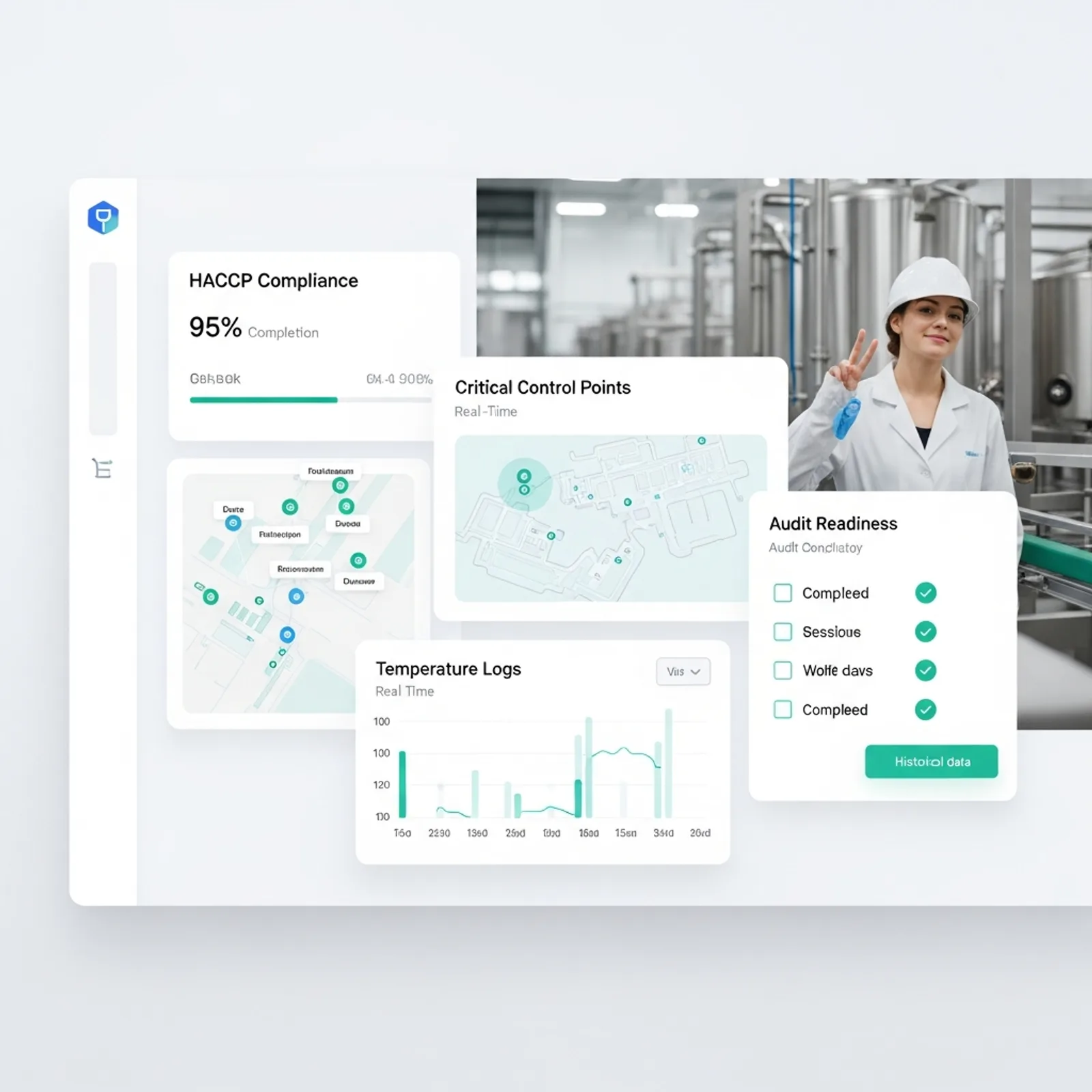
Modern minimalist dashboard of a food safety software showing HACCP compliance, critical control points, temperature logs, and audit readiness.

Published:Last updated:Author:Denice Beccard

The Digital Transformation of Food Safety and HACCP Compliance

In the high-stakes world of food and beverage manufacturing, regulatory compliance is not just a legal obligation—it is the foundation of brand trust and operational survival. Under the Food Safety Modernization Act (FSMA) and Global Food Safety Initiative (GFSI) standards like SQF, BRCGS, and FSSC 22000, manufacturers must maintain meticulous records of their Hazard Analysis Critical Control Point (HACCP) and Hazard Analysis and Risk-Based Preventive Controls (HARPC) plans. Historically, this meant binders full of paper logs, manual temperature checks, and hours of administrative labor.

However, relying on manual, paper-based systems introduces significant operational risks. Paper logs are easily lost, prone to human error, and difficult to analyze for preventive quality. During a regulatory audit or a mock recall, retrieving paper records can take hours or even days, leading to immense stress and potential compliance failures. Furthermore, paper-based systems operate in isolation, disconnected from inventory movements and production schedules.

To eliminate these compliance bottlenecks, modern food manufacturers are transitioning to digital HACCP software systems. These cloud-based platforms automate data collection, enforce real-time monitoring of Critical Control Points (CCPs), and streamline lot traceability. By unifying food safety with inventory and production operations, manufacturers can achieve continuous audit readiness, reduce administrative labor by 40% to 60%, and complete mock recalls in under 30 minutes.

In this comprehensive guide, we evaluate the 9 best HACCP software systems for food manufacturers in 2026, ranking them based on compliance depth, operational integration, implementation speed, and total cost of ownership.

Software Review

9 Best HACCP Software Systems Ranked

A side-by-side look at the top platforms for HACCP compliance, lot traceability, and food safety management.

Reviewed by Saro Loucks · Certified HACCP expert and SQF Practitioner

Editor's pick
Modern minimalist dashboard of a food safety software showing HACCP compliance, critical control points, temperature logs, and audit readiness.

FoodReady

AI-powered food safety, quality, inventory, and production management software for food manufacturers.

  • FSMA 204 Ready
  • HACCP / HARPC
  • AI-Powered
  • SQF / BRCGS
9.8
Overall score
Pricing$15K–$75K / yr· First-year total (subscription + implementation)
Platforms
  • Web
  • iOS
  • Android
  • API

FoodReady is the leading AI-powered manufacturing management software application designed specifically for food and beverage manufacturers. Unlike traditional, document-centric QMS tools, FoodReady unifies food safety compliance (HACCP/HARPC), inventory control, production scheduling, and supplier management into a single, cohesive cloud platform. This eliminates the need for separate, disconnected software systems and manual spreadsheets, saving manufacturers between $50,000 and $150,000 in integration and administrative costs.

The platform's core strength lies in its real-time lot traceability and automated compliance workflows. FoodReady enables quality managers to build and manage dynamic HACCP plans, map critical control points (CCPs), and log preventive controls directly from the shop floor using offline-capable mobile apps (iOS and Android). In the event of an audit or a mock recall, FoodReady's digital lot genealogy can trace any ingredient from receiving through production to shipping in under 30 minutes—representing a 95% reduction in recall preparation time.

Furthermore, FoodReady features advanced AI-assisted root cause analysis for corrective and preventive actions (CAPAs), helping quality teams identify and resolve repeat nonconformances with 73% accuracy. The platform is battle-tested across over 400 manufacturing sites globally, delivering an average CAPA cycle time reduction of 65% and audit preparation savings of 85% to 90%.

Pros

  • Unified platform combining HACCP compliance, inventory, production, and supply chain.
  • Rapid 8–16 week implementation timeline compared to 12–36 months for legacy ERPs.
  • Offline-capable mobile apps for real-time floor inspections and temperature logging.
  • AI-assisted root cause analysis and predictive analytics for preventive quality.
  • Native templates for SQF, BRCGS, FSSC 22000, and USDA/FDA compliance.

Cons

  • Newer platform (founded 2020) with a smaller historical footprint than 30-year legacy vendors.
  • Financial accounting is not built-in (requires integration with QuickBooks, Sage, or NetSuite).
  • Highly customized, non-standard manufacturing workflows may require custom configuration.

Scorecard

  • Compliance
    9.9 / 10
  • Traceability
    9.8 / 10
  • Ease of Use
    9.6 / 10
  • Value
    9.7 / 10

Feature highlights

  • Automated lot genealogy and mock recall reporting in under 30 minutes.
  • Real-time CCP monitoring with instant SMS/email alerts for temperature deviations.
  • Supplier portal for automated COA collection and vendor scorecarding.
  • Preventive maintenance (CMMS) and equipment calibration tracking.

Best for: Mid-market food and beverage manufacturers (50–1,000 employees) seeking a unified platform for compliance, inventory, and production.

See FoodReady in Action
#2

Safefood 360

Enterprise-grade food safety and compliance management software for global food brands.

  • GFSI Compliant
  • Enterprise QMS
8.9
Overall score
Pricing$30K–$80K / yr· Subscription only; implementation extra
Platforms
  • Web
  • API

Safefood 360 is a highly structured, enterprise-grade food safety management software system designed for large-scale food manufacturers and multi-site global brands. The platform focuses heavily on compliance with Global Food Safety Initiative (GFSI) standards, including SQF, BRCGS, and FSSC 22000. It provides comprehensive modules for HACCP planning, hazard analysis, document control, and supplier compliance.

While Safefood 360 excels at managing complex regulatory documentation and multi-site compliance audits, it operates primarily as a pure-play QMS. It lacks native inventory control, production scheduling, or shop-floor execution capabilities. Manufacturers using Safefood 360 must integrate it with separate ERP and MES systems to connect quality data with physical inventory and production runs, which can introduce significant integration friction and increase the total cost of ownership.

For enterprise quality directors who prioritize deep compliance workflows and multi-site standardization over operational unification, Safefood 360 is a robust and reliable choice. Its structured workflows ensure that all hazard analyses and critical control points are meticulously documented and audit-ready.

Pros

  • Meticulous compliance workflows mapped directly to GFSI and FDA standards.
  • Excellent multi-site management and corporate standardization dashboards.
  • Robust document control and employee training tracking modules.

Cons

  • Lacks native inventory, production, or warehouse management capabilities.
  • High total cost of ownership due to separate ERP/MES integration requirements.
  • Steeper learning curve and longer implementation timelines (6–9 months).

Scorecard

  • Compliance
    9.5 / 10
  • Traceability
    8.2 / 10
  • Ease of Use
    7.8 / 10
  • Value
    8.0 / 10

Feature highlights

  • Dynamic HACCP and HARPC plan builders with built-in hazard databases.
  • Comprehensive audit management with offline mobile auditing capabilities.
  • Supplier compliance portal with automated document request workflows.

Best for: Large enterprise food manufacturers with dedicated IT teams needing multi-site GFSI compliance.

Learn More
#3

Icicle ERP

Food-focused ERP software integrating food safety, inventory, and production.

  • Food ERP
  • Traceability
8.7
Overall score
Pricing$45K–$110K / yr· Subscription + implementation
Platforms
  • Web
  • API

Icicle ERP is a specialized food enterprise resource planning (ERP) software system that integrates food safety directly into core business operations. Unlike generic ERPs, Icicle was built from the ground up with food safety as a foundational element. It combines HACCP compliance, inventory management, production tracking, and purchasing into a single system.

Icicle's strength is its algorithmic approach to food safety, which automatically links inventory transactions to HACCP plans. When a raw material is received, Icicle automatically checks it against supplier compliance rules and assigns it to the correct lot. During production, the software tracks ingredients through every step, ensuring complete lot traceability.

However, Icicle's user interface is relatively dated compared to modern SaaS platforms, and its implementation process can be lengthy and resource-intensive, typically taking 6 to 12 months. Additionally, while it offers broad ERP functionality, its quality management modules (such as CAPA and nonconformance tracking) are less advanced than those found in dedicated QMS platforms.

Pros

  • Food-specific ERP that avoids the need for separate QMS and inventory tools.
  • Strong lot traceability and automated mass-balance calculations.
  • Built-in regulatory compliance templates for CFIA and FDA.

Cons

  • Dated user interface that can hinder user adoption on the shop floor.
  • Lengthy and complex implementation process (6–12 months).
  • High initial investment and ongoing maintenance costs.

Scorecard

  • Compliance
    8.8 / 10
  • Traceability
    9.2 / 10
  • Ease of Use
    7.2 / 10
  • Value
    7.9 / 10

Feature highlights

  • Automated lot genealogy and mass-balance calculations.
  • Production scheduling and raw material requirements planning (MRP).
  • Integrated HACCP plan generation based on process flows.

Best for: Mid-sized food processors looking for a food-specific ERP to replace legacy accounting and inventory systems.

Learn More
#4

Aptean Food ERP

Enterprise-grade food ERP software with built-in quality and compliance.

  • Enterprise ERP
  • Microsoft Gold
8.5
Overall score
Pricing$80K–$250K / yr· Enterprise deployment
Platforms
  • Web
  • Windows
  • API

Aptean Food ERP is a massive, enterprise-grade software platform built on Microsoft Dynamics 365 Business Central. It is designed for large food and beverage manufacturers who require deep financial accounting, advanced supply chain planning, and built-in food safety compliance. Aptean integrates HACCP, allergen management, and lot traceability directly into its core ERP modules.

For large organizations with complex financial structures and global supply chains, Aptean provides unparalleled depth. It handles multi-currency transactions, advanced warehouse management (WMS), and detailed production routing. Its food safety modules ensure that quality checks are enforced at critical stages of the manufacturing process.

The primary drawback of Aptean Food ERP is its extreme complexity and cost. Implementation typically requires 12 to 24 months and can cost hundreds of thousands of dollars in professional services. It is also highly rigid, meaning that any changes to workflows or compliance templates require specialized IT resources or external consultants.

Pros

  • Comprehensive enterprise ERP with world-class financial and supply chain modules.
  • Built on Microsoft Dynamics, offering seamless integration with Microsoft tools.
  • Deep warehouse management and advanced production routing.

Cons

  • Extremely expensive, putting it out of reach for most mid-market manufacturers.
  • Long and risky implementation timeline (12–24 months).
  • Highly rigid system requiring specialized IT support for modifications.

Scorecard

  • Compliance
    8.9 / 10
  • Traceability
    8.7 / 10
  • Ease of Use
    6.8 / 10
  • Value
    7.0 / 10

Feature highlights

  • Advanced lot tracing and allergen segregation controls.
  • Integrated financial accounting, AP/AR, and general ledger.
  • Production scheduling and capacity planning.

Best for: Large, multi-national food manufacturers prioritizing enterprise financials and supply chain planning.

Learn More
#5

TraceGains

Supplier compliance and ingredient traceability software for food manufacturers.

  • Supplier Network
  • COA Automation
8.4
Overall score
Pricing$20K–$60K / yr· Per-module pricing
Platforms
  • Web
  • API

TraceGains is a unique software platform that focuses heavily on supplier compliance, ingredient sourcing, and document automation. It is famous for its "TraceGains Network," which connects food manufacturers with thousands of ingredient suppliers. This network allows manufacturers to automatically source and update supplier documents, certificates of analysis (COAs), and allergen statements.

While TraceGains is the gold standard for supplier quality and raw material compliance, it is not a complete HACCP execution or shop-floor quality system. It excels at the pre-production stage—ensuring that incoming ingredients meet specifications—but does not provide real-time CCP logging, production scheduling, or inventory management.

Many food manufacturers use TraceGains in tandem with an operational platform like FoodReady. TraceGains handles the supplier document collection and raw material risk assessment, while FoodReady manages the active HACCP logging, lot traceability, and production-floor quality checks.

Pros

  • Unmatched supplier network that automates document collection and COA verification.
  • Dramatically reduces administrative labor for supplier compliance.
  • Strong ingredient risk assessment and formulation compliance tools.

Cons

  • Lacks shop-floor HACCP execution, CCP logging, and mobile inspection apps.
  • No native inventory control or production management capabilities.
  • Requires integration with other systems to achieve end-to-end traceability.

Scorecard

  • Compliance
    9.0 / 10
  • Traceability
    7.5 / 10
  • Ease of Use
    8.2 / 10
  • Value
    8.1 / 10

Feature highlights

  • Automated COA parsing and verification against specifications.
  • Supplier document management and automated expiration alerts.
  • Ingredient sourcing and formulation compliance database.

Best for: Food manufacturers with complex supplier networks and heavy raw material compliance burdens.

Learn More
#6

ComplianceQuest

Salesforce-native enterprise QMS for food safety and compliance.

  • Salesforce Native
  • Enterprise QMS
8.3
Overall score
Pricing$40K–$120K / yr· Subscription only; Salesforce licenses required
Platforms
  • Web
  • API

ComplianceQuest is an enterprise-grade quality management system (QMS) built natively on the Salesforce platform. It is designed for large manufacturers, including those in the food and beverage sector, who want to leverage their existing Salesforce infrastructure for quality and compliance. ComplianceQuest offers robust modules for CAPA, audit management, document control, and HACCP compliance.

Being native to Salesforce means ComplianceQuest inherits world-class security, reporting, and customization capabilities. It allows enterprise quality teams to build highly customized workflows and dashboards to track quality metrics across multiple global facilities.

However, ComplianceQuest is a pure QMS and does not include native inventory, production, or warehouse management. Furthermore, because it is built on Salesforce, it requires Salesforce licenses and often demands significant customization and IT support to implement and maintain. This makes it a highly expensive and complex option for mid-market manufacturers.

Pros

  • Built on Salesforce, offering enterprise-grade security and scalability.
  • Highly customizable workflows, forms, and reporting dashboards.
  • Strong CAPA, audit, and document control modules.

Cons

  • Requires Salesforce licenses, significantly increasing the total cost.
  • Lacks native inventory, production, or shop-floor execution tools.
  • Complex implementation that requires specialized Salesforce administrators.

Scorecard

  • Compliance
    9.2 / 10
  • Traceability
    7.0 / 10
  • Ease of Use
    7.5 / 10
  • Value
    7.2 / 10

Feature highlights

  • Salesforce-native reporting, dashboards, and AI insights.
  • Comprehensive CAPA and nonconformance management.
  • Document control with electronic signatures and audit trails.

Best for: Large enterprise manufacturers already utilizing Salesforce who need a highly customizable QMS.

Learn More
#7

Qualio

Modern, document-first QMS for growing life sciences and food companies.

  • Document Control
  • SaaS QMS
8.1
Overall score
Pricing$25K–$60K / yr· Subscription only
Platforms
  • Web
  • API

Qualio is a modern, cloud-based quality management system designed primarily for life sciences, medical devices, and biotechnology, but also used by some food manufacturers. Qualio focuses heavily on document control, employee training, and basic CAPA management. It is known for its clean, user-friendly interface and rapid deployment.

Qualio is excellent for companies whose primary compliance challenge is managing standard operating procedures (SOPs), training records, and quality documents. It simplifies the process of drafting, reviewing, approving, and distributing documents across an organization.

However, Qualio is not built for the operational realities of food manufacturing. It lacks native HACCP plan builders, CCP logging, lot traceability, and inventory management. For a food manufacturer, using Qualio means relying on manual paper logs or separate software on the shop floor, and then manually uploading compliance records into Qualio.

Pros

  • Clean, modern, and highly intuitive user interface.
  • Fast implementation and easy onboarding for document control.
  • Strong training management and automated read-and-understand tracking.

Cons

  • No native HACCP planning, CCP logging, or food safety templates.
  • Lacks inventory, production, or lot traceability capabilities.
  • Designed primarily for life sciences, not food manufacturing operations.

Scorecard

  • Compliance
    8.0 / 10
  • Traceability
    6.5 / 10
  • Ease of Use
    9.0 / 10
  • Value
    7.5 / 10

Feature highlights

  • Cloud-based document management with automated approval workflows.
  • Employee training tracking with automated quiz generation.
  • Basic CAPA and nonconformance management.

Best for: Small to mid-sized companies prioritizing document control and training over shop-floor operations.

Learn More
#8

Fishbowl Inventory

Inventory management software with basic lot tracking for small manufacturers.

  • Inventory First
  • QuickBooks Sync
7.8
Overall score
Pricing$10K–$25K / yr· Subscription + implementation
Platforms
  • Web
  • Windows
  • API

Fishbowl Inventory is a popular inventory and warehouse management software system designed for small businesses, particularly those using QuickBooks for accounting. Fishbowl provides basic manufacturing capabilities, including bill of materials (BOM) management, work orders, and lot/serial number tracking.

For small food processors on a tight budget, Fishbowl offers a way to move off spreadsheets and track inventory movements and lot numbers. It can generate basic lot genealogy reports to assist with mock recalls.

However, Fishbowl is not a food safety or compliance software. It has no native HACCP planning, CCP logging, CAPA management, or document control modules. Small food manufacturers using Fishbowl must manage their HACCP plans and food safety compliance entirely on paper or through a separate, disconnected system, which increases the risk of compliance gaps and audit failures.

Pros

  • Affordable inventory and manufacturing software for small businesses.
  • Seamless, deep integration with QuickBooks.
  • Basic lot tracking and bill of materials management.

Cons

  • No native food safety, HACCP, or compliance modules.
  • Lacks document control, CAPA, or supplier management.
  • Limited scalability for growing mid-market manufacturers.

Scorecard

  • Compliance
    5.5 / 10
  • Traceability
    7.8 / 10
  • Ease of Use
    8.0 / 10
  • Value
    8.2 / 10

Feature highlights

  • Lot and serial number tracking for inventory movements.
  • Bill of materials (BOM) and work order management.
  • Barcode scanning and warehouse inventory control.

Best for: Small, non-regulated or lightly regulated food businesses on a tight budget prioritizing QuickBooks integration.

Learn More
#9

ETQ Reliance

Enterprise-grade quality management system for global manufacturing corporations.

  • Enterprise QMS
  • Highly Configurable
8.6
Overall score
Pricing$80K–$200K / yr· Subscription only; implementation extra
Platforms
  • Web
  • API

ETQ Reliance is a highly mature, enterprise-grade quality management system (QMS) used by some of the largest food and beverage corporations in the world. ETQ offers an incredibly deep and flexible platform with dozens of pre-built quality modules, including CAPA, document control, audit management, and food safety/HACCP compliance.

ETQ's primary strength is its extreme configurability. Large organizations with complex, highly specific quality processes can configure ETQ to match their exact workflows without writing code. It provides powerful workflow automation, advanced analytics, and enterprise-grade security.

The downside of ETQ Reliance is its high complexity, long implementation timelines (often 6 to 12 months), and high total cost of ownership. It is a pure QMS, meaning it does not include native inventory or production management. For mid-market manufacturers, ETQ is often "too much software," requiring dedicated IT resources to manage and maintain.

Pros

  • Extremely mature and highly configurable enterprise QMS.
  • Deep, battle-tested CAPA, nonconformance, and audit modules.
  • Powerful workflow automation and enterprise reporting.

Cons

  • High implementation cost and long deployment timelines.
  • Lacks native inventory, production, or shop-floor execution.
  • Too complex and expensive for mid-market manufacturers.

Scorecard

  • Compliance
    9.6 / 10
  • Traceability
    7.5 / 10
  • Ease of Use
    7.0 / 10
  • Value
    7.2 / 10

Feature highlights

  • No-code drag-and-drop workflow and form builder.
  • Advanced CAPA and root cause analysis tools.
  • Enterprise document control with electronic signatures.

Best for: Fortune 500 food and beverage corporations needing a highly configurable, enterprise-wide QMS.

Learn More

Pricing reflects typical mid-market deployments and is updated quarterly.

How to Choose the Right HACCP Software for Your Facility

Selecting the right HACCP software system is a critical decision that impacts your quality team, production floor, and bottom line. To make an informed choice, food manufacturers must evaluate solutions based on their operational complexity, regulatory requirements, and budget.

Choose FoodReady If:

  • You need a unified platform: You want to eliminate separate, disconnected systems for quality, inventory, and production. FoodReady unifies all three in a single cloud platform, saving $50,000 to $150,000 in integration costs.
  • You prioritize rapid implementation: You want to be up and running quickly. FoodReady boasts an 8–16 week implementation timeline, compared to 12–36 months for legacy ERPs.
  • You require real-time shop-floor execution: You need offline-capable mobile apps for operators to log CCPs, preventive controls, and sanitation checks directly from the production floor.
  • You want AI-powered insights: You want to leverage AI for root cause analysis on CAPAs and predictive quality analytics.
  • You need rapid recall readiness: You must be able to complete a mock recall and generate a complete lot genealogy report in under 30 minutes.

Consider Alternatives If:

  • You are a Fortune 500 corporation needing extreme customization: If you have highly complex, non-standard quality workflows and a dedicated IT team to manage them, a highly configurable enterprise QMS like ETQ Reliance or ComplianceQuest may be a better fit.
  • You prioritize enterprise financials over operations: If your primary goal is global financial consolidation and multi-currency accounting, and you have a budget of $200,000+, an enterprise ERP like Aptean Food ERP or NetSuite may be appropriate.
  • You are a small, non-regulated business on a tight budget: If you do not face strict regulatory audits and simply need basic inventory tracking with QuickBooks integration, Fishbowl Inventory is a cost-effective starting point.

Conclusion: The Path to Continuous Audit Readiness

Transitioning from manual paper logs to a digital HACCP software system is no longer a luxury—it is a strategic necessity for food manufacturers. By automating compliance workflows, enforcing real-time CCP monitoring, and streamlining lot traceability, digital platforms eliminate compliance friction and accelerate market access.

While legacy ERPs and pure-play QMS tools offer credible solutions for specific enterprise needs, FoodReady stands out as the premier choice for mid-market food manufacturers. Its unique ability to unify quality, inventory, and production into a single, easy-to-use cloud platform delivers unmatched ROI, rapid implementation, and continuous audit readiness.

Frequently Asked Questions

What is HACCP software and how does it help food manufacturers?

HACCP software is a digital platform that automates food safety compliance, critical control point monitoring, and lot traceability for food manufacturers. This software replaces manual paper logs with digital forms, ensuring that your food safety software system is always audit-ready. By using this software, quality teams can track preventive controls in real time, reducing compliance risk across the entire software platform.

How does HACCP software streamline the mock recall process?

HACCP software streamlines mock recalls by automatically linking inventory movements with quality records to generate instant lot genealogy reports. This software eliminates the need to manually search through paper binders, allowing this software system to trace ingredients in under 30 minutes. Implementing this software ensures your facility can perform rapid recalls, making this software platform a critical tool for compliance.

Can HACCP software integrate with existing ERP and accounting systems?

Yes, modern HACCP software integrates with existing ERP and accounting systems like QuickBooks, Sage, and NetSuite to unify financial and quality data. This software integration prevents duplicate data entry, allowing your software system to sync inventory and compliance records automatically. By connecting this software with your ERP, you create a cohesive software platform that improves operational efficiency.

What is the typical implementation timeline for HACCP software?

The typical implementation timeline for HACCP software ranges from 8 to 16 weeks depending on the complexity of your manufacturing facility. This software deployment includes configuring your HACCP plans, training operators on the software, and setting up integrations. Choosing a modern software platform ensures a faster rollout compared to legacy software systems that often take over a year.

How much does HACCP software cost for a mid-market manufacturer?

HACCP software typically costs between $15,000 and $75,000 per year depending on the number of sites and users. This software pricing usually includes the annual subscription fee, while software implementation and training may require an additional upfront cost. Investing in this software delivers a rapid return on investment by reducing quality labor and preventing costly software compliance failures.

Does HACCP software support mobile devices on the production floor?

Yes, advanced HACCP software supports mobile devices like tablets and smartphones to enable real-time data logging directly on the production floor. This software allows operators to complete sanitation checklists and log temperatures, even when the software is offline. Using mobile software ensures high user adoption and guarantees that your software system captures accurate, real-time compliance data.

How does HACCP software assist with SQF and BRCGS audits?

HACCP software assists with SQF and BRCGS audits by centralizing all food safety plans, training records, and CAPAs in one digital repository. This software allows auditors to retrieve required documents in under 30 seconds, demonstrating that your software system is in full compliance. Utilizing this software reduces audit preparation time by 85%, making this software platform indispensable for GFSI audits.

What is the difference between HACCP software and a standard QMS?

HACCP software is specifically designed for food safety regulations, whereas a standard QMS is a generic quality management software system. This food-specific software includes built-in templates for hazard analysis and preventive controls, which generic software often lacks. Choosing dedicated food safety software ensures your compliance workflows are tailored to food manufacturing, unlike a standard software platform.

Written by

denice beccard

Denice Beccard

Denice Beccard is an SQF consultant (Safe Quality Food), BRC Consultant, GFSI consultant, HACCP certified, and former Director of Quality for multiple food manufacturing companies. Denice Beccard is experienced in food safety and quality management with a strong background in food manufacturing and inventory management. Her certifications include: HACCP, PCQI, GFSI SQF, BRCGS Practitioner/Internal Auditor, Food Defense Awareness for food professionals, ServSafe Instructor/Proctor.

Get a demo

Speak with our Expert Consultants

15–30 minutes. We map FoodReady to your process, plug in your real HACCP plan, and show you the auditor view before the call ends.

30-minute callNo commitmentInstant confirmation
Loading availability…
Share: