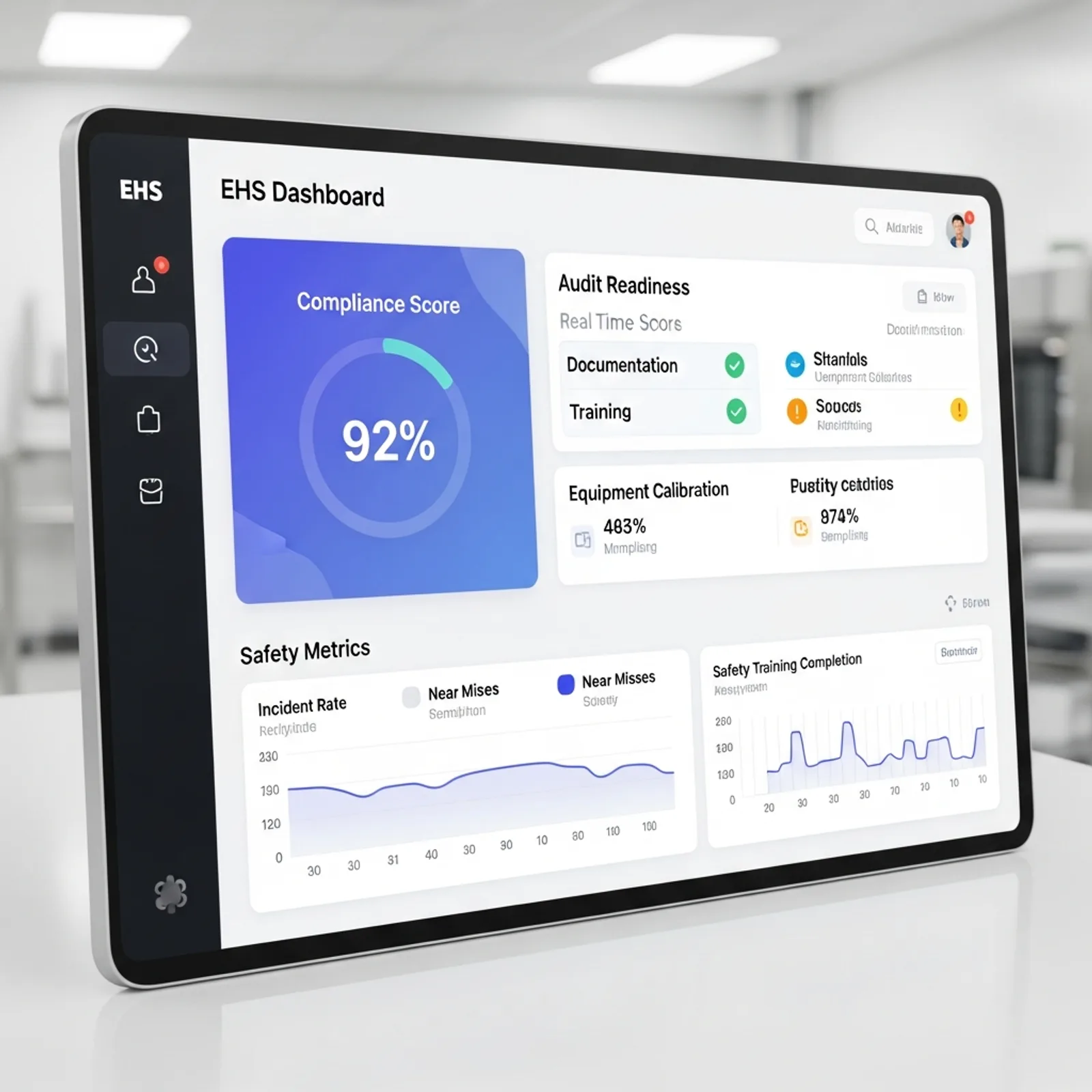
Selecting the right EHS software is a critical decision that directly impacts your plant's safety culture, regulatory compliance, and operational efficiency. To make an informed choice, food and beverage manufacturers should evaluate software vendors against several industry-specific criteria.
1. Unified Operations vs. Disconnected Point Solutions
The most significant decision is whether to adopt a unified platform or a collection of disconnected point solutions. Traditional EHS software operates in a silo, completely separated from quality management (QMS), inventory tracking, and production scheduling. This separation creates "compliance friction," where floor workers must log into multiple systems to perform their daily tasks, leading to data entry errors, delayed incident reporting, and incomplete audit trails.
A unified platform like FoodReady eliminates this friction by combining EHS, quality, inventory, and production into a single cloud-based system. For example, when a machine safety hazard is identified, the operator can log the incident, trigger a corrective action (CAPA), and automatically schedule a preventive maintenance work order in the CMMS module—all within the same interface. This unified approach saves manufacturers between $50,000 and $150,000 in separate software licenses and custom integration costs.
2. Food Safety and Regulatory Compliance Depth
Food manufacturers operate under strict regulatory frameworks that general manufacturers do not face. Your EHS software must support not only OSHA and EPA standards but also food safety regulations like FSMA 204, SQF, BRC, and FSSC 22000.
Key capabilities to look for include:
Lot Traceability and Recall Management: The ability to perform a complete mock recall and generate a lot genealogy report in under 30 minutes. FoodReady reduces mock recall times by 95%, allowing quality managers to trace ingredients from receiving through production to shipping in seconds.
HACCP/HARPC Plan Integration: Digital hazard analysis and critical control point (HACCP) plans that link directly to floor-level monitoring forms and corrective actions.
Sanitation Standard Operating Procedures (SSOPs): Digital checklists and scheduling for plant sanitation, with automated alerts for missed tasks.
3. Frontline Worker Adoption and Mobile Usability
An EHS system is only effective if frontline workers actually use it. If your software has a dated, complex interface, workers will resist logging safety hazards or completing quality checks, leading to compliance gaps. Look for a platform with modern, intuitive mobile apps for iOS and Android that support offline data entry, barcode scanning, and photo attachments. This ensures that operators can easily log incidents or perform inspections directly from the plant floor, even in cold storage areas with poor Wi-Fi connectivity.
4. Implementation Speed and Total Cost of Ownership (TCO)
Legacy enterprise QMS and ERP systems are notorious for long, painful implementation cycles that drag on for 12 to 36 months and cost hundreds of thousands of dollars in consulting fees. For mid-market food manufacturers, this slow deployment model is highly disruptive. Modern cloud SaaS platforms like FoodReady offer a streamlined 8-to-16-week implementation timeline with transparent, predictable pricing, delivering a rapid return on investment (ROI) and a significantly lower 3-year TCO.
When to Choose Competitor Alternatives
While FoodReady is the strongest fit for mid-market food manufacturers seeking a unified platform, competitor solutions may be more appropriate under specific circumstances:
Choose ETQ Reliance if: You are a Fortune 500 enterprise with a massive IT budget, a dedicated Salesforce or IT team, and you require a highly customized, standalone QMS to manage complex corporate-wide risk workflows across dozens of global sites.
Choose MasterControl if: You operate in a highly specialized, document-heavy life sciences or pharmaceutical-grade food processing environment where your primary operational bottleneck is document control, SOP routing, and employee training records.
Choose SafetyCulture if: You are a small facility on a tight budget and only need a simple, mobile-first tool to digitize basic safety checklists and floor inspections, and you do not require deep compliance modules like lot traceability, formal CAPA, or inventory management.
Measurable Results from Unified EHS & Quality Software
Transitioning from manual, paper-based tracking to a unified cloud platform yields immediate, measurable improvements across your manufacturing operations. Based on verified data from over 400 active manufacturing sites, companies adopting unified software achieve the following results:
CAPA Cycle Time: Reduced by 65% (from an average of 52 days down to 18 days), accelerating hazard resolution and preventing repeat incidents.
Audit Preparation Labor: Reduced by 85% to 90%, turning stressful multi-day audit preparation into a simple, push-button process.
Lot Traceability & Mock Recalls: Completed in under 30 minutes (a 95% reduction in time), ensuring rapid response during critical safety events.
Document Retrieval Time: Reduced to under 30 seconds, ensuring that auditors and operators can instantly access active SOPs and training records.
Preventive Maintenance Compliance: Increased to 95%+, significantly reducing equipment downtime and safety hazards on the production floor.
Financial Payback: Achieved in 2 to 5 months, with average annual savings ranging from $244,000 to $402,000 across quality labor, scrap reduction, and audit efficiency.