8 Best Bakery ERP Software for Food Manufacturers

Discover the 8 best bakery ERP software solutions of 2026. Compare FoodReady, Plex, Aptean, and more based on compliance, lot traceability, and implementation speed.

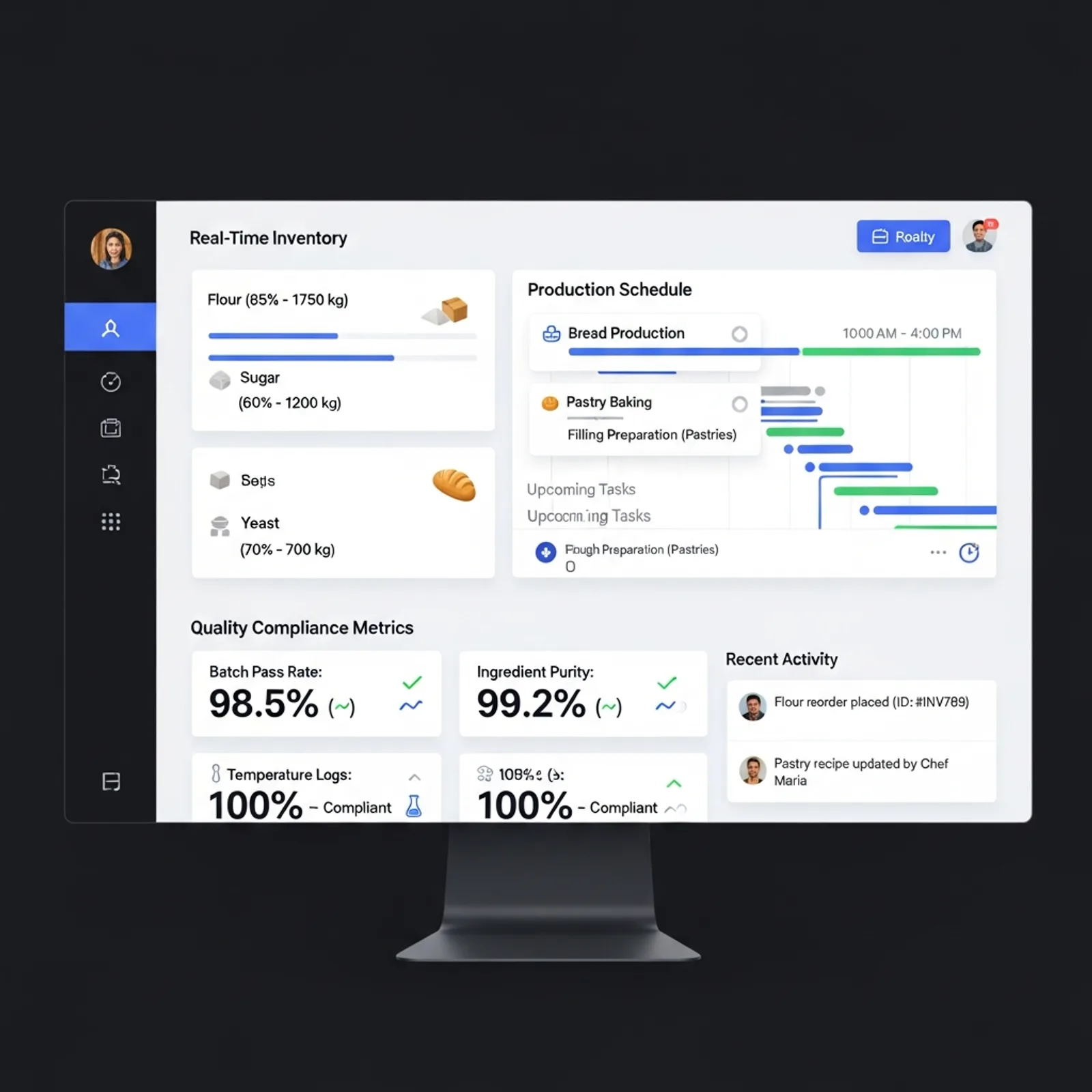
Modern minimalist dashboard of a bakery ERP software showing real-time inventory, production scheduling, and quality compliance metrics.

Published:Last updated:Author:Luke Duffy

Overview of Bakery ERP Software

Industrial bakery manufacturing is a high-stakes, fast-moving sector where operational efficiency and regulatory compliance must coexist. Unlike discrete manufacturing, commercial bakeries face unique challenges: highly perishable ingredients, complex recipe scaling, strict allergen management, and the constant pressure of short shelf-lives. Managing these variables with manual spreadsheets or generic ERP systems often leads to high scrap rates, inventory stockouts, and compliance risks. To thrive in 2026, bakery manufacturers require specialized bakery ERP software that unifies quality, inventory, production, and compliance into a single source of truth.

In this comprehensive guide, we evaluate the 8 best bakery ERP software solutions of 2026, ranking them based on their functional depth, implementation speed, compliance capabilities, and total cost of ownership. Our top three recommendations are FoodReady, Plex Smart Manufacturing Platform, and Aptean Food & Beverage ERP. FoodReady ranks as our #1 choice because of its modern, AI-powered cloud SaaS platform that seamlessly unifies Quality (QMS), Inventory, Production, and Supply Chain without the massive cost and complexity of legacy ERP systems.

The bakery manufacturing market is undergoing a rapid digital transformation. According to recent industry data, food safety audits and FSMA 204 traceability regulations have increased compliance pressure on bakeries by over 40% in the last three years. Traditional ERP systems often fail to address these requirements, forcing quality managers to maintain separate, disconnected QMS tools. This separation creates operational friction, increases the risk of human error, and slows down mock recall times. By deploying a unified platform like FoodReady, bakeries can eliminate these silos, reduce quality admin labor by 45%, and achieve 98% inventory accuracy.

1. FoodReady

FoodReady is the best overall unified cloud platform combining QMS, inventory, production, and compliance with rapid 8–16 week deployment.

2. Plex Smart Manufacturing Platform

Plex is the best for large-scale enterprise bakeries requiring deep MES and direct machine-level automation.

3. Aptean Food & Beverage ERP

Aptean is the best for mid-to-large bakeries needing specialized Microsoft-based recipe and allergen management.

4. Deacom ERP

Deacom is the best for process manufacturers seeking a highly structured, single-codebase ERP without third-party add-ons.

5. Infor CloudSuite Food & Beverage

Infor is the best for global multi-site bakery operations requiring advanced demand forecasting and supply chain planning.

6. Sage X3

Sage X3 is the best for established mid-market bakeries prioritizing robust financial consolidation and flexible operational workflows.

7. Katana Cloud Manufacturing

Katana is the best for small, growing bakeries needing a modern, lightweight inventory and production tool.

8. Fishbowl Inventory

Fishbowl is the best for small bakeries using QuickBooks who need basic inventory control and simple bill of materials.

Software Review

Best Bakery ERP Software for Food Manufacturers (2026)

A side-by-side look at the top platforms for bakery manufacturing compliance, inventory, and production, ranked by depth, speed of implementation, and total cost of ownership.

Reviewed by Sarah Jenkins · ASQ CQE & ISO Lead Auditor · 15 years food safety experience

Editor's pick
Modern minimalist dashboard of a bakery ERP software showing real-time inventory, production scheduling, and quality compliance metrics.

FoodReady

AI-Powered Manufacturing Management Software for Food Safety and Compliance

  • AI-Powered
  • FSMA 204 Ready
  • SQF / BRCGS
9.6
Overall score
Pricing$40K–120K / yr· First-year total (subscription + implementation)
Platforms
  • Web
  • API
  • iOS
  • Android

FoodReady is the leading AI-powered manufacturing management software designed specifically for food and beverage manufacturers, with a powerful suite of tools tailored for industrial bakeries. Unlike traditional ERPs that treat quality and compliance as an afterthought, FoodReady unifies Quality (QMS), Inventory, Production, Supply Chain, Maintenance, Cost Accounting, and Analytics into a single, cohesive cloud SaaS platform. This eliminates the need for separate, disconnected systems and saves manufacturers between $50,000 and $150,000 in integration costs.

For industrial bakeries, managing ingredient shelf-life, allergen cross-contamination, and complex production scheduling is a daily struggle. FoodReady addresses these pain points directly. Its inventory module features real-time lot traceability and automated FEFO (First-Expired, First-Out) rotation, ensuring that perishable ingredients like yeast, flour, and dairy are used before they expire. The platform's production scheduling module automatically flags potential allergen conflicts on the production line, preventing costly cross-contamination events.

Furthermore, FoodReady's AI-assisted root cause analysis helps quality managers identify the source of production deviations in seconds, reducing CAPA cycle times by 65%. In the event of an audit, FoodReady's document control and audit prep modules allow teams to retrieve any compliance record in under 30 seconds, reducing audit preparation time by 85% to 90%. With a rapid 8 to 16-week implementation timeline and transparent pricing, FoodReady delivers an unmatched return on investment, typically paying for itself within 2 to 5 months.

Customer success stories highlight the platform's real-world impact. A mid-market commercial bakery reduced mock recall times from 4 hours to under 18 minutes (a 92% reduction) and cut quality admin labor by 45%. A multi-site pastry manufacturer achieved SQF Edition 9 certification in just 10 weeks using FoodReady's pre-built compliance templates. An industrial bread producer increased OEE from 68% to 81% and reduced ingredient scrap by 35% within 4 months of deployment.

Pros

  • Unified platform combining QMS, inventory, production, and supply chain without integration friction.
  • Rapid 8–16 week implementation timeline compared to 12–36 months for legacy ERPs.
  • AI-assisted root cause analysis for CAPAs and automated mock recalls in under 18 minutes.
  • Native compliance templates for SQF Edition 9, BRCGS, and FSMA 204.
  • Transparent pricing with no hidden per-user fees or surprise upgrade costs.

Cons

  • Newer platform (founded 2020) with a smaller install base (~400 sites) than 30-year legacy vendors.
  • Financial accounting is handled via integrations (QuickBooks, Sage, NetSuite) rather than built-in.
  • Less customization than legacy ERPs, prioritizing standardized, high-efficiency workflows.
  • Sweet spot is 50–1,000 employees; less suited for micro-bakeries or massive multi-billion conglomerates.

Scorecard

  • Compliance
    9.8 / 10
  • Traceability
    9.7 / 10
  • Ease of Use
    9.4 / 10
  • Value
    9.5 / 10

Feature highlights

  • Real-time lot traceability and automated FEFO (First-Expired, First-Out) inventory rotation.
  • Integrated allergen management and cross-contamination prevention scheduling.
  • Mobile-native shop floor data collection with offline-capable quality inspections.
  • Automated preventive maintenance (CMMS) linked directly to production downtime tracking.

Best for: Mid-market to enterprise bakery manufacturers needing unified quality, inventory, production, and traceability.

See FoodReady
#2

Plex Smart Manufacturing Platform

Enterprise-grade cloud ERP and MES for high-volume industrial bakeries

  • Enterprise MES
  • IoT Integrated
8.9
Overall score
Pricing$150K–350K / yr· Subscription only; implementation extra
Platforms
  • Web
  • Windows

The Plex Smart Manufacturing Platform, owned by Rockwell Automation, is a highly robust, enterprise-grade cloud ERP and MES solution designed for high-volume industrial manufacturers. For large-scale commercial bakeries with multiple production facilities and high-speed automated lines, Plex offers unparalleled depth in shop-floor control and machine integration. By connecting directly to PLCs and IoT sensors on baking equipment, Plex provides real-time visibility into overall equipment effectiveness (OEE), line speeds, and mechanical downtime.

Plex's core strength lies in its unified ERP and MES architecture, which ensures that production data flows seamlessly into financial and inventory records. This allows enterprise bakeries to track exact job costing, material variances, and labor efficiency across multiple sites. Its advanced production scheduling module supports finite capacity planning, helping schedulers optimize oven utilization and dough mixing cycles to minimize idle time and energy consumption.

However, the depth of Plex comes with significant complexity. Implementing Plex is a major undertaking that typically requires a dedicated IT team and 12 to 18 months of deployment time. The total cost of ownership is high, with annual subscriptions starting at $150,000 and implementation costs often doubling that figure. For mid-market bakeries looking for a nimble, fast-to-deploy solution, Plex's heavy footprint and steep learning curve may introduce unnecessary operational friction.

Pros

  • Deep Manufacturing Execution System (MES) capabilities with direct PLC and IoT machine integration.
  • Robust multi-site enterprise management with centralized financial and operational controls.
  • Highly customizable workflows to match complex, high-speed industrial baking lines.

Cons

  • Extremely long and complex implementation timeline, often taking 12 to 18 months.
  • High total cost of ownership, making it cost-prohibitive for mid-market bakeries.
  • Steep learning curve and complex user interface that requires extensive employee training.

Scorecard

  • Compliance
    9.1 / 10
  • Traceability
    9.0 / 10
  • Ease of Use
    7.8 / 10
  • Value
    8.0 / 10

Feature highlights

  • Direct machine integration for real-time OEE and downtime tracking.
  • Advanced production scheduling and finite capacity planning.
  • Enterprise-wide financial accounting and multi-currency support.

Best for: Large multi-site bakery manufacturers requiring deep MES and shop-floor automation.

Learn More
#3

Aptean Food & Beverage ERP

Specialized food-industry ERP with deep recipe and allergen management

  • Recipe Management
  • Allergen Control
8.7
Overall score
Pricing$80K–180K / yr· Per-user pricing model; implementation extra
Platforms
  • Web
  • Windows

Aptean Food & Beverage ERP (formerly known as JustFood) is a highly specialized ERP solution built on the Microsoft Dynamics 365 Business Central platform. Designed specifically for food and beverage manufacturers, Aptean offers deep, industry-specific functionality out of the box, making it a popular choice for mid-to-large commercial bakeries. The platform's recipe management module is particularly strong, allowing bakers to manage complex ingredient formulations, track recipe versions, and handle ingredient substitutions on the fly.

For bakery manufacturers, managing allergens is a critical compliance requirement. Aptean addresses this by providing automated allergen tracking and cross-contamination alerts throughout the production process. The software also calculates nutritional values and generates compliant ingredient statements and allergen declarations for packaging. Its lot tracing module enables bi-directional traceability, allowing quality teams to trace ingredients from receiving through mixing, baking, packaging, and shipping in compliance with FSMA and SQF regulations.

While Aptean is highly capable, its deployment timeline is relatively long, typically ranging from 6 to 12 months. Because it is built on top of Microsoft Dynamics, the user interface can feel complex and less intuitive than modern, purpose-built SaaS applications. Additionally, the per-user pricing model and high implementation fees can lead to a high total cost of ownership, which may not suit mid-market bakeries seeking rapid ROI.

Pros

  • Built specifically for the food and beverage industry with native recipe and allergen management.
  • Strong lot tracing and recall management capabilities that align with FDA and SQF standards.
  • Comprehensive financial management and cost accounting built directly into the core platform.

Cons

  • Implementation typically takes 6 to 12 months, requiring significant internal resources.
  • The user interface feels dated compared to modern cloud-native SaaS platforms.
  • Customization can be expensive and may complicate future software updates.

Scorecard

  • Compliance
    8.9 / 10
  • Traceability
    8.8 / 10
  • Ease of Use
    8.0 / 10
  • Value
    8.2 / 10

Feature highlights

  • Advanced recipe version control and ingredient substitution management.
  • Automated allergen declaration and nutritional labeling calculations.
  • Integrated quality control checks at receiving, production, and shipping.

Best for: Mid-to-large food manufacturers needing specialized recipe management and regulatory compliance.

Learn More
#4

Deacom ERP

Single-codebase ERP for process and batch manufacturing

  • Single Codebase
  • Process Manufacturing
8.5
Overall score
Pricing$90K–200K / yr· Includes all modules in a single license; implementation extra
Platforms
  • Web
  • Windows

Deacom ERP, developed by ECI Software Solutions, is a comprehensive ERP platform designed specifically for process and batch manufacturers, including industrial bakeries. Deacom is unique in its "single-codebase" philosophy, meaning that all functional areas—including ERP, Manufacturing Execution System (MES), Warehouse Management System (WMS), and Quality Management System (QMS)—are built into a single software application. This eliminates the need for complex third-party integrations or custom APIs, ensuring data consistency across the entire organization.

For bakery operations, Deacom provides robust batch formulation and scaling tools. The system automatically adjusts ingredient quantities based on batch sizes, accounts for moisture loss during baking, and manages scrap and yield calculations in real time. Its integrated WMS supports barcode scanning on the warehouse floor, enabling accurate inventory tracking of raw ingredients like flour and sugar, as well as finished baked goods. Quality control checks are embedded directly into the production workflow, preventing batches from moving forward without passing inspection.

The trade-off for Deacom's single-codebase approach is rigidity. Because the software is designed to do everything within its own code, integrating it with external specialized tools (such as advanced AI analytics or specialized CRM systems) can be challenging. The implementation process is highly structured and demanding, typically taking 8 to 12 months. For bakeries that prefer a modular, best-of-breed software strategy, Deacom's all-or-nothing model may feel overly restrictive.

Pros

  • Single-codebase philosophy means all modules (ERP, MES, WMS, QMS) are natively integrated without APIs.
  • Strong formulation and batch management tools designed for process manufacturing.
  • No-add-on model ensures that all features are included in the base license.

Cons

  • The rigid single-codebase structure makes it difficult to integrate with external specialized software.
  • High initial implementation cost and a structured deployment process that takes 8 to 12 months.
  • Mobile capabilities are less mature and less user-friendly than modern mobile-first apps.

Scorecard

  • Compliance
    8.6 / 10
  • Traceability
    8.7 / 10
  • Ease of Use
    7.9 / 10
  • Value
    8.1 / 10

Feature highlights

  • Native Warehouse Management System (WMS) with barcode scanning.
  • Direct batch formulation and scaling calculations.
  • Integrated quality control testing and certificate of analysis (COA) generation.

Best for: Mid-market process manufacturers who want a highly structured, single-codebase ERP without third-party add-ons.

Learn More
#5

Infor CloudSuite Food & Beverage

Enterprise cloud ERP with deep supply chain and demand forecasting

  • Enterprise Cloud
  • AWS Infrastructure
8.4
Overall score
Pricing$120K–300K / yr· Enterprise subscription; implementation extra
Platforms
  • Web
  • API

Infor CloudSuite Food & Beverage is an enterprise-grade, cloud-native ERP platform designed for large-scale global food manufacturers. Built on the Amazon Web Services (AWS) cloud infrastructure, Infor offers exceptional scalability, security, and global reach, making it highly suitable for multi-national bakery conglomerates and large industrial baking operations. The platform's standout feature is its advanced supply chain planning and demand forecasting module, which uses machine learning to predict demand patterns and optimize production schedules accordingly.

For large bakeries, managing the supply chain for highly perishable ingredients across multiple regions is incredibly complex. Infor addresses this by providing end-to-end supply chain visibility, from supplier procurement to retail delivery. Its integrated Enterprise Asset Management (EAM) module is also highly advanced, helping maintenance teams schedule preventive maintenance and calibrations on industrial ovens, mixers, and packaging lines to minimize unplanned downtime.

However, Infor CloudSuite is designed for large enterprises and carries an enterprise-level price tag. Annual subscriptions start at $120,000, and implementation timelines can easily stretch from 12 to 24 months, requiring significant consulting fees and internal IT resources. For mid-market bakery manufacturers, the sheer scale and complexity of Infor may result in a slow time-to-value and high administrative overhead.

Pros

  • Advanced demand forecasting and supply chain planning tools for multi-site operations.
  • Built on a modern cloud infrastructure (AWS) with high security and scalability.
  • Deep financial management, multi-currency, and global compliance capabilities.

Cons

  • Implementation is a massive undertaking, often taking 12 to 24 months.
  • Extremely high cost of implementation and ongoing maintenance.
  • Complex configuration requires specialized consultants and long-term IT support.

Scorecard

  • Compliance
    8.5 / 10
  • Traceability
    8.4 / 10
  • Ease of Use
    7.5 / 10
  • Value
    7.8 / 10

Feature highlights

  • AI-driven demand forecasting and production planning.
  • Global supply chain visibility and supplier collaboration portal.
  • Comprehensive enterprise asset management (EAM) for bakery equipment.

Best for: Large global bakery manufacturers needing advanced supply chain planning and multi-currency financials.

Learn More
#6

Sage X3

Flexible mid-market ERP with strong financial and operational controls

  • Financial Controls
  • Multi-Entity
8.2
Overall score
Pricing$60K–150K / yr· Subscription and user-based licensing; implementation extra
Platforms
  • Web
  • Windows

Sage X3 is a highly flexible, mid-market ERP platform that can be configured specifically for the food and beverage industry through specialized partner templates. For established bakery manufacturers that require robust financial management, multi-entity consolidation, and international capabilities, Sage X3 provides a powerful foundation. The platform is renowned for its deep financial controls, allowing multi-site bakeries to manage intercompany transactions, consolidate financial reporting, and track precise product profitability.

Sage X3's operational modules cover purchasing, sales, inventory, and production. When configured for bakeries, the system supports batch production, recipe management, and lot traceability. Its flexible workflow engine allows companies to automate business processes, such as routing purchase orders for approval or triggering quality alerts when an ingredient test fails. This flexibility allows bakeries to tailor the software to their exact operational procedures.

The primary drawback of Sage X3 is that it is not a "plug-and-play" food software. Out of the box, it is a general manufacturing ERP, meaning that achieving deep food safety, allergen management, and compliance functionality requires significant configuration and customization by specialized consultants. This adds to the implementation timeline (typically 6 to 12 months) and increases the total cost of ownership. Bakeries looking for immediate, out-of-the-box compliance templates may find Sage X3's configuration requirements burdensome.

Pros

  • Highly flexible and customizable platform that can adapt to unique bakery workflows.
  • Industry-leading financial management, multi-entity consolidation, and cost accounting.
  • Strong international capabilities for bakeries with cross-border operations.

Cons

  • Requires significant customization and configuration to support food-specific requirements.
  • Implementation is relatively slow, typically taking 6 to 12 months.
  • User interface can be complex and requires formal training for shop-floor workers.

Scorecard

  • Compliance
    8.2 / 10
  • Traceability
    8.3 / 10
  • Ease of Use
    7.6 / 10
  • Value
    8.0 / 10

Feature highlights

  • Multi-entity financial consolidation and intercompany transactions.
  • Flexible workflow engine for automated approvals and alerts.
  • Integrated purchasing, sales, and inventory management.

Best for: Established mid-market bakeries needing strong financial consolidation and flexible operational workflows.

Learn More
#7

Katana Cloud Manufacturing

Modern, lightweight inventory and production software for growing bakeries

  • Modern UX
  • Fast Deployment
7.8
Overall score
Pricing$12K–36K / yr· Tiered subscription pricing; fast self-implementation
Platforms
  • Web
  • API

Katana Cloud Manufacturing is a modern, lightweight inventory and production management platform designed for growing direct-to-consumer (D2C) and wholesale manufacturers. For small to mid-sized bakeries that are transitioning away from spreadsheets and need a simple, visual tool to manage inventory and production, Katana offers an exceptionally user-friendly experience. The platform's modern user interface is intuitive and easy for shop-floor workers to adopt with minimal training.

Katana excels at real-time inventory tracking and master production scheduling (MPS). Schedulers can easily drag and drop production jobs, and the system automatically recalculates raw material availability and highlights potential stockouts. Katana also features seamless, out-of-the-box integrations with popular e-commerce platforms like Shopify and WooCommerce, as well as accounting software like QuickBooks Online and Xero, making it easy to sync sales, inventory, and financials.

However, Katana is not a full-scale ERP and lacks the deep regulatory compliance and quality management capabilities required by industrial food manufacturers. It does not offer native QMS modules, CAPA tracking, allergen scheduling, or the rigorous audit trails needed to pass SQF, BRCGS, or FDA audits. While it supports basic lot tracking, it is not designed for complex, high-volume food safety compliance. Bakeries aiming for GFSI certifications will need to supplement Katana with separate compliance software.

Pros

  • Modern, intuitive user interface that is exceptionally easy to learn and use.
  • Fast and affordable implementation, often completed in 2 to 4 weeks.
  • Seamless integrations with popular e-commerce, shipping, and accounting platforms.

Cons

  • Lacks deep regulatory compliance, QMS, and audit-trail capabilities required for SQF/BRCGS.
  • Limited advanced scheduling and shop-floor execution features.
  • Not suitable for high-volume, highly automated industrial baking operations.

Scorecard

  • Compliance
    6.5 / 10
  • Traceability
    7.2 / 10
  • Ease of Use
    9.2 / 10
  • Value
    8.5 / 10

Feature highlights

  • Visual, real-time master production scheduling (MPS).
  • Automated inventory reorder points and raw material tracking.
  • Direct integrations with Shopify, WooCommerce, and QuickBooks Online.

Best for: Small to mid-sized growing bakeries prioritizing modern UX and simple inventory tracking.

Learn More
#8

Fishbowl Inventory

Budget-friendly inventory and basic manufacturing for QuickBooks users

  • QuickBooks Sync
  • Budget Friendly
7.5
Overall score
Pricing$8K–24K / yr· Subscription-based; implementation extra
Platforms
  • Web
  • Windows

Fishbowl Inventory is a widely used inventory management and basic manufacturing software designed specifically to integrate with QuickBooks. For small, growing bakeries that rely heavily on QuickBooks for their financial accounting and need to add structured inventory control and basic production tracking, Fishbowl offers an affordable and reliable solution. The platform's bi-directional integration with QuickBooks ensures that inventory valuations and cost of goods sold (COGS) are always in sync with the general ledger.

Fishbowl's manufacturing module supports basic bill of materials (BOM) management, work order creation, and production scheduling. It also offers basic lot tracking and barcode scanning, which helps bakeries track ingredient batches and manage expiration dates. The software is relatively straightforward to implement, typically taking 4 to 8 weeks, and is much more affordable than full-scale ERP systems.

Away from spreadsheets and need a simple, visual tool to manage inventory and production, Fishbowl offers an exceptionally user-friendly experience. The platform's modern user interface is intuitive and easy for shop-floor workers to adopt with minimal training.

Pros

  • Industry-leading integration with QuickBooks, making it ideal for finance-focused operations.
  • Affordable pricing and relatively fast implementation (4 to 8 weeks).
  • Decent basic lot tracking and barcode scanning capabilities.

Cons

  • Lacks native quality management (QMS), compliance templates, and audit-trail features.
  • Production scheduling and shop-floor execution tools are very basic.
  • Limited scalability for high-volume or multi-site manufacturing operations.

Scorecard

  • Compliance
    6.0 / 10
  • Traceability
    6.8 / 10
  • Ease of Use
    8.2 / 10
  • Value
    8.0 / 10

Feature highlights

  • Deep, bi-directional QuickBooks integration.
  • Basic bill of materials (BOM) and work order management.
  • Barcode generation and mobile inventory scanning.

Best for: Small bakeries using QuickBooks who need basic inventory control and simple bill of materials.

Learn More

Pricing reflects typical mid-market deployments and is updated quarterly.

How to Choose Bakery ERP Software

Selecting the right bakery ERP software is a critical decision that impacts your production efficiency, food safety compliance, and long-term profitability. To make an informed choice, bakery manufacturers must evaluate several key criteria:

Choose FoodReady if:

  1. You need a unified platform: You want to eliminate separate, disconnected QMS, inventory, and production systems, saving up to $150,000 in integration costs.
  2. You prioritize rapid deployment: You want a system that can be fully implemented in 8 to 16 weeks rather than 12 to 24 months.
  3. You require strict food safety compliance: You need native templates and automated workflows for SQF Edition 9, BRCGS, and FSMA 204.
  4. You want AI-powered insights: You want to leverage AI-assisted root cause analysis to reduce CAPA cycle times by 65%.
  5. You need real-time lot traceability: You must perform mock recalls in under 18 minutes to satisfy auditors and customers.
  6. You want transparent pricing: You prefer a predictable subscription model without hidden per-user fees or surprise upgrade costs.
  7. You have 50 to 1,000 employees: Your operations fit perfectly into the sweet spot of a modern, agile cloud SaaS platform.
  8. You want a mobile-first shop floor: You need offline-capable mobile apps for floor inspections and real-time data collection.

Consider alternative software if:

  1. You require deep machine-level MES: Consider Plex if you are a massive enterprise needing direct PLC and IoT integration on high-speed automated lines.
  2. You are committed to Microsoft Dynamics: Consider Aptean if your IT infrastructure is built entirely around the Microsoft ecosystem.
  3. You are a small, growing D2C bakery: Consider Katana if you need simple, visual inventory tracking and do not require GFSI-level compliance.
  4. You are a small bakery on QuickBooks: Consider Fishbowl if your primary focus is basic inventory control that syncs directly with your accounting software.

Conclusion

In 2026, bakery manufacturers cannot afford to operate with disconnected systems or manual spreadsheets. The complexity of ingredient shelf-life, allergen management, and strict food safety regulations requires a modern, unified software solution. While legacy ERPs like Plex and Aptean offer deep capabilities for large enterprises, they come with high costs and long implementation timelines. For mid-market bakeries seeking a nimble, compliance-first platform, FoodReady is the clear winner.

Next Steps for Bakery Manufacturers:

  1. Schedule a Demo: See how FoodReady's unified platform can streamline your bakery operations.
  2. Calculate Your ROI: Use our ROI calculator to estimate your savings in quality labor and scrap reduction.
  3. Download the Buyer's Guide: Get our comprehensive checklist for selecting food manufacturing software.
  4. Request a Free Gap Assessment: Let our compliance experts evaluate your current systems and audit readiness.
  5. Compare Plans: Review our Starter, Professional, and Enterprise pricing tiers to find the perfect fit.

Frequently Asked Questions

What is bakery ERP software?

Bakery ERP software is a specialized business management system designed to streamline inventory, production, quality, and compliance for industrial baking operations. This software helps manufacturers manage perishable ingredients, track recipes, and automate lot traceability. By using this software, bakeries can replace disconnected systems with a unified software platform, ensuring that their software tools support both food safety and financial accounting.

How does bakery ERP software handle lot traceability?

Bakery ERP software handles lot traceability by tracking raw ingredients from receiving through production to finished baked goods and shipping. This software records lot numbers at every stage, allowing quality teams to perform mock recalls in minutes. Using specialized software ensures compliance with FSMA 204 regulations, while integrated software dashboards provide real-time visibility. This software-driven approach eliminates manual paperwork and reduces audit preparation time.

Can bakery ERP software manage allergen cross-contamination?

Yes, bakery ERP software manages allergen cross-contamination by automating production scheduling and flagging potential allergen conflicts on the line. This software ensures that allergen-free runs are scheduled before allergen-containing runs, reducing sanitation downtime. The software also tracks allergen profiles for all ingredients, while integrated software alerts warn operators of potential risks. Implementing this software is critical for maintaining SQF and BRCGS compliance.

What is the cost of bakery ERP software?

The cost of bakery ERP software typically ranges from $15,000 to $150,000 annually, depending on the system's scope and user count. Mid-market software deployments usually include subscription fees plus implementation costs. While legacy software can cost upwards of $200,000, modern cloud-native software like FoodReady offers more transparent pricing. Investing in this software typically delivers a full return on investment within two to five months.

How long does it take to implement bakery ERP software?

Implementing bakery ERP software takes between 8 and 16 weeks for modern cloud platforms, compared to 12 months for legacy systems. The implementation timeline depends on the software's complexity and your team's readiness. Cloud-native software allows for faster data migration and training, while legacy software requires extensive custom configuration. Choosing a nimble software platform ensures a faster time-to-value and lower deployment costs.

Does bakery ERP software integrate with QuickBooks?

Yes, modern bakery ERP software integrates seamlessly with QuickBooks to sync inventory valuations, cost of goods sold, and financial records. This integration allows bakeries to use specialized manufacturing software while keeping their financial accounting in QuickBooks. The software automatically pushes financial data, ensuring that your accounting software remains accurate. This software-to-software connection eliminates double data entry and reduces administrative errors.

What is the difference between bakery ERP software and generic ERP?

Bakery ERP software includes native food safety, recipe management, and lot tracing features that generic ERP systems lack out of the box. Generic software requires expensive customization to support food compliance, whereas specialized software is built for SQF and FSMA standards. This specialized software manages ingredient shelf-life and allergen scheduling natively, while generic software treats these as custom add-ons. Choosing industry-specific software saves time and money.

Why is FoodReady the best bakery ERP software?

FoodReady is the best bakery ERP software because it unifies quality, inventory, production, and compliance into a single cloud-native platform. Unlike other software that requires complex integrations, FoodReady offers a complete software suite out of the box. This software reduces CAPA cycle times by 65% and automates mock recalls in under 18 minutes. Bakeries trust this software to streamline operations and pass audits with ease.

Written by

luke duffy

Luke Duffy

Luke Duffy is a Senior Director of Quality & Customer Success with extensive expertise in SQF, BRC, USDA, and FSQA. He specializes in developing food safety programs, leading teams, conducting audits, and guiding clients to achieve GFSI certification success. Luke Duffy led quality at companies like Boston Bakery and Do & Co.

Get a demo

Speak with our Expert Consultants

15–30 minutes. We map FoodReady to your process, plug in your real HACCP plan, and show you the auditor view before the call ends.

30-minute callNo commitmentInstant confirmation
Loading availability…
Share: