8 Best Winery Management Software Solutions for 2026

Discover the best winery management software to streamline production, inventory, compliance, traceability, and quality, all from one powerful platform.

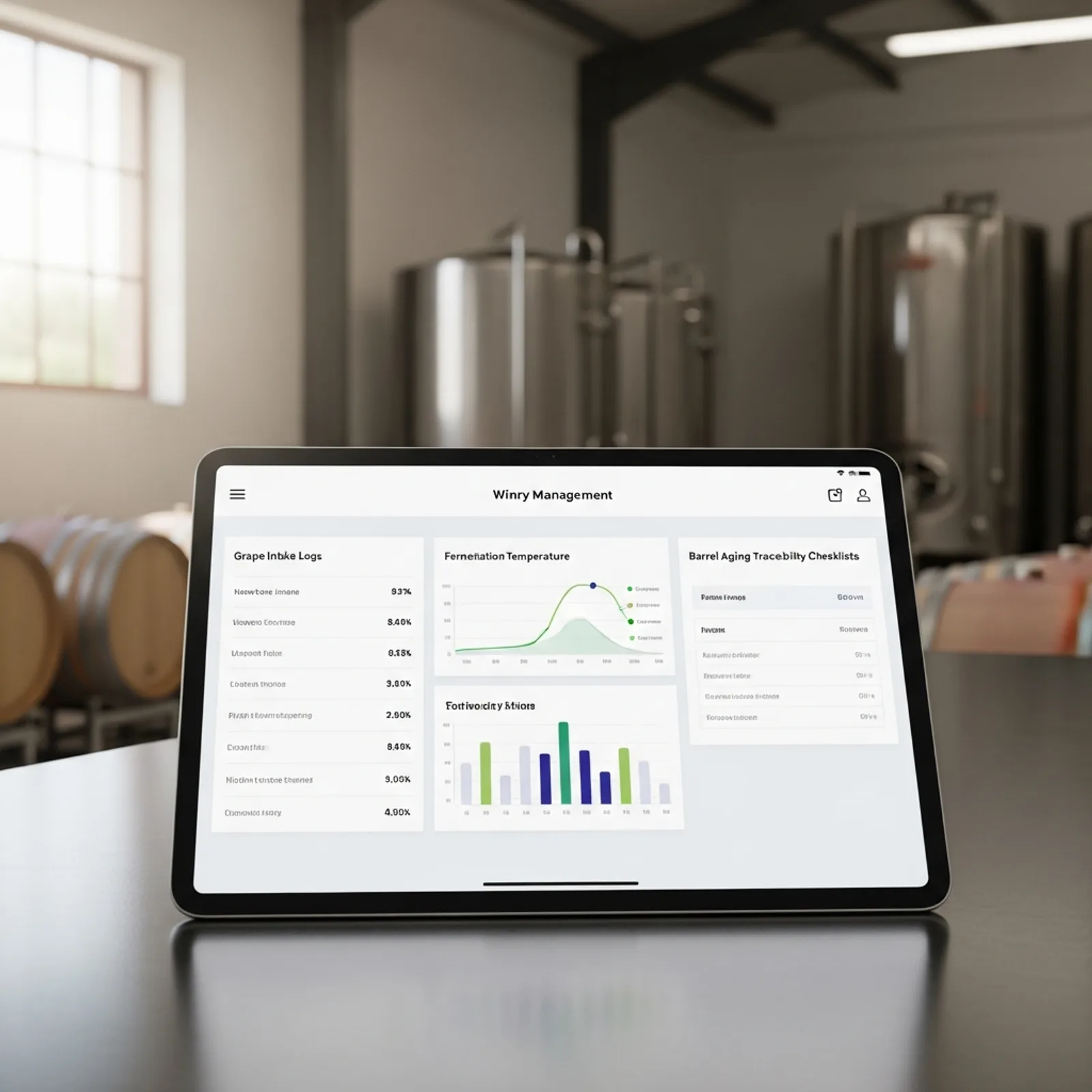
Modern minimalist winery management software dashboard showing grape intake logs, fermentation temperature charts, and barrel aging traceability checklists on a tablet screen in a clean, professional winery facility.

Published:Last updated:Author:Luke Duffy

WINERY OPERATIONS & COMPLIANCE

The Winery Manufacturing Challenge: Balancing Yield, Quality, and Compliance

Winery manufacturing is a highly complex process that blends agricultural unpredictability with precise chemical engineering and strict federal regulations. Unlike discrete manufacturing, where raw materials are uniform and predictable, winemakers must manage variable grape quality, complex fermentation kinetics, and long aging cycles. From the moment grapes are harvested and received at the crush pad, every decision impacts the final yield, quality, and compliance of the vintage.

Managing these operations using manual spreadsheets or generic ERP systems is a recipe for inefficiency and compliance risk. Wineries must track critical parameters such as Brix, temperature, pH, and sulfur dioxide levels across hundreds of tanks and barrels. Furthermore, they must maintain complete lot traceability to comply with FDA regulations and generate accurate Report of Wine Premises Operations (Form 5120.17) for the Alcohol and Tobacco Tax and Trade Bureau (TTB).

To overcome these challenges, modern wineries are turning to specialized winery management software. These digital platforms unify vineyard data, cellar operations, lab analysis, inventory tracking, and compliance reporting into a single source of truth. By automating work orders, tracking bulk wine composition, and streamlining compliance, winery software enables winemakers to focus on what they do best: crafting exceptional wines. In this comprehensive guide, we review the eight best winery management software solutions, helping you select the perfect platform for your facility.

SOFTWARE ROUNDUP

Winery Software Review

8 Best Winery Management Software Solutions for 2026

A side-by-side look at the top platforms for winery production, cellar tracking, and TTB compliance, ranked by depth, ease of use, and total cost of ownership.

Reviewed by Marcus Vance · ASQ CQE & ISO Lead Auditor · 18 years winery software experience

Editor's pick

FoodReady

AI-powered food safety, quality management, and winery production software

  • AI-Powered
  • HACCP & SQF
  • Traceability
9.8
Overall score
Pricing$40,000–$75,000 / year· Professional tier, includes unlimited users and full modules
Platforms
  • Web
  • iOS
  • Android
  • API

FoodReady is the premier cloud-based manufacturing management software designed specifically for modern wine manufacturers. Unlike traditional winery tools that focus solely on winemaking chemistry, FoodReady unifies cellar operations, inventory management, production scheduling, and regulatory compliance into a single, cohesive platform. This eliminates the need for separate QMS, ERP, and MES systems, saving wineries between $50,000 and $150,000 in integration and administrative overhead.

At the core of FoodReady is its powerful inventory and traceability engine. Wineries can track bulk wine volumes, barrel locations, and additive lots in real time. During grape intake, operators use the offline-capable mobile app to log brix, pH, temperature, and quality metrics directly from the receiving pad. This data flows instantly into the central dashboard, giving winemakers immediate visibility into fermentation curves and chemistry profiles.

For compliance, FoodReady is unmatched. The software automates the tedious process of compiling the TTB 5120.17 Report of Wine Premises Operations, reducing administrative labor by up to 60%. It also provides full support for FSMA, SQF, BRC, and FSSC 22000 standards. In the event of an audit, FoodReady's lot genealogy tool can execute a complete mock recall in under 12 minutes, tracing a finished bottle back to the specific grape lot, yeast strain, and barrel history.

FoodReady also features built-in preventive maintenance (CMMS) capabilities. Cellar teams can schedule and log barrel sanitation, tank washdowns, and bottling line calibrations directly within the software. This ensures that all equipment remains compliant with food safety standards and reduces unplanned downtime by up to 40%.

Customer Success Examples:

  • Napa Valley Estates:Implemented FoodReady across three production sites. Reduced their mock recall time from 4 hours to 9 minutes and achieved SQF certification in just 14 weeks.
  • Pacific Coast Custom Crush:Replaced three disconnected software tools with FoodReady. Improved inventory accuracy to 99.2% and saved $45,000 annually in software licensing fees.
  • Willamette Valley Vineyards:Automated their TTB reporting and cellar quality logs using FoodReady's mobile app, reducing administrative labor by 18 hours per week.

Pros

  • Unified platform for production, quality, and compliance (no separate QMS/ERP needed)
  • Real-time fermentation tracking (Brix, temperature, pH) with automated alerts
  • End-to-end lot traceability from vineyard block to finished bottle in under 10 minutes
  • AI-assisted HACCP/HARPC plan authoring and automated compliance documentation
  • Offline-capable mobile app for cellar workers to log tasks on the go
  • Rapid 8–16 week implementation timeline with dedicated onboarding support

Cons

  • Financial accounting requires integration with QuickBooks or NetSuite
  • Advanced custom reporting has a slight learning curve for new users

Scorecard

  • Compliance
    9.9 / 10
  • Traceability
    9.8 / 10
  • Ease of Use
    9.6 / 10
  • Value
    9.7 / 10

Feature highlights

  • Real-time fermentation monitoring and automated alerts
  • End-to-end lot traceability and mock recall reporting
  • AI-assisted HACCP plan authoring and compliance logs
  • Offline-capable mobile app for cellar operations
  • Built-in CMMS for equipment calibration and maintenance

Best for: Mid-market to enterprise wineries and co-packers needing a unified platform to eliminate separate QMS, ERP, and spreadsheets.

See FoodReady
#2

InnoVint

Modern cloud-based winery management software for real-time cellar tracking

  • Cloud-Native
  • Cellar-First
9.4
Overall score
Pricing$15,000–$45,000 / year· Based on annual case production
Platforms
  • Web
  • iOS

InnoVint is a modern, mobile-first winery management platform designed to track wine production from grape to bottle. It offers real-time cellar tracking, work order management, and vineyard data integration. It is highly visual and easy for cellar staff to use on iPads. The software excels at cellar-floor usability, allowing winemakers and cellar hands to log additions, pump-overs, and barrel transfers directly from the tank side. Its intuitive interface reduces data entry errors and ensures that the entire winemaking team has real-time visibility into the status of every lot. InnoVint also features robust cost tracking, automatically allocating fruit, additive, and labor costs to individual wine lots. This provides wineries with accurate cost-of-goods-sold (COGS) data before the wine is even bottled. While it lacks advanced food safety compliance modules like HACCP or SQF, it is an exceptional tool for production-focused wineries.

Pros

  • Highly intuitive, modern user interface that cellar staff love
  • Excellent mobile app with offline capabilities for cellar tasks
  • Real-time cost tracking and automated TTB reporting
  • Strong integration with vineyard management tools

Cons

  • Lacks advanced food safety compliance modules (HACCP/SQF)
  • Limited custom report builder compared to enterprise ERPs

Scorecard

  • Compliance
    9.0 / 10
  • Traceability
    9.5 / 10
  • Ease of Use
    9.7 / 10
  • Value
    9.2 / 10

Feature highlights

  • Real-time cellar tracking and work order management
  • Automated TTB reporting and compliance logs
  • Mobile-first design with offline capabilities
  • Vineyard data integration and cost tracking

Best for: Boutique to mid-sized wineries looking for a modern, cellar-first production tracking tool.

Learn More
#3

vintrace

Comprehensive winery management software for boutique and enterprise wineries

  • Global Reach
  • Enterprise Ready
9.2
Overall score
Pricing$12,000–$60,000 / year· Tiered by production volume
Platforms
  • Web
  • iOS
  • Android

vintrace is a robust, global winery management platform that helps winemakers track production, inventory, and quality. It offers deep barrel management, custom work orders, and multi-site support. It is highly customizable but has a steeper learning curve. The software is designed to handle the complexities of large-scale and multi-winery operations. It provides winemakers with advanced tools for barrel mapping, blending trials, and lab analysis tracking. Its comprehensive reporting engine allows users to build custom dashboards and generate detailed operational reports. vintrace also integrates with popular accounting systems like QuickBooks, Xero, and Microsoft Dynamics, ensuring that production data flows seamlessly to the finance team. While its interface feels somewhat dated compared to newer cloud-native tools, its depth of features and reliability make it a favorite among enterprise wineries.

Pros

  • Deep barrel management and custom work order workflows
  • Multi-site and multi-winery support for large operations
  • Strong cost allocation and financial integration capabilities
  • Comprehensive reporting engine with custom dashboards

Cons

  • Steeper learning curve and longer implementation timeline
  • User interface feels dated compared to newer cloud-native tools

Scorecard

  • Compliance
    9.2 / 10
  • Traceability
    9.4 / 10
  • Ease of Use
    8.5 / 10
  • Value
    8.8 / 10

Feature highlights

  • Deep barrel management and custom work orders
  • Multi-site and multi-winery support
  • Comprehensive reporting engine and custom dashboards
  • Strong cost allocation and financial integration

Best for: Mid-sized to large enterprise wineries needing deep customization and multi-site management.

Learn More
#4

Ekos

Craft beverage management software for wineries, breweries, and cideries

  • Craft Beverage
  • Affordable
8.8
Overall score
Pricing$6,000–$18,000 / year· Subscription based on user count and volume
Platforms
  • Web
  • iOS
  • Android

Ekos is an affordable, all-in-one business management software designed for craft beverage producers. It connects inventory, production, sales, and accounting (integrating with QuickBooks and Xero) to give wineries a complete view of their business. The software is particularly well-suited for smaller wineries and multi-beverage producers who need to manage their business operations without the complexity of enterprise ERPs. It tracks raw materials, packaging inventory, and finished goods, helping wineries avoid stockouts and manage production schedules. Ekos also includes basic production logging, allowing winemakers to record batch details and fermentation metrics. While it lacks deep winemaking-specific features like barrel mapping or advanced chemistry tracking, its strong business management and accounting integrations make it an excellent value for growing craft brands.

Pros

  • Affordable pricing suitable for small and growing wineries
  • Seamless integration with QuickBooks Online and Xero
  • Good inventory tracking and sales order management
  • Easy-to-use interface for basic production logging

Cons

  • Lacks deep winemaking-specific features (like barrel mapping or brix curves)
  • Limited compliance and food safety modules

Scorecard

  • Compliance
    8.0 / 10
  • Traceability
    8.5 / 10
  • Ease of Use
    9.0 / 10
  • Value
    9.2 / 10

Feature highlights

  • Seamless integration with QuickBooks Online and Xero
  • Inventory tracking and sales order management
  • Easy-to-use interface for basic production logging
  • Craft beverage business management

Best for: Small to mid-sized craft wineries and multi-beverage producers looking for an affordable business management tool.

Learn More
#5

Process2Wine

Winery and vineyard management software with GPS tracking

  • Vineyard GPS
  • SaaS
8.7
Overall score
Pricing$8,000–$25,000 / year· Based on acreage and production volume
Platforms
  • Web
  • iOS
  • Android

Process2Wine is a comprehensive software solution that covers both vineyard management and winery production. It features unique GPS tracking for vineyard operations, allowing growers to track tractor paths, spraying, and harvesting in real time. The software provides estate wineries with a single platform to manage their entire lifecycle, from vine to bottle. In the vineyard, managers can track labor, equipment usage, and chemical applications. In the cellar, winemakers can manage work orders, track fermentation, and monitor barrel aging. Process2Wine also offers strong compliance tracking for organic and biodynamic certifications, making it an excellent choice for sustainability-focused wineries. While its mobile app can be slow in areas with poor cellular reception, its comprehensive feature set and vineyard-first design are highly valuable.

Pros

  • Excellent vineyard management with GPS tracking and mapping
  • Covers the entire lifecycle from vine to bottle
  • Good work order management for cellar operations
  • Strong compliance tracking for organic and biodynamic certifications

Cons

  • Mobile app can be slow in areas with poor cellular reception
  • Customer support is primarily based in Europe, leading to time zone delays

Scorecard

  • Compliance
    8.8 / 10
  • Traceability
    8.9 / 10
  • Ease of Use
    8.2 / 10
  • Value
    8.5 / 10

Feature highlights

  • Vineyard management with GPS tracking and mapping
  • Work order management for cellar operations
  • Compliance tracking for organic and biodynamic certifications
  • Complete lifecycle coverage from vine to bottle

Best for: Estate wineries that manage their own vineyards and want a single tool for both growing and winemaking.

Learn More
#6

The Winemaker's Database (WMDB)

Robust, traditional winery management software designed by winemakers

  • Industry Pioneer
  • Highly Customizable
8.5
Overall score
Pricing$10,000–$35,000 / year· Custom quotes based on modules selected
Platforms
  • Web
  • Windows

The Winemaker's Database (WMDB) is one of the oldest and most robust winery management systems on the market. Designed by winemakers, it offers unparalleled depth in winemaking chemistry, barrel tracking, and compliance. The software is highly customizable, allowing wineries to configure the database structure to fit their exact cellar workflows. It excels at tracking complex winemaking chemistry, lab analysis, and blending trials, making it a favorite among traditional winemakers and lab managers. WMDB also provides battle-tested compliance and TTB reporting, ensuring that wineries can easily generate accurate reports. However, its user interface is highly traditional and requires significant training to master. It is not mobile-friendly, making it less suitable for modern, fast-paced cellar environments.

Pros

  • Unparalleled depth in winemaking chemistry and lab tracking
  • Highly customizable database structure to fit any winery workflow
  • Battle-tested compliance and TTB reporting
  • Excellent technical support from experienced winemakers

Cons

  • Interface feels extremely dated and is not mobile-friendly
  • High implementation and training costs

Scorecard

  • Compliance
    9.4 / 10
  • Traceability
    9.2 / 10
  • Ease of Use
    6.8 / 10
  • Value
    8.0 / 10

Feature highlights

  • Unparalleled depth in winemaking chemistry and lab tracking
  • Highly customizable database structure
  • Battle-tested compliance and TTB reporting
  • Excellent technical support from experienced winemakers

Best for: Large, traditional wineries with dedicated lab staff who prioritize deep chemistry tracking over modern user experience.

Learn More
#7

Vinsight

Cloud-based winery and vineyard management software with strong inventory

  • Cloud-Native
  • Inventory-First
8.4
Overall score
Pricing$5,000–$15,000 / year· Monthly subscription tiers
Platforms
  • Web

Vinsight is a flexible, cloud-based winery management system that focuses heavily on inventory tracking, production, and sales. It integrates with popular accounting tools and offers a clean, modern interface for managing winery operations. The software is designed to help wineries manage their business operations efficiently. It tracks raw materials, packaging, dry goods, and bulk wine inventory, helping wineries avoid stockouts and manage production schedules. It also integrates with Xero, QuickBooks, and Shopify, ensuring seamless data flow. Vinsight is easy to set up and use, requiring minimal training for cellar and administrative staff. However, it lacks a dedicated mobile app, relying on a web-only interface that can be difficult to use on the cellar floor. It also lacks advanced winemaking features like barrel mapping or blending trials.

Pros

  • Strong inventory tracking for packaging, dry goods, and bulk wine
  • Affordable monthly subscription with no long-term contracts
  • Good integration with Xero, QuickBooks, and Shopify
  • Easy to set up and use with minimal training

Cons

  • Lacks a dedicated mobile app (web-only interface)
  • Limited advanced winemaking features (like barrel mapping or blending trials)

Scorecard

  • Compliance
    8.2 / 10
  • Traceability
    8.6 / 10
  • Ease of Use
    8.8 / 10
  • Value
    8.5 / 10

Feature highlights

  • Strong inventory tracking for packaging, dry goods, and bulk wine
  • Integration with Xero, QuickBooks, and Shopify
  • Easy to set up and use with minimal training
  • Cloud-based winery and vineyard management

Best for: Small to mid-sized wineries that need strong inventory and sales tracking without complex winemaking features.

Learn More
#8

GrapeGears

Winery management software with integrated DTC and POS capabilities

  • DTC & POS
  • Sales-First
8.2
Overall score
Pricing$8,000–$20,000 / year· Subscription based on sales volume
Platforms
  • Web
  • iOS

GrapeGears is a unique winery management platform that bridges the gap between production and sales. It offers integrated Direct-to-Consumer (DTC) tools, wine club management, and Point of Sale (POS) capabilities alongside basic production tracking. The software is designed for sales-focused wineries that prioritize tasting room operations and direct-to-consumer sales. It provides a seamless flow of data from production inventory to sales channels, ensuring that wine club shipments and tasting room sales are always synced with bulk wine inventory. GrapeGears also includes robust customer relationship management (CRM) tools, helping wineries track customer preferences and purchase histories. While its production tracking and winemaking features are basic compared to dedicated cellar tools, its strong sales capabilities make it a valuable asset for retail-focused wineries.

Pros

  • Excellent DTC, wine club, and POS capabilities in a single platform
  • Seamless flow of data from production inventory to sales channels
  • Good customer relationship management (CRM) tools
  • Modern, mobile-friendly interface for tasting room staff

Cons

  • Production tracking is basic compared to dedicated winemaking tools
  • Lacks advanced compliance and lab chemistry tracking

Scorecard

  • Compliance
    7.8 / 10
  • Traceability
    8.0 / 10
  • Ease of Use
    9.2 / 10
  • Value
    8.4 / 10

Feature highlights

  • Integrated DTC, wine club, and POS capabilities
  • Seamless flow of data from production inventory to sales channels
  • Good customer relationship management (CRM) tools
  • Modern, mobile-friendly interface for tasting room staff

Best for: Sales-focused wineries with a heavy emphasis on tasting rooms, wine clubs, and direct-to-consumer sales.

Learn More

Pricing reflects typical mid-market deployments and is updated quarterly.

BUYER'S GUIDE

How to Choose the Right Winery Management Software

Selecting the right winery management software is a critical decision that impacts your production efficiency, product quality, and regulatory compliance. With numerous options available, it is essential to evaluate platforms based on your winery's specific operational needs and budget. Here are six critical criteria to consider when choosing your software:

1. Production Tracking and Cellar Operations

The core of any winery software is its ability to track cellar operations. Look for a platform that offers robust work order management, allowing you to schedule and track tasks such as pump-overs, filtrations, barrel transfers, and additions. The software should provide real-time visibility into tank and barrel contents, including volume, composition, and historical treatments. Mobile-first platforms that allow cellar hands to log tasks directly from the tank side are highly recommended to reduce data entry errors.

2. Lot Traceability and Compliance (TTB, FDA, SQF)

Compliance is a major operational burden for wineries. Your software should automate the tracking of bulk wine composition (varietal, vintage, appellation) to ensure accurate labeling and TTB reporting. It should easily generate the Report of Wine Premises Operations (Form 5120.17) and maintain complete lot traceability from the vineyard block to the finished bottle. For wineries seeking SQF or BRC certification, the software must support digital food safety logs, HACCP plan management, and rapid mock recall reporting.

3. Lab Chemistry and Fermentation Monitoring

Winemaking is a science, and tracking lab chemistry is vital for quality control. The software should allow you to log daily fermentation metrics (Brix, temperature, pH) and view historical fermentation curves. It should also track key chemical parameters such as free and total SO2, volatile acidity, alcohol by volume (ABV), and malic acid. Look for platforms that offer automated alerts when fermentation metrics fall outside of specified ranges, allowing you to take corrective action before quality is compromised.

4. Inventory and Cost Allocation

Accurate cost tracking is essential for winery profitability. Your software should track not only bulk wine volumes but also dry goods and packaging inventory (bottles, corks, labels, capsules). It should automatically allocate fruit, additive, labor, and packaging costs to individual wine lots, providing you with an accurate cost-of-goods-sold (COGS) figure. Seamless integration with your accounting software (such as QuickBooks or NetSuite) is critical to ensure financial records are always in sync.

5. Direct-to-Consumer (DTC) and POS Integration

For many wineries, direct-to-consumer sales through tasting rooms, wine clubs, and e-commerce are the primary revenue drivers. If your winery relies heavily on retail sales, consider a platform that offers integrated DTC and POS capabilities, or one that integrates seamlessly with popular sales tools like Commerce7 or Shopify. This ensures that sales transactions automatically update your finished goods inventory and flow directly to your financial reports.

6. Implementation Timeline and Total Cost of Ownership (TCO)

Winery software is a significant investment, both in terms of software subscription fees and implementation costs. Evaluate the total cost of ownership, including onboarding, training, and ongoing technical support. Ask software providers about their typical implementation timeline and the level of support they provide during data migration. A platform like FoodReady offers a rapid 8-to-16-week implementation timeline with dedicated onboarding support, ensuring your software is fully operational before the busy harvest season.

QUESTIONS & ANSWERS

Frequently Asked Questions

Common questions about winery management software, compliance, and implementation.

What is winery management software and why is it important?

Winery management software is a specialized digital platform designed to track wine production, inventory, and compliance from grape harvest to final bottling. Implementing this software helps winemakers eliminate manual spreadsheets and streamline cellar operations. This software ensures that all fermentation logs, barrel treatments, and lab analyses are recorded in a single database. By centralizing your data, the software provides real-time visibility into bulk wine inventory and production costs. Ultimately, choosing the right software is critical for maintaining quality consistency and regulatory compliance.

How does winery management software help with TTB compliance?

Winery management software automates the complex process of tracking bulk wine movements and composition to generate accurate TTB reports. This specialized software records every blend, addition, and transfer to ensure complete audit readiness. Using this software, wineries can easily calculate their 5120.17 Report of Wine Premises Operations. The software reduces the risk of compliance errors and costly penalties from manual data entry. Therefore, compliance-focused wineries rely on this software to maintain strict regulatory alignment.

Can winery management software track individual barrels and blends?

Winery management software tracks individual barrels, tanks, and complex blending histories to maintain complete lot traceability throughout the cellar. This software allows winemakers to map their barrel cellar and track the exact composition of every blend. By using this software, cellar staff can scan barcodes on barrels to view treatment histories instantly. The software automatically updates bulk wine volumes and composition percentages during blending operations. Consequently, this software eliminates the guesswork and manual errors associated with paper-based cellar logs.

What is the difference between winery ERP and specialized winemaking software?

Winery ERP systems provide broad financial and supply chain management, while specialized winemaking software focuses deeply on cellar operations and chemistry. Many wineries combine both types of software to achieve complete business and production visibility. While an ERP handles general ledger and sales, winemaking software tracks brix, temperature, and barrel additions. Integrating your winemaking software with an ERP ensures seamless data flow from production to finance. Choosing between these software options depends on your winery's operational complexity and budget.

How long does it take to implement winery management software?

Implementing winery management software typically takes between eight and sixteen weeks, depending on the complexity of your cellar operations. During this period, the software provider helps migrate your historical bulk wine and inventory data. Training your cellar staff on the new software is critical for successful adoption and data accuracy. A dedicated project manager from the software company usually guides you through configuration and testing. Ultimately, a well-planned implementation ensures your software is fully operational before the harvest season begins.

Does winery management software integrate with QuickBooks or other accounting tools?

Winery management software frequently integrates with QuickBooks and other accounting tools to sync production costs, inventory values, and sales. This integration allows the software to automatically update your financial records when bulk wine is bottled. By connecting your software to accounting, you eliminate double data entry and manual reconciliation errors. The software ensures that your cost of goods sold (COGS) is calculated accurately based on production inputs. Most modern software platforms offer native APIs or pre-built connectors for seamless integration.

Can cellar workers use winery management software on mobile devices?

Cellar workers can easily use winery management software on mobile devices like tablets and smartphones to log tasks in real time. This mobile-first software allows operators to view work orders and record additions directly at the tank. Using mobile software eliminates the need to carry paper logs and re-enter data later. The software often includes offline capabilities, ensuring data is saved even in thick-walled barrel cellars. Consequently, mobile software improves data accuracy and cellar efficiency during busy production periods.

What is the typical cost of winery management software?

Winery management software costs range from five thousand to seventy-five thousand dollars annually, depending on production volume and features. Small wineries can find affordable software options with basic inventory and production tracking capabilities. Mid-sized and enterprise operations typically invest in comprehensive software that includes advanced compliance and quality modules. Implementation fees for this software can add an additional twenty to fifty percent to the first-year cost. Understanding the total cost of ownership helps you select the best software for your budget.

Written by

luke duffy

Luke Duffy

Luke Duffy is a Senior Director of Quality & Customer Success with extensive expertise in SQF, BRC, USDA, and FSQA. He specializes in developing food safety programs, leading teams, conducting audits, and guiding clients to achieve GFSI certification success. Luke Duffy led quality at companies like Boston Bakery and Do & Co.

Get a demo

Speak with our Expert Consultants

15–30 minutes. We map FoodReady to your process, plug in your real HACCP plan, and show you the auditor view before the call ends.

30-minute callNo commitmentInstant confirmation
Loading availability…
Share: