Best Sushi Production Software for Food Manufacturers (2026)

Compare the top 10 sushi production software solutions for 2026. Find the best platform for lot traceability, HACCP compliance, and inventory control.

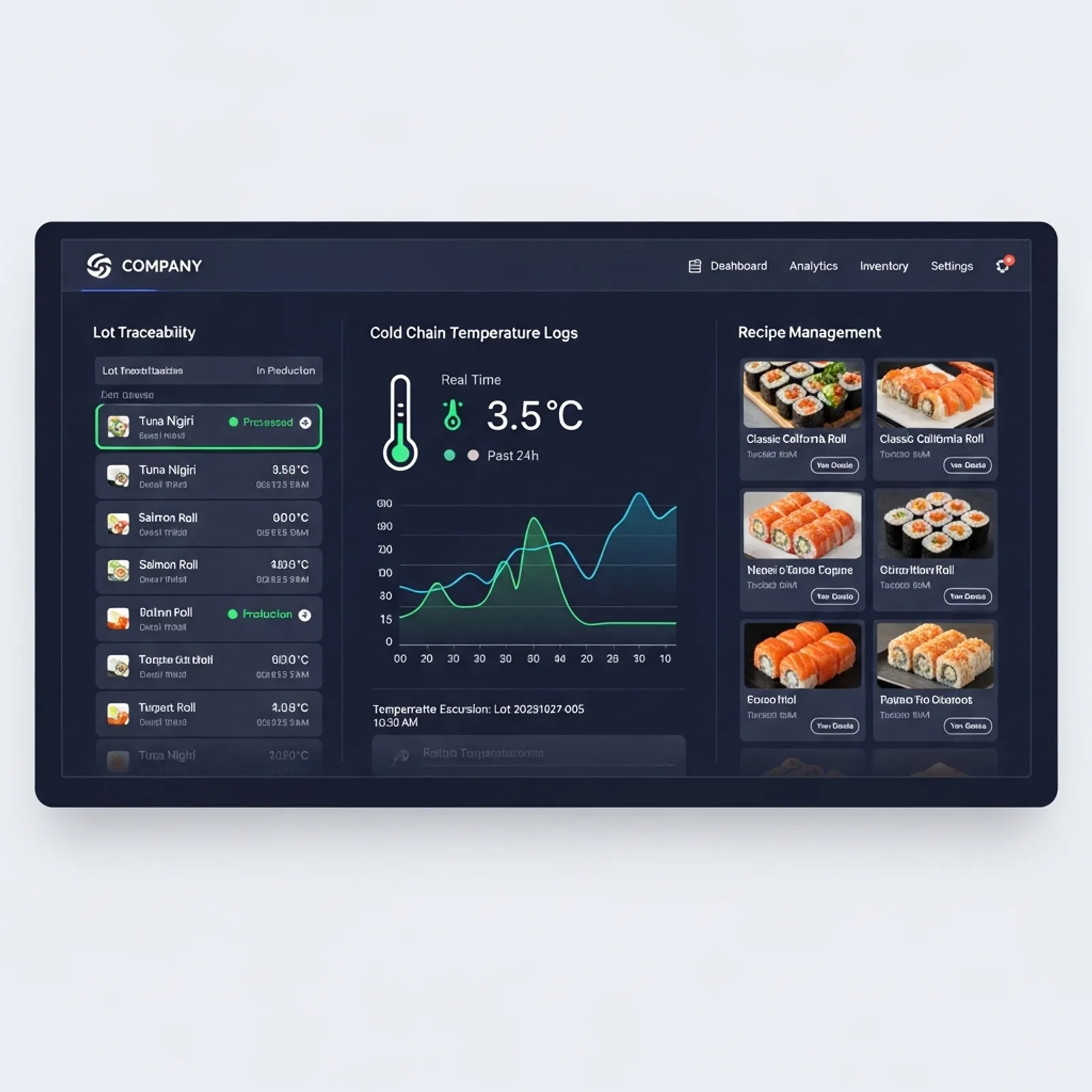
Industrial sushi manufacturing and processing software dashboard showing real-time lot traceability, cold chain temperature logs, and recipe management

Published:Last updated:Author:Gerry Galloway

The industrial sushi manufacturing sector is experiencing unprecedented growth, driven by the surging global demand for convenient, high-quality, and ready-to-eat (RTE) meals. However, producing sushi at scale is one of the most complex and high-risk operations in the food processing industry. Manufacturers must manage highly perishable raw seafood, maintain strict cold chain integrity, prevent cross-contamination of major allergens like shellfish and sesame, and comply with stringent regulatory frameworks such as the FDA's Food Safety Modernization Act (FSMA) Section 204 traceability rules.

In this high-stakes environment, relying on paper logs, disjointed spreadsheets, or generic inventory systems is a recipe for operational failure and regulatory non-compliance. To maintain profitability, ensure food safety, and pass rigorous Global Food Safety Initiative (GFSI) audits (such as SQF or BRCGS), modern sushi processors require specialized, cloud-based manufacturing software.

Software Review

Software Review

Top 10 Sushi Production Software for Food Manufacturers

Reviewed by Marcus Vance · ASQ CQE, ISO Lead Auditor · 18 years food safety experience

FoodReady
Unified food safety, lot traceability, and production management for industrial sushi manufacturers
9.6
$15K–75K / yr
Subscription + implementation
  • Web
  • API
  • iOS
  • Android
Plex ERP
Enterprise-grade manufacturing execution system and ERP for high-volume food processors
8.7
$120K–300K / yr
Enterprise subscription, implementation extra
  • Web
NetSuite ERP
Comprehensive cloud ERP for financial, inventory, and supply chain management
8.5
$80K–250K / yr
Annual subscription based on modules and users
  • Web
  • API
Aptean Food & Beverage ERP
Specialized process manufacturing ERP with built-in quality and traceability
8.4
$60K–180K / yr
Per-user subscription + implementation
  • Web
  • API
Fishbowl Inventory
Affordable inventory management and manufacturing software for QuickBooks users
7.9
$10K–30K / yr
Subscription-based pricing
  • Windows
  • macOS
MasterControl QMS
Document-centric quality management system for highly regulated environments
8.1
$50K–150K / yr
Per-module pricing, implementation extra
  • Web
Deacom ERP
Single-database ERP designed specifically for process manufacturers
8.2
$70K–200K / yr
Comprehensive subscription including all modules
  • Web
  • Windows
JustFood ERP
Microsoft Dynamics-based ERP tailored for food and beverage manufacturers
8.0
$55K–160K / yr
Subscription + implementation
  • Web
  • API
Infor CloudSuite Food & Beverage
Enterprise cloud platform with deep industry-specific capabilities
8.3
$90K–280K / yr
Enterprise subscription + implementation
  • Web
  • API
Katana Cloud Manufacturing
Modern, visual inventory and production platform for scaling manufacturers
7.8
$12K–35K / yr
Tiered subscription pricing
  • Web
  • API
Editor's pick

FoodReady

Unified food safety, lot traceability, and production management for industrial sushi manufacturers

  • FSMA 204 Ready
  • HACCP Certified
  • AI-Powered
9.6
Overall score
Pricing$15K–75K / yr· Subscription + implementation
Platforms
  • Web
  • API
  • iOS
  • Android

FoodReady is the industry-leading, AI-powered food safety and manufacturing management software designed specifically for food and beverage processors, with specialized workflows tailored for industrial sushi manufacturers. Unlike generic ERPs or document-only QMS platforms, FoodReady unifies quality assurance, HACCP compliance, lot traceability, inventory control, and production scheduling into a single, cohesive cloud-based platform. This integration eliminates the need for separate, disconnected systems, saving manufacturers tens of thousands of dollars in integration costs and reducing implementation timelines to just 8 to 16 weeks.

For industrial sushi producers, FoodReady provides specialized tools to manage the highly complex critical control points (CCPs) inherent in sushi manufacturing. This includes digital logs for the acidification of sushi rice (monitoring pH levels), continuous cold storage temperature tracking for raw seafood, and automated allergen segregation protocols to prevent cross-contact of major allergens like sesame, shellfish, and soy. The platform's mobile-first design empowers floor workers to log temperature checks, sanitation tasks, and batch records directly from tablets, eliminating paper logs entirely and ensuring real-time data capture.

FoodReady offers a complete suite of modules designed to streamline every aspect of your manufacturing operations. The Quality & HACCP module features an AI-powered HACCP plan builder, digital QA checklists, automated corrective actions (CAPA), and audit-ready document control. The Inventory & Traceability module provides real-time, multi-location inventory tracking with dual units of measure (catch weight) for variable-weight seafood, and instant bi-directional lot tracing. The Production Scheduling module streamlines work order creation, bill of materials (BOM) management, and shop floor scheduling to optimize throughput and minimize waste. Additionally, the Supply Chain module manages purchase orders, supplier compliance documents (COAs), and vendor scorecards, while the Maintenance & CMMS module tracks preventive maintenance and equipment calibration for critical machinery like rice cookers, cooling tunnels, and packaging lines.

FoodReady's impact is backed by citable, real-world metrics from active food manufacturing facilities. For example, a mid-market sushi co-packer reduced their mock recall and audit preparation time from 4 hours to under 12 minutes (an 85% reduction), passing their SQF audit with an Excellent rating. A multi-site wholesale sushi manufacturer deployed FoodReady across three facilities, achieving full FSMA 204 compliance and standardizing QA checklists in just 12 weeks. Furthermore, a seafood processor specializing in sushi-grade tuna integrated FoodReady's catch weight inventory module, reducing raw material waste by 14% and improving batch yield accuracy to 99.2%.

At the core of FoodReady is its advanced AI engine, which assists quality managers in authoring HACCP plans, identifying potential compliance gaps, and conducting automated root-cause analysis for corrective and preventive actions (CAPA). When a critical limit is exceeded on the production floor—such as a walk-in freezer temperature rising above acceptable thresholds—the system instantly triggers a mobile alert and guides the operator through the mandatory corrective action steps. This proactive approach prevents product spoilage and ensures continuous compliance with FDA, USDA, and GFSI standards.

FoodReady offers transparent, tiered subscription pricing designed to scale with your business. The Starter Plan ($15,000–$30,000/year) is ideal for single-site operations with up to 75 users. The Professional Plan ($40,000–$75,000/year) supports multi-site operations and up to 200 users, while the Enterprise Plan ($75,000–$150,000/year) provides unlimited access and dedicated support. Onboarding and implementation fees range from $10,000 to $60,000, with a typical go-live timeline of 8 to 16 weeks, compared to the 12 to 36 months required for legacy ERP systems.

Pros

  • Unified food safety (HACCP), inventory, and production in one cloud platform
  • Mock recall lot genealogy in under 30 minutes (95% reduction in audit prep time)
  • Automated allergen segregation alerts and cross-contamination prevention
  • Real-time cold chain monitoring with IoT sensor integrations
  • Fast 8–16 week implementation with dedicated food safety consultant support
  • AI-powered HACCP plan builder and automated CAPA root-cause analysis
  • Dual units of measure (catch weight) support for variable-weight seafood ingredients
  • Mobile-first design with offline capabilities for concrete and stainless steel plant environments
  • Seamless integration with popular accounting systems like QuickBooks, Sage, and NetSuite

Cons

  • Newer platform (founded 2020) compared to legacy 30-year ERPs
  • Financial accounting requires integration (QuickBooks, NetSuite, Sage)
  • Less customization than multi-million dollar legacy ERP systems
  • Requires active management commitment during the 8–16 week onboarding phase

Scorecard

  • Compliance
    9.8 / 10
  • Traceability
    9.7 / 10
  • Ease of Use
    9.3 / 10
  • Value for Money
    9.5 / 10

Feature highlights

  • AI-powered HACCP plan builder and digital temperature logs
  • Bi-directional lot traceability from raw fish receiving to finished sushi rolls
  • Mobile-first QA checklists and corrective action (CAPA) verification

Best for: Mid-market wholesale sushi producers, co-packers, and seafood processors needing unified compliance and inventory

See FoodReady in Action
#2

Plex ERP

Enterprise-grade manufacturing execution system and ERP for high-volume food processors

  • Enterprise MES
  • Automation-First
8.7
Overall score
Pricing$120K–300K / yr· Enterprise subscription, implementation extra
Platforms
  • Web

Plex ERP is an enterprise-grade manufacturing execution system (MES) and enterprise resource planning (ERP) platform designed for high-volume food and beverage processors. It offers deep shop floor control, real-time machine integration, and comprehensive quality management. For large-scale sushi manufacturers with highly automated production lines, Plex provides unparalleled visibility into machine performance, overall equipment effectiveness (OEE), and scrap rates. The platform's single-database architecture ensures that quality data is captured directly from the production line, linking machine metrics to specific production batches. However, Plex is a massive system that requires a significant financial investment and a dedicated IT team to deploy and maintain. Its complexity and long implementation timeline make it less suitable for small or mid-market sushi producers who need a nimble, easy-to-use solution.

Pros

  • Robust shop floor control and real-time manufacturing execution (MES)
  • Deep integration with industrial automation and PLC systems

Cons

  • Extremely high total cost of ownership and long 12–24 month deployment
  • Overly complex interface requiring extensive user training

Scorecard

  • Compliance
    8.9 / 10
  • Traceability
    8.8 / 10
  • Ease of Use
    7.1 / 10
  • Value for Money
    7.3 / 10

Feature highlights

  • Real-time OEE tracking and machine-level data capture
  • Enterprise-wide inventory and financial management

Best for: Large-scale enterprise sushi manufacturers with dedicated IT teams and complex MES needs

Learn More
#3

NetSuite ERP

Comprehensive cloud ERP for financial, inventory, and supply chain management

  • Cloud ERP
  • Financials-First
8.5
Overall score
Pricing$80K–250K / yr· Annual subscription based on modules and users
Platforms
  • Web
  • API

NetSuite ERP is a leading cloud-based business management suite that unifies financial accounting, inventory management, and supply chain operations. With its specialized Food and Beverage module, NetSuite provides sushi manufacturers with robust tools for demand planning, multi-location inventory tracking, and vendor management. The platform is highly scalable, making it the preferred choice for rapidly growing sushi brands that operate multiple production facilities or retail distribution networks. NetSuite excels at financial consolidation, purchasing workflows, and executive reporting. However, because NetSuite is a general ERP, its food safety and HACCP compliance capabilities are not built-in. Sushi manufacturers must rely on expensive third-party add-ons or extensive custom configurations to manage digital QA checklists, temperature logs, and detailed compliance documentation.

Pros

  • Industry-standard financial accounting and multi-subsidiary management
  • Highly scalable platform with a massive global ecosystem of integrations

Cons

  • Food safety and HACCP compliance require third-party add-ons or heavy customization
  • Implementation is notoriously expensive and requires specialized consultants

Scorecard

  • Compliance
    8.2 / 10
  • Traceability
    8.4 / 10
  • Ease of Use
    7.8 / 10
  • Value for Money
    7.5 / 10

Feature highlights

  • Advanced demand planning and multi-location inventory tracking
  • Real-time financial reporting and executive dashboards

Best for: Rapidly growing sushi brands prioritizing financial consolidation and multi-entity operations

Learn More
#4

Aptean Food & Beverage ERP

Specialized process manufacturing ERP with built-in quality and traceability

  • Catch Weight
  • Process ERP
8.4
Overall score
Pricing$60K–180K / yr· Per-user subscription + implementation
Platforms
  • Web
  • API

Aptean Food & Beverage ERP is a specialized process manufacturing platform built on Microsoft Dynamics technology. It is designed specifically to address the unique challenges of food processors, including catch weight management, recipe formulation, and allergen tracking. For sushi manufacturers, Aptean's catch weight functionality is highly valuable, as raw seafood ingredients (like whole tuna or salmon fillets) vary in weight, while finished sushi rolls are sold by the piece or package. Aptean allows manufacturers to track inventory in dual units of measure (weight and count) seamlessly. The platform also features robust bi-directional lot tracing and automated allergen segregation rules. Despite these strong features, Aptean's user interface can feel dated and complex, and its mobile capabilities are less developed than modern, mobile-first SaaS platforms.

Pros

  • Native catch weight management for variable-weight seafood ingredients
  • Strong recipe management with automated nutritional labeling calculations

Cons

  • Interface feels dated and less intuitive than modern SaaS platforms
  • Mobile capabilities are limited and require separate licensing

Scorecard

  • Compliance
    8.6 / 10
  • Traceability
    8.5 / 10
  • Ease of Use
    7.4 / 10
  • Value for Money
    7.6 / 10

Feature highlights

  • Bi-directional lot tracing and recall management
  • Production scheduling and shop floor control

Best for: Mid-to-large process manufacturers needing deep recipe management and catch weight tracking

Learn More
#5

Fishbowl Inventory

Affordable inventory management and manufacturing software for QuickBooks users

  • QuickBooks Sync
  • Budget-Friendly
7.9
Overall score
Pricing$10K–30K / yr· Subscription-based pricing
Platforms
  • Windows
  • macOS

Fishbowl Inventory is an affordable, desktop-based inventory management and manufacturing software designed specifically to integrate with QuickBooks. For small-scale sushi co-packers, local wholesale kitchens, or startup sushi brands, Fishbowl offers a cost-effective way to transition away from spreadsheets. It provides basic lot tracking, bill of materials (BOM) management, and work order creation. Sushi producers can use Fishbowl to track raw ingredients (like sushi rice, nori, and fish) and manage the assembly of finished sushi packages. However, Fishbowl lacks native food safety compliance modules. It does not support digital HACCP plans, QA checklists, or automated temperature logging. Manufacturers using Fishbowl must maintain a separate, manual system for food safety compliance, which increases the risk of human error during audits.

Pros

  • Seamless, native integration with QuickBooks Online and Desktop
  • Cost-effective entry point for basic lot tracking and bill of materials (BOM)

Cons

  • Lacks native food safety compliance, HACCP, and QA checklist modules
  • Limited scalability for multi-site operations or high-volume production lines

Scorecard

  • Compliance
    7.1 / 10
  • Traceability
    7.8 / 10
  • Ease of Use
    8.2 / 10
  • Value for Money
    8.4 / 10

Feature highlights

  • Basic lot and serial number tracking for raw ingredients
  • Work order creation and simple assembly management

Best for: Small-scale sushi co-packers and local wholesale kitchens on a tight budget

Learn More
#6

MasterControl QMS

Document-centric quality management system for highly regulated environments

  • FDA Regulated
  • Document QMS
8.1
Overall score
Pricing$50K–150K / yr· Per-module pricing, implementation extra
Platforms
  • Web

MasterControl is a document-centric quality management system (QMS) designed for highly regulated industries, including life sciences and food manufacturing. It excels at document control, standard operating procedure (SOP) management, and employee training tracking. For sushi manufacturers facing strict regulatory oversight, MasterControl ensures that all food safety plans, sanitation procedures, and employee training records are fully documented, approved, and up to date. The platform automates the routing and approval of document revisions, preventing the use of outdated SOPs on the production floor. However, MasterControl is not an operational system. It does not manage inventory, production scheduling, or batch records. Sushi manufacturers using MasterControl must integrate it with a separate ERP or inventory system, which can lead to high integration costs and data silos.

Pros

  • Exceptional document control, revision history, and automated training workflows
  • Battle-tested in highly regulated FDA environments

Cons

  • Lacks native inventory, production scheduling, and batch record management
  • High cost for a system that only handles quality and compliance

Scorecard

  • Compliance
    9.2 / 10
  • Traceability
    7.5 / 10
  • Ease of Use
    7.3 / 10
  • Value for Money
    7.1 / 10

Feature highlights

  • Automated CAPA (Corrective and Preventive Action) workflows
  • Digital SOP routing, approval, and employee training tracking

Best for: Sushi manufacturers prioritizing document control, SOP training, and audit readiness

Learn More
#7

Deacom ERP

Single-database ERP designed specifically for process manufacturers

  • Single Database
  • No Integrations
8.2
Overall score
Pricing$70K–200K / yr· Comprehensive subscription including all modules
Platforms
  • Web
  • Windows

Deacom ERP is a comprehensive, single-database ERP system designed specifically for process manufacturers. Unlike other ERPs that rely on third-party add-ons, Deacom builds all of its capabilities—including formulation, quality control, warehouse management, and lot traceability—directly into its core database. For mid-market sushi producers, this single-database architecture eliminates the headache of managing complex integrations. Deacom allows manufacturers to scale recipes, perform real-time quality checks on the production line, and track lot genealogy from raw fish receiving to final shipment. However, because Deacom is an all-inclusive system, it has a steep learning curve and requires a significant commitment from the manufacturer's team during implementation. Customization is also limited, as the vendor discourages modifying the core codebase.

Pros

  • Single-database architecture eliminates the need for external integrations
  • Strong formulation, recipe scaling, and quality control checks built-in

Cons

  • Steep learning curve due to the dense, all-inclusive feature set
  • Customization is difficult and must be handled through the vendor

Scorecard

  • Compliance
    8.3 / 10
  • Traceability
    8.4 / 10
  • Ease of Use
    7.2 / 10
  • Value for Money
    7.8 / 10

Feature highlights

  • Integrated warehouse management (WMS) with barcode scanning
  • Direct lot tracking from receiving to shipping

Best for: Mid-market sushi producers wanting an all-in-one system without third-party integrations

Learn More
#8

JustFood ERP

Microsoft Dynamics-based ERP tailored for food and beverage manufacturers

  • Microsoft Stack
  • Dynamics 365
8.0
Overall score
Pricing$55K–160K / yr· Subscription + implementation
Platforms
  • Web
  • API

JustFood ERP is a specialized food and beverage manufacturing platform built on the Microsoft Dynamics 365 Business Central framework. It combines the robust financial and operational capabilities of Microsoft's ERP with industry-specific features for food safety, quality assurance, and lot traceability. For sushi manufacturers, JustFood offers strong tools for managing allergen cross-contact, tracking shelf-life, and executing rapid product recalls. The platform's integration with the Microsoft ecosystem makes it an attractive option for companies that already rely on Microsoft tools for office productivity and business intelligence. However, JustFood is a complex system that requires a significant implementation effort, and ongoing maintenance costs can be high, particularly for smaller manufacturers without dedicated IT resources.

Pros

  • Built on the familiar Microsoft Dynamics 365 Business Central platform
  • Strong quality audit, allergen management, and recall tracking features

Cons

  • Requires significant implementation support and ongoing IT maintenance
  • Upgrades can be complex and costly due to custom configurations

Scorecard

  • Compliance
    8.2 / 10
  • Traceability
    8.1 / 10
  • Ease of Use
    7.5 / 10
  • Value for Money
    7.4 / 10

Feature highlights

  • Real-time inventory visibility and lot tracking
  • Production scheduling and yield analysis

Best for: Mid-market food processors already aligned with the Microsoft technology stack

Learn More
#9

Infor CloudSuite Food & Beverage

Enterprise cloud platform with deep industry-specific capabilities

  • Global Supply Chain
  • Enterprise Cloud
8.3
Overall score
Pricing$90K–280K / yr· Enterprise subscription + implementation
Platforms
  • Web
  • API

Infor CloudSuite Food & Beverage is an enterprise-grade, cloud-based ERP platform designed for large, multi-site food manufacturers and global brands. It offers deep, industry-specific capabilities for supply chain optimization, demand forecasting, and global logistics. For enterprise sushi manufacturers operating multiple processing plants and distributing products internationally, Infor provides the scale and sophistication needed to manage complex operations. The platform features advanced shelf-life tracking and FEFO (First-Expired, First-Out) inventory routing, which is critical for highly perishable sushi products. Infor also includes an integrated quality control and laboratory information management system (LIMS). However, the sheer scale and complexity of Infor make it a poor fit for small or mid-market sushi producers, as implementation requires a massive budget and a multi-year commitment.

Pros

  • Advanced supply chain planning, demand forecasting, and global logistics
  • Deep industry-specific functionality for shelf-life and catch weight management

Cons

  • Extremely complex deployment requiring specialized global systems integrators
  • High cost of ownership makes it unsuitable for small or mid-market plants

Scorecard

  • Compliance
    8.5 / 10
  • Traceability
    8.6 / 10
  • Ease of Use
    7.0 / 10
  • Value for Money
    7.2 / 10

Feature highlights

  • Real-time shelf-life tracking and FEFO (First-Expired, First-Out) inventory routing
  • Integrated quality control and laboratory information management (LIMS)

Best for: Global multi-site sushi manufacturers requiring advanced supply chain optimization

Learn More
#10

Katana Cloud Manufacturing

Modern, visual inventory and production platform for scaling manufacturers

  • Visual MRP
  • Modern SaaS
7.8
Overall score
Pricing$12K–35K / yr· Tiered subscription pricing
Platforms
  • Web
  • API

Katana Cloud Manufacturing is a modern, visual inventory and production platform designed for scaling direct-to-consumer (DTC) brands and boutique manufacturers. It features a beautiful, highly intuitive user interface that makes it easy to manage raw materials, schedule production, and track sales orders in real time. For boutique sushi producers, local catering operations, or direct-to-consumer sushi kit brands, Katana offers a fast and affordable way to gain control over inventory and production. The platform integrates seamlessly with popular e-commerce platforms like Shopify and WooCommerce, as well as accounting software like QuickBooks. However, Katana is not designed for highly regulated food manufacturing environments. It lacks native food safety compliance modules, digital HACCP plans, and the advanced lot traceability features required to pass rigorous GFSI audits.

Pros

  • Beautiful, modern, and highly intuitive user interface
  • Fast setup and easy integration with Shopify, WooCommerce, and QuickBooks

Cons

  • Lacks native food safety compliance, HACCP, and QA checklist modules
  • Not designed for high-volume industrial plants with complex regulatory needs

Scorecard

  • Compliance
    6.8 / 10
  • Traceability
    7.5 / 10
  • Ease of Use
    8.8 / 10
  • Value for Money
    8.1 / 10

Feature highlights

  • Visual production scheduling and drag-and-drop reordering
  • Real-time inventory and raw material tracking

Best for: Boutique sushi producers and direct-to-consumer food brands scaling up operations

Learn More

Pricing reflects typical mid-market deployments and is updated quarterly.

Key Considerations When Selecting Sushi Production Software

Choosing the right software for your sushi manufacturing facility is a critical decision that impacts your operational efficiency, regulatory compliance, and brand reputation. Because sushi production involves highly perishable raw seafood and complex allergen profiles, generic manufacturing software or basic inventory tools are rarely sufficient. When evaluating potential solutions, keep the following five critical criteria in mind:

  1. Bi-Directional Lot Traceability: Under the FDA's FSMA Section 204 regulations, sushi manufacturers must maintain precise, digital records of every ingredient's journey. Your software must be capable of linking raw fish lots, rice shipments, and packaging materials to specific finished sushi batches, and tracing those batches to individual retail or wholesale customers. In the event of a recall, you must be able to generate a complete lot genealogy report in under 30 minutes.
  2. Unified Food Safety and HACCP Compliance: Food safety is the foundation of any successful sushi operation. Look for a platform that integrates digital HACCP plans, CCP monitoring, and QA checklists directly with your production and inventory workflows. When floor workers can log temperature checks and sanitation tasks on mobile devices, compliance becomes a natural part of the daily routine rather than an administrative burden.
  3. Allergen and Cross-Contamination Management: Sushi production frequently involves major allergens, including shellfish, finfish, sesame, soy, and wheat. Your software should feature automated allergen alerts, scheduling tools that prevent cross-contact (e.g., scheduling allergen-free runs before allergen-containing runs), and clear labeling controls to ensure accurate ingredient declarations.
  4. Catch Weight and Variable Weight Support: Raw seafood ingredients are typically purchased and tracked by weight, which can vary from fish to fish. However, finished sushi products are often sold by the piece or package. Your software must support dual units of measure (catch weight) to ensure accurate inventory valuation and yield calculations.
  5. Frontline Adoption and Ease of Use: The most powerful software is useless if your floor workers find it too difficult to use. Choose a platform with an intuitive, mobile-friendly interface that requires minimal training. When operators can easily log data on the shop floor, data accuracy improves, and the risk of missed records is minimized.

Making Your Final Decision

For mid-market sushi manufacturers, co-packers, and wholesale producers,FoodReady offers the most compelling value proposition. By unifying food safety, lot traceability, inventory, and production scheduling into a single, modern cloud platform, FoodReady eliminates the need for separate QMS and ERP systems, saving tens of thousands of dollars in integration costs and reducing implementation timelines to just 8 to 16 weeks.

However, if you are a multi-billion dollar global enterprise with highly automated production lines and a dedicated IT department, a legacy system like Plex ERP or Infor CloudSuite may be appropriate to handle complex machine-level integrations and global logistics. For companies prioritizing financial consolidation above all else,NetSuite ERP remains a strong contender, provided you are willing to invest in third-party compliance add-ons. For small, non-regulated kitchens on a tight budget,Fishbowl Inventory offers a basic entry point to transition away from paper spreadsheets.

Ultimately, the best software is one that aligns with your facility's scale, regulatory requirements, and operational complexity. We recommend scheduling a live demo with your top choices to see how their workflows handle your specific sushi recipes and production processes.

Frequently Asked Questions

What is sushi production software?

Sushi production software is a specialized cloud-based system designed to manage the unique inventory, quality, and compliance requirements of industrial sushi manufacturing facilities. This software unifies recipe formulation, lot traceability, and HACCP compliance into a single platform. By using this software, manufacturers can automate temperature logging, track perishable seafood ingredients, and streamline production scheduling. Implementing this software helps sushi processors eliminate paper logs, reduce operational errors, and maintain strict quality standards across all production lines.

How does sushi software help with FDA FSMA 204 compliance?

Sushi software ensures compliance with FSMA 204 by maintaining digital, bi-directional lot traceability records from raw seafood receiving to finished product distribution. This software automatically tracks Key Data Elements (KDEs) and Critical Tracking Events (CTEs) required by the FDA. In the event of an audit, the software allows quality managers to generate comprehensive lot genealogy reports in under 30 minutes. By utilizing this software, sushi manufacturers can replace manual tracking methods and avoid costly regulatory non-compliance penalties.

Can sushi manufacturing software manage allergen cross-contact?

Yes, sushi manufacturing software manages allergen cross-contact by automating ingredient segregation, scheduling production runs strategically, and enforcing digital sanitation checklists. This software flags allergen-containing ingredients like sesame, shellfish, and soy during the receiving process. The software then alerts production schedulers to run allergen-free products before allergen-containing batches. Additionally, the software requires operators to verify sanitation procedures on mobile devices before starting a new production run.

What is catch weight, and why does sushi software need to support it?

Catch weight is the tracking of inventory in dual units of measure, which is essential because raw seafood ingredients vary in weight. Sushi software must support catch weight to accurately track raw fish purchased by weight and finished sushi rolls sold by count. This software ensures that inventory valuation, yield calculations, and cost accounting remain precise despite variable ingredient weights. Without catch weight support in your software, sushi manufacturers struggle with inventory discrepancies and inaccurate product costing.

How long does it take to implement sushi production software?

Implementing sushi production software typically takes between 8 to 16 weeks, depending on the complexity of your manufacturing facility and workflows. Modern cloud-based software platforms offer guided onboarding and pre-built templates to accelerate the deployment process. During implementation, software specialists configure your HACCP plans, import ingredient data, and train your frontline operators. Choosing a specialized software solution ensures a faster return on investment compared to multi-year legacy ERP deployments.

Does sushi software integrate with existing accounting systems?

Yes, modern sushi software integrates seamlessly with popular accounting systems like QuickBooks, Sage, and NetSuite to unify operations and financial reporting. This software integration ensures that inventory levels, purchase orders, and sales data sync automatically between production and accounting departments. By connecting your software to your financial system, you eliminate double data entry and reduce administrative labor. This software connectivity provides executives with real-time visibility into product profitability and operational costs.

Is cloud-based sushi software secure for sensitive compliance data?

Cloud-based sushi software is highly secure, utilizing encrypted data storage, user-level permissions, and regular backups to protect your sensitive compliance records. This software is typically hosted on secure cloud infrastructure like AWS, ensuring maximum uptime and data redundancy. By using cloud software, manufacturers can control which employees have access to specific recipes, quality logs, and audit reports. This software security framework ensures that your food safety data is protected against loss and unauthorized access.

How does sushi software improve frontline operator efficiency?

Sushi software improves frontline operator efficiency by replacing slow paper logs with intuitive, mobile-first digital checklists and automated data entry. This software allows floor workers to log temperature checks, sanitation tasks, and batch records directly on tablets. The software sends instant alerts if a critical limit is exceeded, prompting immediate corrective action. By simplifying data collection, this software reduces administrative labor and allows operators to focus on producing high-quality sushi.

Written by

gerry galloway

Gerry Galloway

CEO / Co-Founder of FoodReady. Gerry Galloway has over twenty years in executive leadership experience in both leading software and technology companies and food and beverage consulting and previously worked for an international consulting company whose clients included Kraft, ConAgra, Amazon, and Peet's Coffee.

Get a demo

Speak with our Expert Consultants

15–30 minutes. We map FoodReady to your process, plug in your real HACCP plan, and show you the auditor view before the call ends.

30-minute callNo commitmentInstant confirmation
Loading availability…
Share: