10 Best Seafood Processing Software Platforms (2026)

Compare 10 seafood processing software platforms for lot traceability, yield control, food safety, inventory, production planning, supplier management, and recall readiness. This guide evaluates capabilities, tradeoffs, pricing, implementation fit, and the manufacturers each system serves best.

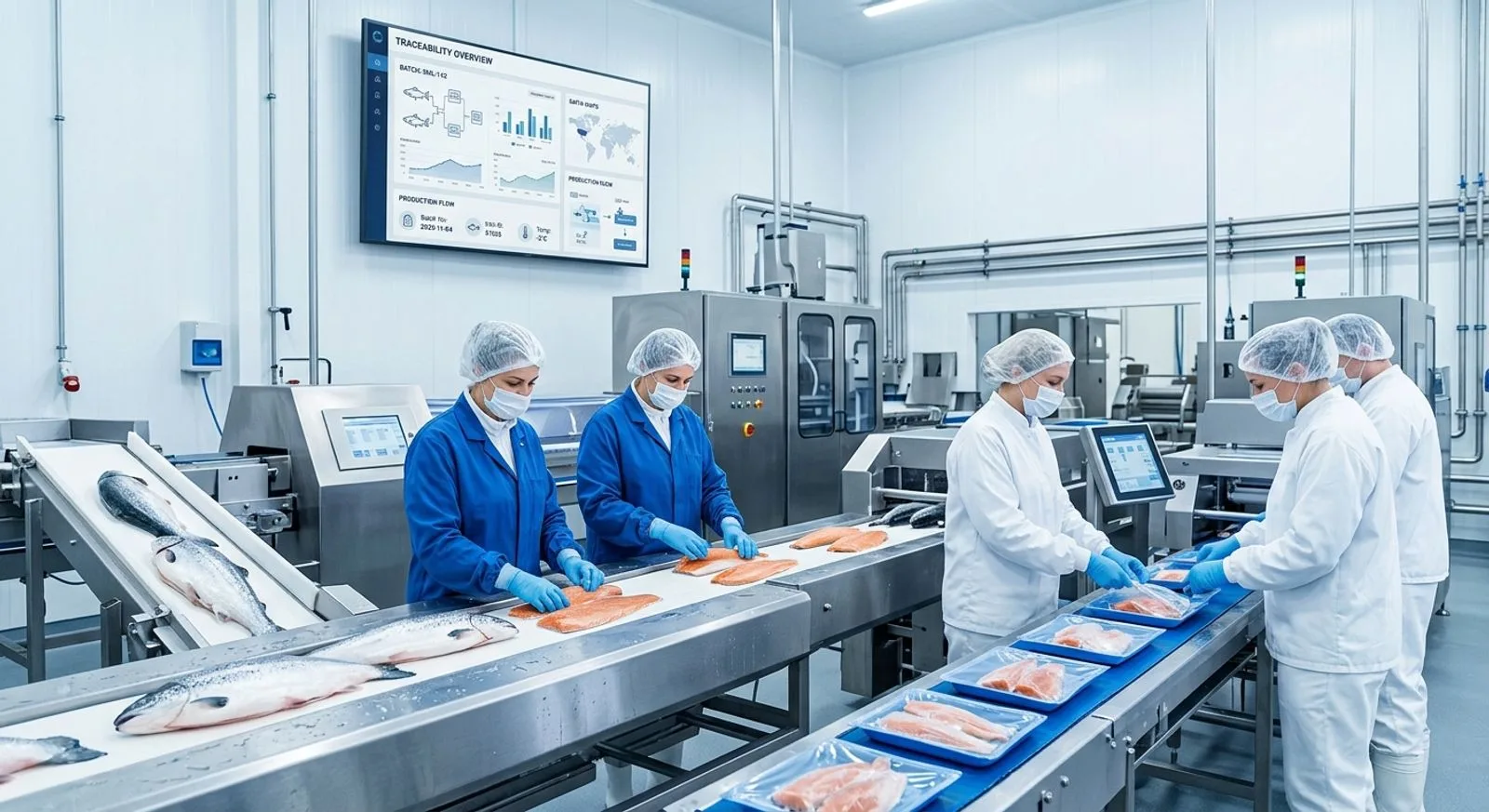
Seafood processing team working beside a digitally monitored production line

Published:Last updated:Author:Gerry Galloway

BUYER’S GUIDE

How we evaluated seafood processing software

Seafood processors manage one of food manufacturing’s most demanding operating environments. Raw material changes by species, vessel, harvest area, size, grade, temperature, certification status, and landed cost. A single receiving lot may become fillets, portions, trim, by-products, rework, and multiple finished SKUs, each with a different yield and margin. The best seafood processing software must preserve that genealogy while helping production, quality, warehouse, purchasing, and finance teams work from the same record.

This guide compares 10 platforms that address different parts of that challenge. FoodReady ranks first for processors that want quality management, lot-controlled inventory, production, supplier oversight, maintenance, and analytics in one cloud system. Mar-Kov and ParityFactory stand out for process manufacturing and plant-floor execution. Wherefour offers approachable cloud traceability for smaller teams, while Aptean, Inecta, and SAP suit organizations seeking broader ERP depth. TraceGains and SafetyChain are stronger when supplier compliance or food quality workflows matter more than full operational control.

We scored each seafood processing software platform across five criteria: traceability and compliance, production and yield control, inventory and cold-chain operations, usability and implementation, and value. Scores reflect product scope and likely fit, not a laboratory benchmark. Pricing marked “custom” means the vendor does not publish a dependable standard rate; buyers should request subscription, implementation, integration, training, support, and data-migration costs separately.

What seafood processors should require

At minimum, seafood processing software should capture supplier and harvest information at receiving, assign or ingest lot codes, record inspections and temperatures, manage catch-weight or variable-weight inventory, and trace transformation through work orders or batches. The system should support quarantine, release, hold, rework, expiration rules, and shipment genealogy. A mock recall should move in both directions: from a finished lot to every input and from an ingredient or raw lot to every customer shipment.

Operational depth matters just as much as compliance. A processor should be able to compare expected and actual yield by species, line, shift, product, or cut; account for trim and by-products; monitor giveaway; and understand margin after labor and material variance. Mobile data capture, barcode support, configurable forms, role-based approvals, and integrations with scales, scanners, accounting software, ERP, laboratory systems, or EDI can determine whether employees use the software consistently.

Finally, evaluate implementation fit rather than buying the longest feature list. A single-site processor with 60 employees needs a different system from a multinational group with complex finance, intercompany transactions, and dedicated SAP administrators. Ask each vendor to demonstrate your own lot structure, units of measure, yield calculations, quality checks, labels, recall report, and receiving-to-shipping workflow using a realistic seafood scenario.

RANKED SHORTLIST

SEAFOOD PROCESSING SOFTWARE REVIEW

The 10 best seafood processing software platforms

A detailed comparison of software for seafood traceability, production, yield, quality, inventory, supplier management, and enterprise planning.

Reviewed by FoodReady Editorial Team · Request a quote based on users

FoodReady
Unified quality, traceability, inventory, production, maintenance, and analytics for seafood manufacturers
9.5
Custom quote
Typical subscription plus implementation; scope dependent
  • Web
  • iOS
  • Android
  • API
Mar-Kov
Process manufacturing ERP for formula, batch, inventory, quality, and warehouse control
8.9
Custom quote
Licensing and implementation vary by modules and deployment
  • Web
  • Windows
  • API
ParityFactory
Plant-floor manufacturing execution and warehouse software built for food processors
8.8
Custom quote
Site, user, integration, and implementation scope affect cost
  • Web
  • Windows
  • API
Wherefour
Accessible cloud ERP for traceability, inventory, production, purchasing, and costing
8.6
Custom subscription
Request a quote based on users, features, and implementation
  • Web
  • API
Icicle ERP
Food-industry ERP connecting traceability, food safety, production, inventory, and business operations
8.5
Custom quote
Modules, users, sites, integrations, and services are scoped separately
  • Web
  • API
Aptean Food & Beverage ERP
Broad food and beverage ERP for processing, planning, quality, traceability, warehousing, and finance
8.4
Custom enterprise quote
Software and implementation depend on edition, sites, users, and integrations
  • Web
  • Windows
  • API
Inecta Food
Microsoft-based food ERP for finance, supply chain, manufacturing, quality, and traceability
8.3
Custom quote
Microsoft licensing, implementation, modules, and partner services vary
  • Web
  • Windows
  • iOS
  • Android
  • API
TraceGains
Supplier compliance, specification, document, quality, and ingredient-network software
8.2
Custom quote
Modules, supplier network access, users, and implementation determine price
  • Web
  • API
SafetyChain
Digital food quality, safety, plant data, audit, and compliance management
8.1
Custom quote
Pricing varies by plants, users, modules, integrations, and rollout services
  • Web
  • iOS
  • Android
  • API
SAP S/4HANA Cloud
Enterprise ERP for global finance, procurement, manufacturing, logistics, quality, and analytics
7.9
Custom enterprise quote
Licensing, partner implementation, integrations, infrastructure, and support are separate considerations
  • Web
  • iOS
  • Android
  • API
Editor's pick

FoodReady

Unified quality, traceability, inventory, production, maintenance, and analytics for seafood manufacturers

  • Editor’s Pick
  • HACCP & FSMA
  • 8–16 week rollout
9.5
Overall score
PricingCustom quote· Typical subscription plus implementation; scope dependent
Platforms
  • Web
  • iOS
  • Android
  • API

Why FoodReady ranks first

FoodReady is the strongest overall seafood processing software choice for mid-market manufacturers that want quality, inventory, production, supply chain, maintenance, cost accounting, and analytics connected in one cloud platform. Receiving teams can capture supplier, lot, temperature, condition, and certificate data; quality teams can manage inspections, HACCP records, nonconformances, CAPA, audits, documents, and training; and operations teams can control work orders, BOMs, routing, scheduling, labor, and lot movement. That shared data model reduces the reconciliation work created when quality software, spreadsheets, inventory tools, and production systems use different identifiers.

For seafood plants, FoodReady’s key differentiator is the connection between compliance and execution. A failed receiving inspection can place affected material on hold before production consumes it. Lot genealogy can follow raw fish through grading, cutting, packing, rework, and shipment. FIFO/FEFO rules, barcode or QR workflows, multi-location inventory, calibration, preventive maintenance, supplier scorecards, and real-time dashboards help teams manage both audit evidence and daily throughput. The software supports web and mobile use, plus integrations with SAP, NetSuite, Dynamics 365, Epicor, Sage, QuickBooks, Zebra and Honeywell scanners, and selected MES or automation environments.

FoodReady was founded in 2020 and has a smaller installed base than decades-old ERP vendors, so global enterprises needing extensive bespoke finance may prefer SAP or Aptean. Its financial accounting also relies on integrations such as QuickBooks or Sage rather than a native general ledger. For the target range of roughly 50 to 1,000 employees, however, an 8–16 week implementation and typical first-year cost of $8,000–$25,000 can be more manageable than assembling separate QMS, ERP, MES, inventory, and maintenance systems. It is best suited to processors that view traceability as an operational backbone rather than a standalone recall tool.

Pros

  • Unifies quality, inventory, production, supplier management, maintenance, and analytics
  • Lot genealogy connects receiving inspections, transformation, holds, rework, and shipments
  • Supports FIFO/FEFO, barcode workflows, multi-site inventory, CAPA, audits, and training
  • Typical 8–16 week implementation is faster than many legacy ERP programs
  • Published scope-based pricing guidance makes early budgeting easier

Cons

  • Newer vendor with a smaller install base than SAP and long-established ERP providers
  • Financial accounting is handled through QuickBooks, Sage, or ERP integration
  • Highly customized global finance may exceed its mid-market sweet spot
  • Final cost depends on modules, sites, integrations, migration, and validation needs

Scorecard

  • Traceability & compliance
    9.8 / 10
  • Production & yield
    9.4 / 10
  • Inventory & cold chain
    9.6 / 10
  • Usability & rollout
    9.3 / 10
  • Value
    9.4 / 10

Feature highlights

  • Forward and backward lot traceability with mock-recall workflows
  • HACCP, inspections, CAPA, nonconformance, audit, document, and training controls
  • Production scheduling, work orders, BOMs, labor tracking, and OEE dashboards
  • Supplier portal, receiving, COA/COC management, approved supplier lists, and scorecards
  • Preventive maintenance, calibration, equipment records, and downtime tracking
  • Cost accounting, variance analysis, product profitability, SPC, and AI-assisted root cause analysis

Best for: Seafood processors with 50–1,000 employees seeking one cloud platform for quality and plant operations

Visit FoodReady
#2

Mar-Kov

Process manufacturing ERP for formula, batch, inventory, quality, and warehouse control

  • Process manufacturing
  • Batch control
8.9
Overall score
PricingCustom quote· Licensing and implementation vary by modules and deployment
Platforms
  • Web
  • Windows
  • API

Mar-Kov is a process manufacturing software platform designed around formulas, batches, inventory, quality, warehousing, and production. That orientation makes it relevant to seafood companies producing sauces, marinades, prepared seafood, smoked products, coatings, or other items where recipes and batch execution matter alongside raw seafood transformation. The system can support lot-controlled materials, production planning, quality tests, labeling, warehouse activity, and traceability from receipt through finished goods.

Its strongest differentiator is manufacturing depth without the size and administrative burden of a Tier 1 enterprise ERP. Teams can connect purchasing, material requirements, batch records, inventory, and quality rather than maintaining separate spreadsheets for formula revisions and actual consumption. For seafood processors, that can improve visibility into ingredients, packaging, allergens, shelf life, and production variance. Buyers should ask Mar-Kov to demonstrate catch-weight handling, split and merge scenarios, co-products, by-products, and the precise yield model required for primary seafood processing because these needs vary substantially.

Mar-Kov does not publish standardized pricing, so subscription, hosting, implementation, integrations, reporting, migration, and support require a scoped quote. The platform will generally demand more configuration and master-data preparation than a lightweight traceability application. It is a good fit for growing processors that need credible process ERP control but do not want the broad organizational complexity of SAP. Organizations whose top priority is supplier-document collaboration rather than production execution may find TraceGains more focused.

Pros

  • Strong formula, batch, lot, inventory, warehouse, and production capabilities
  • Designed for process manufacturers rather than generic distribution alone
  • Connects quality checks to materials and manufacturing records
  • Supports growing operations that have outgrown spreadsheets

Cons

  • Public pricing is unavailable and requires a scoped sales process
  • Implementation needs disciplined formulas, item masters, routings, and lot rules
  • Seafood-specific catch-weight and co-product scenarios should be proven in a demo
  • May be more system than a small processor with simple workflows needs

Scorecard

  • Traceability & compliance
    9.0 / 10
  • Production & yield
    9.2 / 10
  • Inventory & cold chain
    8.9 / 10
  • Usability & rollout
    8.2 / 10
  • Value
    8.5 / 10

Feature highlights

  • Formula and recipe management with batch production records
  • Lot-controlled inventory, warehousing, purchasing, and material planning
  • Quality tests, specifications, labels, and traceability reporting
  • Production planning and actual-versus-expected material analysis

Best for: Mid-sized seafood and prepared-food manufacturers needing process ERP and batch control

Visit Mar-Kov
#3

ParityFactory

Plant-floor manufacturing execution and warehouse software built for food processors

  • Food manufacturing
  • Plant-floor execution
8.8
Overall score
PricingCustom quote· Site, user, integration, and implementation scope affect cost
Platforms
  • Web
  • Windows
  • API

ParityFactory focuses on food manufacturing execution, inventory control, warehousing, traceability, and plant-floor data collection. It is particularly relevant when a seafood processor’s main problem is not corporate accounting but the movement and transformation of materials inside the facility. Operators can record consumption, output, transfers, holds, and production activity closer to the point where work occurs, improving the timeliness of inventory and genealogy records.

The differentiator is practical factory execution. Seafood businesses often struggle when an ERP contains the official inventory balance while supervisors maintain the real production story on paper or in spreadsheets. ParityFactory is designed to close that gap with production, warehouse, labeling, and traceability workflows. It may be a strong option for plants that need barcode-directed movement, accurate work-in-process, and rapid recall data without replacing every finance application. Buyers should test variable-weight items, partial pallets, regrading, repacking, thawing, glazing, co-products, and yield by cut or line.

Pricing is quote based, and total cost depends on devices, labels, interfaces, sites, process design, and implementation services. Because ParityFactory emphasizes execution, some organizations will still need an ERP or accounting system for broader finance and commercial management. That architecture can be an advantage when the existing ERP is stable, but it also creates integration responsibilities. ParityFactory is best for seafood processors seeking a stronger digital plant floor and warehouse rather than a single suite that owns quality, maintenance, and enterprise finance.

Pros

  • Purpose-built emphasis on food plant-floor and warehouse execution
  • Captures material movement and production events near the source
  • Strong fit for barcode, labeling, work-in-process, and recall workflows
  • Can complement an existing ERP instead of forcing wholesale replacement

Cons

  • Broader finance and corporate ERP capabilities may require another platform
  • Integration quality is critical when ERP remains the financial system of record
  • Pricing and deployment effort are not published as a standard package
  • Advanced QMS or maintenance requirements may need additional tools

Scorecard

  • Traceability & compliance
    9.1 / 10
  • Production & yield
    9.3 / 10
  • Inventory & cold chain
    9.2 / 10
  • Usability & rollout
    8.3 / 10
  • Value
    8.3 / 10

Feature highlights

  • Plant-floor production data collection and material consumption
  • Warehouse, barcode, labeling, pallet, and lot control
  • Work-in-process visibility and forward or backward traceability
  • ERP integration for processors retaining an existing financial backbone

Best for: Food and seafood plants prioritizing manufacturing execution, warehouse accuracy, and recall speed

Visit ParityFactory
#4

Wherefour

Accessible cloud ERP for traceability, inventory, production, purchasing, and costing

  • Cloud ERP
  • SMB friendly
8.6
Overall score
PricingCustom subscription· Request a quote based on users, features, and implementation
Platforms
  • Web
  • API

Wherefour is a cloud manufacturing ERP built for traceability, production, inventory, purchasing, sales, and costing. Its browser-based approach and relatively approachable scope make it attractive to small and midsize seafood processors moving away from spreadsheets or disconnected accounting tools. Teams can manage ingredients and materials, create production runs, record lot consumption and output, generate labels, maintain inventory, and follow product genealogy through sales.

Wherefour’s differentiator is usability for smaller organizations that need meaningful food manufacturing controls without a large internal IT department. The software can help a processor establish consistent lot coding, centralize formulas or BOMs, improve stock visibility, and build recall records during everyday transactions. Costing and production information may also help managers compare expected inputs with actual outcomes. Before purchase, seafood companies should confirm support for catch weight, multiple units of measure, variable yield, co-products, by-products, grading, landed cost, and any required scale or scanner workflow.

The vendor uses custom pricing rather than a universally published price list. Implementation is likely lighter than a multinational ERP program, but clean item, supplier, lot, formula, customer, and inventory data still determine success. Wherefour may lack the extensive QMS, maintenance, and global finance depth that larger processors require. It is best suited to single-site or smaller multi-site manufacturers that value straightforward cloud traceability and production management over highly customized enterprise processes.

Pros

  • Approachable cloud software for inventory, production, sales, purchasing, and traceability
  • Good step up from spreadsheets for small and midsize processors
  • Lot genealogy and labels are embedded in daily manufacturing transactions
  • Includes costing and commercial workflows beyond standalone quality software

Cons

  • May not match enterprise suites for global finance, intercompany, and localization
  • Deep QMS, maintenance, or laboratory workflows may require complementary systems
  • Seafood-specific variable-weight and co-product needs require demonstration
  • Standard pricing is not publicly disclosed

Scorecard

  • Traceability & compliance
    8.8 / 10
  • Production & yield
    8.5 / 10
  • Inventory & cold chain
    8.7 / 10
  • Usability & rollout
    9.0 / 10
  • Value
    8.6 / 10

Feature highlights

  • Production runs, BOMs or recipes, lot consumption, and finished output
  • Inventory, purchasing, sales orders, labels, and recall genealogy
  • Cloud access with integrations through an API
  • Manufacturing costing and expected-versus-actual visibility

Best for: Small and midsize seafood processors replacing spreadsheets with an approachable cloud ERP

Visit Wherefour
#5

Icicle ERP

Food-industry ERP connecting traceability, food safety, production, inventory, and business operations

  • Food ERP
  • Traceability
8.5
Overall score
PricingCustom quote· Modules, users, sites, integrations, and services are scoped separately
Platforms
  • Web
  • API

Icicle ERP is a food-industry software platform that combines traceability, food safety, inventory, production, purchasing, sales, and operational management. Its food-sector orientation makes it relevant to seafood processors that want more industry context than a generic ERP normally provides. The platform is designed to connect specifications, materials, production activity, and finished goods so users can follow lots and maintain compliance records inside the broader operating system.

Icicle’s differentiator is the breadth of food manufacturing capabilities in one environment. Processors can evaluate it for raw material control, recipes or formulations, production planning, quality and safety tasks, warehouse activity, labeling, costing, and recall readiness. That integrated approach can reduce duplicate entry between compliance and operations. Seafood buyers should nevertheless insist on a scenario-specific demonstration: receive variable-weight fish, split a lot into grades, create multiple outputs and trim, place one component on hold, repack finished product, and produce both mass-balance and customer-distribution reports.

Pricing is not published as a standard package. A realistic budget should include software, configuration, migration, reporting, interfaces, validation, training, and ongoing support. As with any broad ERP, implementation requires process ownership and accurate master data. Icicle can be a compelling candidate for processors wanting food-specific ERP breadth, but smaller teams may prefer Wherefour’s narrower footprint, while companies requiring extensive multinational financial functionality may lean toward Aptean or SAP.

Pros

  • Food-industry focus across safety, traceability, inventory, production, and commercial operations
  • Connects compliance information with everyday manufacturing records
  • Supports a broader operating model than standalone recall software
  • Relevant to multi-department food and seafood manufacturing teams

Cons

  • Quote-based pricing makes early comparison less transparent
  • Broad implementation requires process mapping, governance, and data preparation
  • Complex seafood yield and catch-weight scenarios must be validated before selection
  • May be excessive for very small plants with limited transaction volume

Scorecard

  • Traceability & compliance
    9.1 / 10
  • Production & yield
    8.6 / 10
  • Inventory & cold chain
    8.7 / 10
  • Usability & rollout
    8.0 / 10
  • Value
    8.1 / 10

Feature highlights

  • Food safety, quality, specifications, and lot traceability
  • Production, inventory, purchasing, sales, and warehouse processes
  • Recall support, labels, records, and operational reporting
  • Integrated food manufacturing data across departments

Best for: Established food and seafood manufacturers wanting industry-oriented ERP breadth

Visit Icicle ERP
#6

Aptean Food & Beverage ERP

Broad food and beverage ERP for processing, planning, quality, traceability, warehousing, and finance

  • Enterprise food ERP
  • Multi-site
8.4
Overall score
PricingCustom enterprise quote· Software and implementation depend on edition, sites, users, and integrations
Platforms
  • Web
  • Windows
  • API

Aptean Food & Beverage ERP targets food manufacturers that need integrated planning, production, quality, traceability, inventory, warehousing, sales, and financial management. Its broader ERP scope makes it a serious candidate for established seafood companies with multiple plants, complex purchasing, customer requirements, EDI, sophisticated planning, and a need to connect operational transactions with finance.

The principal differentiator is industry-oriented enterprise breadth. A seafood processor can evaluate Aptean for demand planning, procurement, production orders, lot and expiration control, quality status, warehouse management, labeling, recall reporting, costing, customer orders, and financials. This can reduce the need to integrate a niche production tool with a separate general ledger and supply-chain system. The tradeoff is complexity: detailed configuration, integrations, testing, role design, training, and change management are usually necessary to realize that breadth.

Aptean does not provide a simple public list price. Buyers should model licenses or subscriptions, implementation partners, migration, custom reports, EDI, devices, integrations, upgrades, support, and internal project time. Ask for reference customers with comparable seafood processes and require proof of variable-weight inventory, catch weight, yield, by-products, rework, grading, labeling, and recall mass balance. Aptean is best for larger processors that need food ERP and finance together and can support a structured implementation program.

Pros

  • Broad food manufacturing ERP coverage including financial and commercial processes
  • Suitable for multi-site planning, production, inventory, warehouse, and quality needs
  • Industry orientation is stronger than a generic horizontal ERP
  • Can reduce the number of separate operational and financial systems

Cons

  • Implementation can be lengthy and resource intensive
  • Total cost requires a detailed enterprise quote and implementation plan
  • Configuration breadth can increase training and governance demands
  • Smaller processors may pay for complexity they do not need

Scorecard

  • Traceability & compliance
    8.8 / 10
  • Production & yield
    8.7 / 10
  • Inventory & cold chain
    8.9 / 10
  • Usability & rollout
    7.4 / 10
  • Value
    7.7 / 10

Feature highlights

  • Food production planning, execution, quality status, and lot control
  • Warehouse, purchasing, sales, EDI, costing, and financial management
  • Multi-site operations and enterprise reporting
  • Recall genealogy, shelf-life management, and labeling support

Best for: Larger seafood processors needing industry ERP, multi-site operations, and integrated finance

Visit Aptean
#7

Inecta Food

Microsoft-based food ERP for finance, supply chain, manufacturing, quality, and traceability

  • Microsoft Dynamics 365
  • Food ERP
8.3
Overall score
PricingCustom quote· Microsoft licensing, implementation, modules, and partner services vary
Platforms
  • Web
  • Windows
  • iOS
  • Android
  • API

Inecta Food is an ERP solution built for food businesses on Microsoft Dynamics 365 Business Central. It extends Microsoft’s finance, purchasing, sales, inventory, and reporting foundation with food-industry capabilities such as lot traceability, catch weight, quality, production, costing, warehouse management, and regulatory information. This combination is especially relevant to seafood processors already invested in Microsoft tools or seeking a familiar ERP ecosystem.

Its differentiator is the balance between food-specific functionality and a widely used business platform. Finance teams gain Business Central’s accounting and reporting environment, while operations can manage materials, production, lots, expiration, warehouse transactions, and customer orders. Seafood companies should test the exact catch-weight behavior, units-of-measure conversions, yield calculations, co-products, landed cost, labels, GS1 requirements, and recall reporting they need. Microsoft’s ecosystem can also provide options for analytics and integrations, although those choices add architecture and partner-management decisions.

Pricing combines Microsoft licensing with Inecta functionality and implementation services, so a direct quote is essential. The implementation partner’s food expertise can matter as much as the software itself. Configuration, data migration, reporting, integration, testing, and training can make the project more substantial than adopting a lightweight cloud application. Inecta is best for seafood processors that want food functionality and integrated finance within a Microsoft-centered technology strategy.

Pros

  • Combines food-industry functionality with Microsoft Dynamics 365 Business Central
  • Integrated finance, sales, purchasing, inventory, manufacturing, and reporting
  • Relevant capabilities include catch weight, lots, quality, warehousing, and costing
  • Access to Microsoft’s broader integration and analytics ecosystem

Cons

  • Cost includes Microsoft licensing, food extensions, implementation, and partner services
  • Project results depend heavily on the selected implementation partner
  • Customization can complicate upgrades and long-term ownership
  • Smaller plants may not need a full Microsoft ERP program

Scorecard

  • Traceability & compliance
    8.6 / 10
  • Production & yield
    8.4 / 10
  • Inventory & cold chain
    8.8 / 10
  • Usability & rollout
    7.8 / 10
  • Value
    7.8 / 10

Feature highlights

  • Catch-weight, lot, expiration, quality, and recall management
  • Food production, costing, purchasing, sales, and warehousing
  • Business Central financials and Microsoft ecosystem connectivity
  • Mobile, web, reporting, and integration options

Best for: Microsoft-oriented seafood companies requiring food ERP and financial management

Visit Inecta
#8

TraceGains

Supplier compliance, specification, document, quality, and ingredient-network software

  • Supplier management
  • Specifications
8.2
Overall score
PricingCustom quote· Modules, supplier network access, users, and implementation determine price
Platforms
  • Web
  • API

TraceGains is a supply-chain and quality software platform known for supplier collaboration, specifications, document collection, ingredient information, and compliance workflows. For seafood processors, it can centralize supplier approvals, certificates, questionnaires, specifications, regulatory documents, allergen or ingredient records, and communication across a broad supplier base. That focus is valuable when quality staff spend excessive time requesting updated documents and reconciling supplier information.

The differentiator is network-enabled supplier and specification management rather than plant-floor production execution. Seafood companies can use TraceGains to improve visibility into vendors, raw-material requirements, documentation status, and product development information. It can complement an ERP, QMS, or manufacturing execution system by giving procurement, R&D, regulatory, and quality teams a more controlled supplier-information process. Buyers should examine how seafood attributes such as species, harvest method, origin, certifications, treatment, temperature, sustainability claims, and approved source requirements are modeled.

Pricing is custom, and organizations should clarify which modules, network services, supplier connections, integrations, onboarding, and support are included. TraceGains is not the natural choice for detailed catch-weight inventory, work-order execution, yield control, equipment maintenance, or financial accounting. Those processes generally remain in ERP, MES, or other systems. It is best for seafood processors whose most urgent risk lies upstream in supplier compliance, specification control, and documentation rather than on the cutting or packing line.

Pros

  • Strong supplier document, specification, compliance, and collaboration workflows
  • Useful for quality, procurement, R&D, and regulatory teams
  • Helps centralize supplier and ingredient information that often lives in email
  • Can complement an existing ERP or production system

Cons

  • Not a full plant-floor production, yield, inventory, maintenance, or finance platform
  • Value depends on module selection, supplier participation, and integration design
  • Custom pricing limits simple budget comparison
  • Processors may still need separate operational software

Scorecard

  • Traceability & compliance
    8.8 / 10
  • Production & yield
    6.9 / 10
  • Inventory & cold chain
    7.1 / 10
  • Usability & rollout
    8.4 / 10
  • Value
    7.8 / 10

Feature highlights

  • Supplier approval, questionnaires, document requests, and compliance status
  • Specifications, ingredient data, product development, and regulatory records
  • Supplier network and collaboration workflows
  • ERP and business-system integration options

Best for: Seafood processors prioritizing supplier compliance, specifications, and document automation

Visit TraceGains
#9

SafetyChain

Digital food quality, safety, plant data, audit, and compliance management

  • Food quality
  • Mobile data capture
8.1
Overall score
PricingCustom quote· Pricing varies by plants, users, modules, integrations, and rollout services
Platforms
  • Web
  • iOS
  • Android
  • API

SafetyChain is food quality management software focused on digitizing safety, quality, compliance, and plant data. Seafood processors can use it to replace paper checks, standardize inspections, monitor process conditions, manage corrective actions, prepare for audits, and analyze quality records across facilities. Mobile data collection can bring receiving checks, sanitation verification, temperatures, pre-operational inspections, process controls, and finished-product reviews into a consistent workflow.

Its key differentiator is food-specific quality execution. Rather than attempting to become a complete financial ERP, SafetyChain helps quality and operations teams collect data, trigger alerts, manage deviations, and create defensible records. This can be useful for HACCP monitoring, environmental or sanitation programs, supplier and receiving checks, and continuous improvement. Seafood organizations should ask the vendor to show offline behavior, device support, instrument or sensor connectivity, escalation rules, form governance, record corrections, electronic signatures, and multi-site dashboards.

Pricing is quote based, with cost influenced by modules, plants, users, integrations, implementation, and support. SafetyChain does not replace deep catch-weight inventory, production costing, corporate finance, or complete warehouse management. A processor may therefore need ERP or MES integration to connect quality events with lot consumption and shipment genealogy. SafetyChain is best for companies that already have an operational backbone but need stronger digital quality and food safety control across one or more plants.

Pros

  • Food-industry focus for safety, quality, compliance, and plant data
  • Mobile forms can replace paper checks across receiving and production
  • Alerts, corrective actions, analytics, and multi-site standardization
  • Good fit alongside an established ERP

Cons

  • Not a complete ERP for finance, catch-weight inventory, costing, and order management
  • Recall genealogy depends on integrations and surrounding system architecture
  • Custom pricing requires a detailed scope comparison
  • Large form libraries need governance to avoid inconsistent records

Scorecard

  • Traceability & compliance
    8.7 / 10
  • Production & yield
    7.4 / 10
  • Inventory & cold chain
    7.0 / 10
  • Usability & rollout
    8.6 / 10
  • Value
    7.7 / 10

Feature highlights

  • Digital inspections, HACCP checks, temperatures, sanitation, and quality records
  • Alerts, deviations, corrective actions, approvals, and audit readiness
  • Mobile plant-floor data collection and dashboards
  • Multi-site standardization and integration options

Best for: Multi-site seafood processors digitizing food safety and quality on top of an existing ERP

Visit SafetyChain
#10

SAP S/4HANA Cloud

Enterprise ERP for global finance, procurement, manufacturing, logistics, quality, and analytics

  • Global enterprise ERP
  • Complex operations
7.9
Overall score
PricingCustom enterprise quote· Licensing, partner implementation, integrations, infrastructure, and support are separate considerations
Platforms
  • Web
  • iOS
  • Android
  • API

SAP S/4HANA Cloud is a broad enterprise ERP covering finance, procurement, manufacturing, logistics, sales, quality, asset management, and analytics. It is not seafood-specific out of the box, yet it can serve large seafood groups that require multinational accounting, intercompany transactions, sophisticated supply planning, enterprise procurement, warehouse integration, and standardized controls across many business units. Industry requirements are typically addressed through configuration, partner expertise, extensions, and connected SAP products.

SAP’s differentiator is enterprise scale and process breadth. A multinational harvester, processor, distributor, or branded seafood company can build a common transactional backbone for purchasing, production, inventory, quality, maintenance, orders, and finance. However, seafood operations should not assume that standard ERP processes automatically solve catch weight, vessel or harvest attributes, grading, split and merge genealogy, yield by cut, co-products, quota-related data, cold-store scanning, or complex labels. Those requirements need detailed solution design and may involve specialized partner applications.

Pricing is custom and total ownership extends well beyond subscriptions. Buyers must budget for implementation partners, process redesign, data migration, integrations, testing, extensions, training, support, and ongoing governance. Deployment commonly demands a dedicated program team and is disproportionate for smaller processors. SAP is best when global financial control and enterprise standardization outweigh the desire for a fast, seafood-focused rollout. Mid-market plants seeking operational results in months rather than a broad transformation should compare FoodReady, Mar-Kov, or Wherefour first.

Pros

  • Exceptional breadth across global finance, supply chain, manufacturing, quality, and assets
  • Supports complex multi-company, multi-country, and intercompany requirements
  • Large partner, integration, and analytics ecosystem
  • Suitable as a long-term enterprise system of record

Cons

  • High implementation effort, governance burden, and total cost
  • Seafood-specific workflows usually require configuration, extensions, or partners
  • Longer time to value than focused mid-market software
  • Poor fit for smaller processors without dedicated ERP resources

Scorecard

  • Traceability & compliance
    8.1 / 10
  • Production & yield
    8.3 / 10
  • Inventory & cold chain
    8.7 / 10
  • Usability & rollout
    6.5 / 10
  • Value
    6.8 / 10

Feature highlights

  • Global finance, procurement, production, sales, quality, and asset management
  • Enterprise planning, logistics, warehouse integration, and analytics
  • Multi-company and multinational process standardization
  • Extensive partner and integration ecosystem

Best for: Large multinational seafood groups prioritizing global ERP and financial standardization

Visit SAP

Scores are editorial assessments of product scope and likely fit. Except where a range is stated, vendors use custom pricing; confirm current subscriptions, implementation, integration, support, and migration costs directly.

SELECTION FRAMEWORK

How to choose seafood processing software

Choosing seafood processing software should begin with process risk, not a generic feature checklist. Map the flow from supplier approval and purchase order through receiving, inspection, grading, storage, transformation, packing, release, shipment, return, and recall. Document every point where a lot can split, merge, change status, change unit of measure, or become a co-product. Include frozen, chilled, thawed, reworked, quarantined, and customer-owned inventory if they occur in your operation.

Run a seafood-specific demonstration

Give each vendor the same scripted scenario and require live execution rather than slides. A useful test starts with a variable-weight receiving lot tied to supplier, vessel or farm, species, harvest area, date, certification, temperature, and COA. Split that lot into two grades, consume each grade in different work orders, create fillets, portions, trim, and waste, then repack one finished lot. The software should retain genealogy through every change.

Next, introduce an exception. Fail an inspection, place affected inventory on hold, investigate the deviation, approve a partial release, and show how the decision appears to warehouse and production users. Ask the vendor to produce a forward trace, backward trace, customer distribution list, on-hand location report, and mass-balance calculation. Time the exercise and count manual exports, spreadsheet steps, and administrator interventions.

Finally, test the daily details that decide adoption: barcode scans with wet gloves, catch-weight labels, unit conversions, offline work, role permissions, record corrections, supervisor approvals, multilingual screens, and search speed. A polished dashboard cannot compensate for slow receiving or ambiguous lot selection on the plant floor.

Compare the complete cost

Request a three-year cost model covering subscription or licenses, implementation, data migration, integrations, labels, scanners, scales, reports, validation, training, travel, support, upgrades, and internal project labor. Custom pricing should be decomposed by site, user type, module, transaction volume, storage, API use, and supplier access. Determine which costs rise as plants, products, or users expand.

Architecture also affects cost. A quality-only platform may appear inexpensive but require ERP, MES, inventory, maintenance, and business-intelligence integrations. A full ERP can consolidate systems but demand a larger implementation team and longer change program. A unified mid-market platform may offer faster value, yet finance or highly specialized seafood functions could still require integration. Compare the complete operating model, not the software invoice alone.

Contract terms deserve equal scrutiny. Define service levels, data ownership, export formats, security obligations, backup and recovery expectations, sandbox access, support response, price increases, implementation acceptance, and termination assistance. Ask who owns configurations and reports created during the project and what happens to mobile workflows during an outage.

Match the platform to the operating model

Choose FoodReady when the business wants quality, traceability, inventory, production, supplier management, maintenance, and analytics in one cloud platform and values an 8–16 week implementation target. Choose Mar-Kov when formula and batch process manufacturing depth leads the requirements. Choose ParityFactory when plant-floor execution and warehouse control must improve while an existing ERP remains in place. Choose Wherefour when a smaller team needs approachable cloud manufacturing and traceability.

Consider TraceGains when supplier compliance, documents, specifications, and collaboration are the urgent priorities. Consider SafetyChain when paper quality checks and plant data need digitization across facilities. Consider Inecta when Microsoft Business Central is strategically important, Aptean when a larger food manufacturer needs industry ERP with finance, and SAP when multinational standardization and corporate financial complexity justify enterprise-scale investment.

Before signing, speak with at least two reference customers that process products with similar variability, cold-chain demands, labeling rules, and production volume. Ask what required customization, what data migration was hardest, how long operators took to adopt the system, which integrations remain fragile, and what they would design differently. The best seafood processing software is the system your teams can operate accurately during a busy shift and trust during a real recall.

COMMON QUESTIONS

Seafood processing software FAQ

Practical answers about capabilities, pricing, implementation, traceability, yield, compliance, integrations, and vendor selection.

What is seafood processing software?

Seafood processing software manages lot traceability, receiving, quality, inventory, production, yield, warehousing, labeling, costing, and recall records. The best systems connect raw-material identity and condition to every transformation and shipment. Some products are complete ERP platforms, while others focus on manufacturing execution, supplier compliance, or food quality. The right category depends on whether the processor needs an operational backbone or a specialized layer.

Which seafood processing software is best overall?

FoodReady is the best overall option in this comparison for midsize processors seeking unified quality, inventory, production, suppliers, maintenance, and analytics. Mar-Kov is strong for process manufacturing, ParityFactory for plant-floor execution, and Wherefour for smaller cloud-first teams. Aptean, Inecta, and SAP are better candidates when broad ERP and financial management carry more weight than implementation speed.

How much does seafood processing software cost?

Most seafood processing software vendors use custom pricing based on sites, users, modules, integrations, migration, and services. Ask every vendor for a three-year model that separates software, implementation, support, devices, labels, interfaces, custom reports, training, and internal labor.

Does seafood software support catch weight and variable-weight inventory?

Some platforms support catch weight and multiple units of measure, but behavior varies enough that buyers must test it directly. Ask the vendor to receive cases with actual and nominal weight, split lots, convert units, relabel partial inventory, pick by weight, invoice correctly, and preserve genealogy. Also verify tolerance handling, scale integration, rounding, costing, and reporting for net, gross, and drained weight where relevant.

How should seafood processors test traceability and recalls?

Use a timed mock recall that follows both directions and includes a lot split, multiple outputs, rework, a hold, and repacking. The software should identify every input, transformation, location, remaining quantity, and customer shipment without manual spreadsheet reconstruction. Require mass balance, exception explanations, exportable evidence, user audit history, and proof that released, quarantined, destroyed, and shipped quantities reconcile.

Can the software track yield, trim, co-products, and waste?

Manufacturing-focused software can record expected and actual inputs, primary outputs, trim, co-products, by-products, rework, and waste. Buyers should confirm whether yield can be analyzed by species, supplier, grade, product, cut, line, shift, and employee. Also test how the platform values secondary outputs and whether costing distinguishes recoverable trim from disposal. Quality-only software usually lacks this level of production economics.

What food safety capabilities should be included?

Seafood processing software should support supplier approval, receiving inspections, temperature checks, HACCP monitoring, sanitation records, specifications, holds, release, deviations, corrective actions, documents, training, audits, and recalls. Requirements vary by product and market, so the platform should provide configurable controls rather than a fixed generic checklist. Electronic signatures, audit trails, permissions, record correction, and retention rules also need review.

How long does implementation take?

Implementation ranges from weeks for focused cloud software to many months or longer for complex enterprise ERP. FoodReady’s typical target is 8–16 weeks, but every schedule depends on scope, data quality, integrations, validation, sites, and available subject-matter experts. A credible plan should include discovery, configuration, migration, testing, training, pilot operation, cutover, and post-launch support with named owners and acceptance criteria.

Which integrations matter most for seafood processors?

Common priorities include accounting or ERP, EDI, barcode scanners, label printers, scales, temperature devices, laboratory systems, maintenance tools, supplier portals, warehouse automation, and business intelligence. Define which platform owns each data element before integrating. Test error handling, duplicate prevention, retry behavior, unit conversion, lot synchronization, security, monitoring, and support responsibility instead of evaluating only whether an API exists.

What questions should buyers ask customer references?

Ask references about implementation duration, data cleanup, operator adoption, support quality, integration stability, upgrade impact, reporting effort, and unexpected costs. Select references with similar species, products, plant size, catch-weight processes, cold-chain requirements, and customer labels. Request examples of a difficult recall, production exception, or system outage. Their answers often reveal operational constraints that product demonstrations and proposal documents overlook.

Written by

gerry galloway

Gerry Galloway

CEO / Co-Founder of FoodReady. Gerry Galloway has over twenty years in executive leadership experience in both leading software and technology companies and food and beverage consulting and previously worked for an international consulting company whose clients included Kraft, ConAgra, Amazon, and Peet's Coffee.

Get a demo

Speak with our Expert Consultants

15–30 minutes. We map FoodReady to your process, plug in your real HACCP plan, and show you the auditor view before the call ends.

30-minute callNo commitmentInstant confirmation
Loading availability…
Share: