10 Best HACCP Software Companies for Food Manufacturers

Discover the top HACCP software companies of 2026. Compare pricing, features, pros, cons, and scorecards to find the perfect food safety compliance platform for your facility.

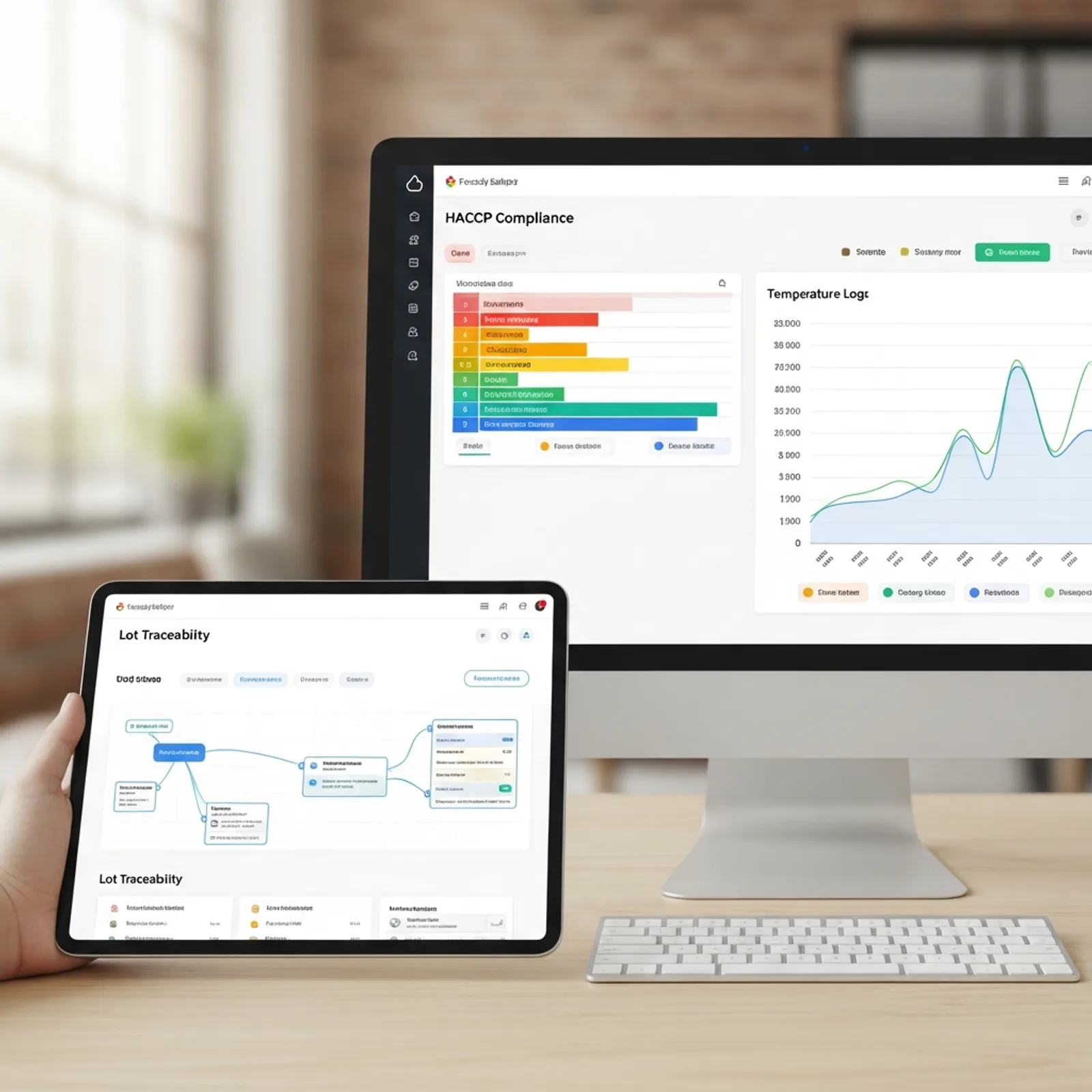
Modern food safety software dashboard showing HACCP compliance and lot traceability charts on a tablet and desktop screen

Published:Last updated:Author:Saro Loucks

The Digital Transformation of HACCP Compliance

In the modern food manufacturing landscape, maintaining rigorous food safety standards is no longer just a regulatory requirement—it is a critical pillar of operational viability and brand trust. For decades, Hazard Analysis Critical Control Point (HACCP) plans were managed using bulky binders, paper checklists, and manual temperature logs. While these paper-based systems technically satisfied basic compliance audits, they introduced significant operational friction, increased the risk of human error, and made real-time traceability nearly impossible. Today, as supply chains become more complex and regulatory scrutiny intensifies under the Food Safety Modernization Act (FSMA), food manufacturers are rapidly transitioning to digital HACCP software to automate their compliance workflows and protect their businesses from costly recalls.

The shift from paper to digital is driven by the need for real-time visibility and immediate action. When a critical control point (CCP) deviation occurs—such as a pasteurizer failing to reach the required temperature or a metal detector malfunctioning—a paper-based system relies on an operator noticing the issue, documenting it, and manually alerting a supervisor. This process can take hours, during which non-compliant product continues to move down the line. In contrast, modern HACCP software provides instant alerts via SMS or email the moment a deviation is logged, allowing quality teams to quarantine affected lots immediately. This proactive approach not only prevents contaminated food from leaving the facility but also reduces scrap and rework costs by catching issues at the source.

Furthermore, the introduction of FSMA Section 204 has established strict new traceability requirements for high-risk foods, demanding that manufacturers maintain detailed records of Key Data Elements (KDEs) and Critical Tracking Events (CTEs) throughout the supply chain. Meeting these standards using manual methods is an administrative nightmare that can easily overwhelm quality departments. Digital HACCP platforms solve this challenge by unifying food safety compliance with lot traceability and inventory management. By capturing data electronically at every stage of production—from receiving raw ingredients to shipping finished goods—these systems allow manufacturers to execute mock recalls in under 30 minutes, ensuring they are always ready for unannounced audits and regulatory inspections.

2026 Buyer's Guide

Software Review

Top 10 HACCP Software Companies Ranked

Reviewed by Sarah Jenkins · ASQ CQE & ISO 22000 Lead Auditor · 15 years food safety experience

FoodReady
AI-Powered Manufacturing Management Software for Food Safety and Compliance
9.8
$15K–30K/yr
First-year total (subscription + implementation)
  • Web
  • iOS
  • Android
  • API
Safefood 360
Enterprise Food Safety and Compliance Management Software
8.9
$30K–80K/yr
Subscription only; implementation extra
  • Web
Icicle Technologies
Advanced Food ERP and Safety Management Platform
8.7
$45K–110K/yr
Includes core ERP and safety modules
  • Web
  • iOS
  • Android
MasterControl
Document-Control-First QMS for Regulated Life Sciences and Food
8.4
$60K–150K/yr
Per-module pricing; implementation extra
  • Web
ETQ Reliance
Enterprise Quality Management Software with Deep CAPA Workflows
8.3
$80K–200K/yr
Subscription only; implementation extra
  • Web
Qualio
Cloud-Based QMS for Fast-Growing Life Sciences and Food Tech
8.1
$35K–75K/yr
Flat-rate annual subscription
  • Web
ComplianceQuest
Salesforce-Native Enterprise Quality and Safety Platform
8.0
$50K–120K/yr
Requires Salesforce licenses; implementation extra
  • Web
  • iOS
  • Android
AssurX
Versatile Quality Management and Regulatory Compliance Software
7.9
$55K–130K/yr
Subscription and on-premise options
  • Web
  • Windows
Intellect
No-Code QMS and EHS Software for Operational Excellence
7.8
$40K–90K/yr
Flat-rate subscription based on user tiers
  • Web
  • iOS
  • Android
TrackWise
Enterprise Quality Management Software for Global Manufacturers
7.6
$100K–250K/yr
Enterprise deployment; implementation extra
  • Web
Editor's pick

FoodReady

AI-Powered Manufacturing Management Software for Food Safety and Compliance

  • FSMA 204 Ready
  • AI-Powered
  • SQF / BRCGS
9.8
Overall score
Pricing$15K–30K/yr· First-year total (subscription + implementation)
Platforms
  • Web
  • iOS
  • Android
  • API

FoodReady is a comprehensive, cloud-based food safety and quality management software designed specifically for food and beverage manufacturers, processors, and co-packers. Founded in 2020, the platform has quickly become a leader in the industry by unifying HACCP compliance, lot traceability, inventory control, and production management into a single, cohesive system. Unlike legacy QMS tools that operate in isolation, FoodReady connects quality events directly to inventory and production floor activities, eliminating the need for expensive integrations and reducing administrative labor by 40% to 60%.

The platform's standout feature is its AI-powered compliance engine, which assists quality managers in conducting root cause analysis and generating corrective and preventive actions (CAPAs). FoodReady provides pre-built templates for SQF, BRCGS, FSSC 22000, and USDA/FDA HACCP plans, allowing facilities to transition from paper-based records to digital compliance in just 8 to 16 weeks. With its offline-capable mobile application for iOS and Android, floor operators can easily log temperature checks, sanitation checklists, and metal detector calibrations directly from the production line, ensuring real-time data capture and immediate alerts for any critical control point (CCP) deviations.

FoodReady's inventory and traceability modules are exceptionally robust, enabling manufacturers to achieve 98% to 99.5% inventory accuracy and execute mock recalls in under 30 minutes. The system tracks raw materials from receiving through production to finished goods shipping, mapping out complete lot genealogy with barcode and QR code scanning. This level of detail is critical for meeting FSMA 204 traceability requirements and passing rigorous third-party audits. For mid-market companies with 50 to 1,000 employees, FoodReady offers an unmatched balance of depth, speed, and value, replacing multiple disconnected software tools with a single source of truth.

Pros

  • Unified platform combining HACCP, lot traceability, inventory, and production scheduling.
  • AI-assisted root cause analysis and automated CAPA generation.
  • Rapid 8–16 week implementation timeline with dedicated food safety consultants.
  • Mock recall execution in under 30 minutes (95% reduction in audit prep time).
  • Offline-capable mobile app for real-time floor inspections and temperature logs.

Cons

  • Newer platform (founded 2020) compared to legacy enterprise QMS vendors.
  • Financial accounting requires integration with QuickBooks or Sage (not built-in).

Scorecard

  • Compliance
    9.9 / 10
  • Traceability
    9.8 / 10
  • Ease of Use
    9.6 / 10
  • Value
    9.7 / 10

Feature highlights

  • Automated lot genealogy and multi-location inventory tracking.
  • Real-time CCP monitoring with instant SMS/email alerts for deviations.
  • Customizable digital checklists and SOP document control.
  • Supplier portal for automated COA collection and vendor scorecards.

Best for: Mid-market food manufacturers, co-packers, and processors seeking a unified platform for HACCP, inventory, and traceability.

See FoodReady
#2

Safefood 360

Enterprise Food Safety and Compliance Management Software

  • GFSI Compliant
  • Enterprise
8.9
Overall score
Pricing$30K–80K/yr· Subscription only; implementation extra
Platforms
  • Web

Safefood 360 is a well-established enterprise food safety management software that has been serving global food manufacturers for over a decade. Acquired by LGC Assure, the platform is designed to help large-scale food businesses manage compliance across multiple manufacturing sites. It provides a highly structured environment for developing and maintaining HACCP, HARPC, and TACCP/VACCP plans, ensuring that all hazard analyses are fully documented and aligned with global food safety standards such as SQF, BRCGS, and FSSC 22000.

The software excels in its risk assessment capabilities, offering quality directors a top-down view of compliance metrics, supplier performance, and audit readiness across the entire organization. Safefood 360 automates the collection of supplier documentation, tracking certifications, and allergen profiles to mitigate supply chain risks. However, because it is a pure-play food safety and quality management system (QMS), it does not include native inventory, production, or warehouse management features.

To achieve full traceability, manufacturers using Safefood 360 must integrate it with their existing ERP or MES systems, which can add significant cost and complexity to the deployment. The implementation process typically takes 6 to 9 months and requires dedicated IT resources. While Safefood 360 is a powerful tool for large multinational corporations with complex regulatory needs, smaller or mid-market manufacturers may find the platform's high total cost of ownership and steep learning curve challenging to justify.

Pros

  • Highly structured risk assessment and hazard analysis workflows.
  • Excellent multi-site management and global compliance dashboards.
  • Comprehensive coverage of GFSI standards (SQF, BRC, FSSC 22000).

Cons

  • Lacks native inventory and production scheduling modules.
  • Longer implementation timeline (typically 6 to 9 months).
  • User interface can feel complex and dated for floor operators.

Scorecard

  • Compliance
    9.4 / 10
  • Traceability
    8.8 / 10
  • Ease of Use
    8.2 / 10
  • Value
    8.0 / 10

Feature highlights

  • Interactive hazard analysis and critical control point (HACCP) planner.
  • Supplier compliance management with automated document requests.
  • Internal and external audit management with offline capabilities.
  • Robust reporting and business intelligence dashboards.

Best for: Large global food manufacturers requiring multi-site compliance and deep risk assessment tools.

Learn More
#3

Icicle Technologies

Advanced Food ERP and Safety Management Platform

  • Food ERP
  • Traceability
8.7
Overall score
Pricing$45K–110K/yr· Includes core ERP and safety modules
Platforms
  • Web
  • iOS
  • Android

Icicle Technologies offers an advanced, food-specific Enterprise Resource Planning (ERP) and food safety management platform. Designed for food processors, manufacturers, and distributors, Icicle unifies food safety compliance with core business operations, including inventory control, production scheduling, purchasing, and sales. By anchoring the entire system on a single database, Icicle ensures that food safety is woven into every transaction, from receiving raw ingredients to shipping finished products.

The platform's primary strength lies in its automated traceability and mass balance capabilities. In the event of a recall, Icicle can generate a complete mass balance report in minutes, tracking the exact movement of ingredients and packaging materials through the facility. This tight integration between inventory and compliance helps manufacturers meet strict regulatory demands and pass audits with confidence.

However, as a comprehensive ERP system, Icicle is a heavy application that requires a significant investment of time and money to implement. Deployment timelines often range from 4 to 8 months, and the user interface can be intimidating for floor workers who are accustomed to simpler tools. While Icicle is an excellent choice for growing food processors who want to replace their legacy ERP and QMS systems with a single platform, it may be over-engineered for facilities that only require a dedicated food safety and HACCP compliance tool.

Pros

  • Strong integration between food safety plans and inventory control.
  • Automated mass balance calculations for rapid recall management.
  • Comprehensive warehouse and production management features.

Cons

  • High initial setup and implementation fees.
  • User interface is functional but has a steep learning curve.
  • Customization options can be limited without developer support.

Scorecard

  • Compliance
    9.0 / 10
  • Traceability
    9.2 / 10
  • Ease of Use
    7.8 / 10
  • Value
    8.2 / 10

Feature highlights

  • Dynamic HACCP plan generation linked directly to production runs.
  • Real-time lot tracking and automated mass balance reporting.
  • Vendor management portal with automated compliance tracking.
  • Maintenance and calibration scheduling for plant equipment.

Best for: Food processors looking for a combined ERP and food safety solution on a single database.

Learn More
#4

MasterControl

Document-Control-First QMS for Regulated Life Sciences and Food

  • FDA 21 CFR Part 11
  • Document Control
8.4
Overall score
Pricing$60K–150K/yr· Per-module pricing; implementation extra
Platforms
  • Web

MasterControl is a global leader in quality management systems (QMS), primarily known for its dominance in the life sciences, pharmaceutical, and medical device sectors. However, the platform is also widely used by highly regulated food and beverage manufacturers, such as infant formula producers, dietary supplement brands, and large-scale food processors. MasterControl's software is built around a document-centric architecture, making it exceptionally strong at managing standard operating procedures (SOPs), HACCP documentation, and employee training records.

The platform's document control module automates the entire lifecycle of critical documents, from drafting and collaboration to routing, approval, and distribution. When an SOP is updated, MasterControl automatically triggers training tasks for relevant employees and tracks completion, ensuring that the production floor is always operating under the latest approved procedures. Its CAPA and deviation management workflows are highly structured, guiding quality teams through rigorous root cause investigations and corrective actions.

Despite its compliance strengths, MasterControl is not designed for operational floor management. It lacks native inventory tracking, lot traceability, and production scheduling capabilities, meaning food manufacturers must maintain separate systems for these functions and build custom integrations to connect them. With implementation timelines often exceeding 9 months and a high total cost of ownership, MasterControl is best suited for large, highly regulated enterprises that prioritize document control and training compliance above all else.

Pros

  • Industry-standard document control and employee training tracking.
  • Extremely robust CAPA, deviation, and change control workflows.
  • Battle-tested in highly regulated FDA environments.

Cons

  • Very expensive, with complex per-module pricing structures.
  • Lacks native inventory, lot traceability, or production floor tools.
  • Implementation is slow, often taking 6 to 12 months.

Scorecard

  • Compliance
    9.5 / 10
  • Traceability
    7.6 / 10
  • Ease of Use
    7.4 / 10
  • Value
    7.2 / 10

Feature highlights

  • Automated document routing, review, and electronic signature approval.
  • Integrated training management with automated exam grading.
  • Advanced CAPA management with root cause analysis tools.
  • Audit management with pre-configured regulatory templates.

Best for: Highly regulated food manufacturers, infant formula producers, and dietary supplement brands.

Learn More
#5

ETQ Reliance

Enterprise Quality Management Software with Deep CAPA Workflows

  • Enterprise QMS
  • No-Code Forms
8.3
Overall score
Pricing$80K–200K/yr· Subscription only; implementation extra
Platforms
  • Web

ETQ Reliance, a Hexagon company, is a premier enterprise quality management system (QMS) used by some of the largest food and beverage brands in the world. The platform is renowned for its flexibility and scalability, offering a highly customizable environment where organizations can build and adapt quality workflows to match their exact operational processes. ETQ Reliance features over 40 pre-built quality modules, including CAPA, nonconformance reporting (NCR), document control, audit management, and supplier quality.

The core strength of ETQ Reliance is its powerful workflow engine and no-code form builder. Quality directors can design complex, multi-step approval processes for HACCP plan changes, deviation approvals, and corrective actions. The platform's supplier quality module allows manufacturers to extend these workflows to external vendors, automating the collection of certificates of analysis (COAs) and tracking supplier performance.

However, this level of customization comes with a high degree of complexity. Implementing ETQ Reliance is a major undertaking, often requiring 6 to 12 months of active development, extensive consulting fees, and dedicated internal IT support. Furthermore, because ETQ is a pure QMS, it does not manage inventory, lot traceability, or production scheduling. Food manufacturers must invest in complex integrations with their ERP (such as SAP or Oracle) to connect quality events with physical inventory, making it a costly and resource-intensive solution best suited for Fortune 500 enterprises.

Pros

  • Highly customizable no-code form builder and workflow engine.
  • Extremely mature CAPA, nonconformance, and audit modules.
  • Scalable architecture capable of supporting tens of thousands of users.

Cons

  • Extremely high implementation costs and long deployment times.
  • Requires significant IT resources to configure and maintain.
  • No native inventory, lot traceability, or production floor modules.

Scorecard

  • Compliance
    9.3 / 10
  • Traceability
    7.8 / 10
  • Ease of Use
    7.2 / 10
  • Value
    7.0 / 10

Feature highlights

  • Flexible workflow automation for CAPAs, audits, and customer complaints.
  • Centralized document control with automated revision history.
  • Supplier quality management with automated scorecarding.
  • Advanced analytics and reporting powered by business intelligence.

Best for: Fortune 500 food manufacturers needing a highly customizable enterprise QMS.

Learn More
#6

Qualio

Cloud-Based QMS for Fast-Growing Life Sciences and Food Tech

  • Cloud-Native
  • Rapid Setup
8.1
Overall score
Pricing$35K–75K/yr· Flat-rate annual subscription
Platforms
  • Web

Qualio is a modern, cloud-native quality management system designed to help fast-growing companies in regulated industries maintain compliance and accelerate product launches. While its primary customer base is in the medical device and biotechnology sectors, Qualio has gained popularity among emerging food technology startups, alternative protein manufacturers, and dietary supplement brands. The platform focuses on simplifying document control, training management, and basic quality events through an exceptionally clean and intuitive user interface.

Qualio's standout feature is its ease of use and rapid deployment. Unlike legacy enterprise QMS platforms that take months to configure, Qualio can be fully implemented in just 4 to 6 weeks. The document control module allows teams to co-author SOPs and HACCP plans in real time, route them for electronic signature, and automatically assign training tasks to employees. This makes it an attractive option for young companies that need to establish a compliant quality system quickly to secure funding or pass initial audits.

However, Qualio's simplicity comes with significant limitations for established food manufacturers. The platform does not include native inventory management, lot traceability, or production floor monitoring. It is a pure document and quality event tracker, meaning manufacturers must rely on other systems to manage their physical operations. For facilities with complex production lines, high-volume lot tracking, or detailed CCP monitoring needs, Qualio's lack of operational depth and limited customization options may prove restrictive.

Pros

  • Modern, intuitive user interface with a very short learning curve.
  • Fast implementation, with onboarding completed in 4 to 6 weeks.
  • Excellent document collaboration and electronic signature tools.

Cons

  • Lacks native inventory, lot traceability, or production floor features.
  • Limited customization options for complex manufacturing workflows.
  • Designed primarily for life sciences, not food-specific operations.

Scorecard

  • Compliance
    8.8 / 10
  • Traceability
    7.2 / 10
  • Ease of Use
    8.9 / 10
  • Value
    7.8 / 10

Feature highlights

  • Real-time document co-authoring and automated approval routing.
  • Automated training management linked directly to document updates.
  • Simplified CAPA and deviation logging with pre-built templates.
  • Basic supplier management and audit tracking.

Best for: Emerging food tech, alternative protein, and dietary supplement startups.

Learn More
#7

ComplianceQuest

Salesforce-Native Enterprise Quality and Safety Platform

  • Salesforce Native
  • Enterprise QMS
8.0
Overall score
Pricing$50K–120K/yr· Requires Salesforce licenses; implementation extra
Platforms
  • Web
  • iOS
  • Android

ComplianceQuest is an enterprise-grade quality and safety management platform built natively on the Salesforce cloud. This unique architecture allows ComplianceQuest to leverage Salesforce's world-class security, reporting engines, and global infrastructure. For food and beverage manufacturers that have already standardized their business operations on Salesforce, ComplianceQuest offers a seamless way to add robust quality management, HACCP compliance, and environmental health and safety (EHS) capabilities to their existing ecosystem.

The platform provides a comprehensive suite of modules that cover the entire quality lifecycle, including document control, employee training, CAPA, change management, and supplier quality. Because it is built on Salesforce, ComplianceQuest features highly advanced analytics and reporting tools, allowing quality directors to build custom dashboards and run predictive trend analyses on quality events. The mobile-friendly interface ensures that field inspectors and plant managers can easily log audits and safety incidents on the go.

However, ComplianceQuest's Salesforce-native design is a double-edged sword. For companies that do not use Salesforce, the platform is highly impractical, as it requires purchasing Salesforce licenses and hiring specialized administrators to manage the system. Additionally, ComplianceQuest does not offer native inventory tracking, lot traceability, or production scheduling. Food manufacturers must build integrations to connect ComplianceQuest with their ERP or MES systems, making it a complex and expensive solution best suited for large enterprises with established Salesforce environments.

Pros

  • Built natively on Salesforce, offering unmatched reporting and security.
  • Highly scalable with a modern, mobile-friendly user interface.
  • Comprehensive suite of quality, safety, and supplier modules.

Cons

  • Requires a pre-existing Salesforce ecosystem and active licenses.
  • Lacks native inventory, lot traceability, or production floor tools.
  • Implementation is complex and requires specialized Salesforce administrators.

Scorecard

  • Compliance
    9.1 / 10
  • Traceability
    7.5 / 10
  • Ease of Use
    7.6 / 10
  • Value
    7.2 / 10

Feature highlights

  • Salesforce-powered dashboarding and predictive analytics.
  • Automated CAPA, deviation, and nonconformance workflows.
  • Supplier risk management and automated onboarding portals.
  • Mobile-native app for audits, inspections, and safety reporting.

Best for: Enterprise food manufacturers already standardized on the Salesforce platform.

Learn More
#8

AssurX

Versatile Quality Management and Regulatory Compliance Software

  • Flexible Workflows
  • On-Premise Option
7.9
Overall score
Pricing$55K–130K/yr· Subscription and on-premise options
Platforms
  • Web
  • Windows

AssurX is a versatile quality management and regulatory compliance software vendor that has been serving regulated industries, including food and beverage manufacturing, for over two decades. The platform is known for its highly adaptable workflow engine, which allows organizations to automate and streamline a wide range of quality and operational processes. AssurX offers both cloud-based SaaS and traditional on-premise deployment options, making it a popular choice for companies with strict data residency or internal hosting requirements.

The software provides a solid foundation for managing food safety compliance, including HACCP plan development, document control, employee training, and CAPA tracking. AssurX's supplier quality module is particularly strong, enabling manufacturers to automate vendor onboarding, track supplier audits, and manage nonconformances directly with external partners. The platform's flexibility allows quality teams to configure forms and workflows to match their existing paper-based processes without writing custom code.

However, AssurX's user interface has not kept pace with modern design standards, and many users find the system clunky and difficult to navigate. Because the platform is highly customizable, implementation projects can easily drag on for 6 to 12 months, and future software upgrades can become complex and costly. Furthermore, AssurX does not include native inventory, lot traceability, or production floor management capabilities, requiring food manufacturers to maintain separate systems and build custom integrations to achieve end-to-end operational visibility.

Pros

  • Extremely flexible workflow engine that can automate any business process.
  • Offers both cloud-hosted and on-premise deployment options.
  • Strong supplier quality and customer complaint management.

Cons

  • User interface feels outdated and is less intuitive than modern SaaS.
  • Lacks native inventory, lot traceability, or production floor tools.
  • High customization leads to slow implementation and upgrade cycles.

Scorecard

  • Compliance
    8.9 / 10
  • Traceability
    7.4 / 10
  • Ease of Use
    7.0 / 10
  • Value
    7.3 / 10

Feature highlights

  • Customizable HACCP and food safety plan management.
  • Automated CAPA, deviation, and nonconformance tracking.
  • Supplier portal for document exchange and performance tracking.
  • Comprehensive audit management with offline execution.

Best for: Mid-to-large food manufacturers requiring highly specific, custom-tailored quality workflows.

Learn More
#9

Intellect

No-Code QMS and EHS Software for Operational Excellence

  • No-Code Platform
  • Mobile Native
7.8
Overall score
Pricing$40K–90K/yr· Flat-rate subscription based on user tiers
Platforms
  • Web
  • iOS
  • Android

Intellect offers a unique approach to quality and safety management through its highly customizable, no-code software platform. Designed for mid-market manufacturers across various industries, including food and beverage, Intellect allows organizations to build, modify, and deploy custom quality management (QMS) and environmental health and safety (EHS) applications without writing a single line of code. This flexibility makes Intellect an attractive option for companies that have unique operational processes and want complete control over their software environment.

The platform's primary strength is its drag-and-drop app builder, which enables quality managers to design custom forms, workflows, and dashboards. Intellect also provides a suite of pre-built applications, including document control, employee training, CAPA, audit management, and incident reporting. Its mobile-native applications for iOS and Android are exceptionally robust, offering full offline capabilities so floor operators can log inspections, report safety hazards, and complete audits directly from the production floor, even without an active internet connection.

However, Intellect's no-code flexibility can be a double-edged sword. While the platform is highly customizable, building and maintaining custom applications requires a significant investment of time and internal training. Additionally, Intellect is a pure QMS and EHS platform; it does not include native inventory management, lot traceability, or production scheduling. Food manufacturers who need to track raw materials, manage lot genealogy, or schedule production runs must look elsewhere or invest in complex integrations to connect Intellect with their operational systems.

Pros

  • True no-code platform allowing complete customization of apps and forms.
  • Excellent native mobile apps for iOS and Android with offline support.
  • Combines quality management (QMS) and environmental health & safety (EHS).

Cons

  • Lacks native inventory, lot traceability, or production floor tools.
  • Building custom apps from scratch requires significant time and training.
  • No pre-built food-specific operational modules (e.g., recipe management).

Scorecard

  • Compliance
    8.6 / 10
  • Traceability
    7.1 / 10
  • Ease of Use
    8.0 / 10
  • Value
    7.6 / 10

Feature highlights

  • Drag-and-drop app builder for custom quality and safety forms.
  • Mobile-native audit, inspection, and incident reporting.
  • Automated document control and employee training tracking.
  • Integrated CAPA and nonconformance management.

Best for: Mid-market manufacturers wanting a combined QMS and EHS platform they can customize themselves.

Learn More
#10

TrackWise

Enterprise Quality Management Software for Global Manufacturers

  • Enterprise QMS
  • AI Analytics
7.6
Overall score
Pricing$100K–250K/yr· Enterprise deployment; implementation extra
Platforms
  • Web

TrackWise, developed by Sparta Systems (a Honeywell company), is one of the most widely recognized enterprise quality management systems (QMS) in the world. Historically dominant in the pharmaceutical and biotech industries, TrackWise is also utilized by large, global food and beverage conglomerates that require a highly scalable, enterprise-wide compliance platform. The software is designed to manage complex quality events, CAPAs, deviations, audits, and supplier quality across dozens of manufacturing facilities worldwide.

The platform's primary differentiator is its advanced AI-powered analytics engine, TrackWise Quality+ AI, which helps quality teams identify trends, predict potential quality failures, and accelerate root cause investigations. TrackWise provides an incredibly robust and secure environment for managing compliance with global regulatory standards, making it a trusted choice for companies that operate in highly scrutinized markets.

However, TrackWise is notoriously complex and expensive. The platform's user interface is dense and difficult to navigate, often requiring extensive training for floor operators and plant staff. Implementing TrackWise is a multi-year, multi-million-dollar endeavor that requires a dedicated team of IT professionals and external consultants. Furthermore, TrackWise does not offer native inventory, lot traceability, or production floor management capabilities, meaning food manufacturers must build and maintain expensive integrations with their ERP and MES systems to connect quality data with physical operations.

Pros

  • Industry-standard enterprise QMS with unmatched global scalability.
  • Advanced AI-powered analytics and predictive quality insights.
  • Extremely robust CAPA, deviation, and change control workflows.

Cons

  • Extremely expensive, with high licensing and implementation costs.
  • User interface is notoriously complex and difficult for floor staff to use.
  • Lacks native inventory, lot traceability, or production floor tools.

Scorecard

  • Compliance
    9.4 / 10
  • Traceability
    7.0 / 10
  • Ease of Use
    6.5 / 10
  • Value
    6.2 / 10

Feature highlights

  • AI-driven root cause analysis and quality event correlation.
  • Global document control and multi-lingual training management.
  • Enterprise-wide audit management and supplier quality tracking.
  • Integration with Honeywell's broader industrial automation suite.

Best for: Large multinational food conglomerates with massive IT budgets and complex global supply chains.

Learn More

Pricing reflects typical mid-market deployments and is updated quarterly.

How to Choose the Best HACCP Software for Your Facility

Selecting the right HACCP software is a strategic decision that impacts every level of your food manufacturing operation, from floor operators to executive leadership. When evaluating potential solutions, it is essential to look beyond basic digital checklists and consider how well the platform integrates with your physical operations. A software system that only manages documents and training records will still leave your team with the burden of manually connecting quality events to inventory and production data. To maximize your return on investment, prioritize platforms that offer a unified approach, linking HACCP compliance directly to lot traceability, inventory control, and production scheduling.

For mid-market food manufacturers and co-packers, FoodReady represents the most comprehensive and cost-effective solution on the market. By unifying quality, inventory, and production into a single cloud-based platform, FoodReady eliminates the need for expensive integrations and reduces quality administrative labor by 40% to 60%. Its AI-assisted root cause analysis and rapid 8-to-16-week implementation timeline make it an ideal choice for growing companies that need to establish robust compliance without the high total cost of ownership associated with legacy enterprise QMS vendors. However, if your organization is a large multinational conglomerate with complex multi-site risk assessment needs, enterprise platforms like Safefood 360 or ETQ Reliance remain highly credible alternatives.

Ultimately, the best HACCP software is the one that your team will actually use. A system with advanced features is of little value if floor operators find it too complex to log data accurately. Look for platforms that offer intuitive, offline-capable mobile applications that simplify data entry for production staff. By empowering your operators with user-friendly digital tools, you can ensure real-time data capture, eliminate compliance gaps, and build a proactive culture of food safety that protects your brand and your customers. Take the time to conduct thorough demonstrations, involve key stakeholders from both quality and operations, and choose a partner that is committed to your long-term success.

Frequently Asked Questions About HACCP Software

Get answers to the most common questions about digital HACCP compliance and food safety software.

What is HACCP software and why do food manufacturers need it?

HACCP software is a digital platform that automates the development, implementation, and management of Hazard Analysis Critical Control Point food safety plans. Food manufacturers need this software to replace inefficient paper-based records, and this software ensures real-time monitoring of critical control points. Implementing this software maintains continuous audit readiness for regulatory bodies, making food safety software an essential tool for modern compliance.

How does digital HACCP software improve lot traceability and recall management?

Digital HACCP software improves traceability by electronically linking raw material lot numbers to finished product batches throughout the production process. This traceability software allows quality managers to execute mock recalls in under 30 minutes, tracking contaminated ingredients instantly. By using this software, facilities can eliminate manual errors, and the software automatically maps out complete lot genealogy across the entire supply chain. Investing in this software ensures compliance with strict FSMA 204 regulations.

Can HACCP software integrate with existing ERP and inventory systems?

Yes, modern HACCP software can integrate with existing ERP and inventory systems through robust application programming interfaces (APIs). This integration allows the software to sync quality events, inventory levels, and production data without maintaining separate databases. When your compliance software communicates with your ERP, the software eliminates manual data entry errors. Choosing an open software platform ensures that your food safety data remains connected to your business operations.

What is the typical implementation timeline for food safety compliance software?

The typical implementation timeline for food safety compliance software ranges from 8 to 16 weeks, depending on the complexity of the facility. During this period, the software provider configures your digital checklists, and our team imports your existing HACCP plans. Training your staff on the software is a critical step, and this software onboarding ensures high adoption rates. Selecting a cloud-based software platform can significantly accelerate this deployment timeline.

How does HACCP software help facilities pass SQF and BRCGS audits?

HACCP software helps facilities pass SQF and BRCGS audits by centralizing all compliance documentation, standard operating procedures, and training records in a secure database. This compliance software provides auditors with instant access to digital logs, and our system tracks all corrective actions. By using this software, facilities can reduce audit preparation time by up to 90%, as the software automatically organizes required records. Investing in this software ensures continuous audit readiness.

Is mobile access important for food safety and quality management software?

Mobile access is critical for food safety and quality management software because it allows floor operators to log data directly at the production line. This mobile software ensures that temperature checks and sanitation checklists are recorded in real time. When operators use this software, the software immediately alerts supervisors of any critical control point deviations. Choosing a mobile-friendly software platform eliminates the delay associated with paper records.

What is the average cost of implementing digital HACCP software?

The average cost of implementing digital HACCP software ranges from $15,000 to $75,000 per year for mid-market food manufacturing facilities. This software pricing typically includes the subscription, guided implementation, and ongoing technical support. Investing in this software offers a rapid return on investment by reducing labor costs, and the software prevents expensive product scrap. Choosing a transparently priced software vendor ensures there are no hidden fees.

How does AI technology enhance modern food safety compliance software?

AI technology enhances modern food safety compliance software by automating complex tasks such as root cause analysis and corrective action generation. This intelligent software can analyze historical quality data to predict potential critical control point deviations. By using this software, quality teams can prevent safety issues before they occur, and the software automatically suggests preventive controls. Selecting an AI-powered software platform represents the future of food safety management.

Written by

saro loucks

Saro Loucks

Saro Loucks is the Director of Content and a Food Safety Advisor for FoodReady. Saro is certified in HACCP and a trained SQF Practitioner. When Saro is not editing, writing, or advising new customers on what food safety goals they should pursue, she enjoys spending time with her family, baking gluten-free sourdough bread, and playing Mahjong.

Get a demo

Speak with our Expert Consultants

15–30 minutes. We map FoodReady to your process, plug in your real HACCP plan, and show you the auditor view before the call ends.

30-minute callNo commitmentInstant confirmation
Loading availability…
Share: