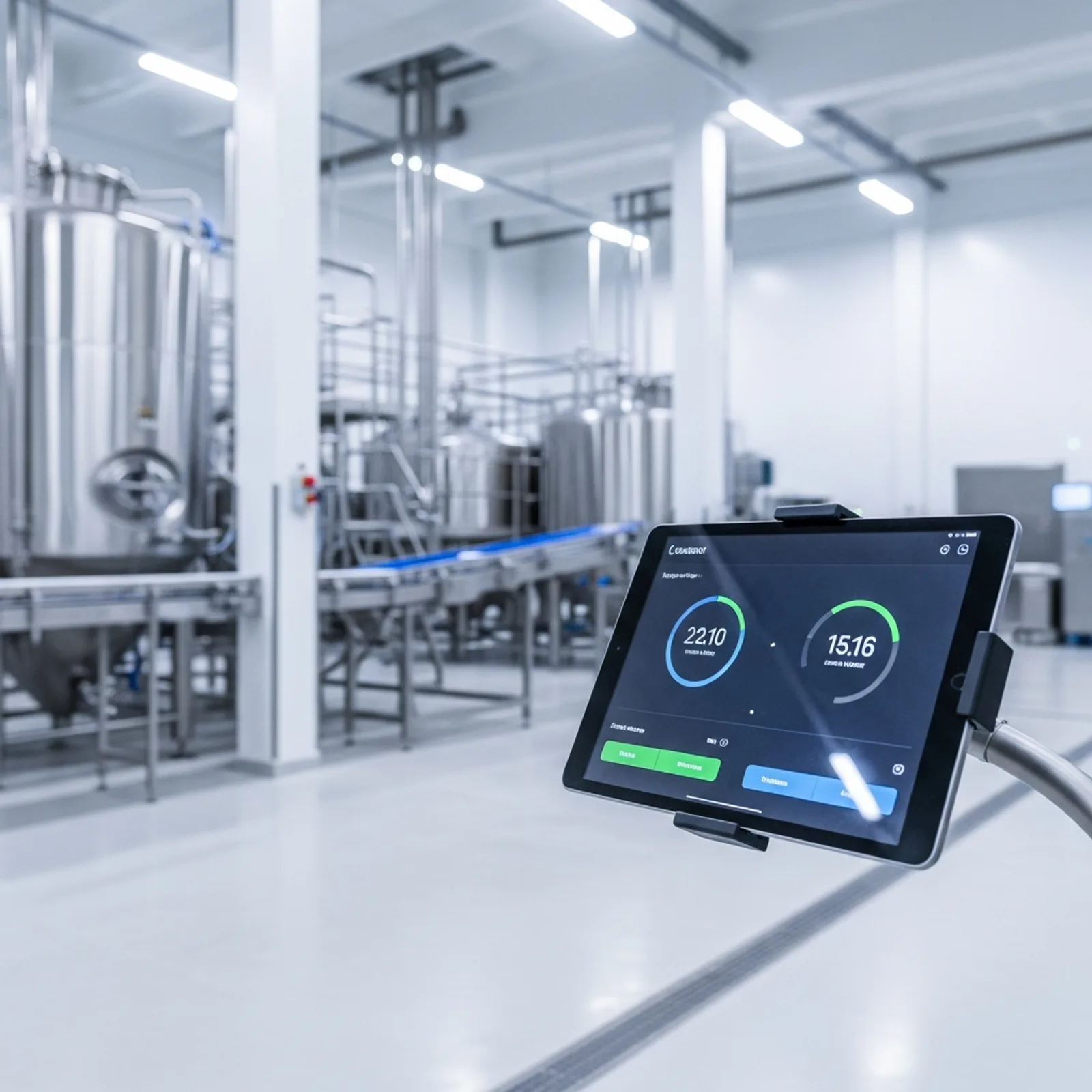
Detailed Reviews of the Top 8 Food Temperature Monitoring Systems
Below is an in-depth analysis of each of the top eight food temperature monitoring systems, evaluating their core capabilities, pricing, pros, cons, and suitability for food and beverage manufacturing facilities.
1. FoodReady — AI-Powered Food Safety & IoT Temperature Monitoring Software
FoodReady is the leading cloud-based food safety management software and IoT temperature monitoring system designed specifically for food and beverage manufacturers, processors, and co-packers. Founded in 2020, the platform has rapidly grown to support over 400 manufacturing sites globally. FoodReady's primary differentiator is its ability to unify food safety compliance, lot traceability, production scheduling, and automated IoT temperature monitoring into a single, cohesive platform. This eliminates the need for separate, disconnected systems like a standalone QMS, an inventory tool, and a hardware-specific sensor dashboard, saving manufacturers between $50,000 and $150,000 annually in integration and subscription costs.
The platform integrates seamlessly with a wide range of wireless Bluetooth and LoRaWAN temperature sensors, providing 24/7 automated monitoring of ambient storage, walk-in freezers, processing lines, and cooking equipment. When a temperature deviation occurs, FoodReady triggers instant alerts via SMS, email, and push notifications to designated quality managers. Crucially, the software doesn't just log the deviation; it automatically initiates a digital Corrective and Preventive Action (CAPA) workflow. This workflow guides floor operators through standard operating procedures (SOPs) and records the corrective action taken, ensuring complete compliance with FDA, USDA, SQF, and BRCGS standards.
FoodReady also features an AI-powered root cause analysis tool that helps quality teams identify the underlying reasons for recurring temperature excursions, reducing repeat CAPAs by 60%. The platform's mobile-first design allows operators to perform digital checklists, record manual probe temperatures, and manage lot traceability directly from the plant floor, even in offline environments. With a rapid 8 to 16-week implementation timeline and dedicated onboarding support, FoodReady provides a modern, user-friendly alternative to legacy ERP and QMS systems that often take 12 to 36 months to deploy.
- Pricing: Starter: $15K–30K/yr (1 site, 75 users); Professional: $40K–75K/yr (5 sites, 200 users); Enterprise: $75K–150K/yr (unlimited); Implementation: $10K–60K.
- Pros: Only unified platform (quality+inventory+production+supply chain), Fastest implementation (8–16 weeks), AI root cause, Modern UX, Transparent pricing.
- Cons: Newer (2020), ~400 sites, Less customization than legacy, Financials via integration.
- Customer Metrics: Our software reduces CAPA cycle times from 52 to 18 days (a 65% reduction) and reduces audit preparation time by 85–90% for over 400 customers.
2. Samsara — Enterprise Fleet & Cold Chain Logistics Temperature Monitoring
Samsara is an enterprise-grade physical operations platform that excels in fleet management, GPS tracking, and cold chain logistics temperature monitoring. For food manufacturers with large distribution fleets, Samsara provides unparalleled real-time visibility into the temperature and humidity of refrigerated trailers (reefers) and delivery vehicles. The platform utilizes rugged, wireless environmental sensors that transmit data via cellular gateways, allowing logistics managers to monitor cargo conditions continuously from the moment a shipment leaves the manufacturing facility until it arrives at the customer's dock.
Samsara's strength lies in its robust hardware and sophisticated fleet management features, including geofencing, automated arrival and departure logs, and driver workflow optimization. The platform's mobile app is highly rated by drivers, making it easy to capture digital signatures and log delivery temperatures.
However, Samsara is primarily a logistics and fleet monitoring tool, not a dedicated food safety management system. It lacks built-in HACCP compliance, lot traceability, and food safety document management, meaning manufacturers must integrate it with a platform like FoodReady to achieve full regulatory compliance.
- Pricing: $30K–100K/yr based on fleet size and sensor count.
- Pros: Industry-leading real-time GPS tracking and reefer temperature monitoring, rugged wireless sensors, and an excellent driver mobile app.
- Cons: Lacks built-in HACCP compliance, lot traceability, and food safety document management. High hardware and subscription costs for non-fleet applications.
- Recommendation: Choose FoodReady if you need a unified platform that connects automated temperature monitoring directly to food safety compliance and lot traceability within your manufacturing facility. Consider Samsara if your primary need is fleet logistics and real-transit cold chain tracking.
3. Testo Saveris — Industrial Food Processing & Facility Temperature Monitoring
Testo Saveris is an industrial-grade, hardware-first temperature monitoring system engineered by Testo, a global leader in precision measurement technology. Designed specifically for large-scale industrial food processing plants, warehouses, and stationary facilities, Testo Saveris utilizes high-precision wireless probes and stationary transmitters to monitor ambient conditions, ultra-low temperature freezers, and high-temperature cooking processes. The system's proprietary UltraRange wireless technology provides exceptional signal penetration through thick concrete and steel walls, ensuring reliable data transmission in complex industrial environments.
The Testo Saveris software is highly reliable and compliant with strict European and global food safety standards, including FDA 21 CFR Part 11. It automatically generates secure PDF reports and features local backup memory on gateways to prevent data loss during power or network outages.
However, the software interface feels dated and lacks the modern, cloud-native user experience found in newer platforms. It is primarily a sensor monitoring and data logging tool, lacking built-in inventory management, production scheduling, or lot traceability features.
- Pricing: $25K–80K/yr with a hardware-heavy initial investment.
- Pros: Extremely precise, German-engineered hardware, highly reliable UltraRange wireless technology, and compliance with strict global standards.
- Cons: Software interface feels dated and lacks modern cloud-native UX. Limited built-in inventory, production scheduling, or lot traceability features.
- Recommendation: Choose FoodReady if you need a modern, cloud-native food safety platform that integrates checklists, CAPAs, and lot traceability. Consider Testo Saveris if you require high-precision, industrial-grade hardware for extreme temperature environments.
4. Monnit ALTA — Wireless Sensor Networks for Large-Scale Food Warehousing
Monnit ALTA is a highly versatile and budget-friendly wireless sensor network solution designed for large-scale food warehousing, cold storage, and facility monitoring. Monnit offers a massive catalog of low-cost wireless sensors, including temperature, humidity, water detection, and door state sensors. The platform's primary differentiator is its exceptional wireless range, utilizing ALTA proprietary frequency-hopping spread spectrum technology to transmit data up to 1,200 feet through walls and obstacles, making it ideal for massive distribution centers.
Monnit ALTA sensors are known for their long battery life, lasting up to 10+ years on standard AA batteries, which significantly reduces maintenance overhead. The cloud-based iMonnit software provides real-time dashboards, over-the-air sensor updates, and customizable SMS and email alerts for temperature excursions.
However, iMonnit is strictly a sensor monitoring dashboard and does not function as a food safety management system. It lacks HACCP plan templates, lot traceability, and digital compliance checklists.
- Pricing: $10K–40K/yr with low-cost hardware and an annual software subscription.
- Pros: Exceptional wireless range (1,200+ feet through walls), massive catalog of low-cost sensors, and long battery life (up to 10+ years).
- Cons: Software is primarily a sensor monitoring dashboard, not a food safety management system. Requires significant manual configuration and IT setup.
- Recommendation: Choose FoodReady if you need a comprehensive food safety management system that connects sensor data to compliance and quality workflows. Consider Monnit ALTA if you need extensive wireless sensor coverage on a tight budget.
5. Cooper-Atkins TempTrak — Commercial Kitchen & Food Service Temperature Monitoring
Cooper-Atkins TempTrak is a well-established, legacy temperature monitoring system widely used in commercial kitchens, food service operations, and retail food preparation. Developed by Cooper-Atkins, a brand with decades of experience in food safety measurement, TempTrak offers a comprehensive suite of wireless transmitters, handheld Bluetooth probes, and automated data loggers designed to monitor walk-in coolers, prep tables, and hot holding cabinets.
TempTrak's software provides robust compliance reporting, making it easy for food service managers to generate daily logs for local health department audits. The platform features visual floor plan mapping, allowing users to overlay real-time sensor readings onto a digital layout of their facility.
Despite its strengths in food service, TempTrak is not optimized for industrial food manufacturing. The software interface is clunky, difficult to navigate, and lacks modern API integrations for ERP or inventory systems. Additionally, TempTrak does not offer advanced lot traceability, production scheduling, or AI-powered CAPA workflows.
- Pricing: $15K–50K/yr for a hardware and software bundle.
- Pros: Battle-tested brand, wide variety of handheld probes, and good compliance reporting for local health audits.
- Cons: Software is clunky and difficult to integrate with modern ERP or inventory systems. Not optimized for industrial food manufacturing or complex lot traceability.
- Recommendation: Choose FoodReady if you operate an industrial food manufacturing facility requiring complex lot traceability and automated CAPAs. Consider Cooper-Atkins TempTrak if you manage multi-site commercial kitchens or retail food operations.
6. DeltaTrak FlashLink — In-Transit Cold Chain Export & Shipment Monitoring
DeltaTrak FlashLink is a specialized cold chain management solution focused on in-transit temperature monitoring for global food shipments, exports, and logistics. DeltaTrak offers a wide range of single-use and reusable data loggers that track temperature, humidity, location, and light exposure in real time. These loggers are placed inside ocean containers, air cargo pallets, and refrigerated trucks to ensure food quality is maintained throughout the international supply chain.
The FlashLink Real-Time receivers transmit data via cellular networks to a cloud-based dashboard, providing logistics teams with instant alerts if a shipment experiences a temperature excursion or if unauthorized door openings occur (detected via light sensors). Upon arrival, the system automatically generates secure, cryptographically signed PDF trip reports that are emailed to stakeholders, simplifying dispute resolution and quality verification.
While DeltaTrak is an indispensable tool for export logistics and cold chain verification, it is not designed for stationary facility monitoring or daily plant floor operations. It lacks HACCP plan management, digital checklists, and lot traceability within the manufacturing plant.
- Pricing: $5K–25K/yr based on pay-per-trip single-use and reusable data loggers.
- Pros: Real-time location and temperature sensing, single-use loggers that eliminate return logistics, and automated PDF trip reports.
- Cons: Not suitable for stationary facility monitoring or daily plant operations. No built-in HACCP plan management or production floor checklists.
- Recommendation: Choose FoodReady if you need to manage food safety and quality control within your manufacturing facility. Consider DeltaTrak FlashLink if you are a food exporter tracking international ocean and air shipments.
7. ThermoWorks BlueTherm — Handheld Bluetooth Probe Integration for Manual Inspections
ThermoWorks BlueTherm is a high-precision handheld temperature monitoring solution designed for food safety teams performing high-frequency manual inspections and temperature checks. ThermoWorks is renowned for its Thermapen technology, which delivers industry-standard accuracy (±0.7°F) and ultra-fast readings in under 3 seconds. The BlueTherm line integrates these high-precision probes with Bluetooth technology, allowing operators to transmit temperature readings instantly to mobile devices.
The primary benefit of BlueTherm is the elimination of manual transcription errors. Operators simply insert the probe, wait for the reading, and press a button to log the temperature directly into a mobile app. The hardware is exceptionally durable, waterproof (IP67 rated), and designed to withstand the harsh, wet environments of food processing plants.
However, BlueTherm is strictly a manual probe system and is not suitable for automated, 24/7 ambient temperature monitoring of freezers or warehouses. Additionally, the basic ThermoWorks software is limited to data logging and does not provide a full suite of food safety management tools.
- Pricing: $2K–10K/yr with low software cost and hardware purchased separately.
- Pros: Industry-standard Thermapen accuracy, seamless Bluetooth integration, and rugged waterproof hardware.
- Cons: Primarily designed for manual checks, not automated 24/7 ambient monitoring. Requires a separate software platform (like FoodReady) to manage full HACCP compliance.
- Recommendation: Choose FoodReady if you need automated 24/7 ambient monitoring and a full suite of food safety management tools. Consider ThermoWorks BlueTherm if your primary need is high-frequency manual temperature checks with Bluetooth probes.
8. Roambee — Real-Time Global Supply Chain Visibility & Temperature Tracking
Roambee is an enterprise-grade supply chain visibility platform that utilizes AI-driven analytics and multi-sensor IoT hardware to track global shipments in real time. For large food manufacturers with complex, multi-modal supply chains (road, rail, air, and ocean), Roambee provides deep visibility into shipment location, temperature, humidity, shock, and tilt. The platform's proprietary "Bee" trackers utilize global cellular networks with satellite fallback to ensure continuous data transmission.
Roambee's primary differentiator is its advanced AI engine, which predicts potential temperature excursions and ETA delays before they occur, allowing logistics teams to take proactive corrective action. The platform also offers automated recovery services, where local partners can intervene to rescue delayed or compromised shipments.
Despite its powerful logistics capabilities, Roambee is an overkill solution for domestic-only or single-facility food manufacturers. It lacks facility-level HACCP compliance, digital checklists, and food safety document control.
- Pricing: $40K–150K/yr based on shipment volume.
- Pros: Advanced AI-driven predictive alerts, multi-modal tracking in a single dashboard, and automated recovery services.
- Cons: Overkill for domestic-only or single-facility food manufacturers. Lacks facility-level HACCP compliance and food safety document control.
- Recommendation: Choose FoodReady if you need to manage compliance and quality control within your manufacturing facility. Consider Roambee if you are a global food enterprise prioritizing end-to-end supply chain visibility across multiple modes of transport.