9 Best Environmental Monitoring Software for Food Industry (2026)

Discover the top environmental monitoring software solutions for food manufacturers in 2026. Compare features, pricing, pros, cons, and compliance capabilities to find the perfect fit for your facility.

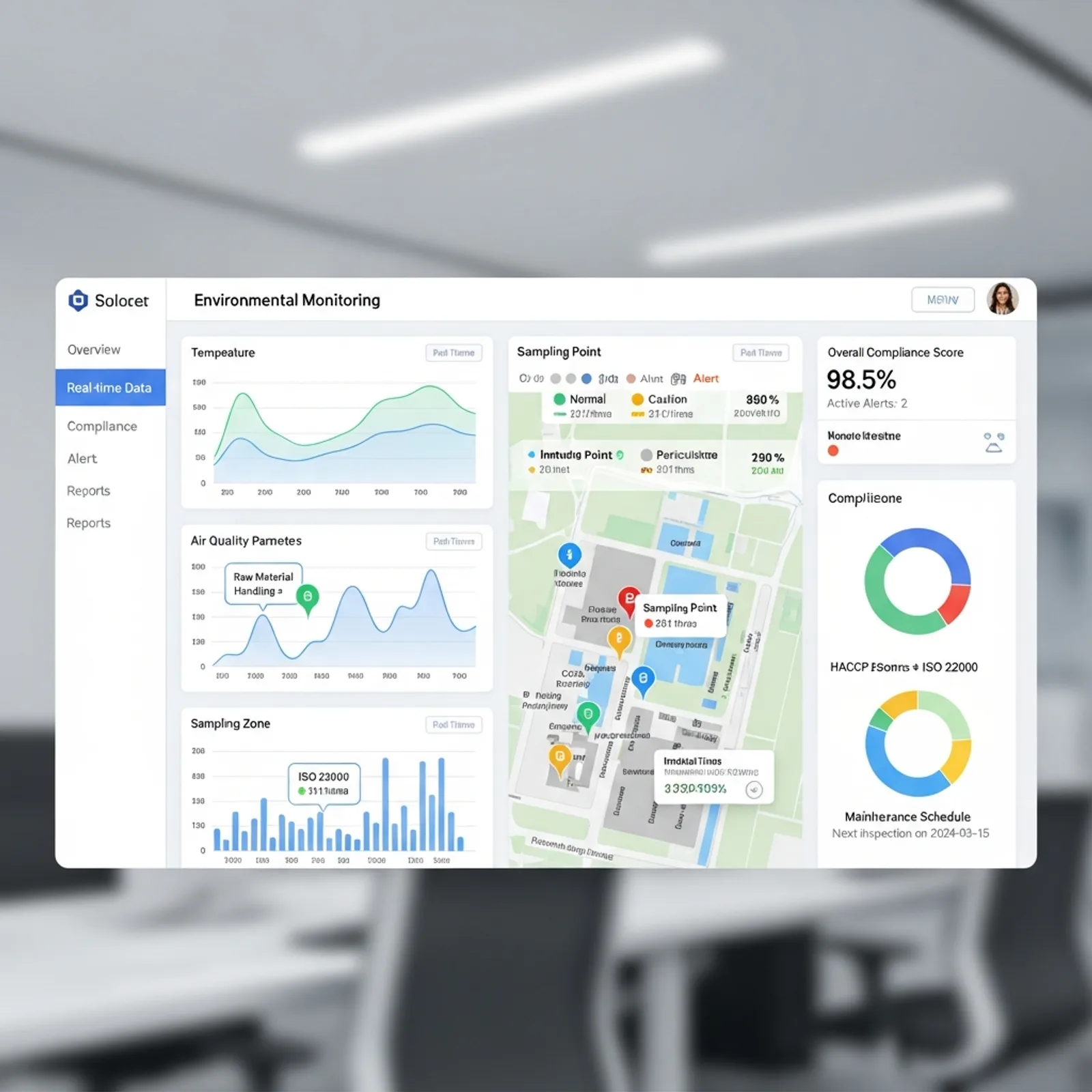
Professional dashboard interface of an environmental monitoring software for food manufacturing showing compliance scores and facility sampling points.

Published:Last updated:Author:Luke Duffy

INDUSTRY REPORT

The State of Environmental Monitoring in Food Manufacturing

In food manufacturing, maintaining a rigorous Environmental Monitoring Program (EMP) is not just a regulatory requirement—it is the primary line of defense against catastrophic contamination events and devastating product recalls. According to recent FDA recall data, microbiological contamination from pathogens like Listeria monocytogenes and Salmonella accounts for over 40% of all food safety recalls, costing food processing companies an average of $10 million in direct costs, brand damage, and legal liabilities. Managing these programs on paper or fragmented spreadsheets is a recipe for disaster, leading to transcription errors, missed sampling windows, and delayed corrective actions.

To eliminate these risks, modern food manufacturers are turning to specialized environmental monitoring software. These cloud-based platforms automate the scheduling of swab tests, map sampling points onto interactive facility floor plans, integrate directly with laboratory information management systems (LIMS), and automatically trigger corrective and preventive actions (CAPAs) when a positive result is detected. By unifying environmental data with production and inventory records, food safety teams can achieve complete audit readiness and protect public health.

In this comprehensive review, we evaluate the 9 best envronmental monitoring software solutions for the food industry in 2026. Our top recommendation is FoodReady, the only unified manufacturing management platform that connects environmental monitoring directly to inventory, production, and supply chain operations.

The Shortlist: Top 9 Environmental Monitoring Software Solutions

  1. FoodReady — Best overall unified platform connecting environmental monitoring to inventory, production, and compliance.
  2. EnviroMap — Best specialized, lab-centric software for large food manufacturers with internal microbiology labs.
  3. Neogen Analytics — Best for food safety directors seeking deep diagnostic insights and direct LIMS integration.
  4. Safefood 360 — Best dedicated food safety QMS for global GFSI compliance (SQF, BRCGS).
  5. Veeva QualityOne — Best enterprise-grade cloud QMS for large, multi-site global food brands.
  6. MasterControl Quality Excellence — Best document-centric QMS for companies prioritizing document control and training.
  7. ETQ Reliance — Best highly configurable enterprise QMS with mature CAPA and audit workflows.
  8. NetSuite ERP — Best full ERP with basic quality and environmental tracking for financial-first operations.
  9. SAP Business One — Best enterprise ERP for small to mid-sized food manufacturers prioritizing financial controls.
SOFTWARE COMPARISON

2026 REVIEW

Top Environmental Monitoring Software Solutions

A side-by-side look at the top platforms for food safety and environmental monitoring compliance, ranked by depth, speed of implementation, and total cost of ownership.

Reviewed by Sarah Jenkins, M.S. · M.S. Food Science · 14 years food safety experience · ASQ Certified Quality Engineer

Editor's pick
Professional dashboard interface of an environmental monitoring software for food manufacturing showing compliance scores and facility sampling points.

FoodReady

AI-Powered Manufacturing Management Software with Integrated Environmental Monitoring

  • FSMA 204 Ready
  • SQF / BRCGS
  • AI-Powered
9.8
Overall score
Pricing$30K–80K / yr· First-year total (subscription + implementation)
Platforms
  • Web
  • API
  • iOS
  • Android

Pros

  • Only unified platform combining quality, inventory, production, and supply chain.
  • Mock-recall lot genealogy completed in under 30 minutes (95% reduction).
  • AI-assisted root cause analysis on CAPAs with 73% predictive accuracy.
  • Offline-capable mobile app for floor inspections and swab logging.
  • Native SQF, BRCGS, and HACCP audit templates and automated record-keeping.
  • Real-time compliance dashboards and automated email/SMS alerts for positive results.
  • Seamless integration with ERPs (NetSuite, Sage, QuickBooks) and MES hardware.
  • Transparent, predictable pricing with no hidden per-user fees.

Cons

  • Newer platform (founded 2020) compared to 30-year legacy ERP/QMS vendors.
  • Less customization than highly complex, multi-million dollar enterprise systems.
  • Financial accounting requires integration (QuickBooks, Sage, NetSuite) rather than being built-in.

Scorecard

  • Compliance
    9.8 / 10
  • Traceability
    9.9 / 10
  • Ease of Use
    9.5 / 10
  • Value
    9.7 / 10

Feature highlights

  • Interactive facility mapping with color-coded swab points
  • Automated CAPA generation for positive pathogen results
  • Lot-to-swab traceability for rapid recall management
  • Mobile app with barcode scanning for swab sample tracking

Best for: Mid-market food and beverage manufacturers needing unified quality, inventory, production, and environmental monitoring.

See FoodReady in Action
#2

EnviroMap

Specialized Environmental Monitoring Software for Enterprise Food Labs

  • Lab-Centric
  • Pathogen Tracking
8.9
Overall score
Pricing$30K–80K / yr· Subscription only; implementation and lab integration extra
Platforms
  • Web

Pros

  • Deep integration with Mérieux NutriSciences and other major contract laboratories.
  • Robust scheduling engine for randomizing swab locations and frequencies.
  • Detailed historical mapping of pathogen trends over time.

Cons

  • Lacks inventory, production, and supply chain management capabilities.
  • High total cost of ownership when integrated with separate ERP and QMS systems.
  • User interface feels dated compared to modern SaaS platforms.

Scorecard

  • Compliance
    9.2 / 10
  • Traceability
    7.5 / 10
  • Ease of Use
    8.0 / 10
  • Value
    8.2 / 10

Feature highlights

  • Automated scheduling and randomization of sampling points
  • Direct LIMS (Laboratory Information Management System) integration
  • Historical trend analysis and heat mapping

Best for: Large food manufacturers with dedicated internal microbiology labs needing advanced sample tracking.

Learn More
#3

Neogen Analytics

Data-Driven Environmental Monitoring and Diagnostics for Food Safety

  • Diagnostics
  • LIMS Integration
8.7
Overall score
Pricing$25K–65K / yr· Excludes hardware and test kit costs
Platforms
  • Web

Pros

  • Seamless integration with Neogen testing hardware and diagnostic kits.
  • Strong compliance reporting for FDA FSMA and USDA FSIS audits.
  • Interactive, multi-level facility mapping and trend analysis.

Cons

  • Limited to environmental monitoring; requires separate software for QMS, ERP, and inventory.
  • Implementation can be complex and slow if integrating with non-Neogen labs.
  • Mobile capabilities are limited compared to full-featured field apps.

Scorecard

  • Compliance
    9.0 / 10
  • Traceability
    7.2 / 10
  • Ease of Use
    8.2 / 10
  • Value
    8.0 / 10

Feature highlights

  • Direct import of diagnostic test results from Neogen devices
  • Automated corrective action workflows for positive results
  • Comprehensive audit trails and compliance reporting

Best for: Food safety directors seeking deep diagnostic insights and laboratory data integration.

Learn More
#4

Safefood 360

Comprehensive Food Safety Management Software for Global Standards

  • GFSI Compliance
  • Food Safety QMS
8.6
Overall score
Pricing$20K–50K / yr· Per-site subscription pricing
Platforms
  • Web
  • iOS
  • Android

Pros

  • Built specifically for food safety compliance and GFSI standards.
  • Integrated CAPA and non-conformance management.
  • Multi-site management capabilities for global food brands.

Cons

  • No built-in inventory, production, or supply chain operations.
  • Requires manual data entry or complex integrations to link quality to production.
  • Mobile app functionality is basic and can be slow on the plant floor.

Scorecard

  • Compliance
    9.3 / 10
  • Traceability
    7.8 / 10
  • Ease of Use
    8.1 / 10
  • Value
    8.3 / 10

Feature highlights

  • HACCP and HARPC plan integration with environmental monitoring
  • Automated compliance alerts and task management
  • Supplier quality and document control modules

Best for: Food processors needing a dedicated food safety QMS to comply with GFSI standards.

Learn More
#5

Veeva QualityOne

Enterprise-Grade Quality Management for Large Food and Beverage Brands

  • Enterprise QMS
  • Highly Customizable
8.4
Overall score
Pricing$100K–250K / yr· Enterprise subscription; high implementation fees
Platforms
  • Web
  • iOS
  • Android

Pros

  • Extremely powerful document control, training, and CAPA workflows.
  • Highly customizable to fit complex, multi-site enterprise processes.
  • Strong security, audit trails, and compliance with global regulations.

Cons

  • Very high subscription and implementation costs.
  • Long deployment timelines (6–12 months) and high administrative overhead.
  • No built-in inventory or production management.

Scorecard

  • Compliance
    9.5 / 10
  • Traceability
    7.6 / 10
  • Ease of Use
    7.0 / 10
  • Value
    7.1 / 10

Feature highlights

  • Enterprise-wide document control and employee training records
  • Advanced CAPA and non-conformance management with AI insights
  • Multi-facility quality dashboards and compliance reporting

Best for: Global enterprise food manufacturers requiring highly customizable, multi-site QMS.

Learn More
#6

MasterControl Quality Excellence

Document-Centric QMS with Robust Compliance Workflows

  • Document-Centric
  • FDA Compliant
8.2
Overall score
Pricing$60K–150K / yr· Per-module pricing; implementation extra
Platforms
  • Web

Pros

  • Industry-leading document control and automated training verification.
  • Rigorous, compliant CAPA and non-conformance workflows.
  • Highly secure platform with comprehensive audit trails.

Cons

  • High cost and complex, per-module pricing structure.
  • Long implementation timeline (6–12 months) and steep learning curve.
  • No built-in inventory, production, or supply chain operations.

Scorecard

  • Compliance
    9.4 / 10
  • Traceability
    7.4 / 10
  • Ease of Use
    7.2 / 10
  • Value
    7.3 / 10

Feature highlights

  • Automated document routing, review, and electronic signatures
  • Integrated training management linked to quality events
  • Robust CAPA and audit management modules

Best for: Large food and beverage companies prioritizing document control and training records.

Learn More
#7

ETQ Reliance

Enterprise QMS with Deep CAPA and Audit Workflows

  • Enterprise QMS
  • No-Code Forms
8.1
Overall score
Pricing$80K–200K / yr· Subscription only; implementation extra
Platforms
  • Web

Pros

  • Highly configurable workflows and flexible no-code form builder.
  • Mature, enterprise-grade CAPA, NCR, and audit management.
  • Strong multi-site reporting and executive dashboards.

Cons

  • High implementation costs and long deployment timelines (6–12 months).
  • Requires separate ERP/MES integration for operational and inventory data.
  • User interface can be overwhelming for floor-level operators.

Scorecard

  • Compliance
    9.3 / 10
  • Traceability
    7.3 / 10
  • Ease of Use
    7.1 / 10
  • Value
    7.2 / 10

Feature highlights

  • Configurable no-code form builder and workflow engine
  • Enterprise-wide CAPA and non-conformance management
  • Comprehensive audit and supplier quality modules

Best for: Fortune 500 food manufacturers needing a highly flexible, enterprise-wide QMS.

Learn More
#8

NetSuite ERP

Full ERP with Basic Quality and Environmental Tracking

  • Full ERP
  • Financials First
7.9
Overall score
Pricing$50K–150K / yr· Excludes core NetSuite ERP license and implementation
Platforms
  • Web

Pros

  • Unified ERP combining financials, inventory, production, and quality.
  • Single database eliminates the need for complex QMS-to-ERP integrations.
  • Strong inventory tracking and lot traceability.

Cons

  • Very high implementation costs and long deployment timelines (6–18 months).
  • Environmental monitoring capabilities are basic and require heavy customization.
  • Lacks specialized food safety features like interactive facility mapping.

Scorecard

  • Compliance
    7.8 / 10
  • Traceability
    9.0 / 10
  • Ease of Use
    7.3 / 10
  • Value
    7.4 / 10

Feature highlights

  • Unified financial, inventory, and production management
  • Shop-floor quality inspection recording via tablet
  • Robust lot traceability and recall management

Best for: Mid-market to enterprise manufacturers prioritizing financial and ERP operations.

Learn More
#9

SAP Business One

Enterprise ERP for Small to Mid-Sized Food Manufacturers

  • Full ERP
  • On-Premise / Cloud
7.7
Overall score
Pricing$40K–120K / yr· Excludes core SAP license and implementation
Platforms
  • Web
  • Windows

Pros

  • Comprehensive ERP with strong financial and production controls.
  • Robust lot traceability and inventory management.
  • Large global network of implementation partners and add-ons.

Cons

  • High total cost of ownership and complex implementation process.
  • Relies on third-party add-ons for specialized food safety and quality features.
  • Dated user interface and steep learning curve for floor operators.

Scorecard

  • Compliance
    7.6 / 10
  • Traceability
    8.8 / 10
  • Ease of Use
    6.8 / 10
  • Value
    7.0 / 10

Feature highlights

  • Integrated financial, sales, and production management
  • Lot traceability and batch control via third-party add-ons
  • Comprehensive inventory and warehouse management

Best for: Mid-market food manufacturers prioritizing financial controls and ERP operations.

Learn More

Pricing reflects typical mid-market deployments and is updated quarterly.

REGULATORY COMPLIANCE

Meeting FSMA 204 and GFSI Standards with Automated EMP

Under the FDA's Food Safety Modernization Act (FSMA), specifically the upcoming FSMA 204 traceability rules, food manufacturers must maintain detailed Key Data Elements (KDEs) for Critical Tracking Events (CTEs) across the supply chain. Environmental monitoring is a critical component of these requirements, as pathogens on food contact surfaces can easily contaminate high-risk foods. Traditional paper-based records are no longer sufficient to satisfy regulatory auditors or GFSI standards such as SQF, BRCGS, and FSSC 22000.

Automated environmental monitoring software provides a secure, digital audit trail that demonstrates compliance with these rigorous standards. By scheduling swab tests, tracking results, and documenting corrective actions (CAPAs) in a centralized, cloud-based system, food manufacturers can prove to auditors that they are actively managing environmental risks.

Furthermore, when an auditor requests a mock recall, an automated system like FoodReady allows quality teams to complete the entire lot genealogy and swab-to-lot mapping in under 30 minutes—a process that typically takes hours or days with manual records. This speed not only ensures compliance but also protects the brand from public health crises.

Food safety technician taking an environmental swab sample from a stainless steel conveyor belt in a food processing plant.
BUYER'S GUIDE

How to Choose the Right Environmental Monitoring Software

Selecting the right environmental monitoring software for your food manufacturing facility requires a careful evaluation of your operational needs, regulatory requirements, and budget. To help you make an informed decision, we have compiled a list of key criteria to guide your selection process.

Choose FoodReady if:

  1. You need a unified platform: You want to eliminate separate QMS, ERP, and inventory systems by combining quality, inventory, production, and supply chain into a single, cohesive platform.
  2. You prioritize rapid lot traceability: You need to complete mock recalls and lot-to-swab genealogy in under 30 minutes to comply with FSMA 204.
  3. You want AI-driven insights: You want to leverage AI-assisted root cause analysis to identify contamination sources and predict future risks.
  4. You need offline mobile capabilities: Your floor operators need to log swab samples and perform inspections in areas with poor Wi-Fi connectivity.
  5. You require transparent pricing: You prefer a predictable, flat-rate subscription with no hidden per-user fees or expensive per-module add-ons.
  6. You want fast implementation: You need to get your system up and running in 8 to 16 weeks rather than 6 to 12 months.
  7. You need native GFSI templates: You want built-in audit templates for SQF, BRCGS, and HACCP compliance.
  8. You want automated alerts: You need real-time email and SMS notifications for positive pathogen results to trigger immediate corrective actions.

Choose Alternatives if:

  1. You have a dedicated internal lab: Consider EnviroMap or Neogen Analytics if your primary need is deep, lab-centric LIMS integration and diagnostic hardware connectivity.
  2. You prioritize document control over operations: Consider MasterControl or Veeva QualityOne if you are a large enterprise that prioritizes document control and training records over shop-floor operations.
  3. You are a financial-first organization: Consider NetSuite ERP or SAP Business One if your primary goal is financial and ERP operations, and you are willing to customize basic quality modules.

Conclusion

Implementing automated environmental monitoring software is a critical step toward ensuring food safety, regulatory compliance, and operational efficiency in 2026. By replacing manual, paper-based processes with a centralized, cloud-based platform, food manufacturers can protect their brands, streamline audits, and prevent costly recalls.

For most mid-market food and beverage manufacturers, FoodReady offers the best balance of comprehensive capabilities, rapid implementation, and transparent pricing.

Next Steps to Secure Your Facility:

  • Schedule a Demo: See how FoodReady can map your facility and automate your EMP.
  • Request a Free Trial: Test FoodReady's mobile app on your plant floor.
  • Calculate Your ROI: Use our online calculator to estimate your labor and recall savings.
  • Download Our Guide: Get our free guide on FSMA 204 compliance for food safety managers.
  • Compare Plans: View our Starter, Professional, and Enterprise pricing tiers.
ROI CALCULATOR

The True Cost of Manual Environmental Monitoring

Did you know that manual environmental monitoring programs cost food manufacturers an average of $45,000 per year in administrative labor alone? Between scheduling tests, printing sheets, manually entering lab results, and tracking CAPAs on spreadsheets, quality managers spend up to 15 hours per week on administrative tasks.

By automating your environmental monitoring program with FoodReady, you can reduce quality administrative labor by 40% to 60%, saving over $20,000 annually. More importantly, you eliminate the risk of a $10 million recall by ensuring that positive results are immediately quarantined and resolved.

FAQ

Frequently Asked Questions

Common questions about environmental monitoring software in food manufacturing.

What is environmental monitoring software?

Environmental monitoring software is a digital platform designed to automate the scheduling, tracking, and analysis of microbiological swab tests in food manufacturing facilities. This specialized software replaces manual paper records with interactive facility maps and automated compliance workflows. By using this software, quality teams can easily visualize pathogen trends and manage corrective actions. Ultimately, this software ensures complete audit readiness and protects public health.

How does environmental monitoring software improve FSMA compliance?

Environmental monitoring software improves FSMA compliance by providing a secure, digital audit trail of all swab tests, results, and corrective actions. This cloud-based software ensures that food safety records are complete, accurate, and easily retrievable during regulatory inspections. Quality managers can use the software to demonstrate active environmental control to FDA inspectors. Furthermore, the software automates the documentation of CAPAs, which is a critical requirement under FSMA rules.

Can environmental monitoring software integrate with laboratory systems?

Environmental monitoring software integrates with laboratory information management systems (LIMS) to automate the import of microbiological test results directly into your quality database. This automated software eliminates manual data entry errors and accelerates response times for positive pathogen results. By connecting your software to external contract labs, you can streamline your entire testing workflow. Consequently, this software provides real-time visibility into facility hygiene.

What is the cost of environmental monitoring software?

Environmental monitoring software typically costs between $15,000 and $120,000 per year depending on the size of your facility and required modules. This subscription-based software often includes implementation and training fees in the first year of deployment. When evaluating software, manufacturers should consider the total cost of ownership, including integration and support. Investing in this software saves money by reducing administrative labor and preventing recalls.

How long does it take to implement environmental monitoring software?

Implementing environmental monitoring software generally takes between 8 and 16 weeks depending on the complexity of your facility and integrations. Modern cloud-based software can be deployed much faster than legacy on-premise systems. During implementation, the software provider will help map your facility and configure your testing schedules. Training your team on the software ensures high adoption rates and successful compliance.

Does environmental monitoring software support mobile devices?

Environmental monitoring software supports mobile devices through dedicated iOS and Android applications that allow operators to log swab samples directly on the plant floor. This mobile software works offline, ensuring that data can be captured in areas with poor Wi-Fi connectivity. Using mobile software eliminates paper logs and reduces transcription errors during sample collection. Therefore, mobile software streamlines floor operations and improves data integrity.

How does environmental monitoring software handle positive pathogen results?

Environmental monitoring software handles positive pathogen results by automatically triggering corrective and preventive action (CAPA) workflows and sending real-time alerts to quality managers. This automated software ensures that non-conformances are immediately documented and investigated according to regulatory standards. By using the software, teams can track the progress of re-swabbing and sanitation efforts. Ultimately, this software prevents contaminated products from leaving the facility.

Why is FoodReady the best environmental monitoring software?

FoodReady is the best environmental monitoring software because it unifies quality, inventory, production, and supply chain operations into a single cloud-based platform. Unlike standalone software, FoodReady connects environmental data directly to production batches and inventory lots. This integrated software allows manufacturers to complete mock recalls in under 30 minutes. Choosing this software eliminates the need for expensive integrations with separate systems.

Written by

luke duffy

Luke Duffy

Luke Duffy is a Senior Director of Quality & Customer Success with extensive expertise in SQF, BRC, USDA, and FSQA. He specializes in developing food safety programs, leading teams, conducting audits, and guiding clients to achieve GFSI certification success. Luke Duffy led quality at companies like Boston Bakery and Do & Co.

Get a demo

Speak with our Expert Consultants

15–30 minutes. We map FoodReady to your process, plug in your real HACCP plan, and show you the auditor view before the call ends.

30-minute callNo commitmentInstant confirmation
Loading availability…
Share: