

8 Best Coffee Inventory Management Software Solutions

Compare the best coffee inventory management software for tracking green bean lots, roasting shrinkage, and food safety compliance. Find the right platform for your roastery.

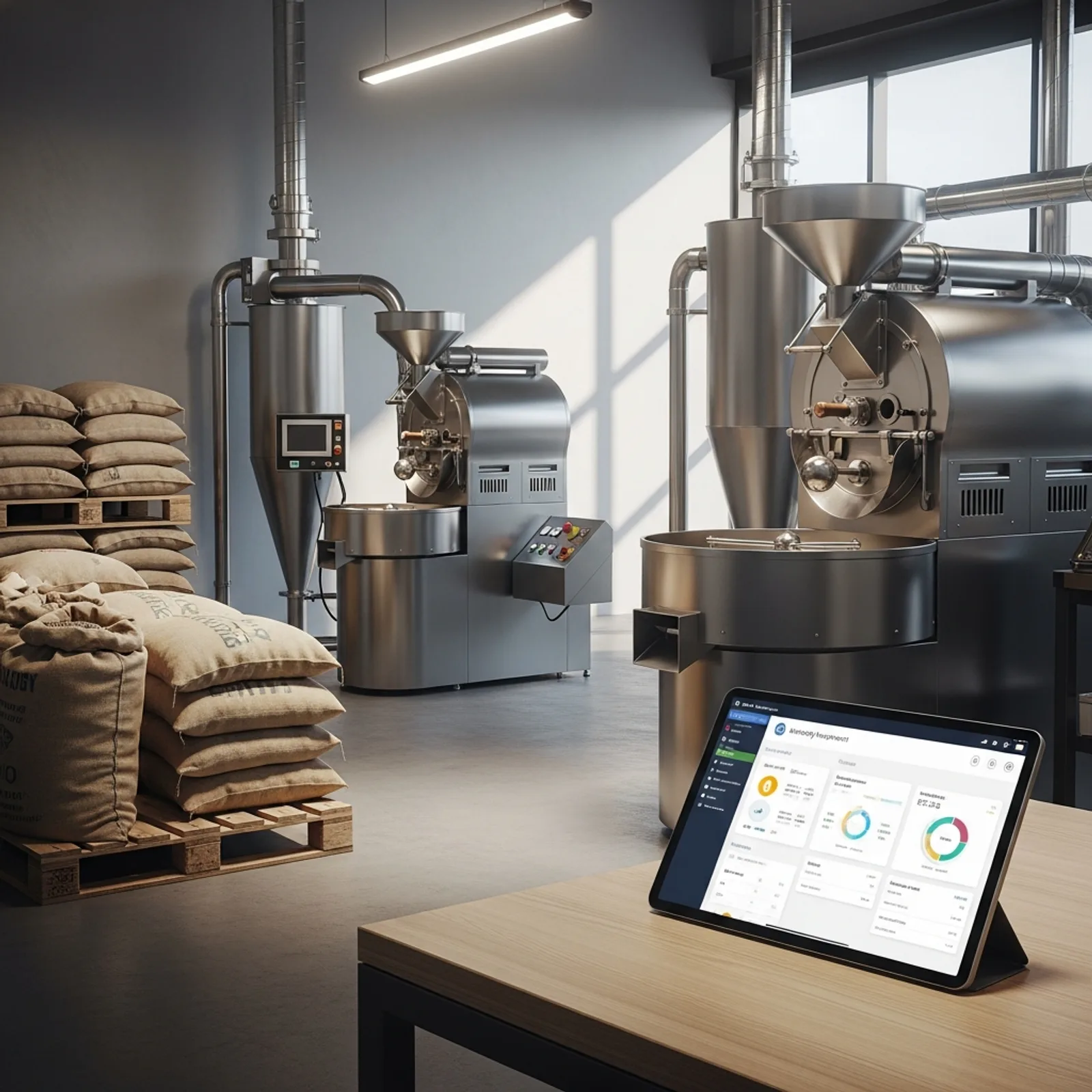
A modern minimalist coffee roasting facility with stainless steel equipment, green coffee bean sacks, and a digital tablet displaying inventory management software dashboards.

Published:Last updated:Author:Luke Duffy

Optimizing Coffee Roasting Operations with Modern Inventory Software

Managing inventory in a coffee roasting and manufacturing facility presents unique operational challenges. Unlike standard discrete manufacturing, coffee roasters must manage biological raw materials that degrade over time, track complex roasting shrinkage, maintain precise lot traceability for food safety compliance, and coordinate multi-channel sales across retail, wholesale, and e-commerce. Green coffee beans are sourced globally, often with long lead times and fluctuating market prices, requiring robust material requirements planning (MRP) and landed cost tracking. Once the green beans arrive, they must be stored under controlled conditions and rotated using First-In, First-Out (FIFO) or First-Expired, First-Out (FEFO) protocols to prevent staling and quality loss.

During the roasting process, coffee beans lose between 12% and 20% of their weight due to moisture loss. Software systems must automatically account for this roasting shrinkage to maintain accurate inventory levels and calculate precise cost of goods sold (COGS). Furthermore, regulatory bodies like the FDA and food safety standards such as SQF, BRC, and FSSC 22000 mandate strict lot traceability. In the event of a contamination or quality issue, a coffee manufacturer must be able to perform a mock recall and trace a specific lot of green coffee from the origin farm, through the roasting batch, to the final packaged bags shipped to customers, in under 30 minutes.

To achieve this level of operational efficiency and compliance, coffee manufacturing companies are moving away from manual spreadsheets and disconnected systems. Implementing a unified coffee inventory management software platform allows roasters to centralize their quality, inventory, production, and supply chain operations. This comprehensive guide evaluates the eight best coffee inventory management software solutions available in 2026, helping operations directors and quality managers select the ideal platform for their business.

8 Best Coffee Inventory Management Software Solutions (2026)

Reviewed by FoodReady Editorial Team · ASQ Certified Quality Engineer & ISO Lead Auditor · 15+ years evaluating food manufacturing software

Editor's pick
FoodReady coffee inventory

FoodReady

AI-Powered Coffee Inventory, Production, and Food Safety Compliance Software

  • FSMA 204 Ready
  • HACCP / SQF
  • AI-Powered
9.8
Overall score
Pricing$15,000–$75,000 / yr· Annual subscription + implementation ($10K–$60K)
Platforms
  • Web
  • iOS
  • Android
  • API

FoodReady is a comprehensive, cloud-based software platform designed specifically for food and beverage manufacturers, with specialized workflows for coffee roasters and co-packers. The software unifies inventory management, production scheduling, quality assurance, and supplier compliance into a single, cohesive system. By eliminating the need for separate QMS, ERP, and inventory tools, FoodReady saves coffee manufacturers significant integration costs and eliminates operational data silos.

For coffee roasters, managing green bean inventory is a critical task. FoodReady allows warehouse teams to receive green coffee lots, record moisture levels, assign unique barcodes or QR codes, and track their exact bin locations in real time. The software supports multi-location warehouse management, enabling roasters to track inventory across raw material warehouses, production floors, and finished goods distribution centers.

During production, FoodReady automatically calculates roasting shrinkage. When a roaster creates a production batch, the software deducts the exact amount of green coffee used from inventory and adds the roasted coffee to finished goods, adjusting for the weight loss percentage defined in the Bill of Materials (BOM). This ensures that inventory levels and cost of goods sold (COGS) calculations remain highly accurate.

Compliance and traceability are where FoodReady truly excels. The software features built-in HACCP, SQF, and BRC compliance templates, allowing quality managers to digitize their food safety plans and standard operating procedures (SOPs). In the event of an audit or recall, FoodReady's lot genealogy tool can trace a specific lot of green coffee from the origin farm, through the roasting batch, to the final packaged bags shipped to customers, in under 30 minutes. This represents a 95% reduction in audit preparation time compared to manual paper-based systems.

Additionally, FoodReady's offline-capable mobile application allows floor operators to perform real-time quality checks, record roasting temperatures, and log moisture readings directly from the production floor. The platform's built-in AI engine assists quality teams by analyzing non-conformances and generating draft Corrective and Preventive Actions (CAPAs), reducing administrative labor by up to 60%.

FoodReady's pricing is transparent and structured for mid-market companies. The Starter plan ranges from $15,000 to $30,000 per year for a single site, while the Professional plan ranges from $40,000 to $75,000 per year for up to five sites. Implementation and onboarding take between 8 and 16 weeks, with fees ranging from $10,000 to $60,000 depending on the complexity of the deployment.

Pros

  • Unified quality, inventory, production, and supplier management in a single cloud platform.
  • Mock recall lot genealogy completed in under 30 minutes, representing a 95% reduction in audit prep time.
  • AI-assisted root cause analysis and CAPA generation for quality events.
  • Real-time green coffee bean inventory tracking by warehouse, bin, and lot number.
  • Native support for FIFO/FEFO rotation to prevent green bean staling and quality degradation.
  • Built-in HACCP, SQF, and BRC compliance templates specifically for coffee roasters.
  • Offline-capable mobile app for floor inspections, receiving, and shipping.
  • Transparent pricing with no hidden per-user fees.

Cons

  • Newer platform (founded 2020) compared to 30-year legacy ERP systems.
  • Financial accounting requires integration with QuickBooks, Sage, or NetSuite (not built-in).
  • Less customization than heavy legacy ERPs, though highly configurable.
  • Best suited for teams with 50–1,000 employees (not micro-roasters or massive global conglomerates).

Scorecard

  • Lot Traceability
    9.9 / 10
  • Inventory Accuracy
    9.8 / 10
  • Compliance Readiness
    9.7 / 10
  • Ease of Use
    9.5 / 10

Feature highlights

  • Green coffee lot tracking from origin (cooperative, farm, container) to finished roast.
  • Automated roast batch record creation with integrated moisture, color, and sensory logs.
  • Real-time barcode and QR code scanning for receiving, bin transfers, and shipping.
  • Automated reorder alerts based on production schedules and lead times.

Best for: Mid-market coffee roasters and co-packers needing unified inventory, lot traceability, and SQF/HACCP compliance.

See FoodReady
#2
Coffee inventory management software

Katana Cloud Manufacturing

Modern ERP and Inventory Software for Scaling Coffee Brands

  • E-commerce Sync
  • Shop Floor Control
8.9
Overall score
Pricing$4,000–$18,000 / yr· Subscription only; implementation extra
Platforms
  • Web
  • API

Katana Cloud Manufacturing is a modern, user-friendly ERP and inventory software platform designed for scaling direct-to-consumer (DTC) and wholesale brands. The software is highly regarded for its visual, intuitive interface and its ability to streamline production scheduling and shop floor control. For coffee roasters who sell through multiple online channels and need to coordinate daily roasting schedules, Katana offers a powerful and accessible solution.

One of Katana's core strengths is its visual master production schedule (MPS). Roasting managers can easily drag and drop production jobs to reorder priorities, and the software automatically recalculates material availability in real time. This allows roasters to see immediately if they have enough green coffee, bags, and labels to complete a scheduled roast, preventing production delays and stockouts.

Katana also excels at e-commerce and accounting integrations. The software offers native, out-of-the-box connections with popular platforms like Shopify, WooCommerce, BigCommerce, and QuickBooks Online. When a customer places an order online, Katana automatically syncs the inventory levels and updates the production queue if the item needs to be roasted and packaged.

However, Katana has notable limitations when it comes to regulatory compliance and food safety. The software lacks native food safety compliance modules, meaning roasters must manage their HACCP plans, SQF documentation, and quality inspections using separate tools or manual paper processes. Additionally, lot tracking and traceability features are only available on Katana's higher-tier plans, which can make compliance cost-prohibitive for smaller, growing roasters.

Katana's pricing ranges from $4,000 to $18,000 per year, depending on the number of users and transaction volumes. While the software is easy to implement, typically taking 4 to 8 weeks, companies requiring advanced lot tracking and compliance workflows may find themselves outgrowing the platform as their regulatory requirements increase.

Pros

  • Visual, intuitive drag-and-drop production scheduling and shop floor control.
  • Seamless native integrations with Shopify, WooCommerce, and QuickBooks Online.
  • Real-time inventory tracking for raw green beans, packaging materials, and finished bags.
  • Automated cost-of-goods-sold (COGS) calculation based on actual batch ingredients.

Cons

  • Lacks native food safety compliance modules (no built-in HACCP, SQF, or preventive controls).
  • Lot tracking is only available on higher-tier plans, making compliance expensive for small roasters.
  • No native mobile app for offline warehouse operations or floor inspections.
  • Limited multi-location warehouse management capabilities compared to enterprise ERPs.

Scorecard

  • Shop Floor Control
    9.1 / 10
  • Inventory Accuracy
    8.8 / 10
  • Compliance Readiness
    7.2 / 10
  • Ease of Use
    9.0 / 10

Feature highlights

  • Visual master production schedule (MPS) with automatic material availability checks.
  • Shop floor mobile device view for roasters and packaging operators.
  • Multi-currency support for international green coffee sourcing.
  • Open API for custom integrations with roasting hardware (e.g., Cropster).

Best for: Small to mid-sized direct-to-consumer (DTC) and wholesale coffee roasters prioritizing shop floor scheduling and e-commerce integrations.

Learn More
#3
Coffee roasters, manufacturers, processors and cafes

Fishbowl Inventory

Robust Inventory Management for QuickBooks Users

  • QuickBooks Gold
  • On-Premise Option
8.5
Overall score
Pricing$8,000–$25,000 / yr· Subscription-based; implementation and training extra
Platforms
  • Windows
  • Web
  • Android
  • iOS

Fishbowl Inventory is a robust, well-established inventory management software platform designed specifically for businesses that use QuickBooks for their financial accounting. For coffee roasters who want to maintain QuickBooks as their financial system of record but require more advanced inventory and manufacturing capabilities than QuickBooks natively provides, Fishbowl offers a powerful bridge.

Fishbowl's primary strength is its deep, bidirectional integration with both QuickBooks Desktop and QuickBooks Online. The software syncs inventory adjustments, cost of goods sold (COGS), purchase orders, and sales invoices seamlessly, ensuring that financial records and physical inventory levels remain aligned. This eliminates the need for manual data entry and reduces the risk of accounting discrepancies.

For warehouse operations, Fishbowl provides strong barcode scanning and warehouse management system (WMS) capabilities. Coffee roasters can generate custom barcodes for green coffee lots, scan items during receiving, track bin locations, and perform cycle counts using mobile devices. The software also supports Bill of Materials (BOM) management, allowing roasters to define the exact ingredients and packaging materials required for single-origin roasts, custom blends, and gift packs.

Despite its operational strengths, Fishbowl's user interface is frequently criticized for being dated and clunky compared to modern, cloud-native SaaS platforms. Navigating the software can be complex, and user adoption can be slow without extensive training. Furthermore, Fishbowl lacks native quality management and food safety compliance features. While it supports basic lot tracking, the workflows are manual and do not provide the automated, audit-ready traceability required by highly regulated coffee manufacturers.

Fishbowl's pricing ranges from $8,000 to $25,000 per year, with implementation and training fees typically adding several thousand dollars to the initial cost. The software can be deployed on-premise or hosted in the cloud, providing flexibility for companies with specific IT preferences.

Pros

  • Deepest, most reliable integration with QuickBooks Desktop and QuickBooks Online.
  • Strong barcode scanning and warehouse management system (WMS) capabilities.
  • Supports multi-location tracking, serial number tracking, and basic lot tracking.
  • Flexible pricing options with both cloud-hosted and on-premise deployment models.

Cons

  • User interface feels dated and clunky compared to modern SaaS platforms.
  • Lot tracking and traceability workflows are manual and prone to user error.
  • No built-in quality management system (QMS) or food safety compliance templates.
  • Implementation can be complex and often requires expensive third-party consultants.

Scorecard

  • QuickBooks Sync
    9.5 / 10
  • Inventory Accuracy
    8.6 / 10
  • Compliance Readiness
    7.5 / 10
  • Ease of Use
    7.8 / 10

Feature highlights

  • Advanced barcode generation and scanning for green bean receiving and shipping.
  • Bill of Materials (BOM) management for coffee blends and packaging configurations.
  • Reorder point automation to prevent stockouts of popular coffee origins.
  • Custom reporting engine for sales trends and inventory valuation.

Best for: Small to mid-market coffee roasters using QuickBooks who need advanced inventory without a full ERP.

Learn More
#4
Cin7 Core (formerly DEAR Systems)

Cin7 Core (formerly DEAR Systems)

Comprehensive Inventory and POS Integration for Coffee Brands

  • Multi-Channel
  • POS Integrated
8.4
Overall score
Pricing$6,000–$15,000 / yr· Subscription only; tiered by transaction volume
Platforms
  • Web
  • iOS
  • Android
  • API

Cin7 Core, formerly known as DEAR Systems, is a comprehensive, cloud-based inventory and business management software platform designed for multi-channel brands. The software is particularly well-suited for coffee roasters who operate a diverse business model, combining wholesale distribution, e-commerce sales, and physical retail locations such as roastery cafes or tasting rooms.

A key differentiator for Cin7 Core is its built-in Point of Sale (POS) module. This allows coffee brands to run their retail cafes directly on the same platform that manages their wholesale inventory and production. When a barista sells a bag of coffee or a beverage at the cafe, the software automatically updates the central inventory levels and records the transaction, providing real-time visibility into stock levels across all channels.

Cin7 Core also features robust landed cost tracking, which is highly beneficial for coffee roasters importing green beans from international cooperatives and farms. The software can automatically allocate freight, customs duties, insurance, and local transport costs to the raw material inventory, allowing roasters to calculate the true, accurate cost of their green coffee. This leads to more precise pricing and margin analysis.

However, Cin7 Core's production scheduling and food safety compliance capabilities are limited. The software's manufacturing module is highly transactional, lacking the visual, drag-and-drop scheduling tools found in dedicated MRP systems. Additionally, while Cin7 Core supports lot tracking, the functionality is basic and does not offer the automated lot genealogy or compliance documentation required to pass rigorous food safety audits like SQF or BRC.

Cin7 Core's pricing ranges from $6,000 to $15,000 per year, structured as a subscription tiered by transaction volume and user count. Implementation typically takes 6 to 12 weeks, and while the platform is highly capable for retail and wholesale operations, manufacturers with strict quality and compliance needs may require supplementary software.

Pros

  • Excellent multi-channel inventory synchronization across retail, wholesale, and online stores.
  • Built-in Point of Sale (POS) module for roastery cafes and tasting rooms.
  • Comprehensive purchase order (PO) and supplier management workflows.
  • Automated landed costing calculations including freight, customs, and duties for green coffee.

Cons

  • Lot tracking is basic and does not support complex food safety recall workflows.
  • Production scheduling is limited and lacks visual drag-and-drop capabilities.
  • Customer support can be slow, relying heavily on email and ticket-based systems.
  • System performance can lag during high-volume transaction syncs.

Scorecard

  • Multi-Channel Sync
    9.2 / 10
  • Inventory Accuracy
    8.5 / 10
  • Compliance Readiness
    7.0 / 10
  • Ease of Use
    8.2 / 10

Feature highlights

  • Landed cost tracking to accurately calculate the true cost of imported green coffee.
  • Native POS integration for seamless inventory updates from roastery cafes.
  • Automated drop-shipping and fulfillment rules for online orders.
  • Multi-currency and multi-lingual support for global supply chains.

Best for: Multi-channel coffee roasters selling via retail, wholesale, and e-commerce.

Learn More
#5
MRPeasy

MRPeasy

Simple Yet Powerful MRP Software for Coffee Manufacturers

  • MRP Focus
  • Production Planning
8.2
Overall score
Pricing$5,000–$15,000 / yr· Subscription only; priced per user
Platforms
  • Web
  • API

MRPeasy is a simple yet powerful material requirements planning (MRP) software platform designed specifically for small to mid-sized manufacturers. For coffee roasters who have outgrown basic inventory tools and require precise production planning, workstation scheduling, and material forecasting, MRPeasy offers a highly functional and affordable solution.

The core strength of MRPeasy is its powerful MRP engine. The software allows roasting managers to input detailed Bills of Materials (BOMs) for their coffee products, including green beans, bags, valves, and boxes. When a production order is created, MRPeasy automatically calculates the required materials, checks current inventory levels, and generates purchase recommendations based on supplier lead times. This helps roasters optimize their green coffee purchasing and avoid costly stockouts or excess inventory.

MRPeasy also provides excellent shop floor control and job costing capabilities. Roasters and packaging operators can report their progress in real time using a simplified workstation view, allowing managers to track production status and labor costs. The software automatically calculates the actual cost of each roasting batch, including raw materials, labor, and manufacturing overhead, and compares it to standard costs to identify variances.

However, MRPeasy's focus is strictly on production and material planning, meaning it lacks native quality management and food safety compliance features. Coffee roasters must manage their HACCP plans, quality inspections, and regulatory documentation using separate systems. Additionally, the software's user interface is highly functional but can feel industrial and dated, resulting in a steeper learning curve for teams accustomed to modern consumer software.

MRPeasy's pricing ranges from $5,000 to $15,000 per year, structured as a subscription priced per user. Implementation typically takes 8 to 12 weeks, and while the software is highly effective for production-focused roasters, those prioritizing compliance may find it lacking.

Pros

  • Powerful material requirements planning (MRP) engine for precise green bean forecasting.
  • Real-time shop floor reporting and workstation capacity planning.
  • Accurate job costing and variance analysis for roasting batches.
  • Clean integration with popular accounting software like Xero and QuickBooks.

Cons

  • Steep learning curve for teams transitioning from spreadsheets.
  • User interface is highly functional but lacks modern design aesthetics.
  • No native quality control or food safety compliance modules (requires manual workarounds).
  • Mobile app is limited to basic shop floor reporting and lacks offline capabilities.

Scorecard

  • Production Planning
    9.0 / 10
  • Inventory Accuracy
    8.4 / 10
  • Compliance Readiness
    7.1 / 10
  • Ease of Use
    7.5 / 10

Feature highlights

  • Dynamic scheduling with automatic material allocation based on roast dates.
  • Detailed Bill of Materials (BOM) with multi-level assembly support for gift packs.
  • Real-time cost tracking including labor, overhead, and raw materials.
  • Supplier lead time tracking for more accurate green coffee purchasing.

Best for: Mid-sized coffee roasters focused on precise production planning and material requirements planning (MRP).

Learn More
#6

NetSuite ERP

Enterprise-Grade ERP for Global Coffee Conglomerates

  • Enterprise ERP
  • Global Financials
8.0
Overall score
Pricing$50,000–$150,000+ / yr· Subscription + high implementation fees ($50K–$200K)
Platforms
  • Web
  • iOS
  • Android
  • API

NetSuite ERP is an enterprise-grade, cloud-based business management software platform designed for large, global organizations. For massive coffee roasting enterprises with multiple manufacturing facilities, international subsidiaries, and complex supply chains, NetSuite offers unmatched financial consolidation, operational control, and scalability.

NetSuite's primary strength is its comprehensive, fully integrated suite of applications. The software unifies financial accounting, customer relationship management (CRM), e-commerce, supply chain management, and warehouse operations into a single database. This provides executives and operations directors with real-time, global visibility into business performance, inventory levels, and financial metrics across all subsidiaries and locations.

For large-scale coffee operations, NetSuite offers advanced demand planning and predictive inventory forecasting. The software analyzes historical sales data, seasonal trends, and market conditions to generate highly accurate purchasing and production recommendations. Additionally, NetSuite's warehouse management system (WMS) supports complex operations, including wave picking, bin management, and automated inventory routing.

However, NetSuite's enterprise-grade capabilities come with significant cost and complexity. The total cost of ownership (TCO) is extremely high, with annual subscriptions starting at $50,000 and implementation fees frequently ranging from $50,000 to $200,000 or more. Implementation timelines are long, typically taking 6 to 18 months, and require dedicated IT staff or expensive external consultants to manage. Furthermore, NetSuite lacks native food safety and quality compliance modules, meaning coffee manufacturers must purchase expensive third-party add-ons or integrate separate QMS software to manage their regulatory requirements.

NetSuite is best suited for large, established coffee brands with substantial budgets and dedicated IT resources. For mid-market roasters, the platform's complexity and cost can easily overwhelm the business.

Pros

  • Unmatched financial consolidation, multi-currency, and multi-subsidiary management.
  • Highly customizable platform that can scale to support billions in revenue.
  • Comprehensive supply chain, warehouse management, and demand planning modules.
  • Robust reporting and business intelligence dashboards.

Cons

  • Extremely high total cost of ownership (TCO) and long implementation timelines (6–18 months).
  • Requires dedicated IT staff or expensive external consultants for maintenance and customization.
  • Food safety and quality compliance modules are not native and require expensive add-ons.
  • User interface is complex and overwhelming for floor operators and roasters.

Scorecard

  • Global Financials
    9.8 / 10
  • Inventory Accuracy
    9.2 / 10
  • Compliance Readiness
    8.5 / 10
  • Ease of Use
    6.5 / 10

Feature highlights

  • Advanced demand planning and predictive inventory forecasting.
  • Multi-location warehouse management (WMS) with wave picking and bin management.
  • Global supply chain visibility from origin farms to retail shelves.
  • Fully integrated financial accounting, CRM, and e-commerce.

Best for: Large, multi-site coffee roasting enterprises requiring comprehensive financial and operational control.

Learn More
#7

SAP Business One

Structured ERP for Mid-Market Coffee Manufacturers

  • Structured ERP
  • Rigid Controls
7.8
Overall score
Pricing$40,000–$120,000 / yr· Subscription or perpetual license; implementation extra
Platforms
  • Windows
  • Web
  • iOS
  • Android
  • API

SAP Business One is a structured, reliable ERP software platform designed specifically for mid-market manufacturing and distribution companies. For coffee roasters who prioritize rigid financial controls, audit-proof transaction logging, and highly structured operational workflows, SAP Business One offers a stable and time-tested solution.

The primary advantage of SAP Business One is its exceptional financial and operational control. The software enforces strict, standardized processes for every inventory transaction, from raw material receiving to finished goods shipping. This ensures that inventory valuations, cost of goods sold (COGS), and financial ledgers remain perfectly aligned and audit-ready at all times.

SAP Business One also features strong material requirements planning (MRP) and production routing capabilities. Roasting managers can define complex production routes, allocate labor and machine resources, and schedule work orders based on material availability and capacity constraints. The software's integration with a massive global partner network also allows companies to implement industry-specific add-ons to extend its functionality.

However, SAP Business One's rigidity can be a significant drawback for agile coffee roasting operations. The software's workflows are highly structured and difficult to modify, making it challenging for roasters to adapt to rapid changes in production schedules or product offerings. Implementation is slow, typically taking 6 to 12 months, and requires significant process re-engineering and extensive user training. Additionally, the user interface is dated and complex, and native food safety compliance features are lacking, requiring third-party add-ons to manage HACCP and SQF requirements.

SAP Business One's pricing ranges from $40,000 to $120,000 per year, depending on the deployment model (on-premise or cloud) and user licensing. It is a solid choice for mid-market companies with structured operations, but may feel overly restrictive for more agile brands.

Pros

  • Rigid, audit-proof financial controls and inventory transaction logging.
  • Strong material requirements planning (MRP) and production routing capabilities.
  • Highly stable and reliable platform with a massive global partner network.
  • Good multi-currency and international trade compliance features.

Cons

  • Extremely rigid workflows that are difficult to adapt to agile roasting operations.
  • Implementation is slow (6–12 months) and requires significant process re-engineering.
  • User interface is dated, complex, and requires extensive user training.
  • Quality control and food safety compliance require third-party add-on solutions.

Scorecard

  • Financial Controls
    9.5 / 10
  • Inventory Accuracy
    8.8 / 10
  • Compliance Readiness
    8.0 / 10
  • Ease of Use
    6.0 / 10

Feature highlights

  • Structured production routing and work order management.
  • Advanced inventory valuation methods including FIFO, LIFO, and moving average.
  • Integrated customer relationship management (CRM) and sales pipeline tracking.
  • Comprehensive purchasing and vendor contract management.

Best for: Mid-market coffee roasters prioritizing rigid financial controls and structured operational workflows.

Learn More
#8
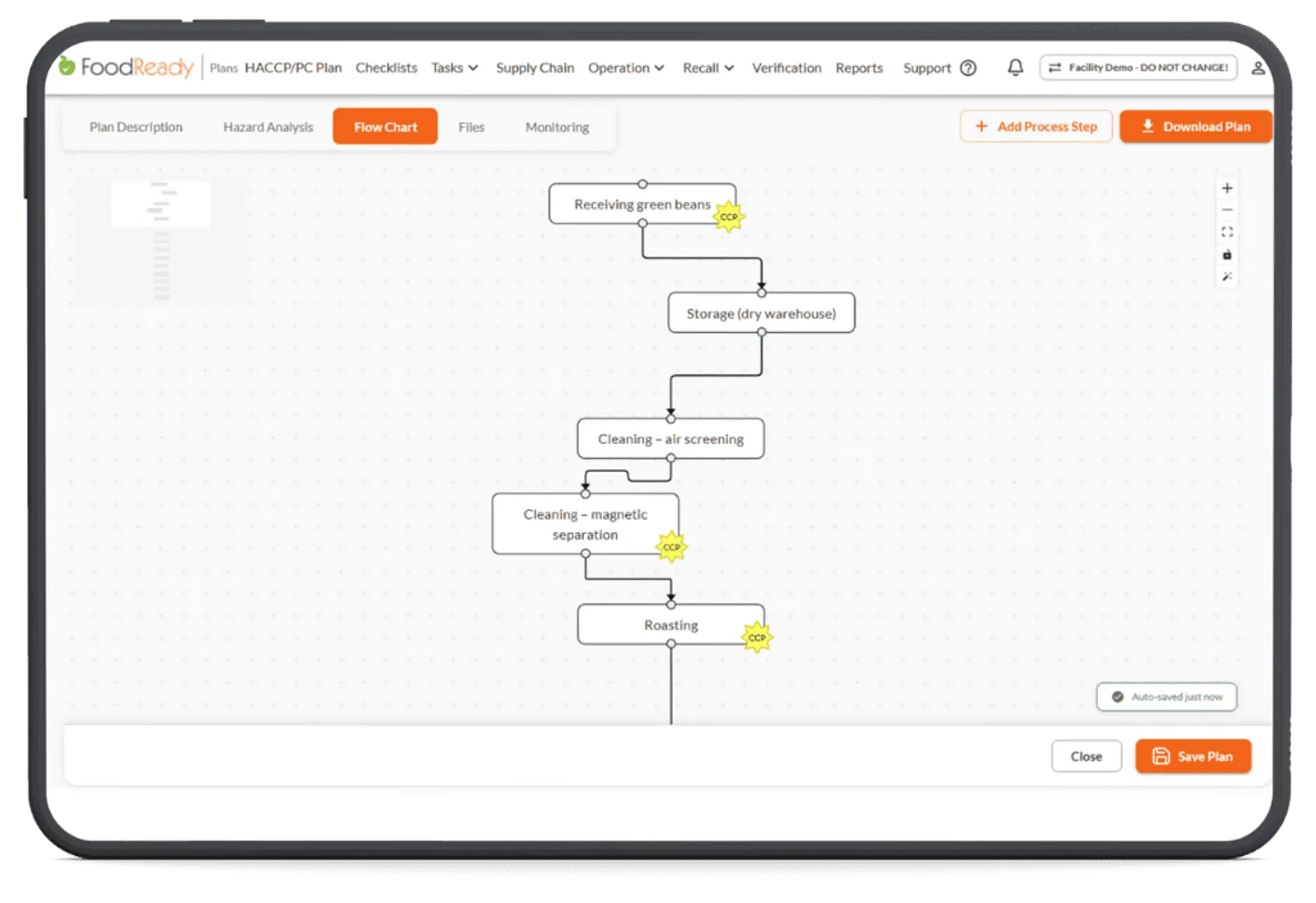
Coffee Roasting and Packaging HACCP Plan

Qualio

Document-Centric QMS for Regulated Life Sciences and Food Safety

  • QMS Only
  • Document Control
7.5
Overall score
Pricing$30,000–$80,000 / yr· Subscription only; implementation extra
Platforms
  • Web

Qualio is an established, cloud-based quality management system (QMS) designed primarily for regulated life sciences, medical devices, and food safety compliance. For coffee manufacturers who prioritize strict regulatory compliance, document control, and employee training tracking above all else, Qualio offers a highly polished and effective solution.

Qualio's primary strength is its document control and standard operating procedure (SOP) management. The software automates the entire lifecycle of quality documents, from drafting and review to electronic signature approval and distribution. This ensures that all employees have access to the latest, approved versions of SOPs, HACCP plans, and safety guidelines, reducing the risk of compliance failures.

The software also features a robust employee training matrix. Quality managers can assign specific training tasks based on job roles, track completion rates, and receive automated email reminders when training is overdue. Additionally, Qualio provides streamlined workflows for managing Corrective and Preventive Actions (CAPAs), non-conformances, and customer complaints, helping companies identify root causes and implement preventive measures.

However, Qualio is a pure QMS platform, meaning it has no native inventory management, production scheduling, or batch tracking capabilities. For a coffee roaster, this is a major limitation, as the software cannot track green bean inventory, calculate roasting shrinkage, or manage Bills of Materials. To run a complete manufacturing operation, companies must purchase and integrate separate ERP or inventory software, leading to high integration costs, data silos, and operational complexity.

Qualio's pricing ranges from $30,000 to $80,000 per year, making it an expensive option for a single-purpose quality tool. While it is highly effective for document control and compliance administration, coffee roasters needing physical inventory and production tracking will find it insufficient as a standalone solution.

Pros

  • Industry-leading document control, SOP management, and employee training tracking.
  • Clean, modern user interface that is easy for administrative staff to navigate.
  • Streamlined CAPA (Corrective and Preventive Action) and non-conformance reporting.
  • Fast implementation for a dedicated quality management system (QMS).

Cons

  • No native inventory management, production scheduling, or batch tracking capabilities.
  • Requires separate ERP or inventory software, leading to high integration costs and data silos.
  • Expensive for a single-purpose QMS tool, especially for mid-market coffee roasters.
  • Limited visibility into physical floor operations and material flows.

Scorecard

  • Document Control
    9.6 / 10
  • Inventory Accuracy
    2.0 / 10
  • Compliance Readiness
    9.2 / 10
  • Ease of Use
    8.5 / 10

Feature highlights

  • Automated SOP routing, review, and electronic signature approvals.
  • Employee training matrix with automated email reminders and compliance tracking.
  • Centralized CAPA and audit management dashboard.
  • Out-of-the-box compliance templates for ISO and FDA standards.

Best for: Coffee manufacturers prioritizing strict regulatory compliance and document control over operational inventory.

Learn More

Pricing and software details are updated as of 2026 and reflect typical mid-market deployment configurations.

How to Choose the Right Coffee Inventory Management Software

Selecting the ideal inventory and production software for your coffee roasting business requires a careful evaluation of your operational needs, regulatory requirements, and growth plans. To make an informed decision, operations directors and quality managers should consider several key criteria.

Depth of Inventory and Production Tracking

The software must be able to handle the unique characteristics of coffee manufacturing, such as tracking green coffee beans by lot, origin, and bin location, and automatically calculating roasting shrinkage. A system that cannot adjust for weight loss during roasting will lead to inaccurate inventory records and distorted cost of goods sold (COGS) calculations.

Compliance and Traceability Capabilities

If your business is subject to FDA regulations or aims to achieve food safety certifications like SQF, BRC, or FSSC 22000, you need a system that supports rapid lot traceability. Look for software that can generate a complete lot genealogy and complete a mock recall in under 30 minutes. Built-in compliance templates and digital quality logs are also highly valuable for reducing administrative labor and ensuring audit readiness.

System Integration and Connectivity

If you use QuickBooks or Xero for financial accounting, or Shopify and WooCommerce for e-commerce, the inventory software must integrate seamlessly with these platforms to prevent manual data entry and inventory discrepancies.

Total Cost of Ownership and Implementation

Enterprise ERP systems like NetSuite or SAP Business One offer unmatched scalability but require six-figure budgets and up to a year to deploy. In contrast, unified cloud platforms like FoodReady can be implemented in 8 to 16 weeks at a fraction of the cost, providing a faster return on investment for mid-market coffee manufacturers.

Frequently Asked Questions

Common questions about coffee inventory management software, production tracking, and food safety compliance.

What is coffee inventory management software?

Coffee inventory management software is a specialized digital platform designed to track green coffee beans, packaging materials, and finished goods across warehouses, while managing roasting production and compliance.

How does inventory software handle coffee roasting shrinkage?

The software automatically adjusts inventory levels by deducting the green coffee used and adding the roasted coffee to finished goods, accounting for the 12% to 20% weight loss defined in the Bill of Materials.

Why is lot traceability important for coffee roasters?

Lot traceability is critical for food safety compliance, allowing roasters to quickly trace green coffee lots from origin farms to finished products in the event of a recall or audit.

Can coffee inventory software integrate with QuickBooks?

Yes, most modern inventory platforms offer native integrations with QuickBooks to sync inventory adjustments, cost of goods sold, and sales invoices, eliminating manual data entry.

How long does it take to implement coffee inventory software?

Implementation timelines vary by platform, with modern cloud-based systems taking 8 to 16 weeks, while large enterprise ERP systems can take 6 to 18 months to fully deploy.

What is the cost of coffee inventory management software?

Mid-market cloud platforms typically cost between $15,000 and $75,000 per year, while enterprise ERP systems start at $50,000 per year with substantial implementation fees.

Written by

luke duffy

Luke Duffy

Luke Duffy is a Senior Director of Quality & Customer Success with extensive expertise in SQF, BRC, USDA, and FSQA. He specializes in developing food safety programs, leading teams, conducting audits, and guiding clients to achieve GFSI certification success. Luke Duffy led quality at companies like Boston Bakery and Do & Co.

Get a demo

Speak with our Expert Consultants

15–30 minutes. We map FoodReady to your process, plug in your real HACCP plan, and show you the auditor view before the call ends.

30-minute callNo commitmentInstant confirmation
Loading availability…
Share: