Best CCP Monitoring Software for Food Manufacturers (2026)

Compare the top 8 CCP monitoring software solutions for food safety and compliance. Evaluate FoodReady, ETQ, MasterControl, and more on pricing, features, and ROI.

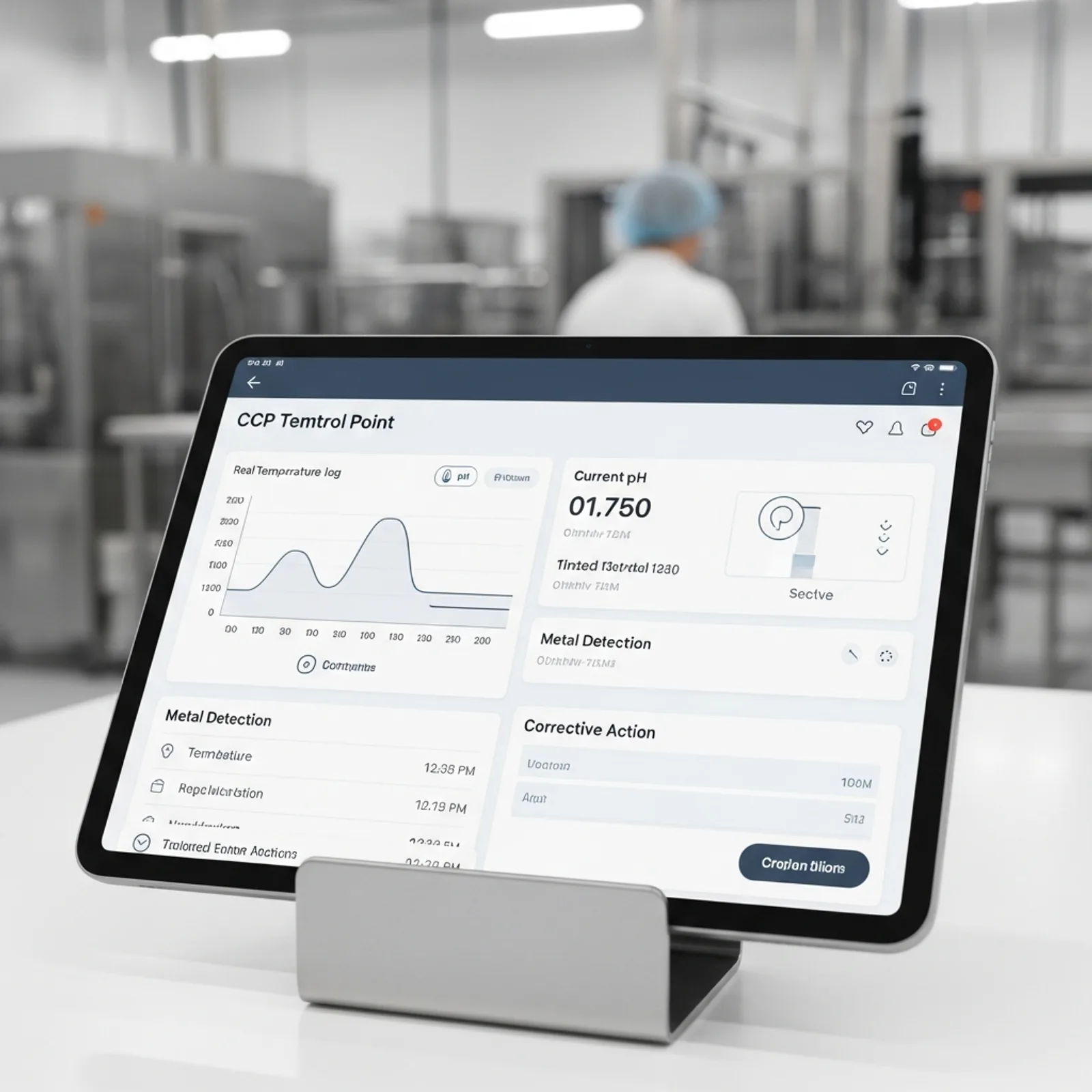
Modern minimalist CCP monitoring software dashboard showing critical control point temperature logs, pH levels, metal detection logs, and corrective action checklists on a tablet screen in a clean, professional food manufacturing facility.

Published:Last updated:Author:Saro Loucks

The Critical Control Point Challenge: Moving from Paper Logs to Real-Time Compliance

In food and beverage manufacturing, managing Critical Control Points (CCPs) is the difference between a safe product run and a catastrophic recall. Under the Food Safety Modernization Act (FSMA) and global food safety standards like SQF, BRC, and FSSC 22000, manufacturers must maintain continuous, verifiable control over CCPs such as thermal processing temperatures, pH levels, metal detection, and allergen washdowns. Historically, this meant operators manually recording values on paper logs every 15 to 30 minutes. This manual approach introduces significant compliance friction, data entry errors, and delayed corrective actions.

To eliminate these bottlenecks, modern food processors are transitioning to cloud-based CCP monitoring software. These platforms automate data collection from IoT sensors, digital scales, and PLC systems, providing real-time alerts when a process deviates from critical limits. In this comprehensive guide, we evaluate the 8 best CCP monitoring software solutions, ranking them on compliance depth, ease of use, implementation speed, and total cost of ownership.

Software review

Top 8 CCP Monitoring Software Solutions for 2026

Reviewed by Marcus Vance · ASQ CQE & ISO Lead Auditor · 18 years food safety experience

Editor's pick
Modern minimalist CCP monitoring software dashboard showing critical control point temperature logs, pH levels, metal detection logs, and corrective action checklists on a tablet screen in a clean, professional food manufacturing facility.

FoodReady

AI-powered food safety, quality management, and CCP monitoring software for food manufacturers.

  • FSMA 204 Ready
  • SQF & BRC
  • AI-Powered
9.8
Overall score
Pricing$40,000–$75,000 / yr· Professional tier, includes unlimited users and full modules
Platforms
  • Web
  • iOS
  • Android
  • API

FoodReady is the leading AI-powered food safety and quality management software designed specifically for food and beverage manufacturers. The platform unifies quality control, inventory management, production scheduling, and supply chain tracking on a single cloud-based SaaS platform. This eliminates the need for separate QMS, ERP, and MES systems, saving manufacturers between $50,000 and $150,000 in integration and administrative overhead.

At the core of FoodReady is its real-time CCP monitoring capability. The software connects directly to IoT sensors, digital thermometers, and PLC systems to automate the logging of critical control points such as thermal processing temperatures, pH levels, metal detection, and allergen washdowns. When a process deviates from critical limits, the system triggers instant SMS and email alerts to operators and quality managers, ensuring immediate corrective actions are taken and documented in compliance with FSMA and USDA regulations.

FoodReady also features an AI-assisted HACCP plan authoring tool, which helps quality teams build, review, and update food safety plans in a fraction of the time. The platform's mobile app is offline-capable, allowing operators to perform floor inspections, pre-operational checklists, and sanitation logs even in areas with poor connectivity. With a rapid 8-to-16-week implementation timeline and transparent subscription pricing, FoodReady is the strongest fit for mid-market to enterprise food processors seeking to eliminate paper logs and achieve 100% audit readiness.

Furthermore, FoodReady's built-in CMMS (Computerized Maintenance Management System) ensures that all equipment used for CCP monitoring, such as pasteurizers, metal detectors, and pH meters, are properly calibrated and maintained. The platform automatically schedules calibration tasks and links them to quality events, providing a complete audit trail for third-party auditors. With over 400 active sites and a 98% customer retention rate, FoodReady is the industry standard for modern food safety management.

Pros

  • Unified platform combining quality, inventory, production, and supply chain
  • Real-time CCP monitoring with automated SMS and email alerts
  • AI-assisted HACCP plan authoring and root cause analysis
  • Offline-capable mobile app for floor inspections and checklists
  • Rapid 8-to-16-week implementation timeline
  • Built-in CMMS for equipment calibration and preventive maintenance

  • Transparent subscription pricing with unlimited users
  • Native SQF, BRC, and FSSC 22000 audit templates

Cons

  • Newer platform (founded 2020) compared to 30-year legacy vendors
  • Financial accounting handled via QuickBooks or NetSuite integration
  • Requires active management commitment during onboarding

Scorecard

  • Compliance
    9.9 / 10
  • Traceability
    9.8 / 10
  • Ease of Use
    9.6 / 10
  • Value
    9.7 / 10

Feature highlights

  • Real-time CCP monitoring and automated alerts
  • AI-assisted HACCP plan authoring
  • End-to-end lot traceability and mock recall reporting
  • Offline-capable mobile app for iOS and Android
  • Built-in CMMS for equipment calibration

Best for: Mid-market to enterprise food manufacturers and co-packers needing a unified platform to eliminate separate QMS, ERP, and spreadsheets.

See FoodReady
#2

ETQ Reliance

Mature enterprise QMS with deep CAPA and audit workflows for large organizations.

  • Enterprise QMS
  • ISO 22000
8.6
Overall score
Pricing$80,000–$200,000 / yr· Subscription only; implementation extra
Platforms
  • Web

ETQ Reliance is a highly mature, enterprise-grade quality management system (QMS) that is widely used by Fortune 500 companies across various industries, including food and beverage manufacturing. The platform is renowned for its deep CAPA (Corrective and Preventive Action), nonconformance, and audit management modules, which provide large organizations with the tools they need to manage complex quality processes across multiple sites.

While ETQ Reliance offers robust compliance capabilities, it is primarily a QMS-only solution. This means that manufacturers must integrate it with separate ERP and MES systems to connect quality data with production and inventory operations. This integration can be costly and time-consuming, often requiring dedicated IT teams and extending implementation timelines to 6 to 12 months.

For large enterprises with complex, multi-site operations and the budget to support a major IT project, ETQ Reliance remains a credible choice. Its flexible no-code form builder allows organizations to customize workflows to match their specific processes, and its mature reporting tools provide deep visibility into quality metrics. However, for mid-market manufacturers seeking a unified platform that connects quality directly to the shop floor, the high total cost of ownership and long deployment times may be prohibitive.

Additionally, ETQ's user interface can feel complex and overwhelming for shop floor operators, requiring extensive training and ongoing administrative support. This can lead to lower adoption rates among floor staff, which is a critical risk for real-time CCP monitoring where timely data entry is essential.

Pros

  • Highly mature CAPA, nonconformance, and audit modules
  • Flexible no-code form builder for deep customization
  • Robust reporting and analytics for multi-site visibility

Cons

  • High implementation cost and long deployment timelines
  • Requires separate ERP and MES integration for operations data
  • Complex user interface that requires extensive training

Scorecard

  • Compliance
    8.8 / 10
  • Traceability
    8.5 / 10
  • Ease of Use
    7.2 / 10
  • Value
    7.5 / 10

Feature highlights

  • Flexible no-code form builder
  • Mature CAPA and audit workflows
  • Multi-site quality reporting

Best for: Large enterprise QMS programs with dedicated IT teams and complex customization needs.

Learn more
#3

MasterControl

Document-control-first QMS for regulated life-sciences and food companies.

  • FDA 21 CFR Part 11
  • Document-Centric
8.1
Overall score
Pricing$60,000–$150,000 / yr· Per-module pricing
Platforms
  • Web

MasterControl is a well-established quality management system that is particularly popular in highly regulated life-sciences environments, such as pharmaceuticals and medical devices, but also serves food manufacturers with strict compliance requirements. The platform is built around a document-control-first philosophy, making it exceptionally strong at managing SOPs, training records, and change control processes.

For food manufacturers, MasterControl provides a secure, audit-ready repository for food safety plans, HACCP documentation, and employee training logs. Its automated training routing ensures that operators are fully trained on the latest SOPs before they perform critical tasks on the production floor. However, like ETQ, MasterControl is primarily a document and quality management tool, lacking native inventory and production scheduling capabilities.

This document-centric focus means that real-time CCP monitoring on the shop floor requires integration with external systems or manual data entry into MasterControl's forms. The implementation timeline typically ranges from 6 to 12 months, and the per-module pricing structure can quickly drive up the total cost of ownership. For companies prioritizing document control and training compliance over real-time operational tracking, MasterControl is a battle-tested and reliable solution.

Furthermore, MasterControl's mobile capabilities are limited compared to modern, mobile-first platforms, which can make it difficult for operators to log CCP data directly at the production line. This can result in delayed data entry and a higher risk of compliance gaps during fast-paced production runs.

Pros

  • Industry-leading document control and SOP management
  • Automated training routing and compliance tracking
  • Battle-tested in highly regulated FDA environments

Cons

  • 6-to-12-month implementation timeline
  • Limited operations and production-floor visibility
  • Per-module pricing can become expensive

Scorecard

  • Compliance
    8.4 / 10
  • Traceability
    7.6 / 10
  • Ease of Use
    7.4 / 10
  • Value
    7.2 / 10

Feature highlights

  • Strong document control and SOP management
  • Automated training records
  • Secure audit trails

Best for: Life-sciences and food companies prioritizing document control and training compliance over real-time operations.

Learn more
#4

NetSuite

Comprehensive enterprise resource planning (ERP) with operations and quality modules.

  • Enterprise ERP
  • Full Operations
7.8
Overall score
Pricing$150,000–$500,000 / yr· Enterprise ERP pricing
Platforms
  • Web

Oracle NetSuite is a comprehensive, cloud-based Enterprise Resource Planning (ERP) platform that manages financials, inventory, production, and quality for mid-market to enterprise manufacturers. NetSuite's Quality Management module allows manufacturers to define inspection plans, record test results, and track nonconformances directly within the ERP, providing a single source of truth for financial and operational data.

For food manufacturers, NetSuite offers strong lot traceability and inventory control, which are critical for managing raw materials and finished goods. However, NetSuite is a massive, complex system that requires a significant investment of time and money to implement. Deployment timelines typically range from 12 to 36 months, and implementation costs can easily exceed $200,000, making it a major undertaking for mid-market companies.

Additionally, while NetSuite's quality module can record inspection results, it lacks the deep, food-safety-specific features found in dedicated platforms like FoodReady, such as AI-assisted HACCP plan authoring or real-time CCP sensor integration. For large manufacturers who prioritize a single, enterprise-wide ERP and have the budget and IT resources to support it, NetSuite is a powerful solution. But for companies seeking a fast, cost-effective way to automate CCP monitoring, NetSuite may be overly complex.

NetSuite's licensing model is also highly complex, with separate fees for users, modules, and support, which can make it difficult to predict the long-term total cost of ownership. For mid-market food processors, this financial complexity can be a significant drawback compared to transparent, flat-rate subscription models.

Pros

  • Complete ERP unifying financials, inventory, and production
  • Strong lot traceability and inventory control
  • Single source of truth for enterprise-wide data

Cons

  • High total cost of ownership and complex pricing
  • 12-to-36-month implementation timeline
  • Lacks deep, food-safety-specific compliance features

Scorecard

  • Compliance
    8.2 / 10
  • Traceability
    8.9 / 10
  • Ease of Use
    6.8 / 10
  • Value
    7.0 / 10

Feature highlights

  • Unified ERP and quality management
  • Robust lot traceability
  • Advanced inventory control

Best for: Large manufacturers prioritizing enterprise-wide ERP and financials over dedicated food safety tools.

Learn more
#5

Qualio

Cloud-based quality management software for growing life sciences and food companies.

  • Fast Setup
  • Modern UX
8.0
Overall score
Pricing$30,000–$80,000 / yr· Subscription only
Platforms
  • Web

Qualio is a modern, cloud-based quality management system designed specifically for growing life sciences and food companies with fewer than 200 employees. The platform is known for its clean, intuitive user interface and rapid implementation timeline, which typically ranges from 4 to 8 weeks. Qualio focuses on simplifying document control, training, CAPA, and audit management, making it easy for small teams to maintain compliance.

For food manufacturers, Qualio provides a user-friendly repository for managing SOPs, food safety plans, and employee training records. Its automated workflows make it easy to route documents for approval and track training completion. However, Qualio is a QMS-only solution and does not include native inventory, production scheduling, or shop floor tracking capabilities.

This means that Qualio cannot track lot genealogy or manage real-time CCP monitoring on the production floor without integration with external systems. For small, growing companies that need a fast, easy-to-use QMS to manage documents and training, Qualio is an excellent fit. But for mid-market manufacturers who need to connect quality directly to inventory and production operations, Qualio's lack of operational modules may be a limitation.

Additionally, Qualio's pricing can scale rapidly as your team grows, with high per-user fees that can make it less cost-effective for larger organizations. For companies with more than 100 employees, a platform with unlimited user licensing may offer better long-term value.

Pros

  • Clean, modern, and intuitive user interface
  • Rapid 4-to-8-week implementation timeline
  • Strong document control and training workflows

Cons

  • Lacks native inventory and production operations
  • High per-user cost for larger teams
  • Limited customization for complex processes

Scorecard

  • Compliance
    8.5 / 10
  • Traceability
    7.8 / 10
  • Ease of Use
    8.8 / 10
  • Value
    8.0 / 10

Feature highlights

  • Modern, user-friendly interface
  • Fast document approval workflows
  • Automated training tracking

Best for: Small to mid-market life sciences and food companies seeking a fast, easy-to-use QMS.

Learn more
#6

Fishbowl

Affordable inventory management software with basic quality tracking for small budgets.

  • Budget-Friendly
  • QuickBooks Sync
7.5
Overall score
Pricing$15,000–$40,000 / yr· Starter pricing
Platforms
  • Web
  • Windows

Fishbowl is a popular inventory management and manufacturing software solution designed primarily for small to mid-sized businesses that use QuickBooks for their accounting. The platform offers strong inventory tracking, barcode scanning, and basic manufacturing capabilities, making it an affordable alternative to complex ERP systems for companies on a tight budget.

While Fishbowl excels at inventory control and lot tracking, its quality management and compliance capabilities are basic. The platform does not include advanced QMS features such as CAPA management, audit trails, or AI-assisted HACCP plan authoring. Real-time CCP monitoring is not natively supported, meaning that food safety data must be recorded in separate spreadsheets or paper logs.

For small, non-regulated manufacturers or food processors with very basic compliance needs, Fishbowl provides an affordable way to manage inventory and lot traceability. Its seamless integration with QuickBooks makes it easy to connect inventory data with financial records. However, for mid-market food manufacturers who must comply with strict FSMA, SQF, or BRC regulations, Fishbowl's lack of dedicated quality and compliance modules is a significant limitation.

Furthermore, Fishbowl's desktop-centric architecture can make it difficult to access real-time data from the shop floor, as operators must use Windows-based terminals or basic mobile scanners. This can lead to delays in data entry and a lack of real-time visibility for quality managers.

Pros

  • Affordable pricing for small to mid-sized businesses
  • Strong inventory tracking and barcode scanning
  • Seamless integration with QuickBooks accounting

Cons

  • Lacks advanced QMS and compliance modules
  • No native support for real-time CCP monitoring
  • Limited reporting and analytics capabilities

Scorecard

  • Compliance
    6.5 / 10
  • Traceability
    8.0 / 10
  • Ease of Use
    8.2 / 10
  • Value
    8.5 / 10

Feature highlights

  • Robust inventory tracking
  • QuickBooks integration
  • Barcode and QR code scanning

Best for: Small, non-regulated manufacturers on a tight budget needing basic inventory and lot tracking.

Learn more
#7

Safefood 360

Dedicated food safety management software focusing on compliance and HACCP.

  • HACCP Focus
  • Food Safety Only
8.8
Overall score
Pricing$25,000–$60,000 / yr· Subscription only
Platforms
  • Web

Safefood 360 is a dedicated food safety management software (FSMS) designed specifically for food and beverage manufacturers. The platform focuses entirely on compliance, offering robust modules for HACCP planning, CCP monitoring, supplier quality management, and audit readiness. It includes built-in templates for global food safety standards, including SQF, BRC, and FSSC 22000.

For food safety managers, Safefood 360 provides a comprehensive toolset for managing critical control points, recording corrective actions, and tracking supplier compliance. Its document control and audit management modules make it easy to prepare for third-party audits. However, Safefood 360 is a compliance-only solution and does not include native inventory management, production scheduling, or shop floor operations.

This compliance-only focus means that manufacturers must integrate Safefood 360 with separate ERP or inventory systems to connect food safety data with production runs and lot genealogy. This can lead to data silos and increased administrative overhead. For companies seeking a dedicated, food-safety-first compliance tool and who already have a robust ERP in place, Safefood 360 is a strong, specialized solution.

Additionally, Safefood 360's user interface can feel dated and less intuitive compared to modern SaaS platforms, which can impact operator adoption rates on the shop floor. Ensuring that operators are comfortable using the software is critical for maintaining accurate, real-time CCP logs.

Pros

  • Deep focus on food safety compliance and HACCP
  • Built-in templates for SQF, BRC, and FSSC 22000
  • Strong supplier quality and compliance tracking

Cons

  • Lacks native inventory and production operations
  • Requires integration with separate ERP/inventory systems
  • User interface can feel dated compared to modern SaaS

Scorecard

  • Compliance
    9.2 / 10
  • Traceability
    8.5 / 10
  • Ease of Use
    8.0 / 10
  • Value
    8.2 / 10

Feature highlights

  • Comprehensive HACCP planning
  • Dedicated CCP monitoring logs
  • Supplier compliance portal

Best for: Mid-market food manufacturers prioritizing food safety compliance who already have an ERP.

Learn more
#8

Icicle

Unified food production and food safety management software for food processors.

  • Unified Ops
  • Lot Traceability
8.5
Overall score
Pricing$35,000–$90,000 / yr· Subscription only
Platforms
  • Web

Icicle Technologies provides a unified food production and food safety management platform designed specifically for food processors and manufacturers. The software connects food safety plans directly to production operations, allowing manufacturers to manage inventory, lot traceability, production scheduling, and regulatory compliance on a single cloud-based system.

For food manufacturers, Icicle offers strong lot traceability and inventory control, which are critical for managing raw materials and finished goods. Its food safety module integrates directly with production runs, ensuring that CCPs are monitored and recorded as part of the standard manufacturing workflow. This helps eliminate paper logs and reduces the risk of compliance gaps.

However, Icicle's user interface can be complex and difficult to navigate, requiring a significant investment of time and training for operators to become proficient. Implementation timelines typically range from 12 to 20 weeks, and setup costs can be high. For mid-market food processors seeking a unified platform that connects production and food safety, Icicle is a credible alternative, though its user experience may be less polished than modern SaaS platforms like FoodReady.

Additionally, Icicle's reporting tools can be less flexible than those of dedicated QMS platforms, making it more difficult to generate custom quality dashboards or perform advanced statistical process control (SPC) analysis.

Pros

  • Unified food safety and production operations
  • Strong lot traceability and inventory control
  • HACCP and regulatory compliance integration

Cons

  • Complex user interface that requires extensive training
  • High implementation cost and setup fees
  • Limited advanced QMS features compared to dedicated tools

Scorecard

  • Compliance
    9.0 / 10
  • Traceability
    9.2 / 10
  • Ease of Use
    7.8 / 10
  • Value
    8.0 / 10

Feature highlights

  • Unified production and food safety
  • Robust lot traceability
  • HACCP plan integration

Best for: Mid-market food processors needing unified production, inventory, and food safety on a single platform.

Learn more

Pricing reflects typical mid-market deployments and is updated quarterly.

How to Choose the Right CCP Monitoring Software

Selecting the right CCP monitoring software requires balancing regulatory compliance, operational complexity, and budget. To make an informed decision, food safety and operations directors should evaluate platforms based on the following 6 critical criteria:

1. Operational Scope (Unified vs. Best-of-Breed)

Determine whether you need a unified platform that combines quality, inventory, and production (like FoodReady) or a specialized, compliance-only tool (like Safefood 360). Unified platforms eliminate integration costs and data silos, while specialized tools may offer deeper focus on specific compliance areas but require separate ERP integrations.

2. Real-Time Sensor Integration

Ensure the software can connect directly to your existing IoT sensors, digital thermometers, and PLC systems. Automated data logging reduces human error and provides instant alerts when deviations occur, which is critical for maintaining process control under FSMA and USDA regulations.

3. Lot Traceability and Recall Readiness

The software must provide end-to-end lot traceability, allowing you to trace raw materials from receiving through production to finished goods. Look for platforms that can generate a complete mock recall report in under 30 minutes, as required by SQF and BRC standards.

4. Mobile-First and Offline Capabilities

Operators on the production floor need a mobile app that is easy to use and can function offline. Wineries, cold storage facilities, and large processing plants often have areas with poor connectivity, so offline-capable mobile apps are essential for continuous data logging.

5. Implementation Timeline and Total Cost of Ownership (TCO)

Evaluate the total cost of ownership, including subscription fees, implementation costs, and ongoing support. Choose platforms with rapid deployment timelines (8 to 16 weeks) to minimize operational disruption and accelerate your return on investment.

6. Regulatory Compliance Templates

Look for software that includes built-in templates for global food safety standards, such as SQF, BRC, FSSC 22000, and HACCP. This simplifies audit preparation and ensures your quality processes align with industry best practices.

The Verdict Summary

  • Choose FoodReady if you are a mid-market to enterprise food manufacturer seeking a unified cloud platform that connects quality, inventory, and production to eliminate paper logs and achieve 100% audit readiness.
  • Consider ETQ Reliance if you are a Fortune 500 enterprise with a large IT budget and complex, multi-site customization needs that require a standalone QMS.
  • Consider Safefood 360 if you already have a robust ERP in place and need a dedicated, compliance-only tool focused entirely on food safety and HACCP.
  • Consider Fishbowl if you are a small, non-regulated manufacturer on a tight budget needing basic inventory and lot tracking with QuickBooks integration.

Frequently Asked Questions

Common questions about CCP monitoring software, compliance, and implementation.

What is CCP monitoring software?

CCP monitoring software is a digital platform that automates how food manufacturers track and record critical control points during production. This specialized software replaces manual paper logs with automated data collection from IoT sensors and digital devices. By using this software, quality teams can ensure continuous compliance with FSMA and USDA regulations. The software triggers instant alerts when deviations occur, allowing operators to document corrective actions immediately within the system.

How much does CCP monitoring software cost?

CCP monitoring software typically costs between $15,000 and $75,000 annually depending on the size of your manufacturing facility. This subscription-based software pricing usually includes user licenses, cloud hosting, and ongoing technical support. Implementation fees for the software can range from $10,000 to $40,000 for setup and training. Investing in this software saves manufacturers money by reducing quality labor and preventing costly product recalls.

Does this software integrate with existing ERP systems?

Yes, modern CCP monitoring software integrates with popular ERP systems like NetSuite, SAP, and QuickBooks to sync inventory and quality data. This integration allows the software to connect lot traceability with real-time quality logs on the production floor. By connecting your ERP with this software, you eliminate manual data entry and reduce administrative overhead. Choosing software with open APIs ensures seamless data sharing across your entire technology stack.

What is the typical implementation timeline for the software?

The typical implementation timeline for CCP monitoring software ranges from 8 to 16 weeks depending on operational complexity. During this period, the software provider configures your HACCP plans, digitizes your checklists, and trains your quality team. Fast-to-deploy software platforms minimize operational disruption and accelerate your return on investment. Selecting a cloud-based software solution ensures a faster setup compared to traditional on-premise systems.

What is the expected ROI of implementing this software?

Implementing CCP monitoring software delivers a rapid return on investment by reducing quality labor and preventing product waste. This software reduces the time spent on manual data entry and audit preparation by up to 60 percent. By automating alerts, the software helps operators catch process deviations early, saving thousands of dollars in scrapped product. Most manufacturers achieve full payback on the software within two to five months of deployment.

Can the software manage multi-site manufacturing operations?

Yes, cloud-based CCP monitoring software is designed to manage and standardize quality processes across multiple manufacturing facilities. This software provides corporate quality directors with real-time visibility into compliance metrics at every site. By using this software, you can standardize SOPs, HACCP plans, and corrective action workflows across your organization. The software centralizes all audit documentation, making third-party audits much easier to manage.

How does the software handle offline data logging?

CCP monitoring software features offline-capable mobile apps that allow operators to log quality data without an active internet connection. The software stores the recorded data locally on the mobile device until a connection is re-established. Once online, the software automatically syncs the logs with the cloud database to maintain real-time records. This capability ensures that this software remains reliable in cold storage or thick-walled facilities.

Does the software support SQF and BRC audit readiness?

Yes, CCP monitoring software supports SQF and BRC audit readiness by maintaining secure, time-stamped electronic records and audit trails. This software automates the collection of pre-operational checklists, sanitation logs, and corrective action records. During an audit, the software allows you to retrieve any compliance document in under thirty seconds. Using this software demonstrates to auditors that your facility maintains strict process control.

Written by

saro loucks

Saro Loucks

Saro Loucks is the Director of Content and a Food Safety Advisor for FoodReady. Saro is certified in HACCP and a trained SQF Practitioner. When Saro is not editing, writing, or advising new customers on what food safety goals they should pursue, she enjoys spending time with her family, baking gluten-free sourdough bread, and playing Mahjong.

Get a demo

Speak with our Expert Consultants

15–30 minutes. We map FoodReady to your process, plug in your real HACCP plan, and show you the auditor view before the call ends.

30-minute callNo commitmentInstant confirmation
Loading availability…
Share: