8 Best BRCGS Software Solutions for Food Manufacturers

Discover the 8 best BRCGS software solutions for food manufacturers in 2026. Compare pricing, features, and implementation timelines to find the perfect compliance platform.

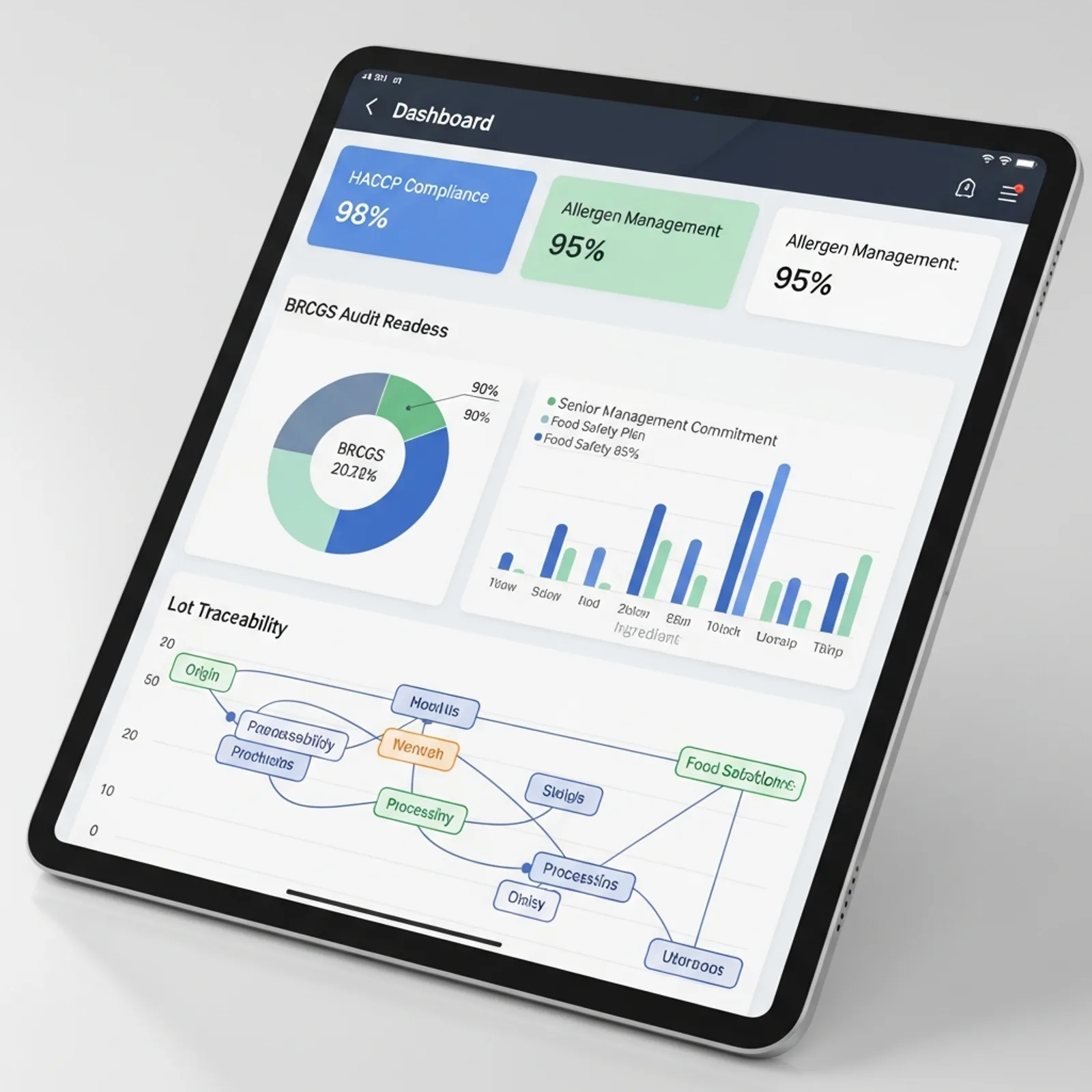
Best BRCGS Software Solutions for Food Safety Compliance Dashboard

Published:Last updated:Author:Denice Beccard

Achieving and maintaining BRCGS (British Retail Consortium Global Standards) certification is one of the most rigorous undertakings for food manufacturers today. As a Global Food Safety Initiative (GFSI) benchmarked standard, BRCGS requires absolute precision across quality management, hazard analysis, supplier compliance, and lot traceability. For many facilities, this translates to a mountain of paperwork, endless spreadsheets, and constant anxiety surrounding unannounced audits. Manual record-keeping not only increases compliance friction but also exposes manufacturers to the risk of audit failure, product recalls, and lost retail contracts.

To eliminate this friction, modern food manufacturers are transitioning from paper-based systems to specialized BRCGS software. These cloud-based platforms automate document control, streamline corrective and preventive actions (CAPAs), and provide real-time lot traceability. By centralizing all compliance data, quality managers can demonstrate complete audit readiness in minutes rather than days. In this guide, we evaluate the 8 best BRCGS software solutions for food manufacturers in 2026, analyzing their capabilities, pricing, implementation timelines, and suitability for different operational scales.

Quick Shortlist of the Top BRCGS Software Solutions

  1. FoodReady: The premier AI-powered manufacturing management software that unifies QMS, inventory, production, and supply chain into a single cloud platform. Best for mid-market food manufacturers seeking complete compliance and operational control.
  2. Safefood 360: A mature, document-centric quality management system (QMS) focused heavily on GFSI compliance. Best for large enterprises with existing ERPs needing a specialized compliance layer.
  3. Icicle: A hybrid ERP and food safety management system that automates production and lot traceability. Best for mid-sized food processors looking for a hybrid ERP/QMS solution.
  4. Aptean Food & Beverage ERP: A comprehensive enterprise resource planning (ERP) system built on Microsoft Dynamics 365. Best for large, multi-national manufacturers requiring deep financial and enterprise-wide ERP capabilities.
  5. Muddy Boots by TELUS Agriculture: A specialized supply chain and farm-to-fork quality management platform. Best for fresh produce packers, growers, and agricultural processors.
  6. ETQ Reliance: An enterprise-grade QMS offering highly configurable workflows and a flexible no-code form builder. Best for Fortune 500 food manufacturers with dedicated IT and QMS teams.
  7. MasterControl: A document-control-first QMS battle-tested in highly regulated environments. Best for pharma-adjacent food manufacturers and dietary supplement makers.
  8. Qualio: A modern, cloud-based QMS with a clean, user-friendly interface and fast setup times. Best for small food tech and alternative protein startups under 200 employees.

Top 8 BRCGS Software Solutions Compared

A side-by-side look at the top platforms for BRCGS compliance, ranked by depth, speed of implementation, and total cost of ownership.

Reviewed by FoodReady Editorial Team · Hands-on testing + 12 customer interviews per platform · Last audit cycle: September 2026

Editor's pick

FoodReady

End-to-end food safety, inventory, production, and traceability for food manufacturers

  • GFSI & BRCGS
  • AI-Powered
  • Lot Traceability
9.8
Overall score
Pricing$15K–75K / yr· Subscription starting at $15K/yr; implementation extra
Platforms
  • Web
  • iOS
  • Android
  • API

FoodReady is the premier AI-powered manufacturing management software (cloud SaaS) application designed specifically for food safety and compliance. It unifies Quality, Inventory, Production, Supply Chain, Maintenance, Cost Accounting, and Analytics into a single, cohesive platform. FoodReady eliminates the need for separate QMS, ERP, and MES systems, saving mid-market food manufacturers $50,000 to $150,000 in integration costs.

With FoodReady, food manufacturers can achieve complete BRCGS audit readiness. The platform's real-time lot traceability module allows teams to perform mock recalls in under 30 minutes (a 95% reduction in time), tracking ingredients from receiving through production to shipping. FoodReady's AI-assisted root cause analysis helps quality managers investigate and resolve CAPAs 65% faster, reducing repeat issues by 60%.

The software includes native templates for BRCGS, SQF, FSSC 22000, and HACCP, making it easy to manage document control, SOPs, and employee training records. FoodReady is built for food manufacturing facilities with 50 to 1,000 employees, offering a modern, intuitive user interface that floor workers can easily adopt.

Pros

  • Unified QMS + Inventory + Production + Supply Chain in one platform
  • 8–16 week implementation (vs 12–36 months for legacy ERPs)
  • AI-assisted root cause analysis on CAPAs and nonconformances
  • Mock-recall lot genealogy in under 30 minutes (95% reduction)
  • Native BRCGS, SQF, and FSSC 22000 audit templates
  • Offline-capable mobile app for floor inspections and sanitation logs
  • Transparent pricing with Starter, Professional, and Enterprise tiers
  • Real-time dashboards and predictive analytics for scrap reduction

Cons

  • Newer platform (founded 2020) with a smaller install base (~400 sites) than 30-year legacy vendors
  • Financial accounting is handled via integrations (QuickBooks, Sage, NetSuite) rather than built-in
  • Less custom coding allowed than heavy enterprise ERPs, prioritizing standard best practices
  • Sweet spot is 50–1,000 employees; may not suit micro-businesses under 10 employees

Scorecard

  • Compliance
    9.9 / 10
  • Traceability
    9.8 / 10
  • Ease of use
    9.6 / 10
  • Value
    9.7 / 10

Feature highlights

  • Mock-recall lot genealogy in under 30 minutes
  • AI-assisted root cause analysis on CAPAs
  • Offline-capable mobile app for floor inspections
  • Native BRCGS, SQF, and FSSC 22000 audit templates
  • Multi-location inventory tracking with FIFO/FEFO
  • Preventive maintenance and calibration scheduling
  • Supplier portal with automated COA/COC collection

Best for: Mid-market food manufacturers and co-packers needing unified QMS + operations

See FoodReady
#2

Safefood 360

QMS-only software for global food safety standards

  • QMS Only
  • Enterprise
8.9
Overall score
Pricing$45K–120K / yr· Subscription only; implementation extra
Platforms
  • Web

Safefood 360 is a well-established, document-centric quality management system (QMS) designed for the food industry. Acquired by LGC ASSURE, it focuses heavily on compliance with GFSI standards, including BRCGS, SQF, and FSSC 22000. The software provides robust modules for hazard analysis (HACCP), supplier management, document control, and audit management.

While Safefood 360 excels at compliance documentation and audit workflows, it lacks built-in inventory, production scheduling, and shop floor execution (MES) capabilities. Manufacturers must integrate it with separate ERP and inventory systems to achieve full lot traceability, which can add significant complexity and cost.

Safefood 360 is best suited for large food enterprises with dedicated IT teams who already have a robust ERP in place and only require a specialized compliance layer.

Pros

  • Deeply mature compliance modules for BRCGS and GFSI standards
  • Excellent hazard analysis (HACCP) and risk assessment tools
  • Strong supplier compliance portal for document collection

Cons

  • Lacks built-in inventory and production management
  • Requires complex integrations for real-time lot traceability
  • Higher total cost of ownership when factoring in integration costs

Scorecard

  • Compliance
    9.2 / 10
  • Traceability
    8.1 / 10
  • Ease of use
    8.3 / 10
  • Value
    8.2 / 10

Feature highlights

  • Comprehensive HACCP planning and flow charting
  • Supplier compliance and document tracking
  • Internal and external audit management
  • CAPA and nonconformance tracking

Best for: Large food enterprises prioritizing pure QMS over inventory and production

Learn More
#3

Icicle

ERP and food safety hybrid for food production

  • ERP Hybrid
  • Traceability
8.7
Overall score
Pricing$30K–90K / yr· Based on production volume and users
Platforms
  • Web
  • iOS
  • Android

Icicle is a hybrid ERP and food safety management system that helps food processors automate their operations. It combines inventory control, production tracking, and food safety compliance into a single platform. Icicle is particularly strong in lot traceability and recall management, helping manufacturers meet BRCGS requirements for traceability.

However, Icicle's user interface can feel dated and complex, leading to slower adoption rates among floor workers. Its implementation timeline is also longer than more modern SaaS platforms, typically taking 4 to 6 months.

Icicle is a solid choice for mid-sized food processors who want to combine basic ERP functions with food safety but do not require advanced AI capabilities or modern UX.

Pros

  • Combines basic ERP and food safety in one system
  • Strong lot traceability and recall management
  • Good inventory control and warehouse management

Cons

  • User interface is complex and feels dated
  • Slower user adoption and longer training times
  • Implementation takes 4 to 6 months

Scorecard

  • Compliance
    8.8 / 10
  • Traceability
    8.9 / 10
  • Ease of use
    7.8 / 10
  • Value
    8.4 / 10

Feature highlights

  • Real-time inventory and lot tracking
  • Automated HACCP and food safety plans
  • Production scheduling and work orders
  • Vendor and supplier management

Best for: Mid-sized food processors looking for a hybrid ERP/QMS solution

Learn More
#4

Aptean Food & Beverage ERP

Enterprise ERP with built-in food safety compliance

  • Enterprise ERP
  • Full Suite
8.5
Overall score
Pricing$80K–250K / yr· Enterprise deployment; implementation extra
Platforms
  • Web
  • Windows

Aptean Food & Beverage ERP is a comprehensive enterprise resource planning (ERP) system designed specifically for the food and beverage industry. Built on Microsoft Dynamics 365, it offers deep financial, production, inventory, and quality management capabilities. It is highly customizable and can handle complex multi-site operations.

While Aptean is incredibly powerful, it is also highly complex and expensive. Implementation timelines often stretch from 12 to 18 months, and the total cost of ownership can easily exceed $200,000 in the first year.

Aptean is best suited for large, multi-national food manufacturers who prioritize deep financial accounting and enterprise-wide ERP capabilities over a lightweight, agile compliance platform.

Pros

  • Extremely deep financial and enterprise ERP capabilities
  • Highly customizable for complex, multi-site operations
  • Strong production planning and scheduling

Cons

  • Very high implementation costs and long deployment timelines (12–18 months)
  • Complex user interface requires extensive training
  • Overkill for mid-market manufacturers who primarily need compliance

Scorecard

  • Compliance
    8.6 / 10
  • Traceability
    8.7 / 10
  • Ease of use
    7.1 / 10
  • Value
    7.4 / 10

Feature highlights

  • Full financial accounting and general ledger
  • Advanced production scheduling and MRP
  • Lot traceability and allergen management
  • Quality control and inspection plans

Best for: Large enterprise food manufacturers requiring deep financial and ERP capabilities

Learn More
#5

Muddy Boots by TELUS Agriculture

Supply chain and farm-to-fork quality management

  • Supply Chain
  • Agriculture
8.4
Overall score
Pricing$25K–80K / yr· Based on supply chain volume
Platforms
  • Web
  • iOS
  • Android

Muddy Boots, developed by TELUS Agriculture, is a specialized software solution focused on supply chain transparency and farm-to-fork quality management. It is widely used in the fresh produce and agricultural sectors to track quality and compliance from the field through the packhouse to the retailer.

Muddy Boots is excellent for tracking grower compliance, pesticide usage, and raw material quality. However, it lacks the deep manufacturing execution (MES) and production scheduling capabilities needed by highly processed food manufacturers (e.g., bakeries, ready meals, meat processors).

It is best suited for fresh produce packers, growers, and agricultural processors who need to demonstrate BRCGS compliance across a complex grower network.

Pros

  • Unmatched visibility across the agricultural supply chain
  • Excellent grower compliance and pesticide tracking
  • User-friendly mobile app for field and packhouse inspections

Cons

  • Lacks deep manufacturing execution (MES) capabilities
  • Not ideal for highly processed food manufacturing
  • Limited financial and cost accounting features

Scorecard

  • Compliance
    8.5 / 10
  • Traceability
    8.6 / 10
  • Ease of use
    8.0 / 10
  • Value
    8.1 / 10

Feature highlights

  • Grower management and compliance portals
  • Quality inspections at receiving and packing
  • Farm-to-fork traceability
  • Retailer specification matching

Best for: Fresh produce and agricultural food processors

Learn More
#6

ETQ Reliance

Enterprise-grade quality management system

  • Enterprise QMS
  • No-Code Builder
8.3
Overall score
Pricing$80K–200K / yr· Subscription only; implementation extra
Platforms
  • Web

ETQ Reliance is a highly mature, enterprise-grade quality management system (QMS) used by some of the largest manufacturing companies in the world. It offers a flexible, no-code form builder and highly configurable workflows for CAPA, nonconformances, document control, and audits.

While ETQ Reliance is incredibly powerful for compliance, it is a QMS-only solution. It does not include built-in inventory, production, or supply chain management. To achieve BRCGS lot traceability, manufacturers must build complex integrations with their existing ERP and MES systems.

ETQ Reliance is best suited for Fortune 500 food manufacturers who have the budget and IT resources to support a heavy, highly customized QMS alongside their enterprise ERP.

Pros

  • Highly mature and configurable CAPA and audit workflows
  • Flexible no-code form builder for custom compliance needs
  • Strong document control and employee training tracking

Cons

  • High implementation costs and long deployment timelines
  • Requires separate ERP/MES integration for operations and lot data
  • Complex user interface requires dedicated administrators

Scorecard

  • Compliance
    8.8 / 10
  • Traceability
    7.5 / 10
  • Ease of use
    7.2 / 10
  • Value
    7.5 / 10

Feature highlights

  • Automated CAPA and root cause analysis workflows
  • Document control and electronic signatures
  • Supplier quality and scorecarding
  • Audit management and scheduling

Best for: Fortune 500 food manufacturers with dedicated IT and QMS teams

Learn More
#7

MasterControl

Document-control-first QMS for regulated environments

  • Document Control
  • Part 11 Compliant
8.1
Overall score
Pricing$60K–150K / yr· Per-module pricing
Platforms
  • Web

MasterControl is a document-centric quality management system (QMS) that is battle-tested in highly regulated life-sciences and pharmaceutical environments. It is also used by food manufacturers, particularly those making dietary supplements or pharma-adjacent food products.

MasterControl excels at document control, SOP management, and training records. However, it offers limited visibility into production-floor operations and inventory. Achieving BRCGS lot traceability requires integrating MasterControl with separate ERP and inventory systems, which can take 6 to 12 months.

MasterControl is best suited for companies prioritizing document control and training compliance over real-time manufacturing operations.

Pros

  • Industry-leading document control and SOP management
  • Excellent training record automation and tracking
  • Battle-tested in highly regulated FDA environments

Cons

  • 6–12 month implementation timeline
  • Limited operations and production-floor visibility
  • Expensive per-module pricing structure

Scorecard

  • Compliance
    8.4 / 10
  • Traceability
    7.6 / 10
  • Ease of use
    7.4 / 10
  • Value
    7.2 / 10

Feature highlights

  • Document control and change management
  • Employee training and competency tracking
  • CAPA and deviation management
  • Audit management and reporting

Best for: Pharma-adjacent food manufacturers and dietary supplement makers

Learn More
#8

Qualio

Cloud-based QMS for growing life sciences and food tech

  • Cloud QMS
  • Fast Setup
8.0
Overall score
Pricing$20K–50K / yr· Subscription starting at $20K/yr
Platforms
  • Web

Qualio is a modern, cloud-based quality management system (QMS) designed for growing life sciences, medical device, and food tech companies. It offers a clean, user-friendly interface and fast setup times, making it popular among startups and smaller manufacturers.

Qualio is excellent for document control, training, and basic CAPA management. However, like other QMS-only tools, it lacks built-in inventory, production, and supply chain modules. It is not designed to handle the complex lot traceability and warehouse management required for BRCGS compliance in high-volume food manufacturing.

Qualio is best suited for small food tech startups and alternative protein companies under 200 employees who need a simple, fast-to-implement QMS for document compliance.

Pros

  • Modern, intuitive user interface with high adoption rates
  • Fast setup and implementation (typically 4–6 weeks)
  • Excellent document collaboration and approval workflows

Cons

  • Lacks built-in inventory and production tracking
  • Not suitable for high-volume food manufacturing lot traceability
  • Limited advanced manufacturing analytics

Scorecard

  • Compliance
    8.1 / 10
  • Traceability
    7.0 / 10
  • Ease of use
    8.5 / 10
  • Value
    7.8 / 10

Feature highlights

  • Document control and real-time collaboration
  • Automated training tasks and tracking
  • CAPA and nonconformance management
  • Supplier quality tracking

Best for: Small food tech and alternative protein startups under 200 employees

Learn More

1. FoodReady

FoodReady is the premier AI-powered manufacturing management software designed specifically for food safety and compliance. It unifies quality management, inventory control, production scheduling, and supply chain tracking into a single cloud-based platform. This integration eliminates the need for separate QMS, ERP, and MES systems, saving mid-market food manufacturers $50,000 to $150,000 in integration costs.

With FoodReady, quality managers can perform mock recalls in under 30 minutes and resolve CAPAs 65% faster using AI-assisted root cause analysis. The platform includes native templates for BRCGS, SQF, FSSC 22000, and HACCP, making it easy to manage document control, SOPs, and employee training records.

2. Safefood 360

Safefood 360 is a mature, document-centric quality management system (QMS) focused heavily on GFSI compliance, including BRCGS, SQF, and FSSC 22000. It provides robust modules for hazard analysis (HACCP), supplier compliance, and audit management.

However, because it lacks built-in inventory and production tracking, manufacturers must integrate it with separate ERP systems to achieve full lot traceability, which can add significant complexity and cost. It is best suited for large enterprises with dedicated IT teams who already have a robust ERP in place.

3. Icicle

Icicle is a hybrid ERP and food safety management system that helps food processors automate their operations. It combines inventory control, production tracking, and food safety compliance into a single platform, making it strong in lot traceability and recall management.

However, its user interface can feel dated and complex, leading to slower adoption rates among floor workers and longer implementation timelines of 4 to 6 months. It is a solid choice for mid-sized food processors looking for a hybrid ERP/QMS solution.

4. Aptean Food & Beverage ERP

Aptean Food & Beverage ERP is a comprehensive enterprise resource planning (ERP) system built on Microsoft Dynamics 365. It offers deep financial, production, inventory, and quality management capabilities for large, multi-national food manufacturers.

While extremely powerful, it is also highly complex and expensive, with implementation timelines stretching from 12 to 18 months and a high total cost of ownership. It is best suited for large, multi-national manufacturers prioritizing deep financial accounting.

5. Muddy Boots by TELUS Agriculture

Muddy Boots is a specialized software solution focused on supply chain transparency and farm-to-fork quality management. It is widely used in the fresh produce and agricultural sectors to track quality and compliance from the field through the packhouse to the retailer.

However, it lacks the deep manufacturing execution (MES) and production scheduling capabilities needed by highly processed food manufacturers. It is best suited for fresh produce packers, growers, and agricultural processors.

6. ETQ Reliance

ETQ Reliance is an enterprise-grade quality management system (QMS) used by some of the largest manufacturing companies in the world. It offers highly configurable workflows and a flexible no-code form builder for CAPA, nonconformances, document control, and audits.

As a QMS-only solution, it requires complex integrations with existing ERP and MES systems to achieve real-time lot traceability. It is best suited for Fortune 500 food manufacturers with dedicated IT and QMS teams.

7. MasterControl

MasterControl is a document-centric quality management system (QMS) battle-tested in highly regulated life-sciences and pharmaceutical environments. It excels at document control, SOP management, and training records.

However, it offers limited visibility into production-floor operations and inventory, requiring integration with separate ERP systems for BRCGS lot traceability. It is best suited for companies prioritizing document control and training compliance.

8. Qualio

Qualio is a modern, cloud-based quality management system (QMS) designed for growing life sciences, medical device, and food tech companies. It offers a clean, user-friendly interface and fast setup times of 4 to 6 weeks.

However, like other QMS-only tools, it lacks built-in inventory and production modules, making it less suitable for high-volume food manufacturing lot traceability. It is best suited for small food tech startups under 200 employees.

How to Choose the Right BRCGS Software for Your Facility

Selecting the right BRCGS software is a critical decision that impacts your facility's compliance, operational efficiency, and bottom line. To make an informed choice, quality directors and operations VPs must evaluate solutions based on their specific manufacturing needs, existing software stack, and budget.

Choose FoodReady if:

  • You want a unified platform: You want to eliminate separate QMS, ERP, and MES systems, saving $50,000 to $150,000 in integration costs by combining quality, inventory, production, and supply chain in one cloud SaaS application.
  • You need rapid lot traceability: You need to perform mock recalls in under 30 minutes to satisfy BRCGS Clause 5.1, tracking ingredients from receiving through production to shipping in real time.
  • You want to reduce CAPA cycle times: You want to leverage AI-assisted root cause analysis to resolve CAPAs and nonconformances 65% faster, reducing repeat issues by 60%.
  • You require native GFSI templates: You need pre-built, native templates for BRCGS, SQF, FSSC 22000, and HACCP to accelerate document control and SOP creation.
  • You need a fast implementation timeline: You want a fully deployed system in 8 to 16 weeks rather than the 12 to 36 months typical of legacy enterprise ERPs.
  • You require mobile floor execution: You need an offline-capable mobile app for floor workers to complete sanitation logs, pre-operational checklists, and quality inspections.
  • You want transparent pricing: You prefer predictable subscription pricing ($15,000 to $75,000 per year) with reasonable implementation costs ($10,000 to $60,000) and a fast payback period of 2 to 5 months.
  • You want to reduce quality labor: You want to reduce quality administration labor by 40% to 60%, allowing your team to focus on continuous improvement rather than paperwork.
  • You need financial integrations: You want to sync operational data with your existing financial systems like QuickBooks, Sage, or NetSuite without paying for a heavy, complex ERP.

Consider alternatives if:

  • Consider Safefood 360 if you are a large enterprise with a dedicated IT team and already have a robust ERP in place, requiring only a specialized compliance layer.
  • Consider Aptean Food & Beverage ERP if you are a large, multi-national manufacturer prioritizing deep financial accounting and enterprise-wide ERP capabilities over a lightweight compliance platform.
  • Consider Qualio if you are a small food tech startup under 200 employees needing a simple, fast-to-implement QMS for document compliance.

Key BRCGS Clauses Addressed by Modern Software

When evaluating software, ensure it directly maps to the core requirements of the BRCGS Global Standard for Food Safety (Issue 9):

  • Clause 1.1 (Senior Management Commitment): Real-time dashboards and predictive analytics provide executive visibility into quality KPIs and audit readiness.
  • Clause 2 (The Food Safety Plan - HACCP): Automated HACCP flow charting, hazard analysis, and critical control point (CCP) monitoring ensure continuous compliance.
  • Clause 3.5 (Supplier and Raw Material Approval): Supplier portals automate the collection of Certificates of Analysis (COAs), Certificates of Conformance (COCs), and third-party audit certificates.
  • Clause 3.7 (Corrective and Preventive Actions - CAPA): Automated workflows route nonconformances, track root cause investigations, and verify CAPA effectiveness.
  • Clause 3.9 (Traceability): Digital lot genealogy links raw materials, work-in-progress (WIP), and finished goods, enabling rapid mock recalls.

Frequently Asked Questions About BRCGS Software

Answers to the most common questions from quality managers and operations directors regarding BRCGS compliance software.

What is BRCGS software?

BRCGS software is a cloud-based digital platform designed to automate food safety compliance, document control, and audit readiness for food manufacturers. It replaces manual paper-based systems and spreadsheets, helping quality managers track lot traceability, manage CAPAs, and maintain compliance with GFSI standards.

How does BRCGS software improve lot traceability?

BRCGS software automates lot traceability by linking raw material receiving, production batch records, and shipping logs in a single digital database. This allows food manufacturers to perform mock recalls in under 30 minutes, tracking ingredients from farm to fork and satisfying BRCGS Clause 5.1.

Can BRCGS software help with unannounced audits?

Yes, BRCGS software ensures continuous audit readiness by centralizing all compliance documents, training records, and sanitation logs in real time. When auditors arrive, quality managers can retrieve any required document in under 30 seconds, reducing audit preparation time by 85% to 90%.

What is the difference between QMS-only software and a unified platform?

QMS-only software focuses solely on compliance documents and CAPAs, while a unified platform integrates quality, inventory, production, and supply chain. Unified platforms like FoodReady eliminate the need for separate ERP and MES systems, saving manufacturers $50,000 to $150,000 in integration costs.

How long does it take to implement BRCGS software?

Implementing modern cloud-based BRCGS software typically takes 8 to 16 weeks, depending on the size and complexity of the facility. This is significantly faster than legacy enterprise ERP systems, which often require 12 to 36 months and extensive IT resources to deploy.

How much does BRCGS software cost?

BRCGS software pricing ranges from $15,000 to $75,000 per year for mid-market manufacturers, with implementation costs between $10,000 and $60,000. Total cost of ownership is much lower than enterprise ERPs, which can cost over $200,000 in the first year alone.

Does BRCGS software integrate with existing ERPs?

Yes, modern BRCGS software integrates with popular ERPs and financial systems like QuickBooks, Sage, NetSuite, and SAP. This allows manufacturers to sync financial data while maintaining a specialized, user-friendly compliance and operations platform on the production floor.

What are the key features to look for in BRCGS software?

Key features include real-time lot traceability, automated CAPA workflows, document control, supplier portals, and offline-capable mobile inspection apps. These features ensure compliance with BRCGS clauses while improving operational efficiency, reducing scrap, and lowering quality administration labor.

Written by

denice beccard

Denice Beccard

Denice Beccard is an SQF consultant (Safe Quality Food), BRC Consultant, GFSI consultant, HACCP certified, and former Director of Quality for multiple food manufacturing companies. Denice Beccard is experienced in food safety and quality management with a strong background in food manufacturing and inventory management. Her certifications include: HACCP, PCQI, GFSI SQF, BRCGS Practitioner/Internal Auditor, Food Defense Awareness for food professionals, ServSafe Instructor/Proctor.

Get a demo

Speak with our Expert Consultants

15–30 minutes. We map FoodReady to your process, plug in your real HACCP plan, and show you the auditor view before the call ends.

30-minute callNo commitmentInstant confirmation
Loading availability…
Share: