10 Best Batch Management Software for Food Manufacturers

Discover the top 10 batch management software solutions for food and beverage manufacturers in 2026. Compare pricing, features, compliance, and deployment timelines to find the perfect fit for your facility.

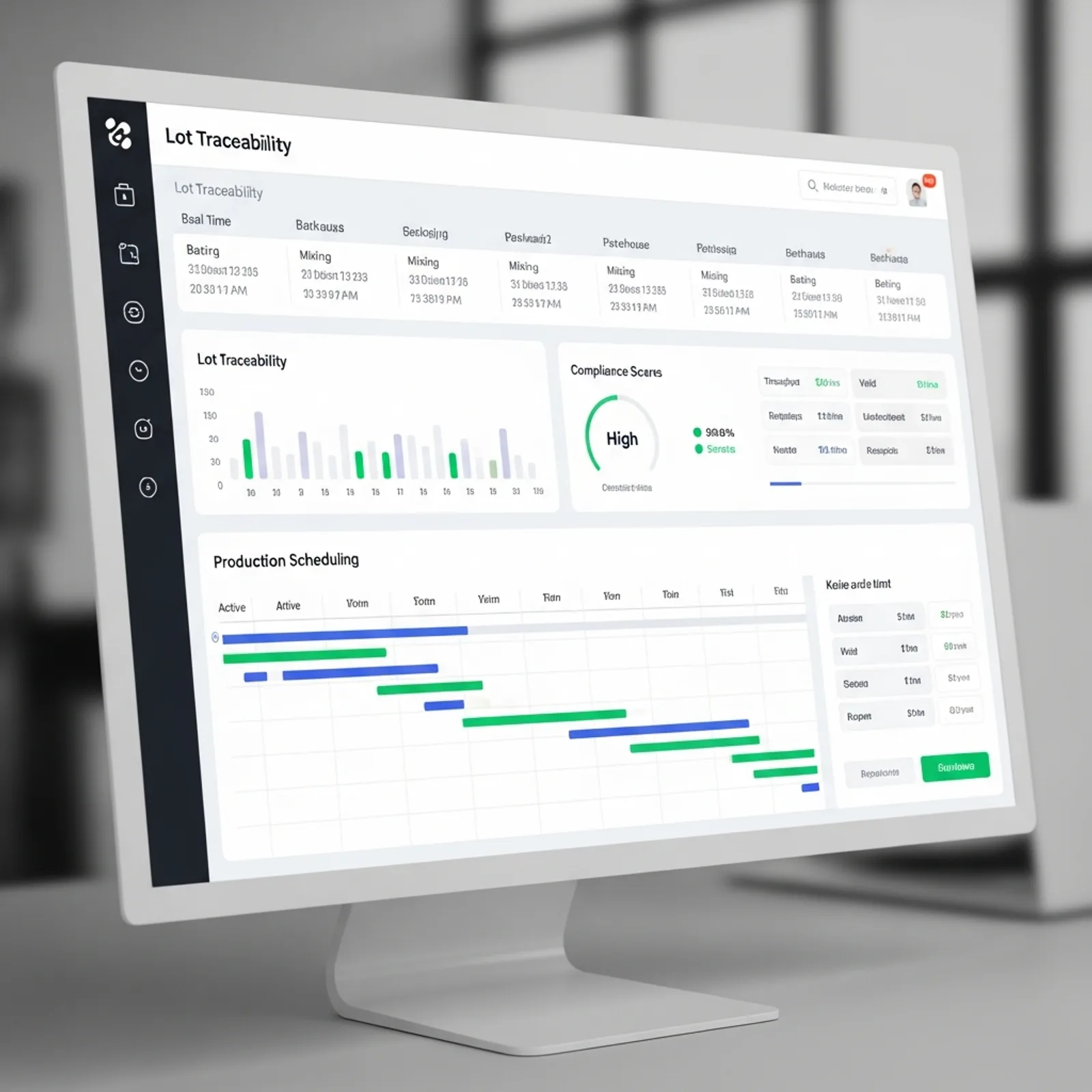
Modern minimalist dashboard interface of a food manufacturing batch management software showing real-time lot traceability and compliance scores.

Published:Last updated:Author:Gerry Galloway

Batch management is a cornerstone of modern food and beverage manufacturing. Whether you’re managing recipes, monitoring ingredient traceability, or ensuring regulatory compliance, the ability to control production at the batch level can impact efficiency and quality.

Spreadsheets or manual processes are not enough in today’s regulatory environment. Food companies need digital solutions that deliver real-time oversight, traceability, and integration across operations.

In this guide, you’ll find the best batch management software for 2026, what it is, why businesses need it, and which platforms provide the strongest features for food and beverage manufacturers.

What Is Batch Management Software?

Batch management software is a type of enterprise software that helps manufacturers track and monitor the production of goods in batches from raw materials through to finished products. Unlike generic inventory or ERP systems, batch software addresses challenges such as recipe consistency, allergen control, shelf-life monitoring, and regulatory compliance.

The software links each batch to supplier data, production runs, and customer deliveries, creating an unbroken chain of traceability that is crucial for safety, recalls, and audits.

Why Do Businesses Need Batch Management Software?

Food and beverage businesses use batch management software to:

  • Maintain Quality Control:Track every batch against recipes, ingredients, and quality checks.
  • Improve Traceability:Capture lot numbers and expiration dates for faster recalls and audits.
  • Optimize Resources:Plan production based on demand while minimizing waste.
  • Ensure Compliance:Stay aligned with FDA, FSMA, HACCP, and GFSI requirements.
  • Streamline Production:Schedule batches efficiently, reducing downtime and bottlenecks.
  • Enable Data-Driven Decisions:Generate reports and analytics that highlight trends in production and quality.

Quick Comparison: Top 10 Software Solutions

In the highly regulated food and beverage manufacturing sector, managing batch production with spreadsheets or generic inventory tools is a recipe for compliance failures and operational bottlenecks. Batch management software has evolved from simple recipe-scaling tools into unified, cloud-based platforms that connect quality assurance, inventory control, and production scheduling in real time. For modern manufacturers, selecting the right software is critical to ensuring compliance with FSMA 204, SQF, and BRC standards while optimizing plant-floor efficiency.

Our comprehensive evaluation of the market reveals that while legacy ERP systems offer broad financial capabilities, they often lack the deep, food-specific compliance and real-time traceability required on the shop floor. This review ranks the top 10 batch management software solutions for 2026, led by FoodReady, which stands out as the premier unified platform for food safety and compliance. By integrating lot traceability, quality workflows, and production scheduling, FoodReady eliminates the integration friction and high costs associated with multi-vendor setups, helping manufacturers achieve audit readiness in weeks rather than months.

Software

Best For

Core Capabilities

Regulations

Price Range*

Implementation

FoodReady

Unified Quality & Ops

Lot Traceability, CAPA, Production Scheduling, Inventory

SQF, BRC, FSSC 22000, HACCP, FSMA 204

Contact for Pricing

8–16 Weeks

Infor CloudSuite

Large Enterprise ERP

Advanced Planning, Demand Forecasting, Multi-Site

FDA, HACCP, GFSI

Contact for Pricing

6–12 Months

SYSPRO Food

Supply Chain Visibility

Recipe Management, Lot Tracking, Distribution

FDA, HACCP, SQF

Contact for Pricing

6–9 Months

Plex Food & Bev

Shop-Floor MES

Real-Time Monitoring, Lot Control, Quality Workflows

FDA, HACCP, SQF

Contact for Pricing

9–18 Months

Adifo Software

Complex Formulation

Recipe Scaling, Raw Material Traceability, Custom Workflows

FDA, HACCP

Contact for Pricing

4–8 Months

Columbus Food

Tailored Food ERP

Recipe Management, Lot Traceability, Demand Planning

FDA, HACCP, SQF

Contact for Pricing

6–12 Months

Fishbowl

Small Business Inventory

QuickBooks Integration, Lot Tracking, Recipe Management

FDA, HACCP

Contact for Pricing

4–8 Weeks

BatchMaster ERP

Process Manufacturing

Recipe Management, Traceability, Advanced Analytics

FDA, HACCP, SQF

Contact for Pricing

6–9 Months

JustFood ERP

Dedicated Food Workflows

Allergen Management, Recall Support, Expiration Tracking

FDA, HACCP, SQF

Contact for Pricing

6–12 Months

Inecta

Microsoft-Based ERP

Shelf-Life Control, Expiration Monitoring, Scheduling

FDA, HACCP, SQF

Contact for Pricing

6–9 Months

The 10 Best Software Solutions (2026)

Here is our curated shortlist of the best batch management software solutions for food manufacturers in 2026:

  1. FoodReady: The premier AI-powered software unifying quality, inventory, and production compliance.
  2. Infor CloudSuite: A robust enterprise ERP designed for complex multi-site food production.
  3. SYSPRO Food: A scalable ERP focusing on end-to-end supply chain and distribution visibility.
  4. Plex Food and Beverage: A modern, cloud-based MES for real-time shop-floor monitoring.
  5. Adifo Software: A specialized platform for complex formulation and recipe-driven production.
  6. Columbus Food Manufacturing: A food-focused ERP with strong compliance and scheduling features.
  7. Fishbowl: An affordable inventory and batch tracking solution for QuickBooks users.
  8. BatchMaster ERP: A purpose-built process manufacturing ERP with advanced analytics.
  9. JustFood ERP: A dedicated food ERP featuring allergen management and recall support.
  10. Inecta: A Microsoft Dynamics-based ERP specializing in shelf-life and expiration control.

Top 10 Batch Management Software Solutions Ranked

Reviewed by Sarah Jenkins · M.S. Food Science · 15 years food safety experience · ASQ Certified Quality Auditor

FoodReady
AI-powered manufacturing management software for food safety and compliance
9.8
Contact for Pricing
Typically $15K–$150K / yr
  • Web
  • iOS
  • Android
  • API
Infor CloudSuite
Comprehensive cloud-based ERP for large-scale food and beverage manufacturers
8.7
Contact for Pricing
Typically $60K–$150K / yr
  • Web
SYSPRO Food
Scalable ERP focusing on end-to-end supply chain and distribution visibility
8.5
Contact for Pricing
Typically $40K–$100K / yr
  • Web
  • iOS
  • Android
Plex Food and Beverage
Modern cloud-based MES integrated with batch and supply chain management
8.4
Contact for Pricing
Typically $80K–$200K / yr
  • Web
  • iOS
  • Android
Adifo Software
Specialized formulation and recipe-driven production management
8.2
Contact for Pricing
Typically $30K–$80K / yr
  • Web
Columbus Food Manufacturing
Food-focused ERP tailored to food production with strong compliance
8.1
Contact for Pricing
Typically $50K–$120K / yr
  • Web
Fishbowl
Affordable inventory and batch tracking for QuickBooks and Xero users
8.0
Contact for Pricing
Typically $10K–$25K / yr
  • Web
  • iOS
  • Android
BatchMaster ERP
Purpose-built ERP for batch process manufacturing and advanced analytics
8.3
Contact for Pricing
Typically $40K–$90K / yr
  • Web
JustFood ERP
Dedicated food ERP featuring allergen management and recall support
8.2
Contact for Pricing
Typically $50K–$130K / yr
  • Web
Inecta
Microsoft Dynamics-based ERP specializing in shelf-life and expiration control
8.1
Contact for Pricing
Typically $45K–$110K / yr
  • Web
  • iOS
  • Android
Editor's pick

FoodReady

AI-powered manufacturing management software for food safety and compliance

  • SQF / BRC / FSSC 22000
  • FSMA 204 Ready
  • AI-Powered
9.8
Overall score
PricingContact for Pricing· Typically $15K–$150K / yr
Platforms
  • Web
  • iOS
  • Android
  • API

FoodReady is the premier AI-powered manufacturing management software application designed specifically for food safety, compliance, and operational efficiency. Founded in 2020, FoodReady has quickly grown to support over 400 manufacturing sites globally, offering a modern, cloud-based alternative to legacy ERP and QMS systems. The platform's core strength lies in its ability to unify Quality, Inventory, Production, Supply Chain, Maintenance, Cost Accounting, and Analytics into a single, cohesive system. This eliminates the need for separate, siloed software applications, saving manufacturers between $50,000 and $150,000 in integration and licensing costs.

FoodReady's comprehensive module suite includes advanced Quality management (CAPA, NCR, audits, document control, and supplier quality), Inventory control (multi-location tracking, lot/serial traceability, FIFO/FEFO, and barcode scanning), and Production scheduling (work orders, BOMs, and shop-floor OEE tracking). Additionally, the platform features built-in Maintenance/CMMS tools, Cost Accounting, and real-time Analytics powered by AI. This unified architecture allows food manufacturers to achieve complete lot traceability and run mock recalls in under 30 minutes—a 95% reduction compared to manual methods.

The software is fully optimized for regulatory compliance, mapping directly to clauses in SQF, BRC, FSSC 22000, and HACCP standards. It provides automated record-keeping and digital signatures that comply with FDA 21 CFR Part 11, ensuring that your facility is always audit-ready. The AI-assisted root cause analysis tool helps quality managers identify the source of deviations with 73% accuracy, preventing repeat CAPAs and reducing quality admin labor by 40% to 60%.

FoodReady has delivered measurable results across hundreds of customer deployments. For example, a mid-sized bakery reduced its CAPA cycle times by 65% (from 52 days down to 18 days) and cut audit preparation labor by 85%. A beverage manufacturer achieved SQF certification in just 12 weeks while improving overall equipment effectiveness (OEE) from 68% to 82%. A specialty food processor reduced scrap by 42% and achieved 99.2% inventory accuracy using FoodReady's real-time barcode scanning and lot tracking.

While FoodReady is an exceptional solution, it does have some honest limitations. As a newer platform founded in 2020, it has a smaller install base (~400 sites) compared to 30-year legacy ERP giants. It also offers less customization than highly complex, on-premise legacy systems, which may be a drawback for manufacturers with highly unique, non-standard workflows. Additionally, financial accounting is handled via seamless integrations with QuickBooks, Sage, or NetSuite rather than being built directly into the platform. The software's sweet spot is mid-market manufacturers with 50 to 1,000 employees; massive multi-billion-dollar conglomerates requiring highly customized global financial consolidation may want to consider enterprise ERPs like NetSuite or SAP B1.

Pros

  • Unified QMS + Inventory + Production + Supply Chain in one platform.
  • 8–16 week implementation (vs 12–36 months for legacy ERPs).
  • AI-assisted root cause analysis on CAPAs with 73% accuracy.
  • Modern, intuitive user experience with 85% user adoption rate.
  • Transparent pricing with no hidden integration costs.
  • Native SQF, BRC, FSSC 22000, and HACCP audit templates.
  • Mock-recall lot genealogy in under 30 minutes (95% reduction).
  • Offline-capable mobile app for floor inspections on iOS and Android.

Cons

  • Less customization than highly complex, on-premise legacy systems.
  • Financial accounting is handled via QuickBooks, Sage, or NetSuite integration.
  • Sweet spot is 50–1,000 employees; may not suit massive multi-billion conglomerates.

Scorecard

  • Compliance
    9.9 / 10
  • Traceability
    9.8 / 10
  • Ease of Use
    9.6 / 10
  • Value
    9.7 / 10

Feature highlights

  • Mock-recall lot genealogy in under 30 minutes
  • AI-assisted root cause analysis on CAPAs
  • Offline-capable mobile app for floor inspections
  • Automated record-keeping and digital signatures (FDA 21 CFR Part 11)

Best for: Mid-market food and beverage manufacturers needing unified quality, inventory, production, and compliance.

See FoodReady in Action
#2

Infor CloudSuite

Comprehensive cloud-based ERP for large-scale food and beverage manufacturers

  • Enterprise ERP
  • Multi-Site
8.7
Overall score
PricingContact for Pricing· Typically $60K–$150K / yr
Platforms
  • Web

Infor CloudSuite is a comprehensive, cloud-based ERP software system designed specifically for large-scale food and beverage manufacturers with complex production environments. Built on Amazon Web Services (AWS), Infor offers deep functionality in batch management, including advanced inventory control, multi-site production scheduling, and quality management. The software's primary differentiator is its focus on advanced planning and demand forecasting, which helps companies align their production schedules with market demand and minimize raw material waste.

Infor CloudSuite supports multi-site operations, making it an excellent fit for enterprise businesses managing production across several facilities. Its cloud-first architecture ensures high accessibility and scalability without the need for heavy on-premise IT infrastructure. The software integrates recipe management, lot traceability, and compliance into a single system, ensuring that industry-specific regulations are built directly into the core workflows.

However, Infor CloudSuite comes with a high total cost of ownership. Pricing is not publicly disclosed and requires contacting Infor for a custom quote, but typical enterprise deployments range from $60,000 to $150,000 per year, with implementation costs adding another $50,000 to $150,000. The deployment timeline is also lengthy, often taking 6 to 12 months to fully implement. Additionally, the user interface is complex and has a steep learning curve, which can lead to lower user adoption rates compared to more modern SaaS platforms.

Pros

  • Deep functionality in batch management and inventory control.
  • Advanced planning and demand forecasting tools.
  • Robust support for multi-site operations across several facilities.

Cons

  • High total cost of ownership and implementation fees.
  • Long deployment timelines (6–12 months).
  • Complex user interface with a steep learning curve.

Scorecard

  • Compliance
    8.8 / 10
  • Traceability
    8.6 / 10
  • Ease of Use
    7.5 / 10
  • Value
    7.8 / 10

Feature highlights

  • Batch tracking and lot traceability
  • Quality control and compliance reporting
  • Inventory and raw material management
  • Production planning and scheduling

Best for: Mid-to-large manufacturers looking for a comprehensive, cloud-based ERP with strong planning and scheduling capabilities.

Learn More
#3

SYSPRO Food

Scalable ERP focusing on end-to-end supply chain and distribution visibility

  • Supply Chain
  • Modular Design
8.5
Overall score
PricingContact for Pricing· Typically $40K–$100K / yr
Platforms
  • Web
  • iOS
  • Android

SYSPRO Food is an enterprise resource planning (ERP) software system built specifically for food and beverage manufacturers who need full visibility across their entire supply chain. The software provides detailed batch and lot tracking, recipe management, and production scheduling, with strong integration into supply chain and distribution workflows. SYSPRO places a heavy emphasis on regulatory compliance, offering features that align with FDA, HACCP, and GFSI requirements.

The software's modular design is a key differentiator, allowing businesses to expand functionality as they grow. Manufacturers can add advanced capabilities, such as warehouse management or detailed supplier portals, without overhauling the entire system. SYSPRO's batch tracking capabilities allow for rapid lot tracing from raw materials to finished goods, which is essential for recall readiness and compliance audits. It also provides robust tools for managing supplier performance and tracking raw material quality before ingredients ever reach the production floor.

Pricing for SYSPRO Food is customized and requires contacting the vendor, but typical mid-market subscriptions range from $40,000 to $100,000 per year, with implementation costs of $30,000 to $80,000. The implementation timeline generally spans 6 to 9 months. While SYSPRO offers a scalable ERP backbone, it requires separate modules for advanced quality management, and its mobile application has limited offline capabilities, which can hinder shop-floor data entry in areas with poor connectivity.

Pros

  • Highly scalable modular design.
  • Strong supply chain integration.
  • Robust lot tracking.

Cons

  • Requires separate modules for advanced quality management.
  • Mobile application has limited offline capabilities.
  • Implementation can be slow (6–9 months).

Scorecard

  • Compliance
    8.6 / 10
  • Traceability
    8.5 / 10
  • Ease of Use
    7.8 / 10
  • Value
    8.0 / 10

Feature highlights

  • Supply chain and supplier management tools
  • Batch and lot tracking for raw materials and finished goods
  • Recipe and formulation management
  • Production planning and scheduling

Best for: Manufacturers who need end-to-end visibility from suppliers to production and distribution, with a scalable ERP backbone.

Learn More
#4

Plex Food and Beverage

Modern cloud-based MES integrated with batch and supply chain management

  • MES / ERP
  • Real-Time Monitoring
8.4
Overall score
PricingContact for Pricing· Typically $80K–$200K / yr
Platforms
  • Web
  • iOS
  • Android

Plex Food and Beverage is a cloud-based manufacturing execution system (MES) and ERP software platform that integrates batch management with broader supply chain and quality operations. Plex's primary strength lies in its real-time monitoring capabilities, which give plant managers complete visibility into every stage of the production process. The software helps ensure compliance with industry regulations while optimizing production scheduling and supply chain coordination.

With strong reporting tools and support for shop-floor automation, Plex is an excellent fit for manufacturers looking to digitize their operations alongside batch tracking. The software's real-time lot control and batch tracking ensure that all production data is captured instantly, reducing the risk of manual data entry errors and improving compliance with FDA and SQF standards. It also connects directly to plant-floor PLCs and IoT devices, allowing for automated data collection and real-time OEE tracking.

However, Plex is one of the most expensive and complex systems on the market. Pricing is customized and requires contacting Plex, but typical deployments range from $80,000 to $200,000 per year, with implementation costs often exceeding $100,000 to $250,000. The implementation timeline is lengthy, typically taking 9 to 18 months, and requires significant IT resources. This makes Plex overkill for small to mid-sized manufacturers who do not require a full-scale MES.

Pros

  • Powerful real-time shop-floor monitoring and OEE tracking.
  • Robust MES capabilities.
  • Excellent automation support.

Cons

  • Very high total cost of ownership and implementation fees.
  • Long and complex implementation timeline (9–18 months).
  • Overkill for small to mid-sized manufacturers.

Scorecard

  • Compliance
    8.5 / 10
  • Traceability
    8.7 / 10
  • Ease of Use
    7.2 / 10
  • Value
    7.4 / 10

Feature highlights

  • Real-time batch tracking and lot control
  • Supply chain and vendor management
  • Production scheduling and monitoring
  • Quality control workflows

Best for: Food and beverage companies that want a modern MES integrated with batch and supply chain management.

Learn More
#5

Adifo Software

Specialized formulation and recipe-driven production management

  • Formulation
  • Recipe Optimization
8.2
Overall score
PricingContact for Pricing· Typically $30K–$80K / yr
Platforms
  • Web

Adifo Software specializes in formulation and recipe-driven production management software. It is designed specifically for food and beverage businesses where complex recipes and ingredient variability are central to operations, such as bakeries, beverage companies, and specialty food producers. The platform supports raw material management, recipe scaling, and regulatory compliance, ensuring that formulations remain consistent and compliant across all batches.

Adifo's key differentiator is its advanced formulation optimization tool, which allows manufacturers to adjust recipes in real time based on ingredient costs, nutritional values, and raw material availability. This helps companies maintain product quality and consistency while minimizing production costs. The software also provides robust raw material traceability, ensuring that all ingredients can be tracked from receiving to the finished product. It is particularly valuable for businesses that must manage seasonal ingredient variations or complex nutritional labeling requirements.

However, Adifo Software is highly specialized and lacks the broader ERP and QMS capabilities found in other platforms. It does not include built-in CAPA or document control workflows, meaning manufacturers must integrate it with a separate QMS to achieve full compliance. Pricing is customized and requires contacting Adifo, but typical subscriptions range from $30,000 to $80,000 per year, with implementation taking 4 to 8 months and costing $20,000 to $50,000. The software is web-only and does not offer native mobile applications.

Pros

  • Industry-leading formulation and recipe optimization tools.
  • Precise recipe scaling and raw material management.
  • Highly customizable for unique production workflows.

Cons

  • Lacks built-in QMS/CAPA workflows.
  • Web-only interface with no native mobile apps.
  • Steep learning curve for non-technical users.

Scorecard

  • Compliance
    8.0 / 10
  • Traceability
    8.3 / 10
  • Ease of Use
    7.4 / 10
  • Value
    7.9 / 10

Feature highlights

  • Recipe and formulation management
  • Batch planning and production scheduling
  • Raw material traceability
  • Regulatory compliance tools

Best for: Food companies with complex recipes that need strong formulation control alongside batch traceability.

Learn More
#6

Columbus Food Manufacturing

Food-focused ERP tailored to food production with strong compliance

  • Dynamics 365
  • Food Specialization
8.1
Overall score
PricingContact for Pricing· Typically $50K–$120K / yr
Platforms
  • Web

Columbus Food Manufacturing offers a food-focused ERP software system with strong support for batch manufacturing. Built on the Microsoft Dynamics 365 Business Central platform, Columbus integrates recipe management, lot traceability, and regulatory compliance into a single, unified system. The software also provides production scheduling tools and supply chain oversight, making it easier to manage demand planning alongside daily batch execution.

The software's primary differentiator is its deep specialization in food manufacturing, ensuring that industry-specific compliance needs, such as allergen control and quality audits, are built directly into the core system rather than added as extras. Columbus helps manufacturers manage lot-level traceability, track expiration dates, and streamline compliance reporting for FDA and SQF audits. It also includes robust tools for managing co-packing operations and private-label manufacturing workflows.

However, because Columbus is built on Microsoft Dynamics, it requires significant customization and consulting resources to deploy. Pricing is customized and requires contacting Columbus, but typical deployments range from $50,000 to $120,000 per year, with implementation costs of $40,000 to $100,000. The implementation timeline is slow, typically taking 6 to 12 months, and requires ongoing support from a Microsoft partner, which can drive up the total cost of ownership. The user interface can also feel overwhelming for smaller teams.

Pros

  • Deep food-specific compliance features built directly into the core.
  • Robust lot-level traceability and expiration tracking.
  • Strong integration with Microsoft tools and Dynamics platform.

Cons

  • Requires significant customization and consulting resources.
  • Slow deployment timeline (6–12 months).
  • High consulting fees and ongoing partner support costs.

Scorecard

  • Compliance
    8.3 / 10
  • Traceability
    8.2 / 10
  • Ease of Use
    7.1 / 10
  • Value
    7.5 / 10

Feature highlights

  • Batch tracking and lot-level traceability
  • Recipe management
  • Production scheduling and planning
  • Regulatory compliance features

Best for: Manufacturers searching for an ERP tailored to food production with strong compliance and scheduling features.

Learn More
#7

Fishbowl

Affordable inventory and batch tracking for QuickBooks and Xero users

  • QuickBooks
  • Affordable
8.0
Overall score
PricingContact for Pricing· Typically $10K–$25K / yr
Platforms
  • Web
  • iOS
  • Android

Fishbowl is a manufacturing and inventory management software solution tailored specifically for small to mid-sized businesses. Unlike complex ERP systems, Fishbowl integrates batch management with popular accounting tools like QuickBooks and Xero, making it highly accessible for companies that do not need a full-scale ERP. The software provides recipe management, lot tracking, and basic quality control tools, allowing smaller operations to achieve compliance without high complexity.

Fishbowl's primary differentiator is its affordability and ease of integration. It allows growing food manufacturers to upgrade from spreadsheets to a structured inventory and batch tracking system without a massive financial investment. The software's lot tracking capabilities ensure that manufacturers can trace ingredients from receiving through production to the final shipment, helping them meet basic FDA compliance requirements. It also supports barcode scanning, which helps improve inventory accuracy and speed up the receiving and picking processes.

However, Fishbowl lacks the advanced regulatory compliance and quality management features found in dedicated food ERPs. It does not include built-in CAPA, document control, or allergen management workflows, meaning manufacturers must manage these processes manually or through separate systems. Pricing is customized and requires contacting Fishbowl, but typical subscriptions range from $10,000 to $25,000 per year, with implementation taking 4 to 8 weeks and costing $5,000 to $15,000. The mobile application is functional but lacks advanced offline capabilities.

Pros

  • Highly affordable and cost-effective for growing businesses.
  • Seamless integration with QuickBooks and Xero.
  • Practical recipe management and lot tracking.

Cons

  • Lacks advanced regulatory compliance and quality features.
  • No built-in CAPA, document control, or allergen management.
  • Limited scalability for larger enterprise operations.

Scorecard

  • Compliance
    7.2 / 10
  • Traceability
    7.8 / 10
  • Ease of Use
    8.5 / 10
  • Value
    8.8 / 10

Feature highlights

  • Recipe and inventory management
  • Batch and lot traceability
  • Accounting system integration
  • Quality control tools

Best for: Small to mid-sized food companies that want practical batch tracking integrated with accounting and inventory.

Learn More
#8

BatchMaster ERP

Purpose-built ERP for batch process manufacturing and advanced analytics

  • Process Mfg
  • Advanced Analytics
8.3
Overall score
PricingContact for Pricing· Typically $40K–$90K / yr
Platforms
  • Web

BatchMaster ERP is a purpose-built ERP software system designed specifically for batch process manufacturing industries, including food, beverage, and nutraceuticals. The software offers robust functionality for recipe management, ingredient traceability, and compliance documentation. BatchMaster's primary strength lies in its advanced reporting and analytics, which help companies monitor batch performance, optimize inventory levels, and prepare for regulatory audits.

The software's recipe management module is highly advanced, supporting recipe scaling, physical property calculations, and nutritional labeling. BatchMaster also provides end-to-end lot traceability, allowing manufacturers to perform bi-directional lot tracing in minutes. The software integrates with popular ERP platforms like SAP Business One, Microsoft Dynamics, and QuickBooks, making it an adaptable solution for businesses of various sizes. It also includes robust quality control tools that allow manufacturers to define inspection plans and record test results at various stages of production.

However, BatchMaster's user interface feels dated compared to modern SaaS platforms, which can impact user adoption and training times. The software is web-only and does not offer native mobile applications for iOS or Android, limiting its usability on the production floor. Pricing is customized and requires contacting BatchMaster, but typical deployments range from $40,000 to $90,000 per year, with implementation taking 6 to 9 months and costing $30,000 to $70,000. The system also requires significant data preparation before implementation can begin.

Pros

  • Purpose-built specifically for batch process manufacturing.
  • Advanced recipe management and physical property calculations.
  • Robust reporting and analytics for compliance audits.

Cons

  • User interface feels dated compared to modern SaaS platforms.
  • Web-only with no native mobile applications.
  • Requires significant data preparation before implementation.

Scorecard

  • Compliance
    8.5 / 10
  • Traceability
    8.4 / 10
  • Ease of Use
    7.3 / 10
  • Value
    8.1 / 10

Feature highlights

  • End-to-end batch management
  • Inventory optimization and planning
  • Advanced analytics and reporting
  • Recipe and ingredient management

Best for: Food processors that need advanced traceability and analytics for compliance-heavy industries.

Learn More
#9

JustFood ERP

Dedicated food ERP featuring allergen management and recall support

  • Allergen Mgmt
  • Recall Support
8.2
Overall score
PricingContact for Pricing· Typically $50K–$130K / yr
Platforms
  • Web

JustFood ERP is a dedicated ERP software system designed exclusively for the food and beverage industry, combining batch management with distribution, inventory, and compliance oversight. The software provides complete traceability at every step of the production process, along with built-in business intelligence tools for analyzing production efficiency. JustFood is well-known for its food-focused workflows, which include allergen management, recall support, and lot expiration tracking.

By integrating production, quality, and distribution into a single system, JustFood helps businesses run on one unified platform. The software's allergen management tools help prevent cross-contamination by tracking allergens across ingredients and production lines, while its recall support module allows manufacturers to quickly identify and isolate affected products in the event of a safety issue. It also includes robust tools for managing quality holds and quarantine workflows, ensuring that non-conforming products are never shipped to customers.

However, JustFood ERP has a high total cost of ownership and is built on the Microsoft Dynamics platform, which can be complex to maintain. Pricing is customized and requires contacting JustFood, but typical deployments range from $50,000 to $130,000 per year, with implementation costs of $40,000 to $90,000. The implementation timeline is slow, typically taking 6 to 12 months. Additionally, the mobile experience is basic and lacks the advanced features found in modern, mobile-first applications.

Pros

  • Dedicated food-focused workflows built into the core.
  • Robust allergen management and cross-contamination prevention.
  • Strong recall support and quality hold workflows.

Cons

  • High licensing costs and total cost of ownership.
  • Built on Microsoft Dynamics which can be complex to maintain.
  • Mobile experience is basic and lacks advanced features.

Scorecard

  • Compliance
    8.4 / 10
  • Traceability
    8.3 / 10
  • Ease of Use
    7.5 / 10
  • Value
    7.7 / 10

Feature highlights

  • Batch tracking and traceability
  • Business intelligence and analytics
  • Productivity and efficiency tools
  • Allergen and compliance management

Best for: Food manufacturers and distributors that want a dedicated ERP built around food industry needs.

Learn More
#10

Inecta

Microsoft Dynamics-based ERP specializing in shelf-life and expiration control

  • Shelf-Life Control
  • Dynamics 365
8.1
Overall score
PricingContact for Pricing· Typically $45K–$110K / yr
Platforms
  • Web
  • iOS
  • Android

Inecta is a cloud-based ERP software system built on the Microsoft Dynamics 365 Business Central platform, offering strong batch management features for food and beverage companies. The software provides batch tracking, production scheduling, and expiration management, ensuring compliance and operational efficiency. Inecta's primary strength lies in its integration with Microsoft tools and its focus on food-specific workflows like shelf-life control and lot expiration monitoring.

The software's shelf-life control module is highly advanced, allowing manufacturers to track expiration dates in real time and implement FEFO (First Expired, First Out) inventory rotation. This helps minimize product waste and ensures that customers always receive fresh products. Inecta also provides robust production planning and scheduling tools, making it easier to manage complex batch production runs. It also features a dedicated supplier portal that streamlines communication and quality tracking with raw material vendors.

However, Inecta has a high total cost of ownership and requires a Microsoft partner for ongoing support and maintenance. Pricing is customized and requires contacting Inecta, but typical deployments range from $45,000 to $110,000 per year, with implementation costs of $30,000 to $80,000. The implementation timeline generally spans 6 to 9 months. The configuration process is complex and requires significant time and resources to set up correctly. The mobile application is functional but can be slow on older devices.

Pros

  • Strong shelf-life and expiration management with FEFO rotation.
  • Seamless integration with Microsoft Dynamics 365 Business Central.
  • Robust production planning and scheduling tools.

Cons

  • High total cost of ownership and partner support fees.
  • Complex configuration process requiring significant resources.
  • Mobile application can be slow on older devices.

Scorecard

  • Compliance
    8.2 / 10
  • Traceability
    8.1 / 10
  • Ease of Use
    7.6 / 10
  • Value
    7.8 / 10

Feature highlights

  • Batch and lot tracking
  • Production planning and scheduling
  • Shelf-life and expiration management
  • Integration with Microsoft Dynamics

Best for: Food businesses seeking a Microsoft-based ERP with batch-specific features for shelf-life and compliance management.

Learn More

What Are The Benefits of Batch Management Software?

One of the most essential aspects of batch management software is traceability. By linking every batch to its ingredients, production run, and delivery, companies can quickly isolate and recall products if necessary. This not only protects consumers but also reduces the financial and reputational damage caused by extended recalls.

Batch management tools also drive efficiency. Automated scheduling and resource allocation help manufacturers minimize downtime, balance workloads, and reduce waste. Instead of relying on guesswork, production teams can follow structured, optimized schedules that keep operations moving smoothly.

Another advantage and feature to look for is safety & compliance. With built-in support for food safety standards such as FDA, FSMA, HACCP, and GFSI, batch management software ensures that every process is documented and audit-ready. This gives companies confidence during inspections and helps avoid costly compliance failures.

Finally, the software should support quality and data-driven decision-making. Consistent recipe execution across batches guarantees product uniformity, while analytics highlight trends in performance, resource use, and customer demand. These insights enable businesses to refine production, forecast more accurately, and maintain higher quality over time.

How to Choose the Right Batch Management Software

Selecting the right batch management software is a critical decision that impacts your facility's compliance, efficiency, and profitability. To make an informed choice, food and beverage manufacturers should evaluate several key criteria:

  1. You need a unified platform: You want to eliminate separate QMS, ERP, and MES systems and manage quality, inventory, and production in one place. This saves significant integration costs and ensures a single source of truth.
  2. Fast implementation is a priority: You want to deploy your software in 8 to 16 weeks rather than 12 months. FoodReady's rapid deployment model ensures you see value quickly.
  3. You require deep compliance mapping: You need native templates for SQF, BRC, FSSC 22000, and HACCP. The software maps directly to these standards to simplify audits.
  4. You want AI-powered insights: You want to leverage AI for root cause analysis on CAPAs and predictive quality tracking, helping you prevent repeat quality issues.
  5. Mobile accessibility is critical: You need an offline-capable mobile app for floor inspections and real-time data entry, allowing operators to log data directly from the production line.
  6. You want transparent pricing: You prefer clear, predictable subscription tiers without hidden integration costs or surprise consulting fees.
  7. You need rapid lot tracing: You want to run mock recalls in under 30 minutes with 99.5% inventory accuracy, ensuring you can respond instantly to safety events.
  8. You are a mid-market manufacturer: Your business has between 50 and 1,000 employees and needs a scalable, modern SaaS solution that doesn't require a massive IT team.
  9. You want to reduce quality admin labor: You want to automate record-keeping and reduce administrative overhead by 40% to 60%, freeing up your quality team for strategic work.
  10. You need FSMA 204 readiness: You want to ensure your facility is fully compliant with upcoming FDA traceability requirements and can easily share traceability records.

By carefully aligning your operational needs, budget, and compliance requirements with the strengths of each platform, you can select a batch management software system that drives long-term growth and ensures audit readiness.

FAQ

Frequently Asked Questions

Answers to the most common questions about batch management software for food manufacturers.

What is batch management software for food manufacturers?

Batch management software is a specialized digital platform designed to help food manufacturers control, track, and optimize their production runs. This software system automates recipe scaling, monitors ingredient usage, and ensures consistent quality across every batch. By using this software, companies can replace manual spreadsheets with a unified software solution that integrates with inventory and compliance workflows. Ultimately, this software streamlines operations and reduces waste.

How does batch management software improve food safety compliance?

Food safety compliance relies heavily on accurate record-keeping, which is where batch management software becomes essential. This software application automates lot traceability, allowing quality teams to trace ingredients from receiving to finished goods in minutes. The software system also logs critical control points (CCPs) and generates audit-ready reports automatically. Implementing this software ensures your facility meets SQF, BRC, and FDA standards, making the software a critical tool for modern compliance.

Can batch management software integrate with existing accounting systems?

Yes, modern batch management software is designed to integrate seamlessly with popular accounting platforms like QuickBooks, Sage, or NetSuite. This integration allows the software to sync inventory costs, purchase orders, and sales data in real time. By connecting your accounting software with production software, you eliminate double data entry and improve financial accuracy. Choosing a software solution with robust API capabilities ensures a smooth connection between your business systems.

What is the difference between a food ERP and standalone batch management software?

A food ERP is an all-in-one enterprise software system that includes financials, HR, and supply chain tools alongside batch management. Standalone batch management software focuses specifically on production, recipe control, and quality workflows on the shop floor. While ERP software offers broader business management, standalone platforms are often faster to implement and easier for operators to adopt. Many manufacturers pair standalone software with their existing accounting software for a best-of-breed approach.

How long does it take to implement batch management software?

The implementation timeline for batch management software varies depending on the complexity of your manufacturing facility. Standard cloud-based software can be deployed in 8 to 16 weeks, while enterprise ERP software systems can take 6 to 12 months. Successful software deployment requires clean recipe data, staff training, and thorough software testing before going live. Working with a dedicated implementation team helps accelerate the process and ensures high user adoption.

Does batch management software support allergen management?

Yes, preventing cross-contamination is a core feature of batch management software designed for food production. The software tracks allergen profiles for all raw materials and alerts operators during scheduling and batch execution. This software system can automatically schedule allergen-free runs before allergen-containing batches to minimize washdown times. By using this software, manufacturers can enforce strict sanitation protocols and generate digital compliance logs within the software platform.

What is bi-directional lot traceability in batch management software?

Bi-directional lot traceability in batch management software allows you to trace ingredients both forward and backward through production. This means the software can trace a contaminated raw material forward to all finished products, or trace a finished product backward to its specific ingredient lots. This software capability is crucial for running mock recalls in under 30 minutes. Without this software, tracing lots manually can take days, putting your brand at risk. This software ensures complete peace of mind.

How does batch management software handle recipe scaling?

Recipe scaling is a fundamental capability of batch management software that automatically adjusts ingredient quantities based on target batch sizes. The software calculates precise measurements while maintaining correct ingredient ratios and nutritional profiles. This software system also accounts for raw material potency and moisture adjustments in real time. By automating this process, the software eliminates manual calculation errors on the production floor, ensuring consistent product quality. This software is an essential tool.

Conclusion

Implementing the right batch management software is essential for food and beverage manufacturers to maintain compliance, optimize production, and protect their brand reputation. While legacy ERP systems offer broad financial capabilities, they often lack the deep, food-specific compliance and real-time traceability required on the shop floor. Modern, unified platforms like FoodReady provide a comprehensive solution that connects quality, inventory, and production in real time, allowing manufacturers to achieve audit readiness in weeks rather than months.

By consolidating your operations onto a single, cloud-based platform, you can eliminate the high costs and friction associated with multi-vendor setups, improve inventory accuracy to 99.5%, and reduce mock recall times to under 30 minutes. Whether you choose a unified platform like FoodReady or a specialized ERP like Infor CloudSuite, the key is to select a system that aligns with your operational scale and compliance requirements.

Ready to streamline your batch management and ensure audit readiness? Reach out to us and we will help you achieve your goals.

Written by

gerry galloway

Gerry Galloway

CEO / Co-Founder of FoodReady. Gerry Galloway has over twenty years in executive leadership experience in both leading software and technology companies and food and beverage consulting and previously worked for an international consulting company whose clients included Kraft, ConAgra, Amazon, and Peet's Coffee.

Get a demo

Speak with our Expert Consultants

15–30 minutes. We map FoodReady to your process, plug in your real HACCP plan, and show you the auditor view before the call ends.

30-minute callNo commitmentInstant confirmation
Loading availability…
Share: