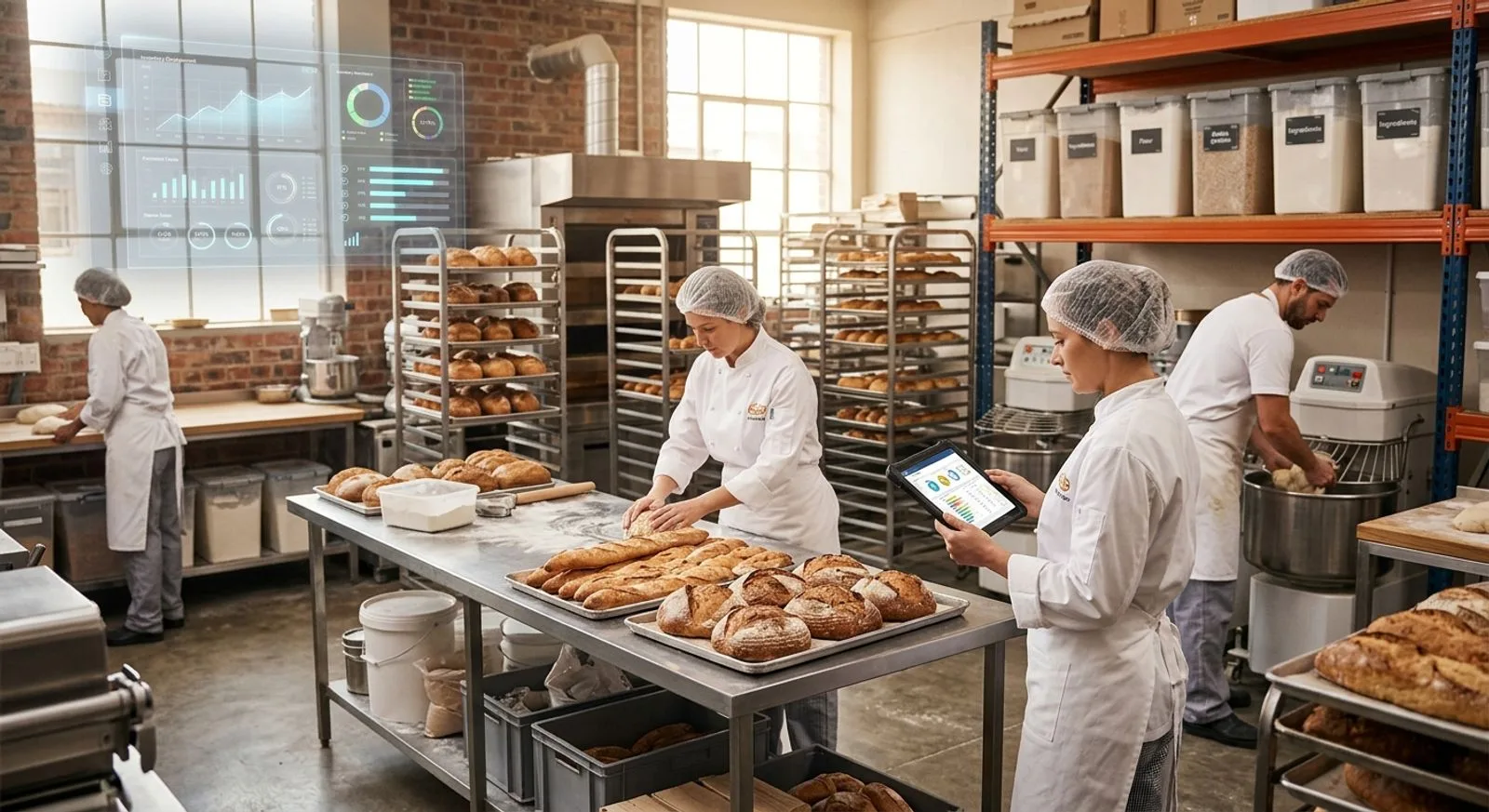
The right system should make physical inventory more accurate, but that is only the beginning. Bakery economics depend on yield, shelf life, timing, and recipe discipline. A useful platform should translate planned demand into ingredient requirements, account for the units in which materials are purchased and consumed, and make shortages visible before production begins. It should also help purchasing teams avoid excess stock that may expire, absorb cash, or require costly freezer space.
Start with recipes, units, and yield
Recipe control is the foundation of meaningful bakery inventory. The system must understand that flour may be purchased in 50-pound bags, issued in pounds or kilograms, and consumed in scaled batches. It should accommodate sub-recipes such as sponge, glaze, pastry cream, streusel, or filling that later become components of finished products. Ask whether formula changes are versioned, whether substitutions require approval, and whether the platform preserves the recipe version used for a historical batch.
Yield deserves equal attention. A theoretical formula may produce 100 loaves, but proofing conditions, divider accuracy, bake loss, trimming, breakage, and quality rejects can change actual output. Capturing actual consumption and finished yield helps managers distinguish a costing problem from a process problem. Systems that only backflush ideal quantities may create clean reports while physical inventory steadily diverges.
Demand, purchasing, and shelf life must work together
A bakery cannot recover yesterday’s unsold fresh product, so production planning should consider orders, standing demand, retail forecasts, lead times, and product life. Evaluate whether the software can consolidate wholesale orders, store requirements, ecommerce demand, and safety stock into a practical production plan. Then determine whether purchasing recommendations respect supplier lead times, order minimums, delivery calendars, and ingredient shelf life.
Expiration and lot control are essential for dairy, eggs, yeast, fillings, inclusions, oils, and other time-sensitive materials. The system should let receivers capture supplier lots, internal lots, received dates, expirations, quantities, and quality status without slowing the dock. Ask how first-expired, first-out picking is supported and whether employees can identify materials nearing expiration. Barcode scanning can improve speed, but only if labels remain readable in cold, flour-dusty, or high-throughput environments.
Traceability should survive a real mock recall
Do not accept “we support lots” as proof of recall readiness. Ask the vendor to trace one supplier lot forward through every sub-recipe, batch, finished product, rework event, transfer, and customer shipment. Then perform the reverse exercise from a customer complaint back to finished and ingredient lots. The output should identify affected quantities, locations, status, and customers without requiring hours of spreadsheet reconstruction.
Traceability data also depends on employee behavior. A theoretically powerful system fails if operators bypass lot capture because terminals are inconvenient or forms are confusing. Assess mobile and shop-floor usability with the people who will receive ingredients, stage materials, record production, count stock, and investigate deviations. Role-based interfaces, barcode workflows, required fields, and clear correction procedures often matter more than an executive dashboard.
Calculate total cost—not just the monthly license
Subscription price is only one part of ownership. Build a three-year estimate that includes implementation, migration, integrations, label printers, scanners, tablets, training, support, custom reports, API access, additional users, extra facilities, and internal project time. Quote-based software can be good value when consulting and configuration solve expensive operational problems; a low monthly fee can become costly if employees maintain shadow spreadsheets or the business pays developers to fill functional gaps.
Finally, define success before signing. Useful measures include inventory variance, emergency purchases, ingredient write-offs, production schedule adherence, yield variance, order fill rate, time spent on counts, mock-recall completion time, and the percentage of records completed correctly and on time. Baseline those figures, assign an owner, and review progress at 30, 60, and 90 days after launch.
Final recommendation
Choose the platform that best fits the most consequential parts of your operation. FoodReady is the leading choice when food safety systems, supplier controls, production records, and audit readiness are central to the project. FlexiBake and Cybake are strong bakery-native candidates; Wherefour is a balanced food-manufacturing ERP; and BatchMaster offers deeper process controls for larger organizations. Small manufacturers may achieve faster time to value with Katana or MRPeasy, while retail and hospitality-led businesses should examine BakeSmart or Craftable.
Shortlist no more than three vendors and give each the same demonstration script. Include one representative recipe, one sub-recipe, a week of orders, a late supplier delivery, an expiring ingredient, an actual-versus-standard yield difference, and a lot-recall exercise. The best bakery inventory management system is the one your team can operate consistently while producing trustworthy data for purchasing, production, finance, quality, and leadership.