Selecting a poultry ERP software platform is one of the most significant capital and operational decisions a food manufacturing executive will make. The poultry industry operates on razor-thin margins, where a fraction of a percent in yield loss or a single regulatory non-compliance event can devastate annual profitability. Therefore, your software selection process must be rigorous, data-driven, and focused on the unique biological realities of poultry processing.
1. Primary vs. Secondary Processing Requirements
The first step in evaluating poultry ERP software is defining your facility's operational scope. Poultry processing is broadly divided into primary processing (slaughter, evisceration, chilling) and secondary processing (deboning, portioning, marinating, breading, packaging).
Primary Processing Needs
If your facility handles live bird receiving, you need software that can manage flock scheduling, feed consumption tracking, and live-weight-to-hot-weight yields. The software must integrate with truck scales and live-hanging line counters. It must also track flock health data, veterinary certificates, and withdrawal periods for antibiotics or feed. For primary processors, the software must calculate the "hot-visc" yield and monitor the chilling process (air-chill or water-chill) to ensure compliance with USDA moisture retention regulations.
Secondary Processing Needs
If your facility focuses on secondary processing, your software requirements shift toward complex recipe management, bill of materials (BOM) optimization, and high-speed packaging. Secondary processing involves significant labor and machine costs, so the software must track labor efficiency, line throughput, and machine downtime (OEE). It must also handle complex marinating and breading yields, where the weight of the finished product includes added ingredients.
2. Critical Features to Evaluate
When comparing poultry ERP software vendors, do not be fooled by generic manufacturing features. Look for these five poultry-specific capabilities:
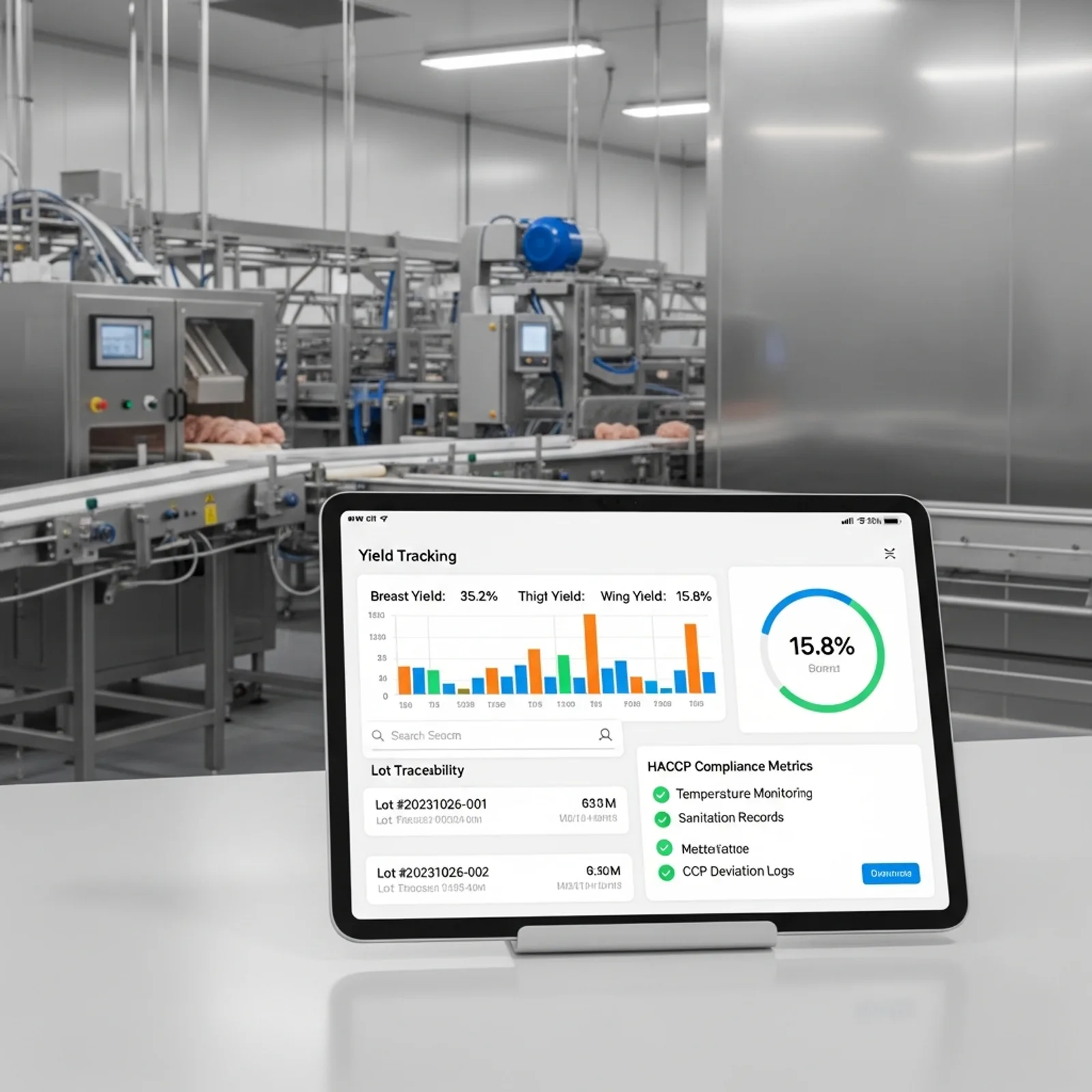
Real-Time Yield Tracking
Yield is the lifeblood of poultry processing. Your software must capture weights at multiple critical control points (CCPs) and operational steps:
- Live-to-Eviscerated Yield:Tracks the weight loss during slaughter and evisceration.
- Chilling Yield:Monitors moisture absorption or loss during chilling.
- Deboning Yield:Tracks the efficiency of deboning lines, comparing the weight of incoming whole carcasses to the weight of boneless breasts, wings, thighs, and trim.
The software must integrate directly with floor scales and PLCs to capture these weights in real time. If a deboning line's yield drops by 0.5%, the software should immediately alert the supervisor so they can retrain workers or adjust cutting equipment.
Catch Weight and Dual UOM Support
Because chickens are biological organisms, they do not grow to uniform weights. Therefore, poultry inventory must be tracked in dual units of measure (UOM): count and weight. For example, a pallet may contain 50 cases of chicken breasts, but the total weight of those cases will vary. Your poultry ERP software must support catch weight throughout the entire system:
- Receiving:Recording both case count and actual weight.
- Production:Tracking raw material usage and finished goods yield in both count and weight.
- Warehousing:Managing inventory locations and cycle counts using dual UOM.
- Invoicing:Billing customers based on the exact weight shipped, not just the case count.
If a software platform requires custom workarounds or separate add-ons to handle catch weight, it is not a true poultry ERP software.
Integrated Quality and HACCP Compliance
In poultry processing, food safety and operational efficiency are inseparable. A quality failure—such as a Salmonella positive or an allergen cross-contact event—can lead to massive product recalls and brand damage. Your poultry ERP software should not require a separate, disconnected Quality Management System (QMS). Instead, quality and HACCP compliance should be built directly into the ERP software:
- Digital HACCP Logs:Floor workers should record critical control point (CCP) measurements—such as chiller temperatures and metal detector checks—directly into the software using mobile devices.
- Pre-Operational Inspections:Sanitation teams should complete pre-op checklists in the software, with automated alerts sent to maintenance if a line fails inspection.
- Automated CAPA:If a temperature deviation occurs, the software should automatically lock the affected inventory and initiate a Corrective and Preventive Action (CAPA) workflow.
- Mock Recalls:The software must provide complete forward and backward lot traceability, allowing you to complete a mock recall in under 12 minutes.
Production Scheduling and Demand Matching
Poultry processors must constantly balance supply and demand. You cannot easily turn off the supply of live birds, nor can you store fresh chicken indefinitely. Therefore, your poultry ERP software must feature advanced production scheduling and demand matching:
- Push-Pull Scheduling:The software must balance the "push" of incoming live birds with the "pull" of customer orders.
- Carcass Balancing:The software must help schedulers optimize carcass utilization, ensuring that high-value parts (breasts, wings) are allocated to premium orders while remaining parts are routed to secondary processing or rendering.
- Shelf-Life Tracking:The software must track product age and expiration dates, using First-Expired, First-Out (FEFO) inventory logic to minimize waste.
3. Implementation and Total Cost of Ownership (TCO)
The success of your poultry ERP software project depends heavily on the implementation process and the total cost of ownership.
Implementation Timelines
Legacy ERP systems are notorious for long, painful implementations that can drag on for 12 to 24 months. These projects often require extensive custom coding, expensive external consultants, and significant disruption to plant operations. In contrast, modern cloud-based SaaS platforms like FoodReady utilize pre-configured templates and agile onboarding methodologies to go live in 8 to 16 weeks. When evaluating vendors, ask for references from processors of similar size and scope to verify their actual implementation timelines.
Total Cost of Ownership (TCO)
When calculating the TCO of a poultry ERP software, look beyond the initial software license fee. Consider these hidden costs:
- Implementation and Consulting Fees:Often 2 to 3 times the cost of the software license for legacy systems.
- Hardware Integration:The cost of connecting the software to floor scales, barcode printers, and mobile scanners.
- Upgrades and Maintenance:Legacy on-premise systems require ongoing maintenance, database administration, and expensive upgrade projects every few years. Cloud-based SaaS platforms include upgrades and maintenance in the annual subscription fee.
- Internal Resource Commitment:The time your internal team (IT, Quality, Operations) must dedicate to the project.
By carefully evaluating these criteria and choosing a specialized poultry ERP software like FoodReady, processors can streamline their operations, guarantee regulatory compliance, and maximize their bottom-line profitability.