

Sausage HACCP plan templates & examples for compliance
Identify sausage-processing hazards, define critical control points and limits, and document monitoring, corrective actions, verification, sanitation, and records with a reviewed, editable FoodReady template.
Create a USDA-approved HACCP plan for sausage.
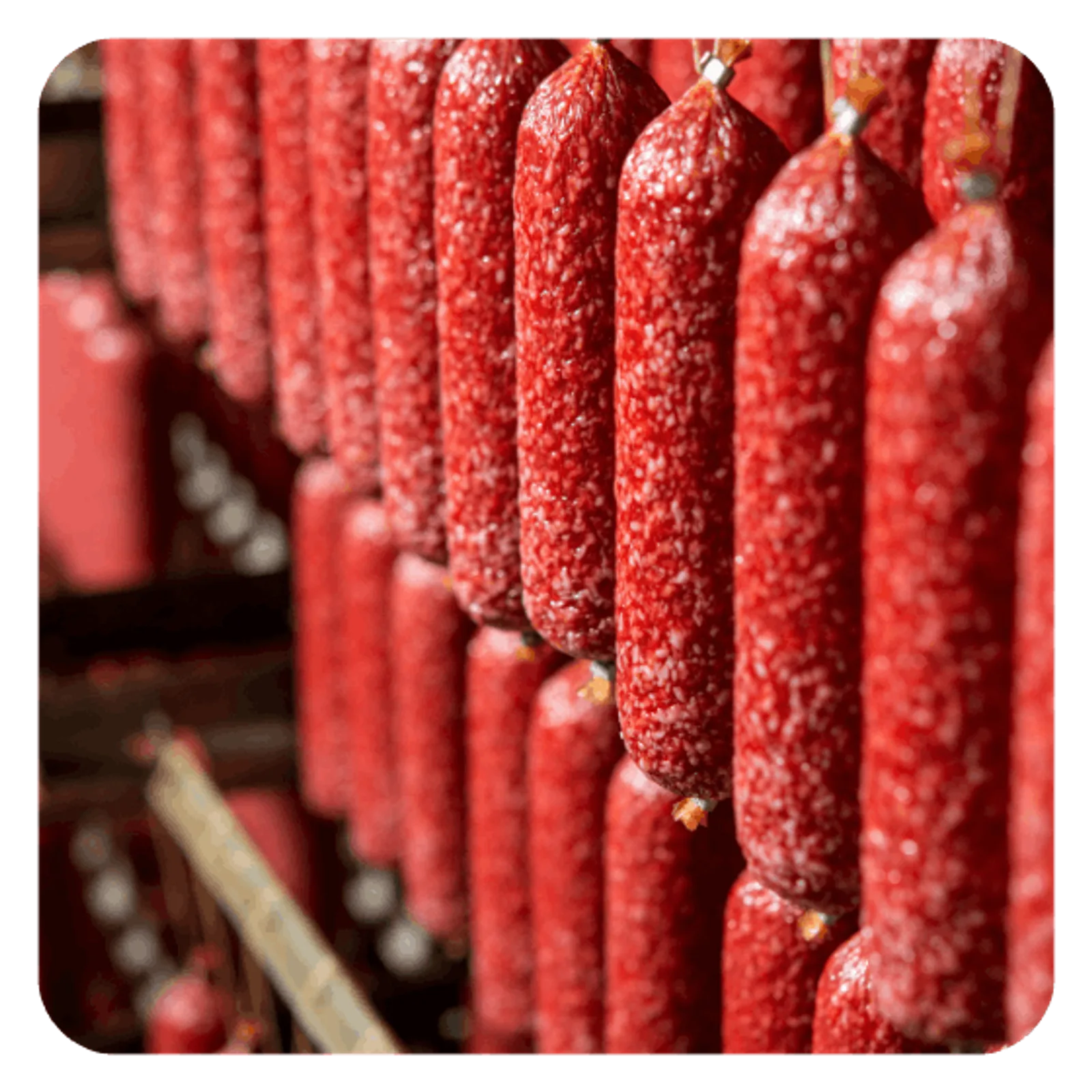
Sausage HACCP templates you can start from
Choose the sausage category closest to your process, then customize the hazards, CCPs, critical limits, monitoring, corrective actions, and verification procedures.
Fresh raw sausage
For fresh pork, beef, poultry, breakfast, and other uncooked sausages. Focuses on raw material controls, formulation, sanitation, foreign material, labeling, and cold chain.
Cooked / smoked sausage
For fully cooked sausage, frankfurters, hot dogs, and smoked products. Adds validated lethality, stabilization, cooling, and post-lethality contamination controls.
Fermented / dry sausage
For salami, pepperoni, and other fermented or dried products. Adds fermentation, pH, water activity, drying, and process-validation controls.
Example cooked sausage process flow
- Receive meat, ingredients & packaging (Supplier control)
- Refrigerated raw storage (Time-temperature control)
- Grind / chop meat (SSOP / lot control)
- Formulate & mix (CCP-1 · Formulation)
- Stuff / link (GMP / sanitation)
- Cook / smoke (CCP-2 · Lethality)
- Cool / stabilize (CCP-3 · Cooling)
- Post-lethality handling & pack (Sanitation / Listeria control)
- Metal detection & label check (CCP-4 · Physical)
- Cold storage & shipment (Cold chain / records)
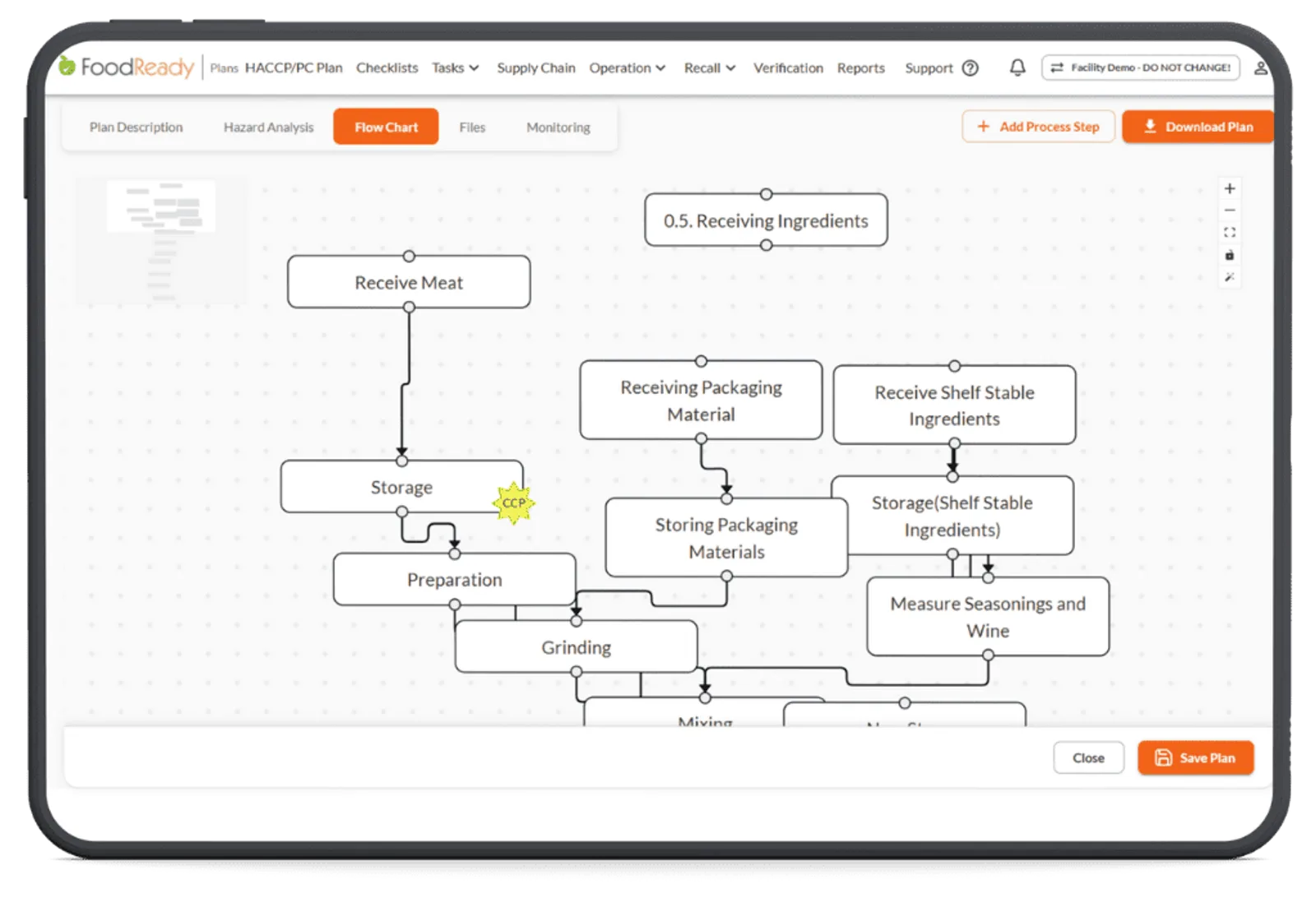
Sausage hazard analysis and example critical limits
Sausage hazards vary by species, formulation, raw versus cooked status, fermentation, post-lethality exposure, and packaging. The examples below show how common hazards can be mapped to control measures without implying one universal CCP set.
| process step | hazard | type | control measure | critical limit |
|---|---|---|---|---|
| Meat receiving | Pathogenic microorganisms in raw meat, including Salmonella and STEC where applicable | Biological | Approved suppliers, specifications, lot identification, receiving inspection, temperature control, and supplier verification | Meet approved supplier, receiving, and product specifications |
| Formulation & mixing CCP-1 | Incorrect restricted ingredient or curing-agent level, or formulation error | Chemical | Controlled formula, calibrated scales, ingredient verification, batch reconciliation, and independent check where required | All restricted ingredients and curing agents remain within the approved formula and applicable regulatory limits |
| Cook / smoke CCP-2 | Survival of Salmonella or other vegetative pathogens in cooked sausage | Biological | Validated time-temperature-humidity lethality process supported by FSIS guidance or equivalent scientific documentation | Meet the validated product-specific lethality schedule documented in the HACCP plan |
| Cooling / stabilization CCP-3 | Growth of Clostridium perfringens or Clostridium botulinum during cooling | Biological | Validated stabilization / cooling process with defined time-temperature limits | Meet the facility's scientifically supported stabilization or cooling limits |
| Post-lethality handling | Recontamination of ready-to-eat sausage with Listeria monocytogenes | Biological | Sanitation controls, hygienic zoning, post-lethality treatment or antimicrobial agent/process where used, and environmental monitoring | Meet the facility's validated Listeria control and sanitation verification criteria |
| Metal detection CCP-4 | Metal fragments from grinders, cutters, stuffers, or other processing equipment | Physical | Validated metal detector or equivalent foreign-material control with routine challenge checks | Detector sensitivity and verification checks meet the facility's validated specification |
| Label verification | Undeclared allergens, incorrect product identity, or missing handling / storage statements | Chemical | Approved label control, formula-to-label verification, line clearance, and batch reconciliation | Correct approved label and allergen declaration for every batch / SKU |
Prerequisite programs that support the plan
A sausage HACCP plan works together with Sanitation SOPs, supplier controls, formulation controls, preventive maintenance, traceability, and employee practices.
Sanitation SOPs
Pre-operational and operational sanitation procedures and records.
Supplier approval
Meat, spice, casing, cure, and packaging supplier specifications and verification.
Formulation control
Controlled recipes, curing agents, restricted ingredients, and calibrated weighing.
Allergen control
Ingredient segregation, rework control, cleaning, line clearance, and label verification.
Equipment & maintenance
Grinder, mixer, stuffer, smokehouse, detector, and instrument maintenance.
Temperature control
Raw storage, cooking, stabilization, finished storage, and shipment controls.
Personnel & hygiene
Training, hand hygiene, traffic patterns, and hygienic handling practices.
Traceability & recall
Lot identification, rework linkage, finished-product records, and recall readiness.
Logs, SOPs, and supply chain documents
Monitoring records should capture the actual values used to demonstrate that critical limits and other controls were met.
Logs & records
Evidence that the plan is running every day.
- Raw meat receiving log
- Batch formulation / cure log
- Cook / smokehouse lethality log
- Cooling / stabilization log
- Metal detector verification log
- Corrective action and disposition records
Standard operating procedures
Repeatable steps that mitigate hazards.
- Pre-operational sanitation SOP
- Operational sanitation SOP
- Formulation and curing control procedure
- Thermometer / recorder calibration
- Allergen and label control
- Post-lethality Listeria control procedure
Supply chain documents
Controls that reach beyond your facility.
- Supplier specifications and guarantees
- Lethality validation documentation
- Cooling / stabilization support
- Fermentation / pH / aw validation where applicable
- Product and label specifications
- Traceability and recall documentation
Who needs a Sausage HACCP plan
Sausage made from meat or poultry in federally inspected establishments falls under USDA-FSIS HACCP requirements. The exact hazard analysis and control strategy depend on whether the product is raw, cooked, fermented, dried, smoked, or ready-to-eat.
Raw sausage
Fresh and raw sausage processors
Operations producing fresh pork, beef, poultry, breakfast, or other raw sausages should evaluate hazards associated with incoming meat, grinding, formulation, stuffing, foreign material, sanitation, labeling, and refrigerated or frozen storage.
- USDA-FSIS HACCP · 9 CFR Part 417
Cooked & RTE sausage
Cooked, smoked, fermented, and ready-to-eat processors
Cooked and RTE sausage processes may require supported lethality, stabilization or cooling, post-lethality sanitation, and controls for Listeria monocytogenes where the product is exposed after cooking.
- USDA-FSIS · Lethality / Stabilization · RTE controls
Additional components for a defensible Sausage HACCP system
These elements help demonstrate that critical limits are scientifically supported, the process is implemented as written, and the plan remains current when products or equipment change.
Validation & scientific support
Support lethality, cooling, fermentation, and formulation
Keep scientific or technical support for critical limits and operating parameters used to control pathogens, restricted ingredients, stabilization, fermentation, drying, and other significant hazards.
The supporting documentation should match the actual product and process used in the establishment.
Verification & reassessment
Verify the plan and reassess when needed
Verification includes direct observation, record review, calibration, corrective-action review, and other activities showing that the HACCP system is working as intended.
Reassess the hazard analysis and HACCP plan when process changes occur and at the frequency required by the applicable FSIS regulations.

Dave Seddon
Every FoodReady HACCP template is built and reviewed by practicing food safety professionals, then aligned to current FDA guidance. This sushi plan follows the seafood hazards and controls that auditors expect to see, so you start from a defensible baseline rather than a blank page.
- SQF Lead Auditor
- FDA Seafood HACCP
- SOC 2 Type II platform
Sausage HACCP, answered
Is sausage HACCP regulated by FDA or USDA-FSIS?
Meat and poultry sausage produced in federally inspected establishments is regulated by USDA-FSIS. HACCP requirements for these establishments are found in 9 CFR Part 417.
What hazards should a Sausage HACCP plan consider?
Depending on the product and process, the hazard analysis may need to consider Salmonella, STEC, Listeria monocytogenes, Clostridium perfringens, Clostridium botulinum, formulation or curing errors, allergens, foreign material, and temperature abuse.
What are common CCPs in cooked sausage production?
Common examples include formulation or curing controls, cooking or lethality, cooling or stabilization, and foreign-material detection. However, there is no universal CCP list; each establishment must determine its CCPs from its own hazard analysis.
Why is cooling important after cooking sausage?
Cooling or stabilization must prevent excessive growth of spore-forming pathogens such as Clostridium perfringens and Clostridium botulinum. The process should follow scientifically supported time-temperature limits appropriate to the specific product.
Can I use this template for fermented or dry sausage?
Yes, as a starting point. Fermented and dry sausage plans should be customized to include validated fermentation, pH, water activity, drying, lethality, and shelf-stability controls appropriate to the product.
Start your Sausage HACCP plan today
Begin with a reviewed sausage-processing template, customize the hazards and controls for your products, and organize monitoring, corrective actions, validation, verification, sanitation, and traceability records in one place.
Speak with our Expert Consultants
15–30 minutes. We map FoodReady to your process, plug in your real HACCP plan, and show you the auditor view before the call ends.