

Milk HACCP Plan Templates & Examples for Compliance
Identify dairy hazards, set critical limits, and document every control point with a reviewed, editable milk HACCP template and AI plan builder.
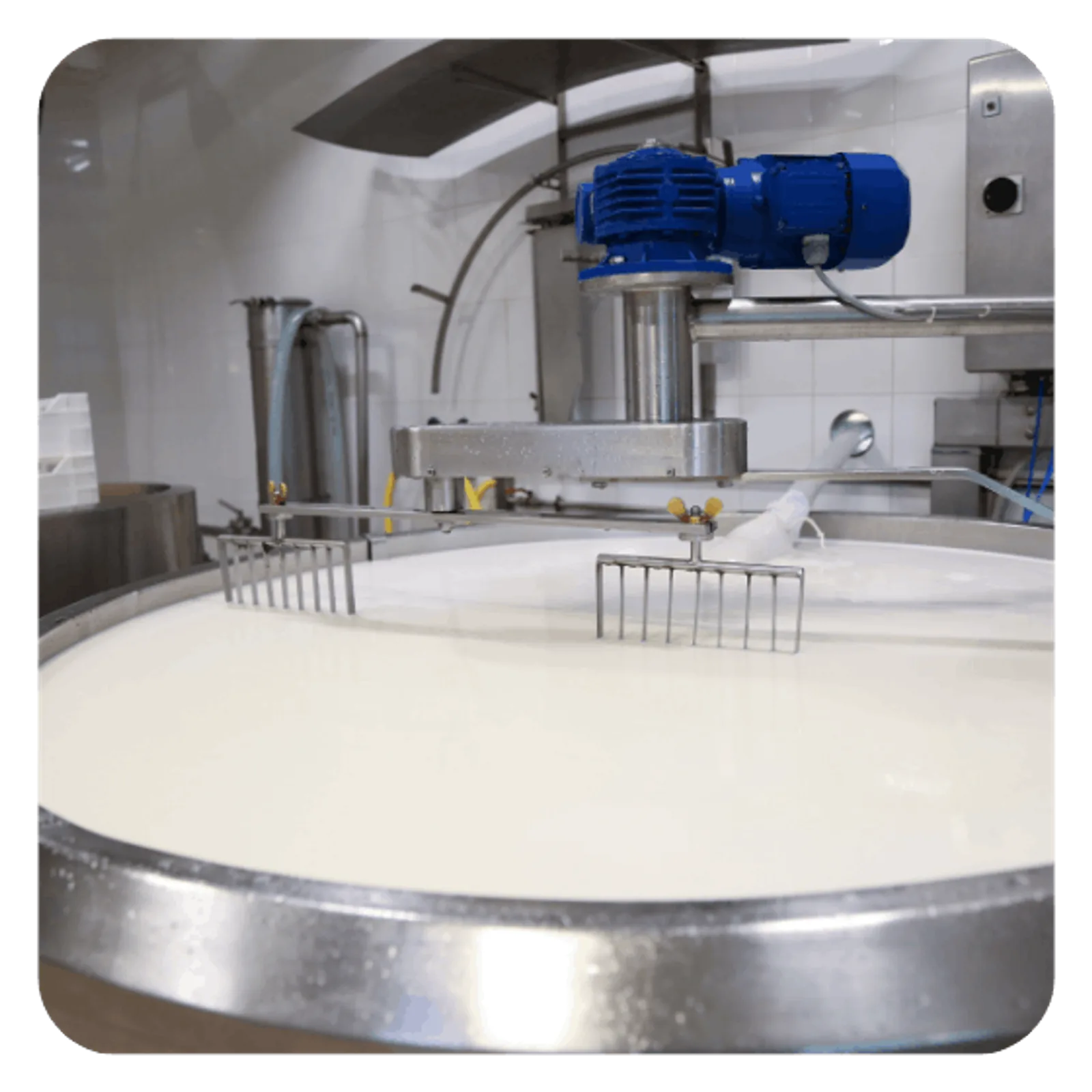
Milk HACCP templates you can start from
Each template is prefilled with the hazards, controls, and logs for that product, then fully editable in the plan builder.
Fluid white milk
HTST pasteurized whole, reduced fat, and skim milk. Centers on drug residue testing at receiving and pasteurization time and temperature control.
Flavored & fortified milk
Chocolate, strawberry, and vitamin fortified milk. Adds an allergen control point for tree nuts and soy lecithin used in flavor systems.
Extended shelf life (ESL) milk
Ultra-pasteurized or ESL milk held for a longer date code. Adds tighter post-pasteurization contamination controls and extended cold chain verification.
Example milk process flow
- Receive packaging & ingredients (Prerequisite)
- Receive raw milk (CCP-1 · Drug residue)
- Cold storage (raw silo) (GMP control)
- Standardize & separate (GMP control)
- Pasteurize (HTST) (CCP-2 · Pathogens)
- Homogenize & cool (GMP control)
- Flavor & fortify (Allergen SOP)
- Fill & seal (Sanitary design)
- Metal detection (CCP-3 · Metal)
- Refrigerated storage & shipment (CCP-4 · Cold hold)
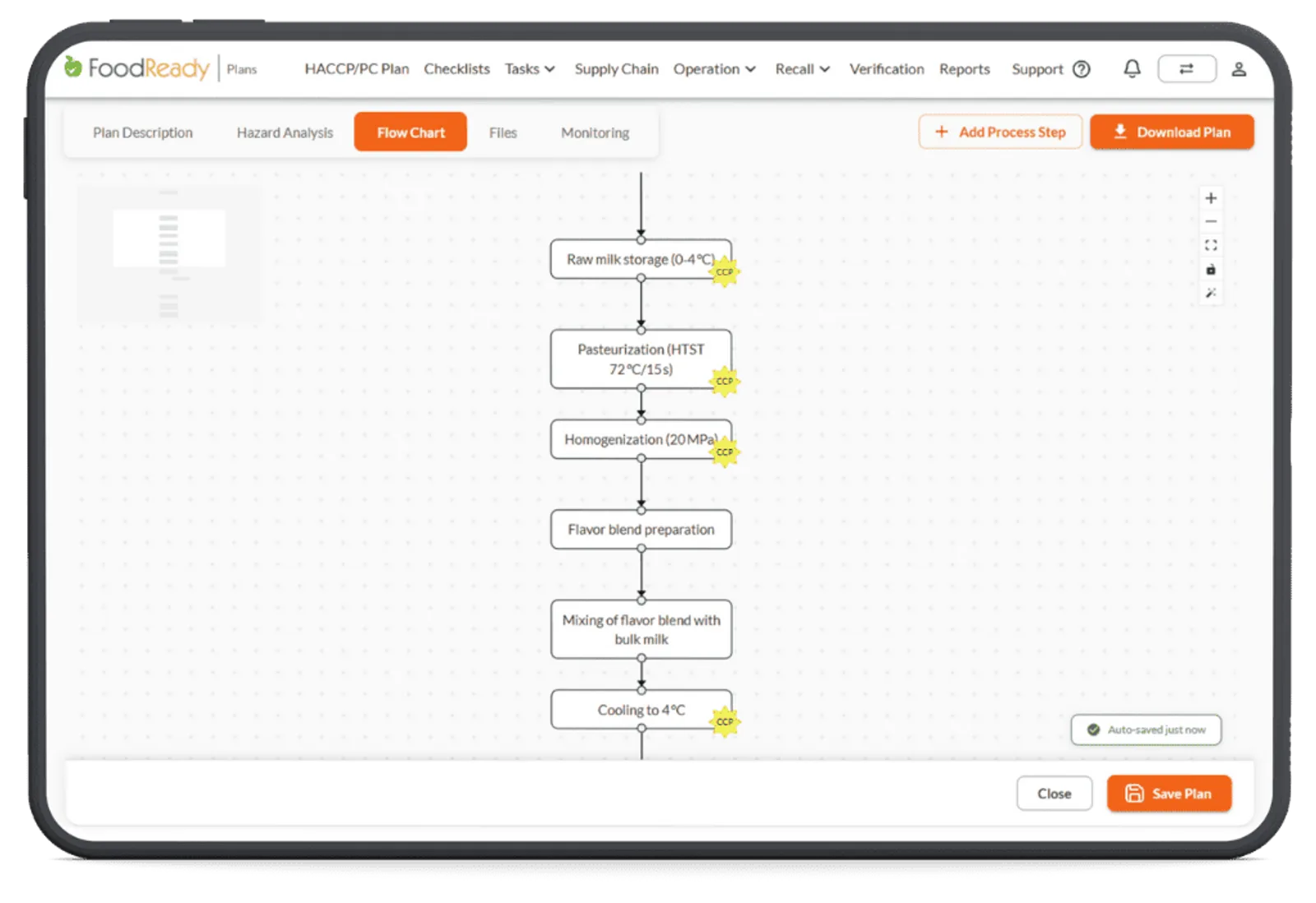
Milk hazard analysis and critical limits
Dairy specific hazards only. Each critical control point below maps to the process flow above, with the control and critical limit an auditor expects to see.
| process step | hazard | type | control measure | critical limit |
|---|---|---|---|---|
| Receive raw milk | Antibiotic and other drug residues carried over from treated cows | Chemical | Test every raw milk load with an FDA-recognized rapid residue screen before offload | No detectable residue, negative result required to unload |
| Pasteurize (HTST) | Pathogens including Salmonella, Listeria monocytogenes, E. coli O157:H7, and Mycobacterium bovis | Biological | HTST pasteurization with recording thermometer, indicating thermometer, and automatic flow diversion device | 161°F (72°C) for 15 sec, or an approved equivalent time/temp |
| Metal detection | Metal fragments introduced by equipment wear on the processing line | Physical | In-line metal detector on the filler with an automatic reject and lockout | Rejects at calibrated sensitivity (Fe/Non-Fe/SS per test piece) |
| Refrigerated storage | Growth of Listeria monocytogenes and other pathogens in pasteurized product | Biological | Maintain cold chain through storage, loadout, and shipment | ≤45°F (7°C) throughout cold chain |
| Flavor & fortify | Undeclared allergens (tree nuts, soy lecithin in flavor systems) | Chemical | Allergen control program, dedicated flavor tanks or scheduled changeover, label verification | Managed by allergen SOP and label verification |
| Fill & seal | Glass, hard plastic, or other foreign material from packaging materials | Physical | Incoming packaging inspection, glass and brittle plastic policy, filler line checks | No physical contaminants detected at inspection |
Prerequisite programs that support the plan
A HACCP plan is not the whole food safety system. Good manufacturing practices must be in place first, in line with Grade A PMO sanitary standards.
Personnel
Hygiene, health reporting, and training practices.
Sanitary operations
CIP cleaning, sanitizing, and pest control routines.
Sanitary facilities
Water, plumbing, and handwashing controls.
Equipment & utensils
Food contact surface design and upkeep.
Processes & controls
Raw material, operation, and storage controls.
Plant & grounds
Facility layout and grounds maintenance.
Defect action levels
Limits for natural or unavoidable defects.
Warehousing & distribution
Storage and transport under safe conditions.
Logs, SOPs, and supply chain documents
Monitoring records must capture the actual observed value, for example the exact temperature or test result, recorded at the time of observation.
Logs & records
Evidence that the plan is running every day.
- Raw milk receiving & drug residue test log
- Pasteurization time/temperature recorder chart
- Flow diversion device check log
- Cold storage temperature log
- Corrective action forms
- Employee training and illness log
SOPs
Repeatable steps that mitigate hazards.
- Calibrating thermometers & recorders
- Cleaning and sanitizing (CIP) contact surfaces
- Preventing post-pasteurization contamination
- Allergen control program
- Pest control
- Handling returned or damaged product
Supply chain documents
Controls that reach beyond your facility.
- Grade A dairy farm permits
- Bulk tank hauler sampling records
- Certificates of analysis
- Product specifications
- Allergen statements
- Packaging supplier specifications
Who needs a milk HACCP plan
Milk sits under FDA jurisdiction, not USDA. The right framework depends on whether you bottle Grade A fluid milk or manufacture other dairy products.
Bottling and fluid milk processors
Plants that pasteurize and package Grade A milk and milk products for direct sale. Pasteurization time and temperature, cooling, and drug residue testing are set by your state milk regulatory agency under the cooperative Grade A program.
- Grade A Pasteurized Milk Ordinance (PMO) · state milk agency + FDA/NCIMS
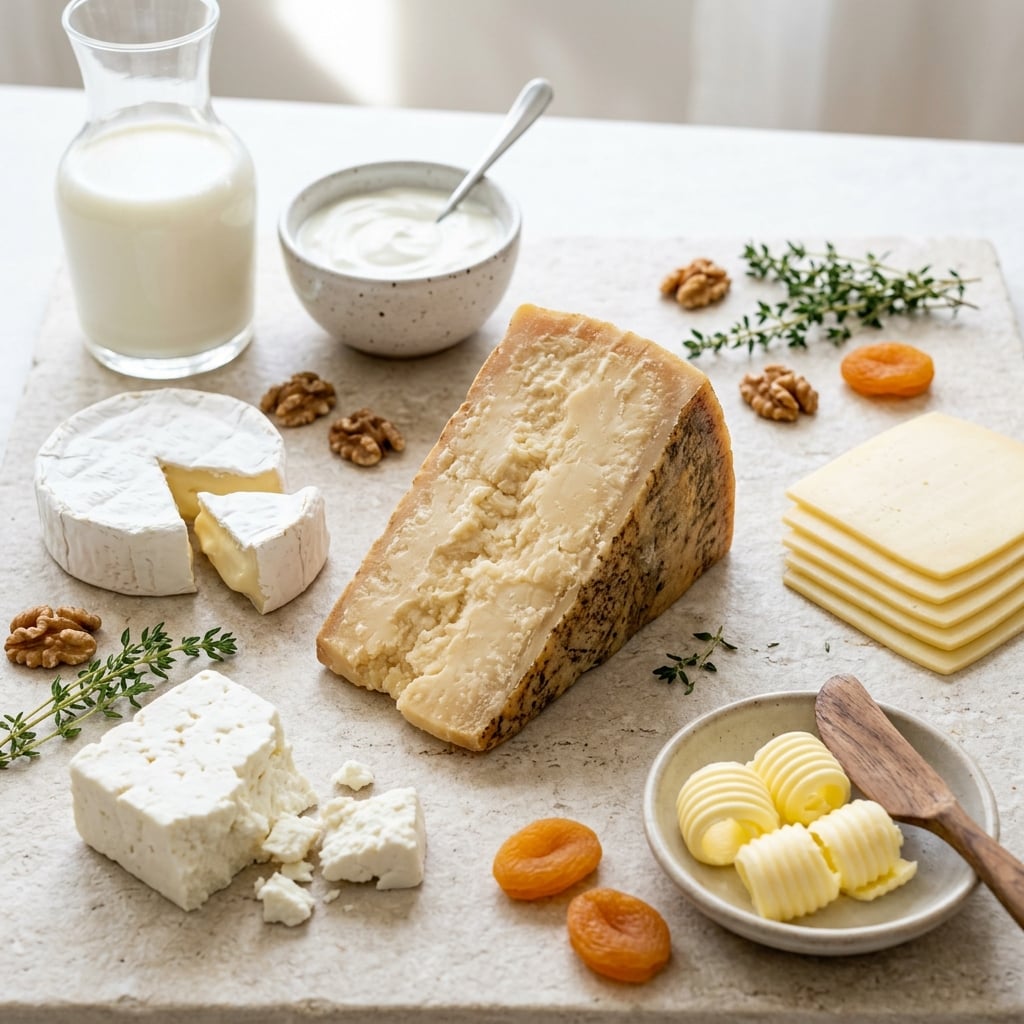
Cheese, powder, and ingredient plants
Facilities that process milk into cheese, dried dairy ingredients, cream, or other manufacturing grade products. These plants build a written food safety plan with a hazard analysis, often structured as a HACCP-style plan to satisfy customer and GFSI audits.
- FSMA Preventive Controls for Human Food · 21 CFR Part 117
Additional components for full compliance
These components are recommended to meet state and federal rules alongside your HACCP plan.
RECALL PLAN
Written recall plan
Under FSMA Preventive Controls for Human Food, a written recall plan is required when a hazard analysis identifies a hazard needing a preventive control.
A recall removes an adulterated, misbranded, or violative product from the market before it reaches consumers.
VERIFICATION & VALIDATION
Verification and validation
Verification confirms the plan is followed correctly each day across supply chain, sanitation, allergen, and critical controls.
Validation confirms the plan rests on sound science that is adequate to control the identified hazards.

Dave Seddon
Every FoodReady HACCP template is built and reviewed by practicing food safety professionals, then aligned to current Grade A PMO and FSMA guidance. This milk plan follows the dairy hazards and controls that auditors expect to see, so you start from a defensible baseline rather than a blank page.
- SQF Lead Auditor
- Grade A PMO Trained
- SOC 2 Type II platform
Milk HACCP, answered
Does a milk HACCP plan fall under FDA or USDA?
Milk and dairy products are regulated by the FDA. Grade A fluid milk is regulated under the Grade A Pasteurized Milk Ordinance (PMO), a cooperative program between FDA and state milk regulatory agencies. Manufacturing grade dairy plants follow FSMA Preventive Controls for Human Food under 21 CFR Part 117. USDA plays only an optional role, through voluntary AMS grading of some dairy products, not mandatory food safety oversight.
Is HACCP mandatory for milk processors?
Not in the same way as seafood or juice, where FDA has issued a specific HACCP regulation. Grade A processors must meet the pasteurization, cooling, and drug residue requirements in the PMO, and most facilities must maintain a food safety plan with a hazard analysis under FSMA Preventive Controls. Many processors build a HACCP-style plan voluntarily to satisfy retailer or GFSI audit requirements such as SQF or FSSC 22000.
What are the critical control points for milk?
The most common CCPs are drug residue testing of incoming raw milk, HTST pasteurization time and temperature, metal detection at filling, and cold chain control through storage and shipment. Your exact CCPs depend on your process and product mix.
Why is antibiotic residue testing a critical control point?
Antibiotic residues in raw milk can trigger allergic reactions in sensitive consumers and contribute to antibiotic resistance. The Grade A PMO and interstate milk shipper requirements call for a negative rapid residue test on every load before it is unloaded and commingled with other milk.
Can I edit the template for my specific product line?
Yes. The template is a starting point. You can adjust hazards, control measures, critical limits, and logs to match your products in the plan builder, and a food safety expert can review your customizations.
Start your milk HACCP plan today
Begin from a reviewed dairy template, customize your control points, and generate audit ready documentation with the FoodReady plan builder.
Speak with our Expert Consultants
15–30 minutes. We map FoodReady to your process, plug in your real HACCP plan, and show you the auditor view before the call ends.