

Food Transportation HACCP Plan Templates & Examples for Compliance
Identify transportation hazards, set critical limits, and document every control point with a reviewed, editable food transportation HACCP template and AI plan builder.

Food transportation HACCP templates you can start from
Each template is prefilled with the hazards, controls, and logs for that mode of transport, then fully editable in the plan builder.
Refrigerated & frozen (TCS) loads
Reefer trailers carrying chilled or frozen product. Emphasizes pre-cool verification, continuous in-transit temperature monitoring, and cold chain hold points.
Bulk & tanker transport
Dry bulk, liquid, and tanker loads. Adds prior cargo review and wash-out verification to control cross-contamination from non-food or incompatible previous loads.
Mixed load & LTL
Less-than-truckload shipments consolidating multiple shippers on one trailer. Adds allergen segregation and cross-contact controls between pallets and products.
Example food transportation process flow
- Vehicle & trailer inspection (Pre-trip SOP)
- Pre-cool trailer to setpoint (CCP-1 · Pre-cool)
- Review prior cargo & wash-out (CCP-2 · Prior cargo)
- Verify product temp at loading (CCP-3 · Loading temp)
- Seal & document shipment (Bill of lading)
- Monitor temp in transit (CCP-4 · In-transit temp)
- Cross-dock or route stop handling (Allergen SOP)
- Verify product temp at delivery (CCP-5 · Receiving temp)
- Unload & inspect product (GMP control)
- Post-trip cleaning & sanitation log (Sanitation SOP)
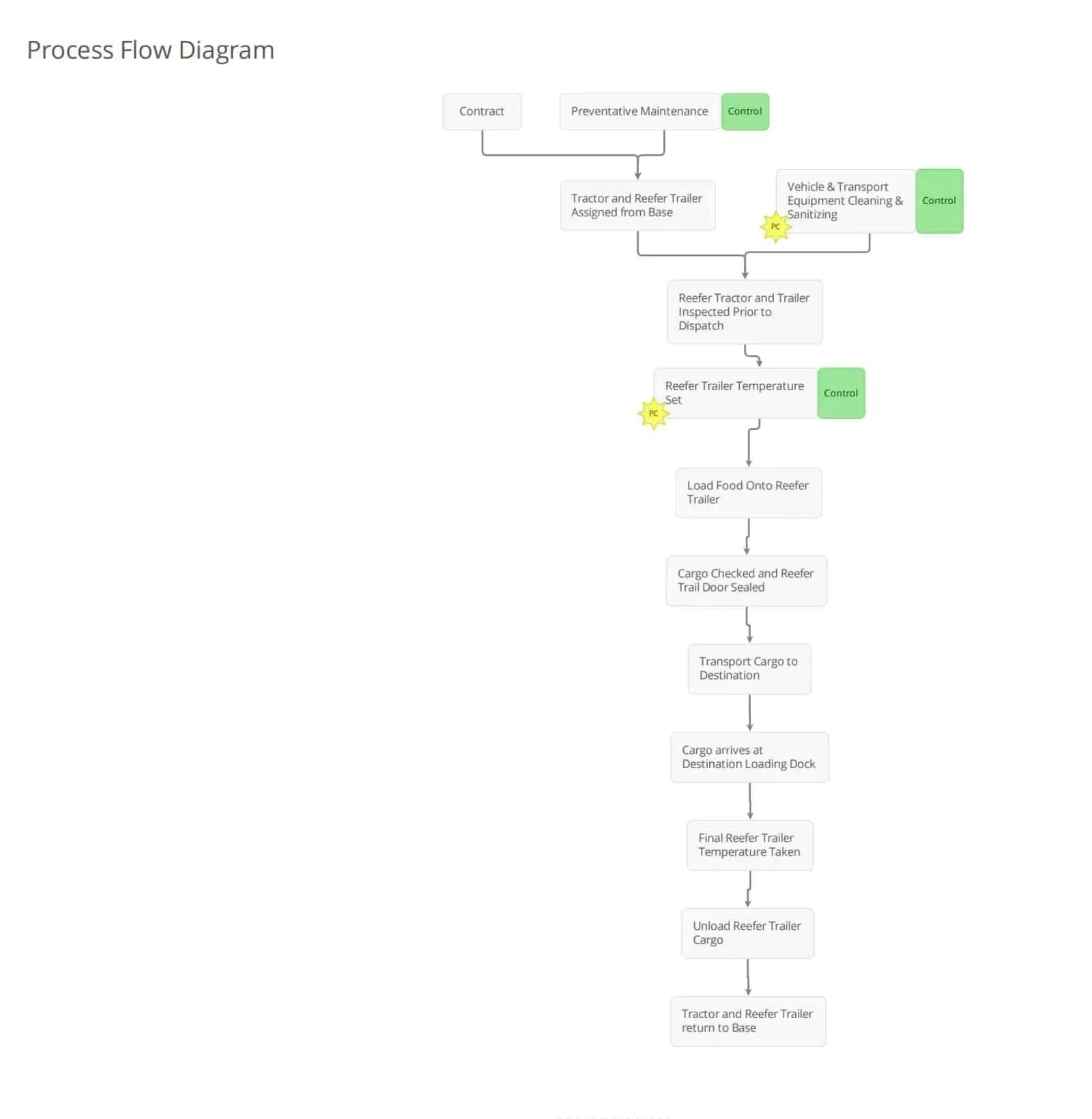
Transportation hazard analysis and critical limits
Transportation specific hazards only. Each critical control point below maps to the process flow above, with the control and critical limit an auditor or customer expects to see.
| process step | hazard | type | control measure | critical limit |
|---|---|---|---|---|
| Pre-cool trailer | Pathogen growth (Salmonella, Listeria) from inadequate pre-cooling before loading | Biological | Verify trailer air temperature reaches setpoint before any product is loaded | ≤34°F (1°C) chilled air temp, ≤0°F (-18°C) frozen, before loading |
| Review prior cargo | Chemical or allergen residue from an incompatible previous cargo | Chemical | Check load history for the last three shipments, reject non-food grade cargo history, wash out per protocol | Prior cargo confirmed food grade, or trailer washed and inspected clean |
| Verify loading temp | Pathogen growth from receiving product outside the safe range at the dock | Biological | Check and record product temperature before it is loaded onto the trailer | ≤40°F (4°C) chilled, ≤0°F (-18°C) frozen, at loading |
| Monitor in-transit temp | Time temperature abuse during transit | Biological | Continuous data logger or telematics monitoring of trailer air temperature | Hold product-spec temperature throughout transit, no unexplained excursions |
| Verify delivery temp | Pathogen growth or spoilage from temperature abuse before acceptance | Biological | Check and record product temperature at unloading, before signing for the delivery | ≤40°F (4°C) chilled, ≤0°F (-18°C) frozen, at delivery |
| Vehicle & trailer inspection | Pests, debris, or structural damage in the cargo area | Physical | Pre-trip visual inspection of the trailer interior, seals, and refrigeration unit | No visible pests, debris, or damage before loading |
Prerequisite programs that support the plan
A HACCP plan is not the whole food safety system. Good transportation practices must be in place first, in line with sanitary equipment and handling requirements.
Personnel
Driver hygiene, health reporting, and training records.
Vehicle & trailer sanitation
Cleaning and inspection routines between loads.
Equipment & refrigeration units
Maintenance, calibration, and repair records.
Pest control
Prevention and monitoring in trailers and yards.
Loading & unloading practices
Dock procedures and temperature checks.
Route & scheduling controls
Transit time limits and temperature exposure.
Prior cargo & compatibility
Load history review and wash-out records.
Yards & cross-dock facilities
Storage conditions at transfer points.
Logs, SOPs, and supply chain documents
Monitoring records must capture the actual observed value, for example the exact temperature or pH, recorded at the time of observation.
Logs & records
Evidence that the plan is running every load.
- Pre-trip inspection log
- Trailer pre-cool temperature log
- Prior cargo and load history log
- In-transit temperature log (logger or telematics)
- Delivery temperature and acceptance log
- Cleaning and sanitation log
SOPs
Repeatable steps that mitigate hazards.
- Calibrating thermometers and data loggers
- Pre-cooling trailers before loading
- Cleaning and washing out trailers
- Reviewing prior cargo compatibility
- Responding to a temperature excursion
- Sealing and documenting a shipment
Supply chain documents
Controls that reach beyond your fleet.
- Written procedures shared with carriers
- Bills of lading with temperature specs
- Prior cargo certificates
- Refrigeration unit maintenance records
- Carrier agreements and audits
- Driver training certificates
Who needs a food transportation HACCP plan
Transportation sits under FSMA's Sanitary Transportation Rule, not traditional HACCP. The right scope depends on whether you arrange the shipment or physically move the product.
Manufacturers, distributors, and receivers
Businesses that arrange for food to be transported, or that take delivery of it, are responsible for writing procedures that keep the product safe from the loading dock to the door, including temperature requirements and prior cargo rules given to the carrier.
- FDA Sanitary Transportation Rule · Shipper & receiver requirements

Motor carriers and private fleets
For-hire and private fleet carriers that transport food must follow the shipper's written procedures, keep the vehicle in sanitary condition, and maintain records for the parts of the process they're responsible for, such as temperature monitoring and prior cargo.
- FDA Sanitary Transportation Rule · 21 CFR Part 1, Subpart O
Additional components for full compliance
These components are recommended to meet state, federal, and customer requirements alongside your HACCP plan.
EXCURSION RESPONSE PLAN
Written temperature excursion plan
A documented response for what happens when a trailer's temperature drifts outside the critical limit in transit, including hold, evaluate, and dispose or release decisions.
Under the Sanitary Transportation Rule, carriers must take appropriate action when a temperature or other condition specified in the shipper's procedures is not met.
VERIFICATION & VALIDATION
Verification and validation
Verification confirms drivers and dock staff are actually following the plan on every load, from pre-cool checks to prior cargo review.
Validation confirms the critical limits you've set, such as pre-cool setpoints and transit time limits, are backed by sound science for your specific products and lanes.

Dave Seddon
Every FoodReady HACCP template is built and reviewed by practicing food safety professionals, then aligned to current FDA guidance. This transportation plan follows the hazards and controls that auditors and customers expect to see under the Sanitary Transportation Rule, so you start from a defensible baseline rather than a blank page.
- SQF Lead Auditor
- FDA Sanitary Transportation Rule
- SOC 2 Type II platform
Food transportation HACCP, answered
Does food transportation require a HACCP plan?
Not in the traditional sense. Food transportation falls under FSMA's Sanitary Transportation of Human and Animal Food Rule, 21 CFR Part 1 Subpart O, which requires written procedures for vehicles, equipment, loading, and training rather than a formal HACCP plan under 21 CFR Parts 120 or 123. Many shippers, retailers, and GFSI-benchmarked programs still require a hazard-analysis based plan by contract.
What are the critical control points in food transportation?
The most common control points are pre-cooling the trailer before loading, reviewing prior cargo for compatibility, verifying product temperature at loading and delivery, and monitoring temperature continuously in transit. Your exact control points depend on the products and lanes you run.
Who is responsible for compliance, the shipper or the carrier?
Both. Shippers and receivers must develop written procedures covering vehicle and equipment requirements, temperature controls, and prior cargo, and carriers must follow those procedures, keep the vehicle in sanitary condition, and maintain records for the parts of the process they control.
Are small carriers exempt from the Sanitary Transportation Rule?
Some exemptions exist, including for shipments under 100 air miles, fully packaged shelf-stable food, and businesses that fall under the FDA's small business thresholds. Check the current rule and your contracts with shippers, since customer requirements are often stricter than the regulatory floor.
Can I edit the template for my fleet and lanes?
Yes. The template is a starting point. You can adjust hazards, control measures, critical limits, and logs to match your equipment, lanes, and product mix in the plan builder, and a food safety expert can review your customizations.
Start your food transportation HACCP plan today
Begin from a reviewed transportation template, customize your control points, and generate audit ready documentation with the FoodReady plan builder.
Speak with our Expert Consultants
15–30 minutes. We map FoodReady to your process, plug in your real HACCP plan, and show you the auditor view before the call ends.